Pranama Meaning: Why Bowing Is a Practice of Reverence
Pranama is the Hindu practice of bowing with reverence. Its forms differ, but each can train humility, gratitude, and recognition of the sacred without coercion.
A bow can say what a long speech cannot: “For this moment, I place reverence before ego.”
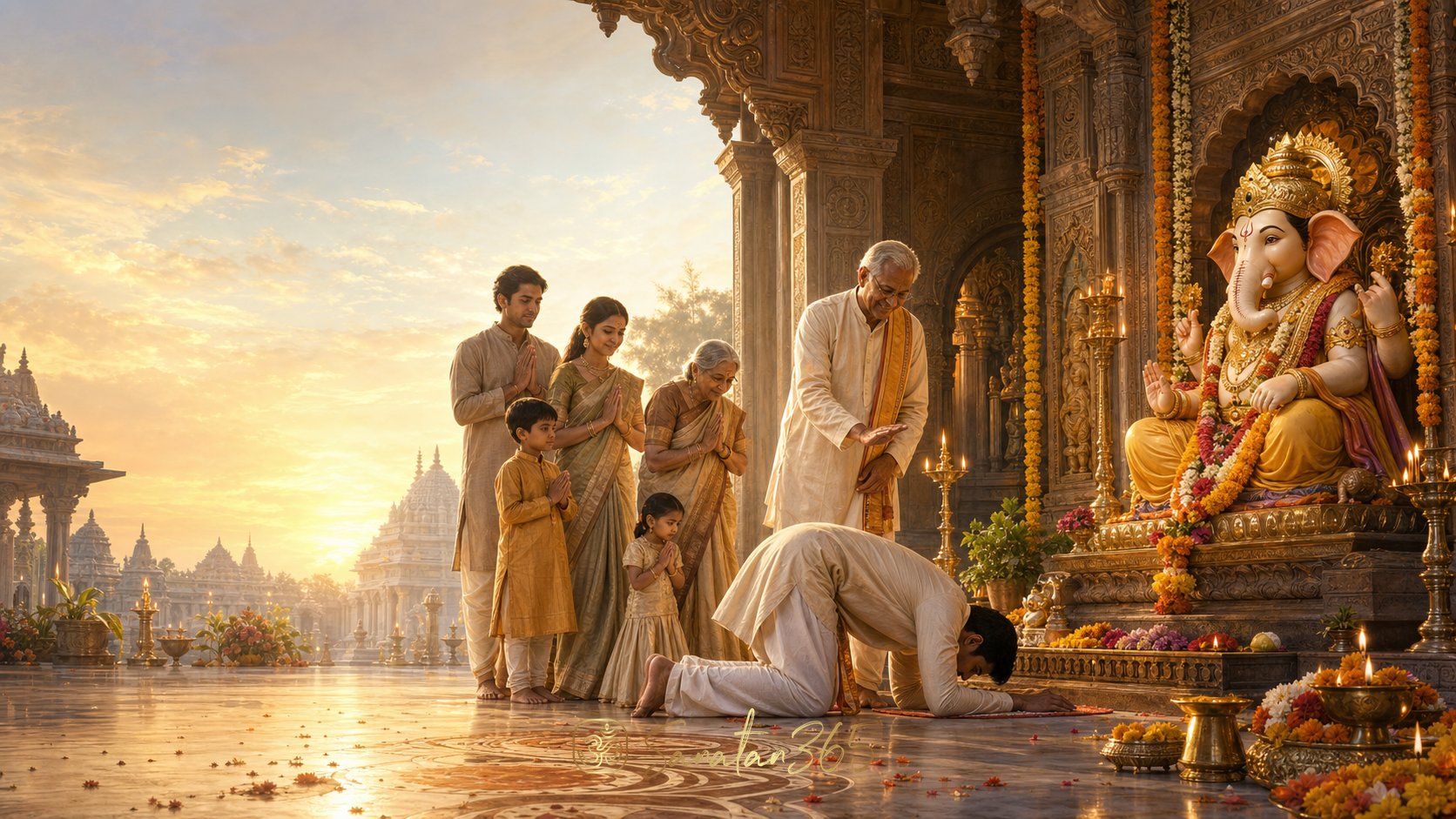
Pranama meaning begins with a respectful inclination of the body before the Divine, a teacher, an elder, a sacred place, or another person worthy of honour. Pranama (प्रणाम, praṇāma, “reverential bow or salutation”) is not one compulsory pose. It is a family of gestures, from joined palms and a lowered head to a full prostration. At its best, it trains humility, gratitude, and awareness. It should never become a demand that erases dignity, consent, health, or thoughtful discernment.
Key takeaway: Pranama turns respect into an embodied action, while its spiritual worth depends on sincere intention rather than the depth of the bow.
What Is Pranama Meaning in Hindu Practice?
The Sanskrit word pranama describes bending or bowing forward in reverence. In everyday speech, pranam is also used as a respectful greeting, especially toward elders, teachers, and revered persons. Closely related terms include namaskara (नमस्कार, namaskāra, “respectful salutation”) and namaste (नमस्ते, namaste, “reverence to you”). Usage differs by language, lineage, household, and region, so these words overlap without always being identical.
The gesture makes an inner relationship visible. When a devotee bows before a murti (मूर्ति, mūrti, “sacred embodied form”), the body acknowledges that the Divine is not being approached casually. When a student bows to a guru or acharya, the gesture honours the source of learning. When a younger person greets an elder with pranama, it can express gratitude for age, care, experience, and family continuity.
Hindu scripture repeatedly joins devotion with bowing. In the Bhagavad Gita 9.34, Krishna asks the devotee to fix the mind on Him, worship, and bow down. The same sequence returns in Bhagavad Gita 18.65. The bow is therefore not merely etiquette. It can be a compact sadhana (साधना, sādhanā, “disciplined spiritual practice”) in which attention, body, and intention align.
Yet the movement is not magic by itself. A person can bend low while remaining proud, manipulative, or inattentive. Another person may be unable to kneel because of pain and still offer profound reverence with joined palms, a seated bow, or a quiet inward salutation. Hindu practice often values bhava (भाव, bhāva, “inner devotional feeling”) as the life within the form.
Key takeaway: The outward bow carries meaning when it expresses an inward recognition of sacredness, gratitude, or honour.
Why Do Hindus Bow Before the Divine, Teachers, and Elders?
Pranama answers three different relationships: devotion, learning, and gratitude.
Before the Divine, bowing loosens the fantasy that the individual ego controls everything. The devotee does not become worthless; rather, the self is placed within a reality larger than personal preference. This is why pranama often appears on entering a temple, approaching a shrine, completing puja, receiving darshan, or beginning a prayer. The body says, “I am present, attentive, and willing to be transformed.”
Before a teacher, bowing honours knowledge rather than celebrity. A genuine teacher does not own truth; the teacher helps transmit, interpret, and embody it. The Taittiriya Upanishad’s ethical instruction includes acharya devo bhava (आचार्य देवो भव, “regard the teacher as worthy of divine honour”) alongside reverence for mother, father, and guest. A translation of this convocation teaching appears in the Taittiriya Upanishad, Shiksha Valli 1.11. The instruction is about grateful responsibility, not surrendering moral judgment to any person who claims authority.
Before elders, pranama can acknowledge care received across generations. Touching the feet may be accompanied by ashirvada (आशीर्वाद, āśīrvāda, “blessing”). The elder often touches the younger person’s head or raises a hand in blessing. Symbolically, respect moves downward through the bow and goodwill returns through the blessing.
There is also a practical lesson. Modern life trains the body to demand attention: upright posture, eye contact, self-presentation, and constant assertion. A voluntary bow interrupts that habit. It teaches that strength and humility can coexist. This complements the reflective discipline described in Namaste Meaning: Sanskrit, Gesture, and Spiritual Significance, where joined palms gather attention and make greeting an act of regard.
Respect, however, does not require obedience to harm. Age, status, robes, family position, or institutional power do not make misconduct sacred. A person may maintain physical distance, decline touch, or choose a simpler greeting where safety, health, boundaries, or conscience require it. Reverence without viveka (विवेक, viveka, “discernment”) can become social pressure; reverence guided by discernment protects both truth and dignity.
Key takeaway: Hindus bow to honour the Divine, knowledge, and intergenerational care, but authentic respect remains joined with discernment.
What Are the Main Forms of Pranama?
There is no single universal list followed identically across Hindu communities. The following forms are widely recognised, while names and details may vary.
- Anjali or namaskara: The palms are joined near the heart or forehead, often with a slight inclination of the head. Anjali (अञ्जलि, añjali, “joined-hand offering or salutation”) is accessible in temples, homes, public greetings, and diaspora settings.
- Head bow: The hands may remain joined while the head and upper body incline. This can express reverence when space, clothing, age, or physical ability makes kneeling impractical.
- Pada pranama: A person bends to touch or approach the feet of an elder, parent, teacher, or revered person. Pada (पाद, pāda) means “foot.” Some families touch both feet; others gesture toward the feet and then touch the forehead or heart.
- Panchanga pranama: Panchanga (पञ्चाङ्ग, pañcāṅga, “five-limbed”) refers to a bow in which five parts of the body are understood to touch the ground according to a lineage’s convention. The exact counting is not described uniformly everywhere.
- Ashtanga or sashtanga pranama: Ashtanga (अष्टाङ्ग, aṣṭāṅga, “eight-limbed”) and sashtanga (साष्टाङ्ग, sāṣṭāṅga, “with eight limbs”) describe full prostration. Different traditions explain the eight points in slightly different ways. The form expresses complete surrender before the Divine, and in some lineages before a revered guru.
- Dandavat pranama: Dandavat (दण्डवत्, daṇḍavat, “like a staff”) is a full-length prostration, especially familiar in several Vaishnava traditions. The straight body symbolises unreserved surrender.
These forms are not a ranking of spiritual worth. A full prostration is more physically extensive, but it is not automatically more sincere than a quiet anjali. Temple architecture, sampradaya (सम्प्रदाय, sampradāya, “living tradition or lineage”), gender customs, clothing, age, health, and local etiquette all influence what devotees do.
The sensible approach is observation joined with humility. In an unfamiliar temple, a visitor can watch respectful local practice, follow posted guidance, and use a simple namaskara when uncertain. Mimicking an elaborate form without understanding is less important than arriving cleanly, calmly, and without obstructing others.
Key takeaway: Pranama ranges from joined palms to full prostration, and no form should be used to measure another person’s devotion.
What Does Touching an Elder’s Feet Mean?
Touching an elder’s feet is often called charan sparsha (चरण स्पर्श, caraṇa sparśa, “touching the feet”). Feet may appear ordinary, but in Hindu devotional language they carry powerful symbolism. The feet of the Divine, guru, or saint represent the place where pride is released and refuge is sought. Sacred literature frequently speaks of charana (चरण, caraṇa, “feet”) as a poetic image of shelter, service, and devotion.
Within family life, the gesture usually has a simpler social meaning: “I honour you and seek your blessing.” It may occur during morning greetings, weddings, birthdays, departures, reunions, festivals, or after a ritual. In some homes it is daily; in others it is reserved for important occasions. Certain elders may gently stop the person from bending and offer a blessing immediately.
The exchange should remain gracious, not theatrical. An elder receiving pranama has a responsibility too. The gesture is not a licence to demand submission, embarrass younger relatives, or ignore their boundaries. Blessing should flow as kindness, not control. A younger person who cannot bend can offer joined palms, touch the elder’s hand, bow from a chair, or speak a respectful greeting according to family comfort.
Questions of touch deserve special care. Illness, disability, pregnancy, injury, trauma, sensory needs, or personal boundaries may change what is appropriate. During crowded gatherings or periods of contagious illness, a no-contact namaskara can protect everyone while preserving respect. Children can be taught the meaning of the gesture and invited gently; forced performance teaches fear, not reverence.
The deeper principle resembles Atithi Devo Bhava: Sacred Hospitality in Hindu Dharma: honour becomes genuine through how people are treated. A dramatic bow followed by dismissive speech is spiritually hollow. A smaller gesture accompanied by patience, service, and gratitude may carry much more truth.
Key takeaway: Touching an elder’s feet seeks blessing and expresses gratitude, but the exchange must preserve kindness, consent, and dignity.
How Does Pranama Differ Across Regions and Families?
India’s devotional life is richly regional. In North Indian households, “Pranam” may be spoken as a greeting to elders, sometimes with charan sparsha. In Bengal, pronam is a familiar form of respectful salutation. In parts of South India, younger people may perform namaskaram or a fuller prostration before elders during weddings, festivals, or important beginnings. Vaishnava communities may use dandavat pranama; other lineages may favour a kneeling or five-limbed form. Sikh, Jain, Buddhist, and wider South Asian communities also have their own distinct gestures of respect, which should not be casually collapsed into one practice.
Temple customs vary just as much. A devotee may bow at the threshold, before the dhvaja-stambha (ध्वजस्तम्भ, dhvaja-stambha, “temple flagstaff”), after darshan, or in a designated open area. Some temples discourage full prostration in crowded paths. Certain traditions prescribe different postures in specific spaces. Local instruction should be followed without assuming one household’s custom is universal.
Diaspora life introduces further adaptations. A family in Toronto, London, Dubai, Singapore, or Melbourne may have limited floor space, mixed cultural settings, or children unfamiliar with the gesture. Explaining pranama as embodied gratitude works better than demanding silent imitation. A simple family practice might be:
- join the palms and greet elders before receiving festival gifts;
- bow briefly before the home shrine at the start and end of prayer;
- ask before touching anyone’s feet;
- let children choose a respectful form suited to their comfort;
- explain the Sanskrit term and the relationship it honours.
This approach preserves roots without turning culture into a test. Authenticity is not sameness. A living tradition can adapt its form while keeping its centre: humility, gratitude, reverence, and responsible relationship.
Key takeaway: Regional forms differ widely, so respectful learning is more faithful than declaring one version of pranama universally correct.
How Can Pranama Be Practiced Respectfully Today?
Pranama can become a small daily discipline when it is thoughtful rather than automatic.
- Pause before the gesture. Take one breath and remember whom or what is being honoured.
- Choose an appropriate form. Joined palms may be enough; kneeling or prostration should suit the place, tradition, clothing, and body.
- Keep the path clear. In a crowded temple, do not prostrate where others may trip or where the gesture interrupts darshan flow.
- Ask before touching. This matters especially across generations, unfamiliar communities, and public settings.
- Do not compare devotion. Another person’s smaller bow may reflect pain, disability, age, or a different lineage.
- Let conduct complete the bow. Speak respectfully, serve without display, keep promises, and accept correction without humiliation.
- Teach meaning before form. Children and newcomers learn better when they understand that the gesture honours relationship rather than status alone.
A useful inward practice is mental pranama. Before beginning work, entering a sacred space, opening a scripture, or speaking with someone difficult, a person can silently bow to the presence of truth. This does not excuse wrongdoing or erase necessary boundaries. It simply prevents disagreement from becoming contempt.
Pranama can also soften achievement. After completing a demanding task, the practitioner may bow inwardly to teachers, family, colleagues, circumstances, and grace. Success then becomes less solitary. Gratitude interrupts the ego’s claim that it accomplished everything alone.
The same embodied attention appears in Pradakshina Meaning: Why Hindus Walk Clockwise Around the Sacred. Pradakshina places the sacred at the centre through movement; pranama lowers the body before that centre. Both show a distinctive strength of Hindu practice: philosophy is not left in the mind. It is rehearsed through posture, direction, rhythm, and relationship.
Key takeaway: Respectful pranama joins a suitable gesture with awareness, consent, safe conduct, and the humility to let reverence shape behaviour afterward.
Conclusion
Pranama is a small movement with a large spiritual grammar. The head lowers, the hands join, or the body rests on the ground, but the real action is inward: pride loosens, gratitude becomes visible, and a relationship is approached with care.
Its many forms protect an important truth. Reverence cannot be reduced to one posture. A full prostration, a seated bow, joined palms, or a silent inward salutation can each be sincere. The gesture becomes sacred when it is freely offered, wisely adapted, and completed through respectful conduct.
The single key takeaway: Pranama is not about making a person smaller; it is about making reverence larger than ego.
FAQ
What is pranama meaning in English?
Pranama means a reverential bow or respectful salutation. In Hindu practice it may be offered to the Divine, elders, teachers, sacred places, or revered persons.
Why do Hindus touch elders’ feet?
Touching an elder’s feet expresses gratitude and respect and traditionally seeks the elder’s blessing. Customs vary, and a no-contact bow or joined palms can be equally respectful when touch is unsuitable.
What is sashtanga pranama?
Sashtanga pranama is a full prostration described as being made “with eight limbs” or points of contact. Exact explanations and use differ by lineage, and it should be performed only when health, space, and local custom allow.
Is pranama the same as namaste?
They overlap but are not always identical. Namaste is commonly a joined-palms salutation, while pranama is a broader term that can include a slight bow, touching the feet, kneeling, or full prostration.
Is it disrespectful if someone cannot bow or touch feet?
No. Injury, disability, age, illness, personal boundaries, or local custom may make another form more appropriate. Joined palms, a seated inclination, respectful words, or an inward salutation can preserve the heart of pranama.
About the author
Sanatan365 Editorial
Bringing Sanatan Dharma to modern seekers through authentic, scripture-grounded content.
Related in Practices
 Practices
Chin Mudra Meaning: A Gesture of Consciousness and Inner Stillness
Chin Mudra joins the thumb and index finger in a quiet circle. Learn its meaning in Yoga and Vedanta, its difference from Jnana Mudra, and…
 Practices
Rangoli Meaning: Why Sacred Patterns Welcome Beauty and Blessing
Rangoli turns an ordinary threshold into a place of welcome, joining beauty, hospitality, impermanence, regional memory, and daily devotion…
 Practices
Dakshina Meaning: Sacred Giving, Gratitude, and Reciprocity
Dakshina is a traditional offering made after sacred teaching or ritual. Its deeper meaning joins gratitude with ethical reciprocity and re…