Abhaya Mudra Meaning: Fearlessness, Protection, and Compassion
Understand Abhaya Mudra as the sacred open-palm gesture of fearlessness, reassurance, protection, and compassionate courage in Hindu iconography.
An open palm can carry more spiritual force than a weapon.
Abhaya Mudra meaning begins with a direct promise: “Do not fear.” Abhaya (अभय, fearlessness or freedom from fear) and mudra (मुद्रा, a sacred gesture or sign) form the name of the raised, outward-facing palm seen in many Hindu murtis and sacred images. It signifies reassurance, protection, peace, and benevolent presence. The gesture does not pretend that danger or uncertainty never exists. It shows that divine steadiness can meet fear without hatred, panic, or retreat.
What Is the Abhaya Mudra Meaning in Hindu Iconography?
The Abhaya Mudra is usually formed with one hand raised, the palm facing outward and the fingers extending upward. Its visual message is immediate: the hand is empty, visible, and withholding harm. The Smithsonian National Museum of Asian Art describes it simply as an open-palmed gesture in Hindu and Buddhist images meaning “fear not.”
That simplicity is part of its power. A clenched hand may prepare to strike or grasp. The open palm does neither. It establishes presence without aggression. In sacred art, the deity does not need to display anxiety in order to protect. The form remains composed while the hand offers assurance.
Hindu iconography uses posture, ornaments, emblems, vehicles, hand gestures, and facial expression as a complete language. A murti (मूर्ति, sacred embodied form) is therefore not merely a portrait. It makes qualities of the Divine visible. The Abhaya Mudra communicates that the worshipper may approach, remember, and take refuge without terror.
The gesture can hold several connected meanings:
- Fearlessness: the Divine is not overcome by the forces that unsettle the human mind.
- Protection: the raised palm signifies shelter and the removal of fear.
- Reassurance: the devotee is invited to become steady rather than reactive.
- Peace: protection is expressed without needless violence.
- Blessing through presence: the hand says that compassionate attention itself can restore courage.
These meanings should not be reduced to a magical guarantee that nothing painful will happen. Hindu sacred symbols often work at more than one level. Protection may mean outer shelter, but it may also mean the inner clarity to act rightly during difficulty. Fearlessness may mean courage in danger, but it can also mean release from the ego’s constant demand for control.
Key takeaway: Abhaya Mudra is the sacred open-palm sign of “fear not,” combining protection with peaceful, compassionate presence.
Why Does an Empty Hand Symbolize Fearlessness?
The empty hand reveals what it is not doing. It is not grasping, concealing, threatening, or bargaining. This makes the Abhaya Mudra a particularly refined symbol of spiritual strength.
Ordinary fear often produces one of three reactions: a person attacks, escapes, or freezes. Each reaction may sometimes serve survival, but fear becomes destructive when it governs every decision. The open palm presents another possibility: remain present, see clearly, and respond from dharma (धर्म, sustaining order, ethical responsibility, and right conduct).
This is why Abhaya is not the same as bravado. Bravado denies vulnerability and performs toughness. Abhaya acknowledges that fear can arise while refusing to let fear become the highest authority. The gesture belongs to a composed form because true courage is not noise. It is steadiness.
The Sanskrit idea also appears in the Brihadaranyaka Upanishad. In 1.4.2, the text connects fear with the perception of a second, separate reality: where one experiences radical division, fear appears. The philosophical point is not that practical caution is useless. It is that the deepest fear grows from isolation, from believing the self is entirely separate and unsupported. Recognition of spiritual unity loosens that fear.
The Bhagavad Gita begins its list of divine qualities in 16.1 with abhayam, fearlessness, followed by purity of mind, steadfastness in knowledge, generosity, self-restraint, and other virtues. This sequence matters. Fearlessness is not licensed recklessness. It lives among discipline, truthfulness, compassion, and restraint.
The open palm therefore makes an ethical statement. Power is trustworthy when it does not need to terrify. Protection is sacred when it preserves dignity. Courage becomes dharmic when it serves life rather than ego.
For modern readers, the hand can become a mirror. Before a hard conversation, an examination, a medical appointment, or a difficult duty, the question is not “How can fear disappear instantly?” A more honest question is “What would a steady, truthful response look like even while fear is present?”
Key takeaway: The empty palm symbolizes strength without aggression and courage governed by dharma rather than by denial.
What Does Abhaya Mudra Mean in Nataraja’s Dance?
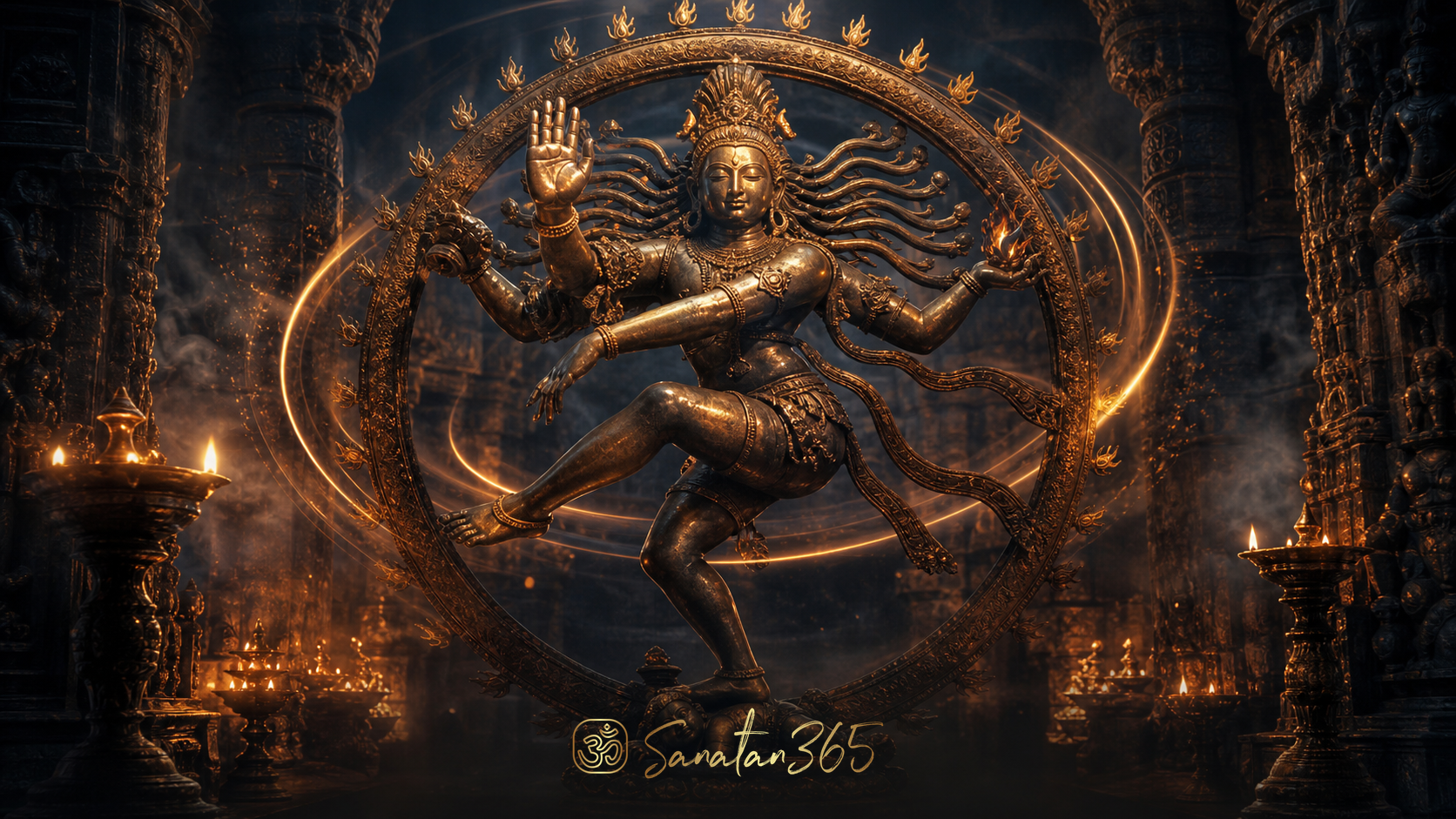
One of the most celebrated Hindu expressions of Abhaya Mudra appears in Shiva as Nataraja (नटराज, Lord of Dance). In Chola bronze imagery, Shiva dances within a ring of fire. One hand holds the damaru (डमरु, a small drum associated with creation and rhythm), another bears flame, one points toward the raised foot of refuge, and a front hand faces the viewer in Abhaya Mudra.
The composition holds apparent opposites together: creation and dissolution, motion and stillness, danger and assurance. The cosmos turns, flames rise, and the dance continues, yet the open palm says, “Do not fear.”
The Metropolitan Museum of Art explains Nataraja imagery through Shiva’s cosmic roles and identifies the raised hand as the gesture that allays fear. The symbolism is especially striking because the assurance does not appear outside change. It appears in the middle of change.
This corrects a common expectation about spiritual protection. Many people imagine safety as a world in which nothing shifts, ends, or surprises them. Nataraja offers a deeper vision. The dance cannot be frozen. Time moves; bodies age; plans change; relationships require adjustment; certainty dissolves. Fearlessness is not found by stopping the dance but by recognizing the still, aware presence within it.
Nataraja’s other gestures deepen the lesson:
- The drum suggests arising, rhythm, and creative unfolding.
- The flame suggests dissolution and transformation.
- The foot upon Apasmara (अपस्मार, forgetfulness or spiritual ignorance) suggests that confusion need not rule consciousness.
- The lifted foot offers refuge and release.
- The Abhaya hand assures the devotee that the whole movement is held within divine order.
The gesture should not be isolated from the full icon. Its meaning grows through relationship. Fire without Abhaya could look terrifying. Abhaya without the dance could look merely comforting. Together they teach mature courage: transformation is real, but fear does not have to become one’s master.
Readers interested in this inner steadiness may also explore Sakshi Bhava and witness consciousness. The witness is not indifferent to life; it is the clear awareness from which life can be met without total identification with every passing emotion.
Key takeaway: In Nataraja, Abhaya Mudra promises fearlessness not outside the cosmic dance, but within its ceaseless change.
How Is Abhaya Different from Varada Mudra?
Abhaya Mudra is often confused with Varada Mudra because both use an open hand. Their orientation and emphasis are different.
Varada (वरद, boon-giving or granting blessings) is commonly shown with the hand lowered and the palm open, sometimes with fingers pointing downward. It signifies generosity, compassion, giving, or the bestowal of grace. Abhaya is commonly raised and outward-facing, emphasizing fearlessness and protection.
Seen together, the two gestures express a complete relationship:
- Abhaya: “You may approach without fear.”
- Varada: “Grace and generosity flow toward you.”
Hindu images vary by region, period, deity, and artistic tradition, so a viewer should avoid treating every hand position as a rigid diagram. Sculpture is a living sacred art, not a standardized instruction manual. Context matters: the deity’s identity, held objects, accompanying figures, posture, and temple tradition all contribute to interpretation.
Yet the basic contrast remains useful. Abhaya removes the barrier of fear; Varada opens the movement of giving. One creates trust, and the other expresses generosity. In devotional life, these are closely linked. A frightened person may be unable to receive. Reassurance creates the inner room in which guidance, blessing, or responsibility can be accepted.
The contrast also has a human application. Good leadership requires both hands, symbolically speaking. People need to know they will not be humiliated or harmed for speaking honestly, and they need real support to act well. Reassurance without help can become empty language. Giving without trust can create dependence or suspicion. Abhaya and Varada together suggest protection that restores agency.
This pairing appears across sacred images, including forms of Shiva and other deities, though exact iconography differs. The wise viewer asks what the complete image is communicating rather than attaching a meaning to one detail and ignoring the rest.
Key takeaway: Abhaya reassures and protects; Varada gives and blesses. Together they express trust joined with grace.
How Can Abhaya Mudra Inspire Daily Courage?
A sacred gesture deserves more than imitation. Its daily value comes from the quality of mind and conduct it asks a person to cultivate.
Abhaya Mudra can inspire a five-part reflection:
- Name the fear accurately. Vague fear grows in darkness. A clear sentence such as “I fear disappointing my family” or “I fear making the wrong decision” gives the mind something honest to examine.
- Separate caution from panic. Caution gathers facts and respects consequences. Panic repeats catastrophe without improving action.
- Return to dharma. Ask what responsibility, truthfulness, compassion, and restraint require in this moment.
- Keep the hand open. Symbolically, this means refusing manipulation, concealed hostility, and desperate grasping.
- Take one steady action. Courage strengthens through conduct, not through endless self-description.
A person may sit quietly and raise the right palm for a few breaths as a reminder, but the gesture should be treated reverently rather than as a guaranteed cure or medical technique. It can support reflection; it does not replace professional help for anxiety, trauma, or any health condition.
The most important daily practice may be offering Abhaya to others. A parent offers it by making honesty safer than concealment. A teacher offers it by correcting without humiliation. A leader offers it by protecting people who speak truth. A friend offers it by listening without immediately judging or controlling.
This reveals the compassionate depth of the symbol. The question is not only “Who will protect me?” It is also “Does my presence reduce unnecessary fear in others?” A raised divine hand becomes an ethical instruction for human hands.
Fearlessness must also remain compatible with boundaries. Compassion does not require tolerating abuse, ignoring danger, or remaining silent before harm. An open palm can signal peace and still say “stop.” Abhaya is not passivity. It is firmness without hatred.
The article on Aparigraha, or non-possessiveness offers a related practice. Much fear comes from clutching an identity, outcome, possession, or expectation. Loosening the grip can restore freedom to act.
Key takeaway: Daily Abhaya means naming fear, choosing dharma, acting steadily, and becoming a reassuring presence for others.
Why Does the Gesture Still Matter Today?
Modern life gives fear new channels but not an entirely new nature. Alerts, predictions, public comparison, financial uncertainty, and constant commentary can keep the nervous system oriented toward threat. The Abhaya Mudra interrupts that atmosphere with an ancient image of composed presence.
Its message is neither “nothing bad can happen” nor “a spiritual person never feels afraid.” Both claims would be untrue and unkind. The gesture says that fear can be met by something deeper: awareness, dharma, compassion, community, and trust in the Divine.
It also challenges cultures of intimidation. When power relies on humiliation, secrecy, or panic, it resembles a clenched fist. The sacred open palm offers another standard. Authority can protect without dominating. Strength can remain transparent. Courage can calm rather than inflame.
For families and diaspora communities, sacred gestures can carry meaning across language barriers. A child may not yet understand a long philosophical explanation, but the open palm of a deity can become a memorable doorway: “This means you do not have to face fear alone, and you should help others feel safe too.” As understanding grows, the symbol grows with the person.
The Abhaya Mudra ultimately joins contemplation and responsibility. The devotee receives assurance, then becomes responsible for embodying it. Fearlessness received should become fearlessness shared.
Key takeaway: Abhaya Mudra remains relevant because it transforms divine reassurance into a modern ethic of transparent, compassionate courage.
The sacred open palm does not erase the world’s uncertainty. It changes how uncertainty is met. Abhaya teaches that courage can be calm, protection can be gentle, and an empty hand can hold a complete promise.
Key takeaway: Abhaya Mudra means “fear not,” and its fullest practice is to meet fear with dharma while offering safety and dignity to others.
FAQ
What is the simple Abhaya Mudra meaning?
Abhaya Mudra means fearlessness, reassurance, and protection. It is commonly shown as a raised open palm facing outward, communicating “fear not.”
Which hand is used for Abhaya Mudra?
In many sacred images, the right hand is raised with the palm outward, but iconographic forms vary across deities, regions, periods, and traditions. The whole image should be read in context.
What does Abhaya Mudra mean in Nataraja?
In Nataraja imagery, the raised open palm allays fear while Shiva performs the cosmic dance. It teaches steadiness within creation, transformation, and dissolution.
Is Abhaya Mudra the same as Varada Mudra?
No. Abhaya is generally raised and signifies protection or fearlessness. Varada is generally lowered with an open palm and signifies giving, grace, or the granting of blessings.
Can someone use Abhaya Mudra in meditation?
A person may use the gesture respectfully as a contemplative reminder of courage and compassionate presence. It is not a guaranteed treatment and should not replace appropriate professional care for health concerns.
About the author
Sanatan365 Editorial
Bringing Sanatan Dharma to modern seekers through authentic, scripture-grounded content.
Related in Wisdom
 Wisdom
Adhyasa Meaning: Why a Rope Can Look Like a Snake
An accessible introduction to superimposition in Advaita Vedanta: the rope-and-snake example, the confusion of Self and body, and the patie…
 Wisdom
Pramana Meaning: How Hindu Philosophy Examines Knowledge
Explore pramana, the means of valid knowledge, through perception, inference and testimony, with clear distinctions among Hindu philosophic…
 Wisdom
Shadripu Meaning: Six Inner Adversaries and Responsible Choice
Understand desire, anger, greed, delusion, pride and envy as six inner adversaries, with practical distinctions that keep self-discipline h…