
Amritabindu Upanishad Meaning: The Mind, Bondage, and Freedom
A close reading of the Amritabindu Upanishad on attachment, the one Self, and the difference between collecting teachings and understanding them.
A single moon can appear in a hundred bowls of water without becoming a hundred moons. The Amritabindu Upanishad uses this kind of everyday image to ask a demanding question: what changes when the mind stops mistaking its reflections for the whole of reality?
The Amritabindu Upanishad meaning centres on the relationship between the mind, attachment, and freedom. It teaches that a mind bound to objects sustains bondage, while freedom from that attachment opens the way to knowledge of the Self. Its concern is not merely having fewer thoughts. It is recognizing what does not depend on the mind's changing contents.
The text is short, but its images reward patient reading. The same mind that becomes entangled can become an instrument of inquiry; the same scriptures that provide direction must eventually become lived understanding.
What is the Amritabindu Upanishad meaning?
The title is commonly rendered “A Drop of Immortality.” Here, amṛta (अमृत) means immortality or the deathless, and bindu (बिन्दु) means a drop or point. The title suggests concentrated teaching rather than a promise that a reader's body will become deathless.
An Upaniṣad (उपनिषद्) is a sacred teaching concerned with fundamental questions about reality and the Self. In this text, ātman (आत्मन्), the Self, is not simply a person's changing preferences, biography, or social role. Brahman (ब्रह्मन्) names ultimate reality. The teaching approaches their relationship through disciplined inward inquiry.
The edition used here contains twenty-two verses, presented with translation and commentary in the Chinmaya International Foundation's Amritabindu study text. Verse references below follow that edition; the explanations distinguish its teaching from contemporary examples offered to clarify it.
The opening verse distinguishes a mind shaped by desire from one free of that conditioning. The next verse states the central claim about bondage and liberation. Later verses turn toward inward contemplation, the one Self appearing in many beings, and the relationship between words and direct knowledge.
Read in that sequence, the text is more than a quotation about positive thinking. It moves from the condition of the mind to a question about identity: is the Self reducible to whatever the mind currently wants, fears losing, remembers, or imagines?
Key takeaway: The text asks how attachment shapes experience and how Self-knowledge differs from another passing mental state.
How can the same mind bind and free?
Verse 2 contains the text's best-known declaration:
Mana eva manuṣyāṇāṃ kāraṇaṃ bandhamokṣayoḥ.
“For human beings, mind alone is the cause of bondage and freedom.”
— Amritabindu Upanishad 2, translation in the study edition
The verse then connects bondage with attachment to objects and freedom with release from that attachment. Manas (मनस्) means mind; bandha (बन्ध) means bondage; mokṣa (मोक्ष) means liberation.
“Objects” should not be reduced to possessions alone. A desired result, admiration, an argument, or a preferred self-image can also become something around which attention repeatedly organizes itself. This is a contemporary application of the verse, not a list supplied by the Sanskrit text.
Consider someone preparing a careful piece of work. Wanting to complete it well provides direction. But if every response becomes a verdict on personal worth, the task acquires a second burden: it must continually secure the worker's identity. The object is no longer merely being used; it becomes something the person feels unable to be whole without.
The teaching does not require pretending that food, shelter, relationships, or responsibility are irrelevant. Its specific concern is the mind's attachment. Attending to a practical need and demanding that a changing thing provide unchanging fulfilment are different movements.
Verse 3 therefore speaks of training the seeker's mind. Freedom is not presented as an excuse for indifference or a reward for repeating the right sentence once. The discipline concerns the direction in which attention habitually turns and the claims it places upon what it encounters.
Readers seeking a complementary account of perception and its limits can turn to the Kena Upanishad's inquiry into mind and awareness. The Amritabindu's distinctive emphasis remains the mind's relation to attachment and release.
Key takeaway: The question is not whether something matters, but whether the mind demands that it become the permanent foundation of the Self.
Does freedom require suppressing every thought?
The text's language is demanding. Verses 4 and 5 describe restraint, inwardness, and the mind's dissolution in the heart. A responsible reading should neither remove that contemplative depth nor turn it into a contest to produce an empty head.
The “heart” here belongs to the language of spiritual inwardness. These verses are not instructions about manipulating an anatomical organ. They point toward the Self rather than toward another object to be acquired.
There is also an important distinction between an advanced spiritual description and a beginner's self-imposed performance target. Counting every thought as a failure can keep attention fixed on the very activity it is trying to transcend. The article offers no technique for forcing a particular inner state and no claim that ordinary pauses amount to liberation.
Verse 6 makes the discussion subtler still: ultimate reality is not to be treated simply as another object of thought, yet contemplation is not abandoned. Verse 7 introduces sound as a support and then points beyond sound. In the study commentary, that support is Om (ॐ), the sacred syllable.
This movement does not make speech, learning, or reasoning worthless. It marks a limit: describing something and knowing its reality are not necessarily the same. A person can repeat a description of sweetness without tasting anything; similarly, a precise philosophical sentence does not by itself establish understanding of the Self.
For a reader beginning this study, a modest response is to read slowly, notice where the mind turns a teaching into another achievement, and seek explanation from a qualified teacher. That is a study orientation, not a substitute for the text's full discipline.
Key takeaway: The Upanishad points beyond dependence on mental objects; it should not be flattened into an instruction to fight every thought.
Why does one Self appear as many?
Verse 11 speaks of one Self across waking, dream, and deep sleep. Verse 12 then offers the image of a single moon appearing in many bodies of water. The reflections differ, but their source is not divided by those differences.
Imagine a still pool, a rippling river edge, and a small vessel beside a lamp-lit veranda. Each may show the moon differently. A broken reflection does not mean that the moon itself has broken; a clear reflection does not mean that its container owns a superior moon.
The analogy serves a philosophical purpose. In the text's nondual teaching, plurality of appearances does not establish a plurality of ultimate Selves. Advaita (अद्वैत), nonduality, means “not two.” It does not mean that visible differences must be denied in ordinary conversation.
A teacher can explain the analogy while still recognizing distinct people, responsibilities, and circumstances. Shared spiritual reality is not permission to disregard another person's needs or boundaries. Those are ethical implications drawn here for daily conduct, not an additional verse inserted into the text.
Nor is moonlight a scientific demonstration of the doctrine. An analogy makes a relationship intelligible; it is not laboratory evidence for a metaphysical conclusion. Its usefulness lies in changing the question from “How many reflections exist?” to “What is being reflected?”
The Mundaka Upanishad's two-birds image supplies another way of considering involvement and witnessing. Each image has its own setting. Reading them together can deepen inquiry without collapsing different passages into one interchangeable quotation.
Key takeaway: The many-water reflections illustrate the text's teaching of one Self, not the erasure of human difference or responsibility.
What do grain and butter teach about study?
The later verses correct another possible misunderstanding: inward knowledge is not obtained simply by collecting more descriptions of it.
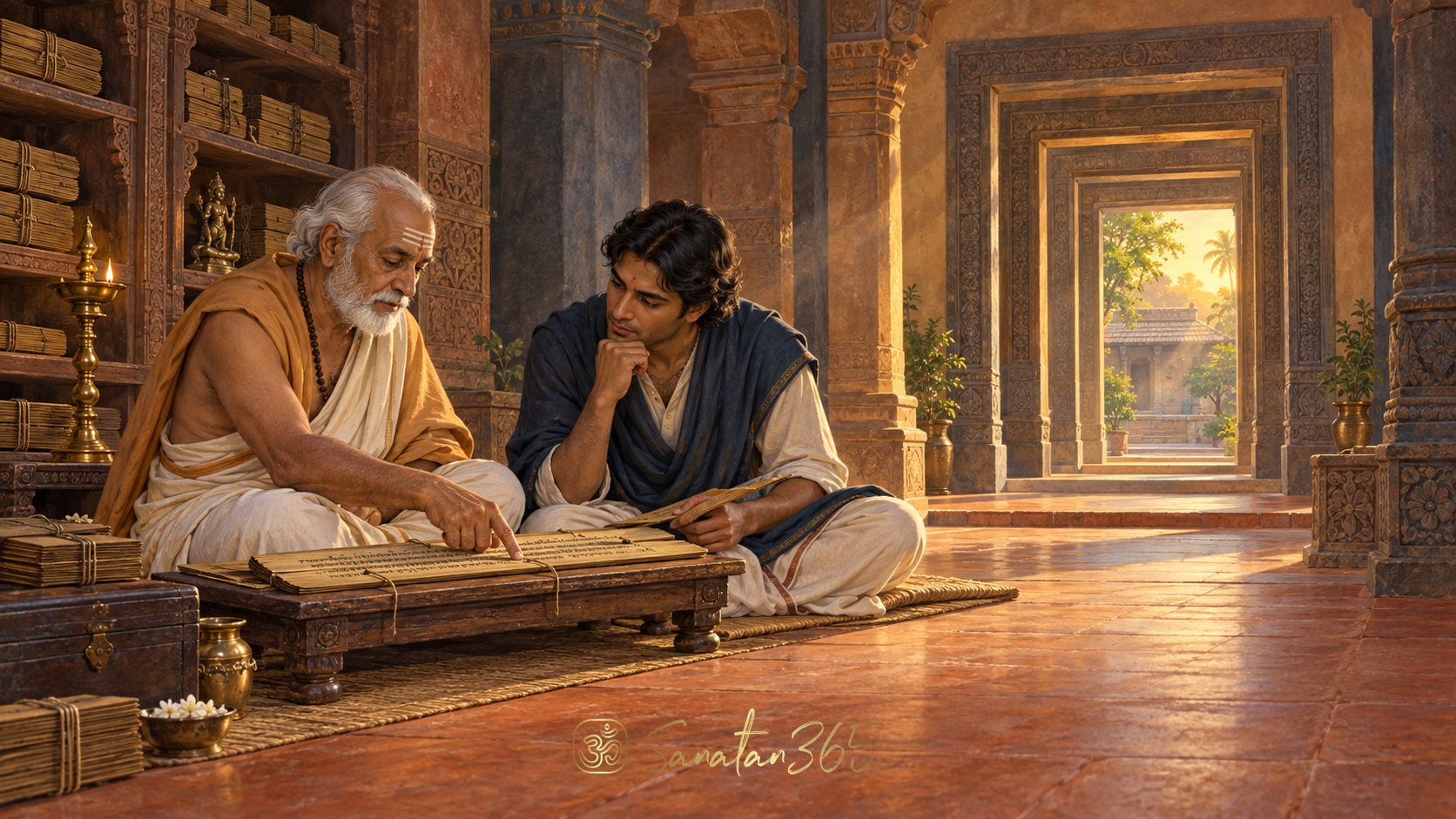
Verse 17 distinguishes knowledge expressed through words from the supreme reality toward which that knowledge points. Verse 18 compares the discerning student with someone seeking grain who leaves the husk behind. The sequence matters: the student has studied before moving beyond dependence on the text.
This is not an invitation to contempt for scriptures, teachers, translation, or careful reasoning. The commentary explicitly explains that “discarding” does not mean physically throwing books away. It means recognizing the purpose they serve and allowing their teaching to become more than an object stored in memory.
A useful everyday parallel is learning a musical passage. Reading notation matters; understanding rhythm matters; guidance matters. Yet possessing the score is not identical with being able to perform the passage attentively. The comparison is limited, because the Upanishad concerns Self-knowledge rather than a musical skill, but it clarifies the difference between a support and its fulfilment.
Verse 19 uses cows of different colours and milk of one colour to reflect on diversity and knowledge. Verse 20 offers butter hidden in milk, with the mind as a churning rod. These are images of discovery through sustained inquiry, not promises that insight appears merely because time has passed.
Taken together, the metaphors protect two truths. Learning deserves care, and learning has a purpose beyond accumulation. Rejecting study too soon loses the grain; never moving beyond collection leaves the grain covered.
This also changes how a reading habit can be evaluated. Instead of asking only how many pages were completed, a student might ask which distinction became clearer, which assumption remains unexamined, and which question needs a teacher's help. These are practical reading prompts, not measurements of spiritual attainment.
Key takeaway: Scriptures are honoured by understanding what they teach, not merely by possessing, quoting, or dismissing them.
How can its teaching inform an ordinary day?
The Amritabindu Upanishad is not a modern productivity manual. Nevertheless, its distinction between use and attachment can illuminate familiar situations without claiming that household reflection is equivalent to final realization.
A short reading practice might proceed as follows:
- Choose one verse. Begin with its wording and translation rather than an isolated social-media quotation.
- Identify its actual claim. Is it discussing attachment, contemplation, the Self, or the limits of verbal knowledge?
- Notice one concrete example. A desire for recognition or insistence on winning may reveal how attention becomes tied to an object.
- Keep responsibility intact. Loosening possessiveness does not mean leaving work unfinished, withholding care, or ignoring a necessary conversation.
- Return to study. Write down the unresolved question and seek reliable commentary or a teacher's explanation.
These steps are an introductory way of reading, not a prescribed sequence from the Upanishad. They require no elaborate equipment, special location, or claim of instant insight.
For families and readers in the diaspora, a translated passage can become a thoughtful conversation about why a result matters and why personal worth should not be reduced to that result. For experienced students, the same passage may open a much deeper inquiry that needs sustained guidance. Neither context should be treated as a competition.
The strongest conclusion is also the simplest: the mind need not be despised because it becomes entangled. The text asks that it be understood and trained, so that words, attention, and inquiry serve recognition rather than further possession.
Key takeaway: Begin with honest observation and careful study, while keeping the Upanishad's larger aim of Self-knowledge in view.
FAQ
What is the main message of the Amritabindu Upanishad?
Its central teaching is that the mind is connected with both bondage and liberation. Attachment to objects binds, while freedom from that attachment supports Self-knowledge. The later verses connect this inquiry with nonduality and the difference between verbal learning and understanding.
What does Amritabindu Upanishad verse 2 mean?
Verse 2 identifies the mind as the cause of bondage and freedom, then distinguishes attachment to objects from release from that attachment. It is a spiritual teaching about dependence and liberation, not a claim that thinking alone controls every external circumstance.
Does the text say that books are unnecessary?
No. Verse 18 first describes a student who has studied and seeks knowledge and wisdom. Its grain-and-husk comparison concerns moving beyond dependence on words after understanding their purpose, not rejecting education or treating uninformed opinion as realization.
Can a beginner read the Amritabindu Upanishad?
Yes, with a reliable translation and commentary. Its short length does not make every verse simple. A beginner can start with one passage, distinguish the text from personal interpretation, and take difficult questions to a qualified teacher without claiming an immediate final understanding.
About the author
Sanatan365 Editorial
Bringing Sanatan Dharma to modern seekers through authentic, scripture-grounded content.
Related in Scriptures
 Scriptures
Tattva Bodha Meaning: Four Qualifications for Clear Self-Inquiry
A beginner-friendly reading of Tattva Bodha, its four qualifications, six inner disciplines, and careful distinction between preparation an…
 Scriptures
Nirvana Shatakam Meaning: Six Verses of Self-Inquiry
Read the six verses of Nirvana Shatakam as careful Advaita self-inquiry, understand Shivoham, and distinguish contemplative freedom from ne…
 Scriptures
Atharva Veda Meaning: Household Prayer and Cosmic Questions
The Atharva Veda brings household concerns, communal hopes, and questions about existence into sacred speech. Learn its scope and how to re…

