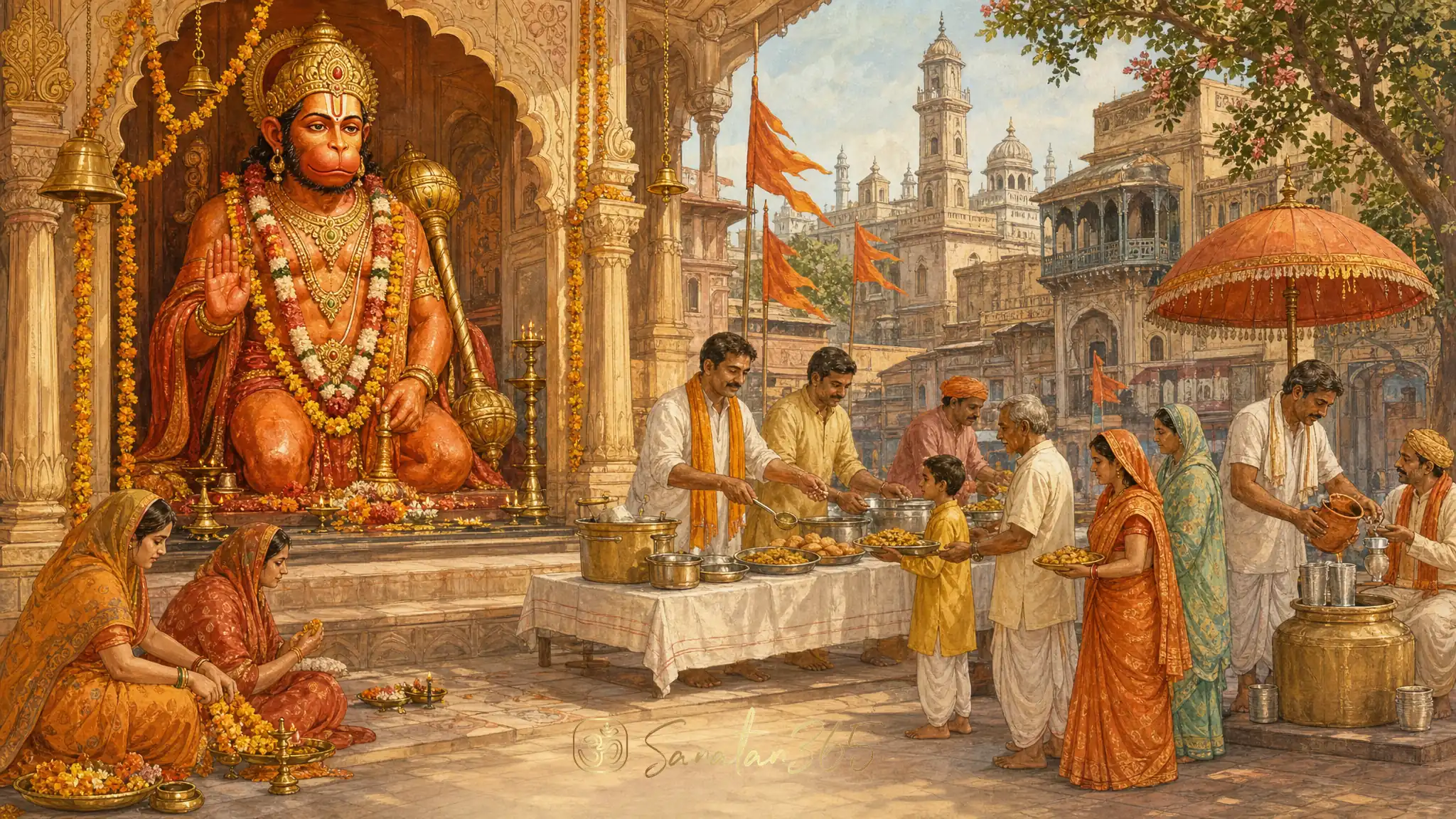
Bada Mangal 2026: Hanuman Devotion, Bhandara Seva, and Lucknow’s Jyeshtha Tuesdays
A careful guide to Bada Mangal 2026, the Hanuman-focused Jyeshtha Tuesday tradition of Lucknow and Uttar Pradesh, with bhandara seva, puja, and meaning.
The most visible form of Hanuman bhakti in Lucknow is not only a temple queue; it is a city learning to feed strangers in the heat.
Bada Mangal 2026 refers to the sacred Tuesdays of Jyeshtha (ज्येष्ठ, the hot late-spring Hindu month) dedicated to Lord Hanuman, observed with special devotion in Uttar Pradesh, especially Lucknow and the wider Awadh region. The tradition is also called Bada Mangalwar (बड़ा मंगलवार, great Tuesday). Devotees visit Hanuman temples, offer sindoor, chant the Hanuman Chalisa, and organize bhandara seva (भंडारा सेवा, community food service) where prasad, water, sherbet, fruit, and full meals are distributed freely.
Key takeaway: Bada Mangal is Hanuman worship expressed through courage, humility, and public seva.
What Is Bada Mangal 2026 and Why Is It Linked to Hanuman?
Bada Mangal 2026 is best understood as a regional Hanuman observance, not a single pan-India festival date like Diwali or Janmashtami. It falls on Tuesdays during Jyeshtha, and in Lucknow the observance can continue across multiple Tuesdays depending on the calendar cycle. Contemporary festival listings for 2026 note an unusually extended run of Bada Mangal Tuesdays, while local reporting from Lucknow has been tracking the second and third Bada Mangal gatherings through May 2026 Hindustan Times.
The devotional reason is simple: Tuesday, or Mangalwar (मंगलवार), is widely associated with Lord Hanuman in North Indian practice. Hanuman represents strength held in service, power governed by devotion, and fearlessness rooted in Rama-bhakti. Many devotees approach him for protection, steadiness, courage, and relief from inner weakness.
Bada Mangal makes that private prayer visible in public life. A family may begin with darshan at Hanuman Setu, Aliganj Hanuman Mandir, or a neighborhood shrine. A shopkeeper may sponsor water distribution. A student may help serve poori-sabzi after an exam. A household may sponsor a small stall outside a lane, not as display, but as offering.
The word "bada" does not mean only "big" in scale. It also suggests an expanded spirit: bigger generosity, bigger remembrance, and bigger willingness to serve without asking who the recipient is.
Key takeaway: Bada Mangalwar is a Tuesday discipline in which Hanuman devotion moves from the altar into the street.
How Did Lucknow Become the Heart of Bada Mangalwar?
Lucknow's Bada Mangal is deeply tied to the city's temple memory, especially the old and new Hanuman temples of Aliganj. Local accounts connect the tradition with the Awadh period and the rise of public bhandaras around Hanuman worship. The Bada Mangal archive describes Aliganj Hanuman Mandir as a central geographic heart of the observance and records the local belief that the tradition took shape around Jyeshtha Tuesdays BadaMangal.com.
Because the history is carried through temple tradition, oral memory, local historians, and community practice, it should be handled carefully. It is better to say "local tradition holds" than to flatten every story into one hard historical claim. What can be said with confidence is that Lucknow has preserved Bada Mangal as a living civic-religious custom for generations.
That living quality matters. Bada Mangal is not confined to one priestly ritual. It is marked by temples, neighborhoods, volunteers, traffic diversions, food stalls, water stations, small businesses, resident associations, and families. News reports from recent years have described thousands of bhandaras across Lucknow on Bada Mangal, with large crowds at Hanuman temples and free prasad served across the city Hindustan Times.
In that sense, Bada Mangal shows a distinctive feature of Sanatan practice: worship is not only vertical, from devotee to deity. It is also horizontal, from one human being to another. Hanuman is remembered through seva because his own life is the model of service.
Key takeaway: Lucknow's Bada Mangal survives because it is both temple tradition and neighborhood practice.
Why Is Bhandara Seva Central to Bada Mangal 2026?
The most recognizable public sign of Bada Mangal 2026 is the bhandara. A bhandara (भंडारा, community food offering) is not merely a meal distribution drive. In devotional understanding, it is prasad-based service: food offered with sacred intention, then shared without social distance.
Jyeshtha is one of North India's hottest months. Serving water, sharbat, fruit, buttermilk, or a simple meal during this period has practical compassion built into it. The timing gives the ritual its moral weight. Hanuman bhakti becomes visible as care for tired commuters, workers, students, passersby, pilgrims, and anyone who accepts prasad.
A Bada Mangal bhandara usually carries a few simple principles:
- Serve without asking status, identity, or background.
- Keep the food sattvic, clean, and respectful.
- Treat the recipient as a guest, not a burden.
- Remember Hanuman before, during, and after the serving.
- Avoid waste, crowding, and careless noise.
This is why bhandara seva feels so powerful in Lucknow. The act is public, but the mood is intimate. Someone may stand for hours ladling chole, refilling water, or handing out prasad. Another person may quietly sponsor ingredients. A child may learn that devotion is not only folding hands before a murti, but also offering a plate with both hands.
The deeper discipline is humility. Hanuman is strong, but never self-advertising. He serves Rama, protects dharma, and then stands with folded hands. Bada Mangal asks devotees to carry some of that bhava (भाव, devotional feeling) into a modern city.
Key takeaway: Bhandara on Bada Mangal is not charity alone; it is Hanuman bhakti practiced as public care.
What Puja and Practices Do Devotees Follow on Bada Mangalwar?
There is no single universal home ritual for Bada Mangalwar, because the observance is regional and family customs vary. Still, many devotees follow a gentle pattern of Hanuman worship on Jyeshtha Tuesdays.
A common Bada Mangal practice may include:
- Morning bath and clean clothing, often with red, orange, or saffron elements.
- Visit to a Hanuman temple for darshan.
- Offering sindoor, jasmine oil, flowers, tulsi where locally appropriate, and sweets such as boondi or laddoo.
- Recitation of Hanuman Chalisa, Bajrang Baan, Hanuman Ashtak, or simple Rama-nama.
- Lighting a diya and praying for strength, protection, discipline, and service.
- Participating in bhandara seva or supporting one through food, water, utensils, cleaning, or volunteer help.
- Keeping speech and conduct steady through the day.
One famous line from the Hanuman Chalisa captures the mood of Bada Mangal:
"Bhoot pishach nikat nahin aave, Mahavir jab naam sunave."
The line is traditionally understood as a devotional assurance that fear and harmful influences lose force when Mahavir Hanuman is remembered. In a Bada Mangal setting, the practical meaning is equally important: courage grows when remembrance is joined with disciplined action.
Devotees who cannot reach a temple can still honor the day at home. A small diya before a Hanuman image or murti, a sincere Chalisa recitation, and one act of food or water seva are enough to keep the spirit of the observance. Diaspora families can adapt the practice by donating meals locally, serving water at a community event, or cooking prasad at home and sharing it with neighbors.
Key takeaway: Bada Mangal puja is strongest when temple worship, mantra, and seva support one another.
How Does Bada Mangal Teach Hanuman’s Kind of Strength?
Hanuman's strength is never isolated from devotion. In the Ramayana tradition, he is brave because he is surrendered, wise because he is humble, and tireless because his effort is offered to Rama. Bada Mangal turns this theology into practice.
The heat of Jyeshtha gives the observance a physical honesty. It is easy to speak about compassion in comfort. It is harder to stand outside in summer and serve water patiently. It is easy to praise Hanuman's power. It is harder to imitate even a small part of his sevak-bhava (सेवक भाव, the inner attitude of a servant of the Divine).
Three qualities stand out:
- Bal (बल, strength): not aggression, but the energy to do what is right.
- Bhakti (भक्ति, devotion): not sentiment alone, but loving remembrance.
- Seva (सेवा, service): not performance, but useful action for others.
This triad explains why Bada Mangal has lasted. It gives every person a role. A priest may conduct puja. A family may sponsor prasad. A teenager may manage drinking water. A driver may slow down near a crowded bhandara. A devotee may offer one packet of fruit. No contribution is too small when the bhava is clean.
For modern readers, this is the most practical lesson. Hanuman devotion is not only asking for strength. It is training the body, speech, and resources to become useful.
Key takeaway: Bada Mangal teaches that true strength becomes sacred when it protects and serves.
What Should Visitors Know Before Joining Bada Mangal in Lucknow?
Anyone visiting Lucknow during Bada Mangal should approach the day with reverence and practical awareness. Major Hanuman temples can become crowded, and bhandaras may appear across busy roads, markets, and residential lanes. Local police and civic bodies may issue traffic or crowd guidance, so visitors should follow current local instructions.
A respectful visitor can keep these points in mind:
- Accept prasad with gratitude and avoid wasting food.
- Do not block queues, roads, or temple entrances for photos.
- Dress modestly for temple visits.
- Keep footwear, plastic waste, and disposable plates in the correct places.
- If sponsoring a bhandara, plan hygiene, shade, drinking water, and cleanup.
- Avoid loud self-promotion. Let the seva remain seva.
- Check local panchang and temple notices because observance details may vary by neighborhood.
The best way to experience Bada Mangal is not as a spectacle. It is to receive the city through its offering. Stand in a temple line, help at a stall if invited, accept a glass of water, and remember that the act carries the name of Hanuman.
Readers who want a daily devotional rhythm beyond festival days can also build a simple Tuesday practice: Hanuman Chalisa, one small act of food seva, and a short reflection on courage without ego. Sanatan365's Lord Hanuman AI guide may support reflection for users who want to think through Hanuman's qualities in daily life, but the real practice remains grounded in devotion, conduct, and service.
Key takeaway: Join Bada Mangal with humility; the tradition is less about watching and more about serving.
FAQ
What is Bada Mangal 2026?
Bada Mangal 2026 is the observance of sacred Jyeshtha Tuesdays dedicated to Lord Hanuman, especially in Uttar Pradesh and Lucknow. Devotees visit Hanuman temples, recite prayers such as Hanuman Chalisa, and organize bhandaras where food and water are served freely.
Is Bada Mangal the same as Hanuman Jayanti?
No. Hanuman Jayanti marks the celebration of Hanuman's birth according to regional calendars, while Bada Mangalwar is a Jyeshtha Tuesday tradition centered on Hanuman devotion, temple visits, and community seva, especially in Lucknow and Awadh.
Why are bhandaras organized on Bada Mangal?
Bhandaras are organized as seva in Hanuman's name. Because Jyeshtha is a hot month in North India, offering water, prasad, and meals carries both devotional and practical compassion. It reflects Hanuman's own ideal of strength used in service.
Can someone observe Bada Mangal outside Lucknow?
Yes. A devotee outside Lucknow can observe Bada Mangal by worshipping Hanuman on Tuesday, reciting Hanuman Chalisa, offering a simple sattvic prasad, and doing one act of food or water seva in a local, respectful way.
What is the key takeaway from Bada Mangalwar?
The key takeaway is that Hanuman bhakti becomes complete when remembrance turns into service. Bada Mangal asks devotees to seek courage, but also to use that courage for humility, care, and community well-being.
About the author
Sanatan365 Editorial
Bringing Sanatan Dharma to modern seekers through authentic, scripture-grounded content.

