Dana Meaning: How Hindu Giving Becomes Selfless Dharma
A careful guide to dana in Hindu Dharma, explaining selfless giving, Bhagavad Gita 17.20, discernment, humility, and everyday charity practice.
The smallest gift can become sacred when the giver disappears from the center of the act.
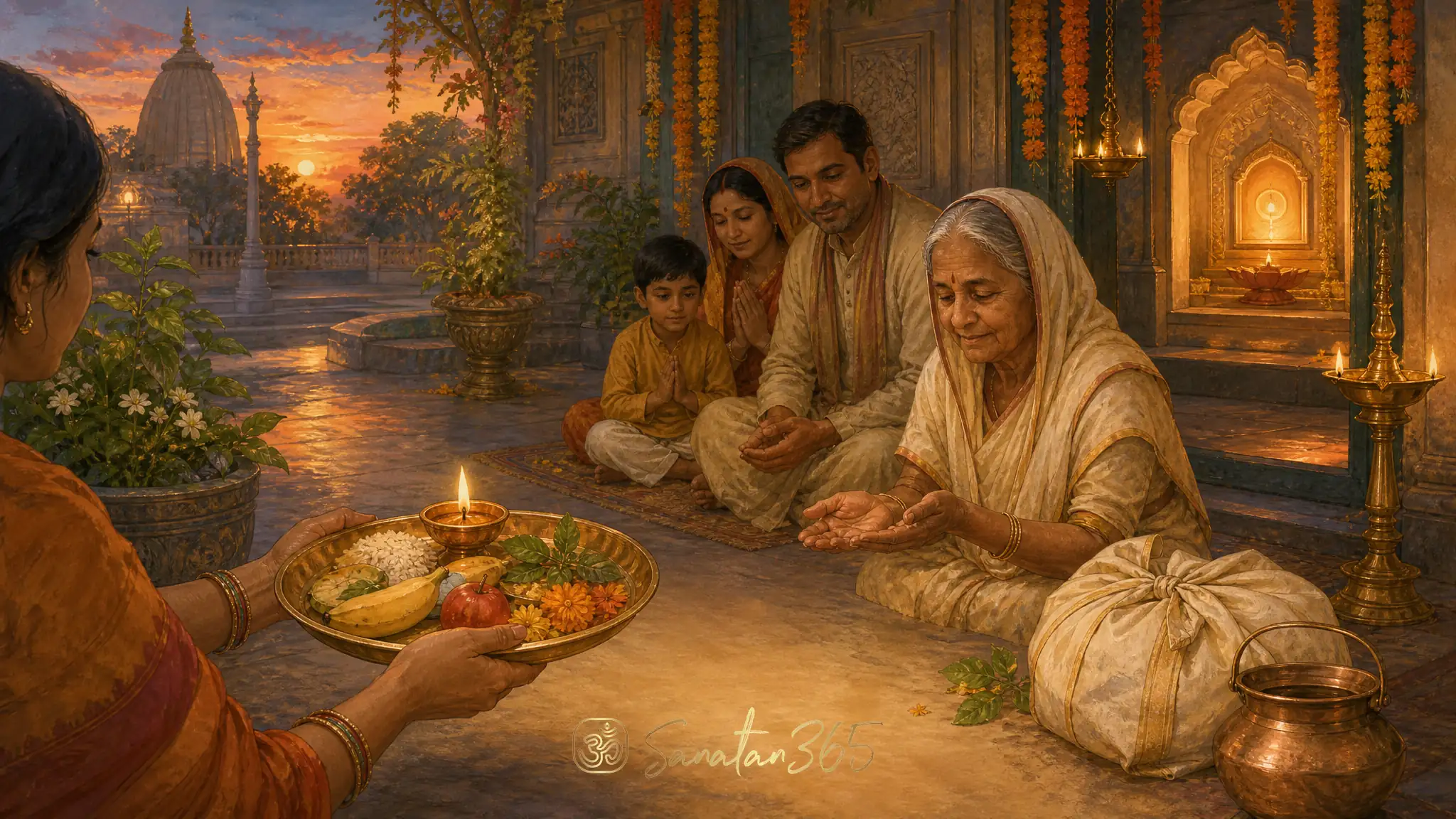
Dana meaning begins with the Sanskrit word dana (दान, giving or charity), but in Hindu Dharma it is more than donation. Dana is the disciplined act of giving with respect, discernment, and no expectation of return. The Bhagavad Gita describes sattvic dana as giving because it ought to be given, at the right place and time, to a worthy recipient, without looking for repayment Bhagavad Gita 17.20. True dana turns wealth, food, time, knowledge, and attention into dharma.
Key takeaway: Dana is not measured only by how much is given, but by the purity, humility, and usefulness of the giving.
What Is Dana Meaning in Hindu Dharma?
Dana meaning is often translated as charity, but the English word can feel too narrow. Charity may suggest occasional help from one person to another. Dana suggests a dharmic discipline: the giver recognizes that resources are not held for ego alone. They are meant to circulate in ways that protect life, learning, worship, hospitality, and social care.
In Hindu thought, giving appears beside other ethical practices such as self-restraint, truthfulness, study, sacrifice, and compassion. The Chandogya Upanishad includes dana among duties that shape a life of ethical sacrifice and inward refinement Chandogya Upanishad overview. The Taittiriya Upanishad's convocation teaching also gives careful instructions about giving: give with faith, modesty, fear of doing wrong, and sympathetic understanding Taittiriya Upanishad overview.
That combination matters. Dana is not random distribution. It is giving with shraddha (श्रद्धा, reverent faith), viveka (विवेक, discernment), and maryada (मर्यादा, right conduct or boundary). A person may give food to someone hungry, support a temple, help a student, serve water during summer, contribute to disaster relief, sponsor a scripture class, or quietly assist a family in difficulty. The form changes. The inner discipline remains.
The spiritual insight is that possession can either harden the heart or train it. When giving is practiced with respect, wealth stops being only private security. It becomes a tool for dharma.
Key takeaway: Dana is a dharmic practice that transforms resources into care, learning, worship, and protection.
Why Does the Bhagavad Gita Teach Three Kinds of Giving?
The Bhagavad Gita places dana inside a larger teaching on the three gunas (गुण, qualities of nature): sattva, rajas, and tamas. This is important because the same outward act can carry different inner qualities.
In Gita 17.20, Krishna describes sattvic dana (सात्त्विक दान, clear and harmonious giving) as giving out of duty, without expectation of return, in the right place and time, to a worthy recipient Bhagavad Gita 17.20. In the next verses, rajasic giving is linked with expectation, return, or reluctance, while tamasic giving is careless, disrespectful, wrongly timed, or directed without discernment Bhagavad Gita 17.21-22.
This teaching protects the dignity of both giver and receiver. It says that giving is not automatically pure just because something changed hands. The giver's attitude matters. The recipient's real need matters. The method matters. The timing matters. Respect matters.
For example, feeding people during intense summer heat can be sattvic when done cleanly and humbly. Public giving can become rajasic when the real aim is praise, branding, or social approval. Even a large gift can become tamasic if it humiliates the receiver, supports harm, or is given carelessly to avoid moral discomfort.
The Gita does not ask ordinary people to stop giving because motives are imperfect. It asks them to refine the motive. Begin where you are, then remove expectation, contempt, and display.
Key takeaway: The Gita's threefold teaching shows that giving becomes sacred when intention, timing, recipient, and respect are aligned.
How Does Dana Differ from Seva?
Dana and seva (सेवा, service) often overlap, but they are not identical. Dana emphasizes giving something: money, food, clothes, land, books, knowledge, medicine, time, or practical support. Seva emphasizes serving through action: cooking, cleaning, teaching, carrying, listening, organizing, protecting, or caring.
In lived Hindu practice, the two often join. A family may give ingredients for a bhandara, while volunteers cook and serve the food. A devotee may donate books, while a teacher offers time to explain them. A temple may receive funds, while the community maintains the space. The gift and the labor become one current of dharma.
This joining prevents two common mistakes. Dana without seva can become distant and transactional. Seva without dana can become exhausted if resources are never replenished. Together they create a fuller discipline: give what is needed, then serve in a way that protects the gift from ego.
For modern readers, this is practical. A person who cannot donate much money can still give time, skill, transport, tutoring, food preparation, administrative help, or patient listening. A person with financial capacity can give quietly and also respect those who serve with their hands. No single form is superior in every situation.
The deeper question is not, "Did I give enough to look generous?" It is, "Did this act reduce suffering, support dharma, and preserve dignity?"
Key takeaway: Dana gives resources, seva gives action, and together they train the heart to become useful without seeking applause.
What Makes Dana Sattvic in Daily Life?
Sattvic dana is not limited to temples, festivals, or major public acts. It can enter ordinary life through careful choices. The Gita's criteria give a simple framework: right intention, right time, right place, right recipient, and no expectation of return.
A daily-life checklist can help:
- Give with respect. The receiver should not feel small, exposed, or shamed.
- Give what is useful. Food, money, books, time, or support should match a real need.
- Give cleanly. Avoid expired food, broken items, hidden conditions, or careless handling.
- Give without control. A gift should not become a leash around another person's dignity.
- Give with discernment. Support people, institutions, and causes that use help responsibly.
- Give quietly when possible. Public proof may be necessary for institutions, but ego-display weakens the inner practice.
- Give consistently. A small monthly act can shape character more deeply than one dramatic moment.
The Taittiriya Upanishad's teaching on giving with faith and sensitivity is especially relevant here. Faith prevents cynicism. Sensitivity prevents arrogance. Modesty prevents the giver from turning the receiver into a stage for self-image.
In families, dana can be taught early. Children can place grains for birds, help pack food, share books, contribute part of festival money, or join elders in temple service. The lesson should not be guilt. The lesson should be gratitude: because we have received, we learn to give.
This same spirit connects with other daily disciplines, including sattvic-food-meaning-hindu-wellness and bhakti-meaning-devotion-daily-life, because food, devotion, and generosity all ask the heart to become cleaner than habit.
Key takeaway: Sattvic dana is useful, respectful, discerning, and steady; it protects the receiver's dignity as much as the giver's virtue.
Why Is Dana Important During Festivals, Vrats, and Sacred Months?
Dana becomes especially visible during festivals, vrats, pilgrimages, and sacred months because these periods heighten awareness. A vrat (व्रत, sacred vow) disciplines the body and mind. Dana expands that discipline outward.
During Ekadashi, Adhik Maas, Navratri, Kartik, Shravan, Makar Sankranti, and other observances, many families give food, clothes, water, books, dakshina, or support to temples and community kitchens. The timing matters because sacred days remind the mind to act before laziness returns. Public panchang calendars for 2026, for example, show how Adhik Maas and Padmini Ekadashi created a period of intensified Vishnu worship and charity in late May Prokerala Panchang, HinduTone calendar.
Yet festival giving needs care. Sacred timing should not become social pressure or superstition. Dana is not a transaction that buys divine favor. It is an offering that purifies the giver's relationship with possession. If the act is done only to bargain for reward, its quality changes.
The best festival dana is often simple and concrete: feed someone respectfully, support a student's books, help a temple maintain cleanliness, sponsor drinking water, assist a widow or elder, contribute to a verified relief effort, or give time to community service. The festival becomes complete when worship and compassion meet.
Diaspora families can adapt this beautifully. A household in New Jersey, London, Nairobi, Singapore, or Sydney may not have the same local customs as a village or Indian city, but it can still connect puja with giving. A box of groceries, a temple volunteer shift, a student scholarship fund, or a quiet donation can carry the same spirit.
Readers reflecting on sacred time may also connect dana with padmini-ekadashi-2026-adhik-maas-vrat, where vrat, Vishnu remembrance, and charity come together during Adhik Maas.
Key takeaway: Festival dana turns sacred time into compassionate action, but it should remain humble offering, not spiritual bargaining.
How Can a Modern Seeker Practice Dana Without Ego?
The most difficult part of dana is not parting with money. It is parting with self-importance. Modern life turns generosity into content, metrics, screenshots, and public identity. Hindu dana asks for a quieter center.
One useful practice is to divide giving into three forms. First, visible accountable giving, where receipts or public reporting are needed because an institution must be transparent. Second, private relational giving, where someone is helped without being exposed. Third, anonymous inner training, where no one knows except the giver and the Divine.
All three can be valid. The problem is not visibility itself. The problem is attachment to visibility. If public proof helps trust, use it. If public display humiliates someone, avoid it. If secrecy protects the purity of the act, preserve it.
A modern dana rhythm may look like this:
- Keep a fixed monthly dana amount, even if small.
- Keep one skill-based seva commitment.
- Keep one emergency reserve for sudden human need.
- Review whether the giving is useful, not merely emotional.
- Avoid sharing another person's hardship without consent.
- Offer gratitude after giving, because the act was an opportunity.
This last point is subtle. In dana, the receiver is not merely "beneficiary." The receiver gives the giver a chance to soften greed, serve dharma, and remember interdependence. That is why contempt has no place in true giving.
Key takeaway: Modern dana stays pure when accountability is balanced with privacy, usefulness, humility, and freedom from self-display.
FAQ
What is dana meaning in Hindu Dharma?
Dana meaning in Hindu Dharma is giving or charity practiced as dharma. It includes giving money, food, knowledge, time, or support with respect, discernment, faith, and no expectation of return.
What does the Bhagavad Gita say about dana?
The Bhagavad Gita 17.20 describes sattvic dana as giving because it ought to be given, at the right place and time, to a worthy recipient, without expecting repayment. Verses 17.21-22 contrast this with giving driven by expectation, reluctance, carelessness, or disrespect.
Is dana the same as seva?
Dana and seva are related but different. Dana emphasizes giving resources or support, while seva emphasizes service through action. In practice, they often work together, such as donating food and also serving it respectfully.
Can dana be practiced without money?
Yes. Dana can include time, knowledge, food, books, care, attention, practical help, and skills. A person with little money can still practice meaningful dana through useful and respectful giving.
How can dana be done without ego?
Dana can be done without ego by giving quietly when possible, protecting the receiver's dignity, avoiding display, choosing useful support, and remembering that giving is a chance to serve dharma rather than prove superiority.
Conclusion
Dana begins as an act of giving, but it matures into a way of seeing. Nothing we hold is ours in isolation. Food comes through soil, rain, labor, trade, family, and grace. Knowledge comes through teachers. Wealth comes through society as well as effort. Dana remembers this web of receiving and returns something back into it.
Key takeaway: Dana is selfless Hindu giving when resources move with humility, discernment, respect, and the quiet intention to support dharma.
About the author
Sanatan365 Editorial
Bringing Sanatan Dharma to modern seekers through authentic, scripture-grounded content.
Related in Wisdom
 Wisdom
Pramana Meaning: How Hindu Philosophy Examines Knowledge
Explore pramana, the means of valid knowledge, through perception, inference and testimony, with clear distinctions among Hindu philosophic…
 Wisdom
Shadripu Meaning: Six Inner Adversaries and Responsible Choice
Understand desire, anger, greed, delusion, pride and envy as six inner adversaries, with practical distinctions that keep self-discipline h…
 Wisdom
Mudita Meaning: Joy in Another Person's Goodness
Explore mudita in Yoga Sutra 1.33: appreciative joy in another person's goodness, its limits, and a grounded way to practise it.

