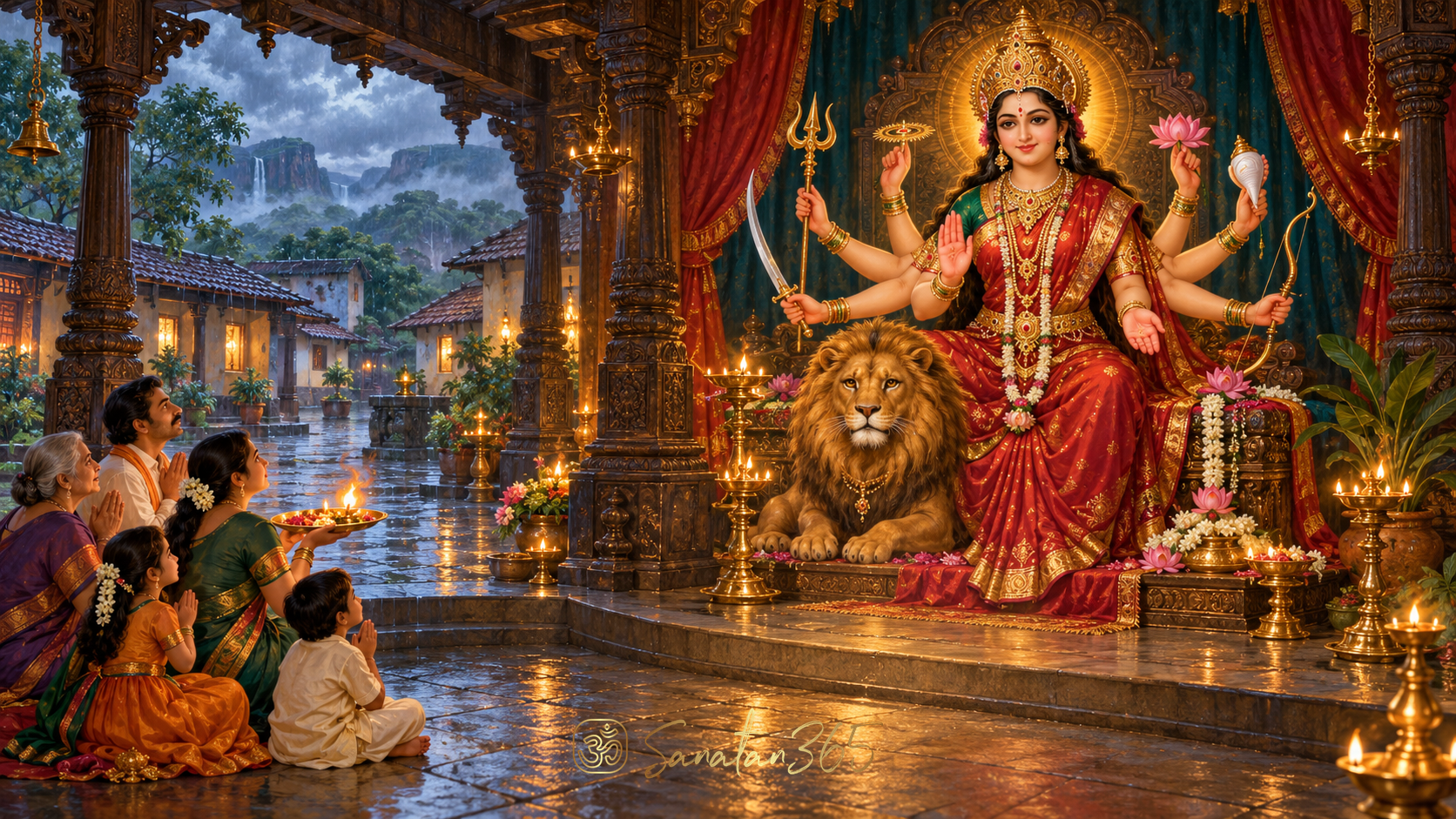
Durge Durghat Bhari Aarti Meaning: A Marathi Prayer for Refuge
Read the Marathi Durga aarti through its appeal for compassion, the limits of description, and its closing image of devotion at the Mother’s feet.
A prayer can begin with defeat and still refuse despair. In the Marathi song Durge Durghat Bhari, the worshipper does not first announce courage or achievement: the opening asks the Mother to extend her compassion.
Durge Durghat Bhari aarti meaning centres on seeking refuge in Goddess Durga amid the difficulty of worldly existence. Aarti (आरती, a devotional song associated with offering light) here moves through three verses: a plea for help, recognition that descriptions cannot contain the Goddess, and loving absorption at her feet. Its returning refrain praises her victory over Mahishasura. This is a prayer of trust, not a guarantee that singing removes every difficulty.
A close reading makes the familiar melody more attentive. The Marathi words do not merely accompany the flame; they give its circling movement a purpose. They ask how vulnerability, praise and hope can belong within the same act of worship.
What is the Durge Durghat Bhari aarti meaning?
The opening addresses Durga (दुर्गा, the Goddess invoked as a powerful protector) as Amba (अंबा, Mother). The relationship is both reverent and intimate. The singer stands before divine strength yet speaks as someone who needs care, rather than someone making a formal claim to a reward.
The hymn is in Marathi, although it uses Sanskrit-derived sacred names and expressions. Treating every line as Sanskrit can obscure its conversational directness. Words such as tujavina, meaning “without you,” belong to the song’s immediate address. The worshipper is speaking to the Mother, not presenting an abstract definition of divine power.
The Marathi text published by Vishwa Marathi Parishad presents three verses with a recurring refrain. Its final line includes the name Narahari. That signature is worth noticing, but the song alone does not establish a detailed biography, date of composition or securely identified historical author. Such claims need evidence beyond a name in a verse.
The complete progression is easy to remember:
- First verse: worldly life feels difficult; the singer asks for compassion and release.
- Refrain: the congregation praises the Goddess through her protective, victorious form.
- Second verse: even learning and argument cannot exhaust her description.
- Third verse: the attention settles on her gracious presence and lotus feet.
Marathi households and recordings may differ in spelling, pronunciation, repeated lines and the precise form of the refrain. Those differences should be checked against the family or community’s trusted text. They need not be turned into a contest over whose devotion is genuine.
For the broader relationship between flame and song, the article on aarti as an offering of light provides useful context. This hymn’s distinctive contribution is its particular movement from difficulty toward refuge.
Key takeaway: The song is a compact devotional progression, not simply repeated praise attached to a familiar tune.
Why does the first verse ask the Mother for refuge?
दुर्गे दुर्घट भारी तुजविण संसारी । अनाथनाथे अंबे करुणा विस्तारी ॥
A plain-language reading is: “O Durga, worldly existence is deeply difficult without you; Mother, protector of those without support, extend your compassion.” This is an explanatory rendering, not a word-for-word replacement for the Marathi song.
Durghat (दुर्घट, difficult or hard to accomplish) should not be reduced to the modern sense of an accident. The verse speaks more widely about the difficulty of existence. Its emotional setting includes ordinary limitations: uncertainty, failure, separation and the discovery that effort does not place every outcome under personal control.
Anathanathe (अनाथनाथे, protector of those without a protector) sharpens the appeal. It praises a form of care that reaches someone who feels unsupported. The next expression, karuna (करुणा, compassion), names what the singer seeks. The opening is therefore not merely a request for power. It asks divine strength to appear as mercy.
The following lines ask for release from birth and death and for the removal of distress. The published English devotional translation renders the closing appeal of this verse as a request for relief when the singer feels defeated. The scale changes from an immediate difficulty to a larger spiritual longing: freedom from recurring limitation itself.
That movement deserves care. A reader may approach the song while facing a practical problem, but its language is not a timetable for a particular result. Nor is admission of helplessness a rejection of responsibility. Asking for help and taking the next responsible step can coexist.
A household reading might pause at one question: what would compassion look like in the matter presently troubling the singer? The answer may include patient speech, accepting support, correcting a mistake or offering care to someone else. These are reflective applications of the verse, not hidden instructions that its Marathi words explicitly prescribe.
The prayer also creates room for honesty. Devotion need not begin with a performance of invulnerability. Saying “this is difficult” can be an act of truthful attention when it is joined to care and action.
Key takeaway: The first verse seeks compassionate refuge without requiring denial of difficulty or abandonment of practical responsibility.
What does the Mahishasuramathani refrain praise?
The refrain begins with the repeated acclamation Jai Devi (जय देवी, victory or praise to the Goddess). It names her Mahishasuramathani (महिषासुरमथनी, the one who subdues Mahishasura). A familiar variant uses Mahishasuramardini (महिषासुरमर्दिनी, the slayer of Mahishasura). Both point toward Durga’s protective victory in devotional memory; households should follow the form in their trusted version.
The contrast with the opening is striking. The individual has spoken of difficulty; the gathering answers with an image of divine strength. Yet the refrain does not replace the compassionate Mother with an unrelated warrior. It brings protection and compassion into the same devotional address.
The published translations connect the remaining expressions with granting blessings, carrying beings across difficulty, and giving or renewing life. Taraka (तारक, a saviour or one who carries across) makes the image of rescue explicit. Sanjivani (संजीवनी, life-giving or reviving) intensifies that praise. Within a hymn these are sacred acclamations, not clinical descriptions or promises of a measurable result.
The repeated refrain also changes the experience of the verses. After an admission of distress, it voices confidence. After the limits of language, it returns to praise. After the final image of devotion, it gives the whole gathering words to sing together. Repetition is doing structural work: it gathers different emotional moments into one shared orientation.
A listener need not turn the Mahishasura image into a label for another person or community. The article’s subject is a devotional hymn, not a warrant to identify human enemies. Reverent attention can remain with the Goddess’s protective presence and the singer’s need for courage, without making the song divisive.
Those familiar with Jai Ambe Gauri and its language of Durga devotion will recognise related reverence. The Marathi hymn nevertheless has its own wording, pace and closing gesture. One should not silently substitute the meaning of another song for the words actually being sung.
Key takeaway: The refrain joins victorious protection with maternal compassion and gives the congregation a recurring shared response.
Why do the four and six fall silent before the Goddess?
The second verse expands the field of vision. It praises the Goddess across the three worlds, then says that the “four” have laboured and the “six” have become entangled in debate. In the published explanations, the four refer to the Vedas, the foundational bodies of Vedic sacred learning; the six are associated with systems of philosophical inquiry.
The numeral language can sound cryptic when the song is learned only by ear. Its poetic point is less obscure: even vast learning does not finish the work of describing the Divine. The verse moves from the reach of sacred knowledge to the limitations of argument, then returns to the Goddess’s responsiveness to a devotee.
There are differences in how explanatory sources enumerate the six. A careful reading need not impose one source’s list as the unquestionable meaning of every performance. The stable point supported by the verse and its explanations is the contrast between exhaustive intellectual effort and the immediacy of devotion.
This is not an instruction to despise knowledge. A song can honour learning while admitting that description has limits. Reading about a flame, naming its colour and understanding its use do not replace standing in its light. That analogy illustrates the devotional contrast; it is not an additional historical claim about the hymn.
Nor does praise of the chosen Goddess require dismissal of other Hindu forms of worship. Devotional poetry often speaks with wholehearted intimacy. Here it gives voice to the singer’s relationship with the Mother. Reading that intimacy as a ranking table of traditions would flatten its purpose and introduce a rivalry the act of worship does not need.
The verse can also teach restraint in explanation. Someone introducing the aarti to children or new listeners need not supply elaborate claims for every word. A modest explanation is stronger: sacred learning is honoured, but the Divine is not exhausted by what a speaker can explain.
Key takeaway: The second verse places a limit on claims to complete description, not on the value of thoughtful study.
How does the final verse turn praise into loving attention?
The third verse begins with the Goddess’s gracious face. Prasanna (प्रसन्न, serene, gracious or pleased) gives this closing movement a different texture from the opening difficulty and the victorious refrain. The singer now attends to a compassionate presence rather than describing the scale of the problem.
The verse asks for release from affliction and from bhavapasha (भवपाश, the bonds of worldly existence). Its language belongs to devotional longing for freedom. The request is larger than wishing for a convenient day, although ordinary hopes are not excluded from the relationship of trust.
The final image names Narahari as absorbed at the Mother’s lotus feet. Pada-pankaja (पदपंकज, lotus feet) is a reverent poetic expression. The published English rendering evokes even the smallest particle associated with those feet. The movement is from attempting to describe greatness to resting attention in a small, cherished point of devotion.
That ending gives the hymn a remarkable proportion. The Goddess is praised across the worlds, yet the song closes with humility and nearness. Grandeur has not disappeared; it has become intimate. The singer need not master a complete account of the Divine before offering attention.
For a family learning the song, a simple sequence can help:
- Read one verse aloud without rushing the melody.
- Explain its central movement in ordinary language.
- Sing the refrain in the household’s familiar version.
- Return to the verse and notice which words now carry meaning.
- Finish with a brief quiet pause rather than an examination of who remembered most.
A Marathi-speaking elder or trusted teacher can help with pronunciation and local usage. A written transliteration is useful, but it cannot capture every sound or replace listening to a careful singer. Outside Maharashtra, including diaspora gatherings, an accessible explanation can welcome listeners without requiring everyone to possess the same language background.
Where light is offered, the gathering should remain attentive to the flame and surrounding space. The meaning of the song does not depend on a large arrangement, expensive offerings or a display of accomplishment. Its own opening makes a different claim on attention: compassion matters more than the appearance of self-sufficiency.
Key takeaway: The final verse brings cosmic praise into intimate, humble attention; the whole hymn moves from difficulty toward compassionate refuge.
FAQ
Is Durge Durghat Bhari a Marathi or Sanskrit aarti?
It is a Marathi aarti with Sanskrit-derived sacred names and expressions. Understanding its Marathi sentences helps preserve the direct appeal to the Mother rather than treating the song only as a sequence of sacred sounds.
What does “Anathanathe Ambe” mean?
It addresses Mother Amba as the protector of those without support or a protector. Joined to the request to extend compassion, it makes care for vulnerability central to the first verse.
Who is Narahari in the last line?
Narahari is the name appearing in the hymn’s devotional signature. The sources used here do not establish a detailed historical identification, so this reading does not assign a biography or composition date on that basis alone.
Does singing this aarti guarantee that a difficulty will disappear?
No guaranteed outcome follows from the song. It expresses prayer, trust and longing for freedom. Devotional practice can accompany responsible action and appropriate help; it should not be treated as a substitute for either.
Must every household sing exactly the same wording?
Published texts and performances contain variants, including in the Mahishasura epithet and repeated lines. Follow a trusted family or community version, seek help with unfamiliar words, and approach other respectful versions without turning variation into a test of devotion.
About the author
Sanatan365 Editorial
Bringing Sanatan Dharma to modern seekers through authentic, scripture-grounded content.
Related in Aarti
 Aarti
Aarti Kunj Bihari Ki Meaning: Seeing Krishna Through Song
Read the names and poetic images of Aarti Kunj Bihari Ki, from Krishna's flute and forest grove to Radha, Ganga and attentive devotional si…
 Aarti
Jai Ganesh Deva Aarti Meaning: Reading the Song With Reverence
Understand the familiar Hindi Ganesh aarti through its refrain, sacred imagery, offerings and language of refuge, without turning devotiona…
 Aarti
Om Jai Saraswati Mata Aarti Meaning: Learning, Speech, and Reverence
Read the familiar Saraswati aarti through its images of light, lotus, music and wisdom, with careful meanings and a grounded approach to de…

