Hanuman Chalisa Meaning: What Each Verse Reveals About Devotion, Strength, and Surrender
The Hanuman Chalisa is far more than a forty-verse hymn — it is a condensed map of bhakti, courage, and self-mastery. Here is what Tulsidas encoded in each section and why millions recite it daily.
Forty verses. Five minutes to recite. Centuries of accumulated faith.
The Hanuman Chalisa meaning extends far beyond a devotional hymn recited out of habit. Composed by Goswami Tulsidas (गोस्वामी तुलसीदास) in the sixteenth century, this chalisa — literally "forty verses" — is one of the most recited sacred texts in the world. Estimates suggest that on any given Tuesday or Saturday, tens of millions of people across India and the global Hindu diaspora chant these verses. Yet most reciters know the words by heart without fully understanding the layered theology, psychology, and spiritual architecture that Tulsidas embedded in each line.
This article breaks open the structure of the Hanuman Chalisa, examines what its key verses actually communicate, and explores why this particular hymn has maintained its hold on devotional life for over four hundred years.
Who Wrote the Hanuman Chalisa and Why?
Goswami Tulsidas (1532–1623 CE) is best known for the Ramcharitmanas (रामचरितमानस, "The Lake of Rama's Deeds"), his retelling of the Ramayana in Awadhi — a language ordinary people could understand, unlike the Sanskrit of Valmiki's original. The Hanuman Chalisa is written in the same Awadhi dialect, making it accessible to farmers, merchants, and wandering sadhus alike.
According to traditional accounts, Tulsidas composed the Chalisa while imprisoned in Mughal-era Delhi. The story holds that he began reciting verses to Hanuman from his cell, and that an army of monkeys descended on the city, causing such disruption that the authorities released him. Whether literal or allegorical, the origin story captures the Chalisa's central claim: that sincere devotion to Hanuman generates real protection and real power.
What makes this hymn structurally distinctive is its economy. In just forty chaupais (चौपाई, four-line stanzas) bookended by two dohas (दोहा, couplets), Tulsidas compresses Hanuman's entire biography, his theological significance, his relationship to Rama, and a practical manual for devotional life. No other hymn in the bhakti tradition achieves this density in so few lines.
Key takeaway: The Hanuman Chalisa was designed as a complete devotional system in miniature — biography, theology, and practice compressed into a text short enough to memorize.
How Is the Hanuman Chalisa Structured?
The Chalisa follows a precise architecture that most reciters absorb instinctively without analyzing:
-
Opening Doha (2 couplets): Invocation. Tulsidas requests Hanuman's grace to purify his mind and grant him strength, knowledge, and the removal of all afflictions (कलेश, klesha).
-
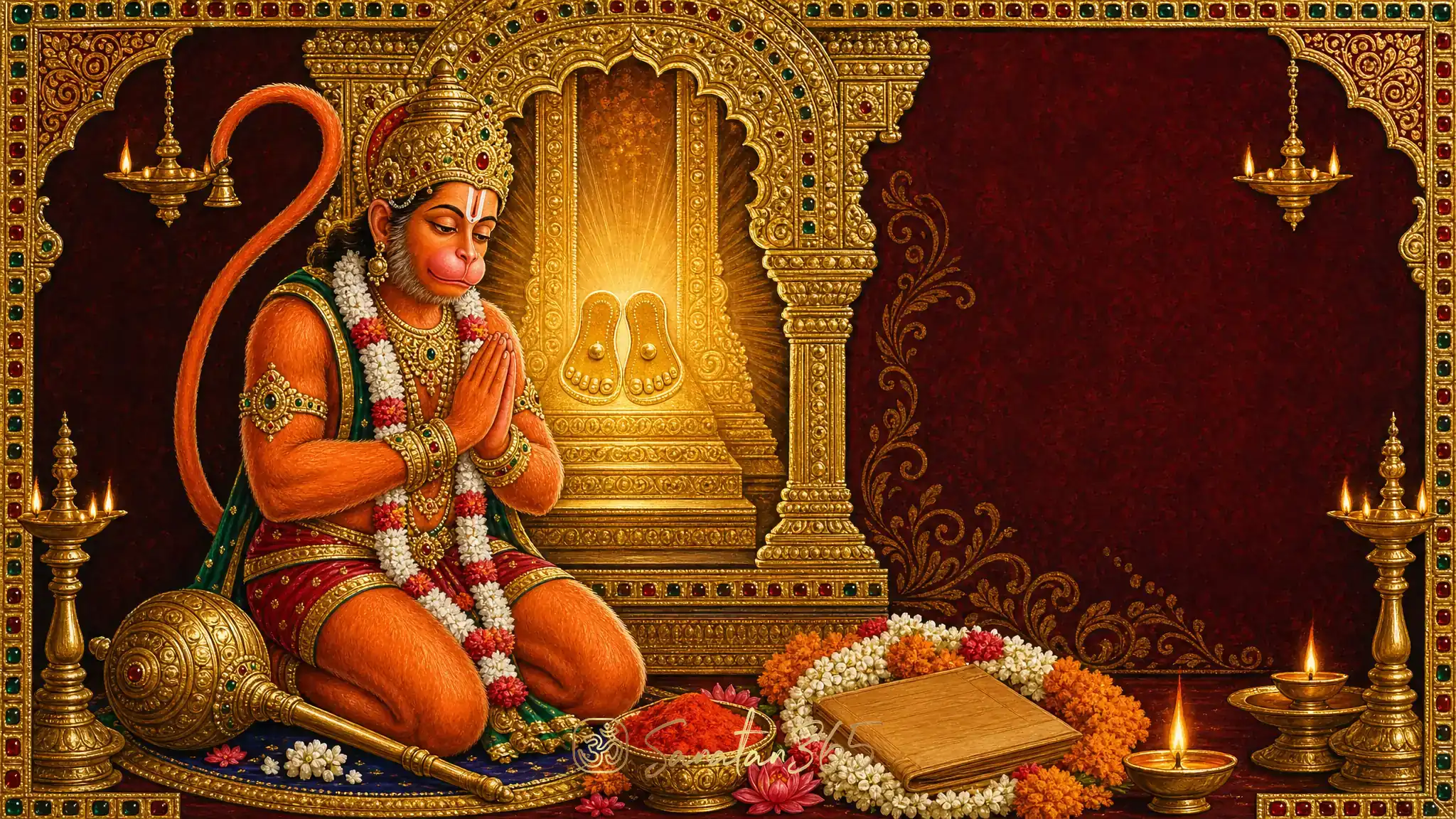
Chaupais 1–5: Hanuman's identity and appearance. Golden body (kanaka varana), earrings, curly hair, wielding the thunderbolt mace (vajra) and flag. These are not decorative details — they establish Hanuman as a being of immense cosmic power who has chosen to appear in a specific form.
-
Chaupais 6–15: Hanuman's deeds in the Ramayana. Burning Lanka, carrying the mountain of healing herbs (Sanjeevani), serving as Rama's ambassador to Sita. Each deed illustrates a specific virtue: courage, selflessness, resourcefulness, and unwavering loyalty.
-
Chaupais 16–25: Hanuman's cosmic status. Son of Vayu (the wind god), worshipped by all three worlds, remover of disease and suffering. This section elevates Hanuman from a character in an epic to a universal spiritual force.
-
Chaupais 26–35: The benefits of devotion. Protection from ghosts and evil spirits, the granting of the eight siddhis (अष्ट सिद्धि, eight supernatural perfections) and nine nidhis (नव निधि, nine divine treasures), and the promise that Hanuman's devotees receive Rama's grace directly.
-
Chaupais 36–40: The closing promise. Whoever recites this Chalisa a hundred times will be freed from bondage and attain supreme bliss. Tulsidas concludes by placing his own devotion at Hanuman's feet.
-
Closing Doha: A final seal affirming that Hanuman resides in the heart of anyone who remembers Rama.
Key takeaway: The Chalisa moves from physical description to epic deeds to cosmic status to practical benefits — a deliberate progression from the concrete to the transcendent.
Hanuman Chalisa Meaning: What Do the Key Verses Reveal?
Rather than a mechanical word-by-word translation, consider the spiritual intent behind the most referenced verses:
"Buddhiheen tanu jaanike, sumirau pavan kumar" (Opening Doha)
Knowing myself to be without wisdom, I remember the Son of the Wind.
This is not false modesty. Tulsidas establishes the foundational posture of bhakti (भक्ति, devotion): the recognition that human intellect alone is insufficient for spiritual transformation. By declaring his own limitation, the devotee creates space for divine grace to enter. Every recitation of the Chalisa begins from this place of receptive humility.
"Jai Hanuman gyan guna sagar" (Chaupai 1)
Victory to Hanuman, ocean of wisdom and virtue.
The first word the devotee speaks after the invocation is "jai" — victory. Not a request, not a plea, but a declaration. Tulsidas frames the entire hymn as an act of celebration rather than supplication. The metaphor of "ocean" (sagar) is deliberate: Hanuman's qualities are not a pond you can measure but a sea without visible boundaries.
"Mahabir bikram Bajarangi" (Chaupai 3)
Great hero of immense strength, whose body is hard as Vajra (thunderbolt).
Bajrang (बजरंग) derives from vajra (वज्र, thunderbolt) + anga (अंग, body). Hanuman's body is composed of the same indestructible substance as Indra's weapon. This is not mere physical praise — it communicates that true devotion makes the devotee spiritually indestructible. The tradition holds that no force in the universe can harm one who has genuinely surrendered to the divine.
"Ram dware tum rakhvare, hot na aagya binu paisare" (Chaupai 21)
You are the guardian of Rama's door; none may enter without your permission.
This verse positions Hanuman as the gatekeeper between the devotee and the ultimate divine (Rama). It implies that bhakti — specifically the selfless, active devotion that Hanuman represents — is the prerequisite for reaching the highest spiritual state. Intellectual knowledge alone cannot open this door. Service and surrender can.
"Ashta siddhi nau nidhi ke daata" (Chaupai 31)
You bestow the eight siddhis and nine nidhis.
The ashta siddhis (अष्ट सिद्धि) in yogic tradition include powers such as anima (becoming infinitely small), mahima (becoming infinitely large), and laghima (becoming weightless). The nava nidhis (नव निधि) are nine forms of divine wealth described in Shaiva and Vaishnava texts. Tulsidas states that Hanuman can grant all of these — but the verse that follows is the key: these powers are given as Sita (Janaki) has given you the blessing. Even cosmic power flows through the chain of devotion, not through personal ambition.
Key takeaway: The most powerful verses in the Chalisa consistently redirect attention from personal gain toward the architecture of devotion itself — humility, service, surrender, and grace flowing through relationship.
Why Has This Hymn Endured for Four Centuries?
Several factors explain the Chalisa's remarkable staying power:
Linguistic accessibility. Unlike Vedic hymns in Sanskrit, the Chalisa's Awadhi is close enough to modern Hindi that most North Indian speakers can follow it without formal training. This was a deliberate choice by Tulsidas, who believed sacred knowledge should not be locked behind linguistic barriers.
Brevity and memorability. At roughly five minutes of recitation time, the Chalisa fits into any daily routine — morning worship, evening aarti, a bus commute, a hospital waiting room. Its rhythmic metre (the chaupai form) makes it naturally memorable, and most devotees learn it by hearing it repeatedly rather than by reading.
Psychological completeness. The Chalisa addresses fear (protection from evil), aspiration (the granting of siddhis), grief (removal of suffering), and meaning (connection to Rama through Hanuman). It functions as a complete emotional and spiritual support system within a single text.
Embodied practice. The Chalisa is not meant to be read silently. It is chanted, often with specific breathing patterns, hand positions, or physical postures. This embodied dimension — voice, breath, body — creates a multisensory devotional experience that purely intellectual study cannot replicate.
Community reinforcement. Tuesday and Saturday recitations at Hanuman temples across India create a social rhythm around the text. The Chalisa is simultaneously a private meditation and a communal event, reinforcing both individual practice and collective identity.
Key takeaway: The Chalisa endures because it works on every level simultaneously — linguistic, psychological, physical, social, and spiritual.
How Should One Recite the Hanuman Chalisa?
Traditional guidance varies by lineage, but several principles appear consistently across sources:
-
Time: Tuesday (Mangalvar, मंगलवार) and Saturday (Shanivar, शनिवार) are considered especially auspicious for Hanuman worship. Early morning (Brahma Muhurta, ब्रह्म मुहूर्त, roughly 4:00–5:30 AM) or evening sandhya (संध्या, twilight) are preferred times.
-
Posture: Sit facing east or north. A clean seat (asana) is recommended. Some traditions prescribe standing for certain portions.
-
Pace: Neither rushed nor artificially slow. The natural rhythm of the chaupai metre guides the pace. If chanting with a group, follow the lead voice.
-
Intention (sankalpa, संकल्प): Before beginning, hold a clear intention. The tradition distinguishes between recitation for a specific purpose (kamya, काम्य) and recitation as a daily devotional practice (nitya, नित्य). Both are valid.
-
Repetition: A single recitation is standard. For specific devotional observances, sets of 7, 11, 21, or 108 repetitions are traditional. The Chalisa itself states that one hundred recitations lead to liberation, though this is understood as a principle of sustained practice rather than a literal transaction.
-
Offering: Sindoor (सिन्दूर, vermilion), jasmine garland, or laddoo prasad are traditional offerings to Hanuman during or after recitation.
Key takeaway: The most important element is regularity and sincerity, not perfection of external form. A daily recitation with genuine attention outweighs an elaborate ritual performed mechanically.
What Makes Hanuman's Devotion Unique in the Hindu Tradition?
Hanuman represents dasya bhakti (दास्य भक्ति, devotion through service) — arguably the most demanding and the most transformative of the nine forms of devotion described in the Bhagavata Purana. While other forms of bhakti involve listening (shravana), singing (kirtana), or friendship (sakhya), dasya bhakti requires the devotee to place the beloved's will entirely above their own.
Hanuman never acts for personal reward. When offered liberation after helping Rama defeat Ravana, he famously declines, choosing instead to remain in the world wherever Rama's name is spoken. This is the deepest teaching embedded in the Chalisa: true strength comes not from acquisition but from surrender, and true freedom comes not from escape but from choosing to serve.
The Sundara Kanda (सुन्दर काण्ड, "The Beautiful Chapter") of the Valmiki Ramayana — the section where Hanuman leaps across the ocean to Lanka — is named "beautiful" not because of its setting but because of the beauty of Hanuman's devotion in action. Tulsidas understood this. The Chalisa is, in essence, the Sundara Kanda distilled into forty verses.
Key takeaway: Hanuman's model of devotion — active, selfless, joyful service without desire for reward — is the spiritual engine that powers the Chalisa.
FAQ
What is the Hanuman Chalisa meaning in simple terms?
The Hanuman Chalisa is a forty-verse devotional hymn composed by Goswami Tulsidas in the sixteenth century. It celebrates Lord Hanuman's qualities, recounts his heroic deeds from the Ramayana, establishes his cosmic significance, and promises spiritual protection and liberation to those who recite it with devotion. The word "chalisa" means "forty" in Hindi, referring to the forty chaupai stanzas that form the hymn's core.
When is the best time to recite the Hanuman Chalisa?
Traditional practice recommends recitation during the early morning (Brahma Muhurta, roughly 4:00–5:30 AM) or evening twilight (sandhya). Tuesdays and Saturdays are considered especially auspicious for Hanuman worship. However, the Chalisa can be recited at any time — consistency and sincerity matter more than specific timing.
How many times should you recite the Hanuman Chalisa?
A single daily recitation is the most common practice. For specific devotional observances or prayers, traditional sets include 7, 11, 21, or 108 repetitions. The Chalisa's own text states that one hundred recitations lead to liberation, understood as a teaching about sustained practice rather than a precise formula.
What are the spiritual benefits of reciting the Hanuman Chalisa?
Devotees and traditional sources describe benefits including protection from negative energies, reduction of fear and anxiety, increased courage and mental clarity, and deepened connection to the divine through Lord Rama's grace. The Chalisa also references the granting of ashta siddhis (eight spiritual perfections) and nava nidhis (nine divine treasures) to sincere devotees.
Why is the Hanuman Chalisa recited on Saturdays?
Saturday (Shanivar) is associated with Shani Dev (the planet Saturn) in Hindu astrology. Tradition holds that Lord Hanuman has the power to mitigate the difficult effects of Shani's influence. The story of Hanuman rescuing Shani from Ravana's captivity in Lanka established a bond between the two — Shani promised never to trouble Hanuman's devotees. Saturday Hanuman worship thus became a widespread practice across India.
About the author
Sanatan365 Editorial
Bringing Sanatan Dharma to modern seekers through authentic, scripture-grounded content.
Related in Mantras
 Mantras
Vakratunda Mahakaya Meaning: A Ganesha Prayer Before Beginning
Read the Sanskrit, word meanings and devotional intent of Vakratunda Mahakaya, with a grounded approach to prayer before everyday work.
 Mantras
Shubham Karoti Kalyanam Meaning: The Evening Lamp Prayer
Read the evening lamp prayer in Sanskrit and transliteration, understand its words, and explore a thoughtful household practice of light an…
 Mantras
Shiva Panchakshara Stotram Meaning: Five Verses, Five Sacred Sounds
Read the five verses of Shiva Panchakshara Stotram through their sacred images, refrain, and careful devotional practice.