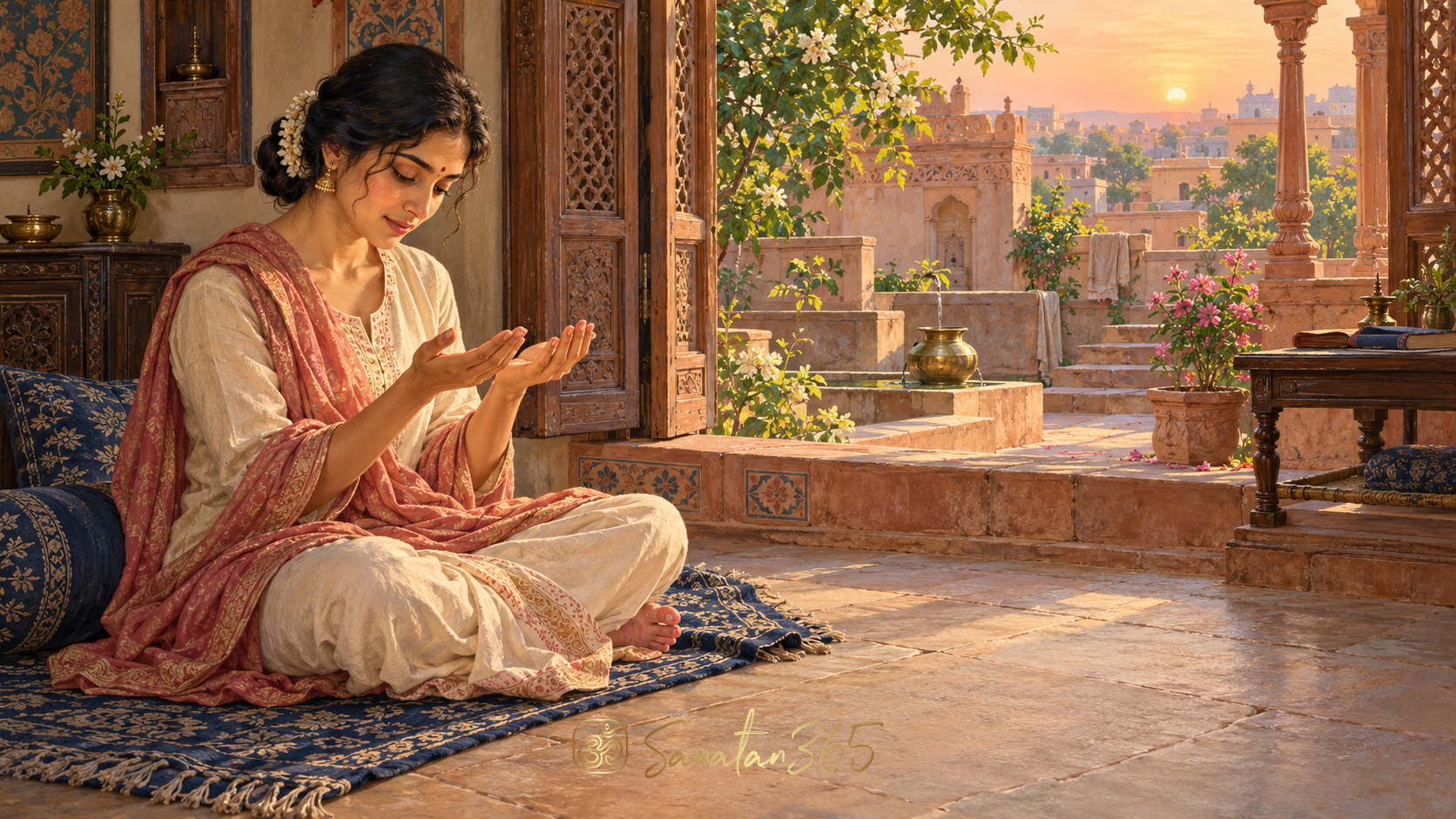
Karagre Vasate Lakshmi Meaning: The Morning Prayer to the Hands
Read the morning hand-viewing prayer through its words, three divine names and gentle invitation to begin the day with reverence and responsibility.
Before the hands reach for a phone, a brief Hindu prayer invites them to become the day's first object of reverent attention.
Karagre Vasate Lakshmi meaning is straightforward: Lakshmi is remembered at the tips of the hands, Saraswati in their middle, and Govinda at their base; therefore, the hands are viewed in the morning. This practice is often called karadarshanam (करदर्शनम्, viewing the hands). The verse joins a small physical gesture with remembrance of the Divine. It is not a method for reading destiny from palm lines, nor a guarantee of money or success.
In Chinmaya Mission Calgary's prayer collection, it appears under “Early Morning Upon Waking Up.” That placement offers a helpful starting point: this is a prayer for entering ordinary life, not escaping it. Its brevity leaves room for a question that can accompany the whole day: how will these hands be used?
What is the Karagre Vasate Lakshmi meaning, line by line?
The Calgary collection prints the prayer in Roman letters as follows, with line breaks added here for readability:
Karaagre vasate Lakshmi Kara madhyetu Saraswati Kara moole tu Govindam Prabhaate kara darshanam
Its English explanation places Lakshmi at the tip of the palm, Saraswati in its middle, and Govinda at its base, followed by looking at the hand in prayer. This article retains the booklet's wording, including “madhyetu” and “Govindam,” rather than silently replacing it with another version. Other circulated versions may differ in wording or grammatical form as well as Roman spelling.
The words become easier to remember when separated into meaningful parts:
- Kara (कर) means hand.
- Agra (अग्र) means tip or foremost part; karāgre locates something at the hand's tip.
- Vasate (वसते) means dwells or abides.
- Madhya (मध्य) means middle; karamadhye means in the middle of the hand.
- Mūla (मूल) means root or base; karamūle means at the hand's base.
- Prabhāta (प्रभात) means morning or dawn; prabhāte means in the morning.
- Darśana (दर्शन) means seeing or beholding, here directed toward the hands.
The final phrase names the gesture. It need not be expanded into a complicated ceremony. An unhurried look, a remembered verse and a moment of attention are enough to understand what the text describes.
Spelling can vary across English-language resources: Karaagre, Karagre, Sarasvati and Saraswati are familiar examples. A learner should distinguish spelling differences from a genuinely different wording. When following a household or teacher's version, it is sensible to learn that version consistently rather than assemble lines from several recordings.
The institution's booklet supports the prayer's use and basic meaning. It does not establish a precise ancient author or a Vedic textual location. Calling this a traditional morning prayer is more careful than giving it an impressive but unverified scriptural address.
Key takeaway: The verse maps three divine names onto the hands and closes with a simple morning act of beholding.
Why are Lakshmi, Saraswati and Govinda remembered together?
The prayer does not begin with an abstract list of personal goals. It names Lakshmi, Saraswati and Govinda, placing daily capacity within a devotional relationship.
Lakshmi is associated with prosperity and auspiciousness. Saraswati is associated with knowledge, learning and the arts. Govinda is a sacred name of Krishna, also used in Vishnu devotion. These associations provide a natural contemplative reading: resources, understanding and divine remembrance belong together rather than competing for attention.
That reading should be kept distinct from translation. The Sanskrit line does not literally say, “Earn honestly, study carefully and serve others.” Those are possible reflections prompted by the prayer, not extra words hidden in it. Preserving this distinction allows a short traditional verse to remain itself while still speaking to a contemporary household.
Consider an ordinary learning task. A student needs a place to work and suitable materials, but also patient understanding and the willingness to use learning well. Remembering only achievement can make study narrow. Remembering only good intentions can leave the task unfinished. The three divine names invite a more integrated beginning, without reducing the deities to motivational symbols.
For an adult preparing to work, Lakshmi's remembrance may invite gratitude for resources already available. Saraswati's may invite care with facts and speech. Govinda's may recall that usefulness and success do not exhaust life's meaning. These are devotional applications, not promises that a particular result will follow.
The hand-viewing gesture also differs from requesting a divine transaction. A devotee is not presenting a receipt that heaven must honour by evening. Reverence can coexist with uncertainty, effort and disappointment. Its depth need not depend on immediate external reward.
Readers interested in how a name carries devotional meaning can also explore the eight-syllable prayer Om Namo Narayanaya. The texts are different, but both reward attention to meaning rather than sound alone.
Key takeaway: The three divine names can orient resources, learning and action toward reverence; they are not three mechanisms for obtaining guaranteed benefits.
What does looking at the hands change about a morning?
The gesture brings attention close to home. No distant object has to be acquired. The hands that will prepare food, open a notebook, type a message or offer assistance are already present.
This makes the prayer unusually concrete. A person can move from its words into one identifiable act: preparing a meal with care, completing a promised task or checking a message before sending it. Such examples are reflective suggestions, not requirements prescribed by the verse.
A gentle way to approach the practice is:
- Pause after waking, in a comfortable and safe position.
- If comfortable, bring the open hands into view without strain.
- Recite the version learned from a reliable teacher or household resource.
- Remember the meaning of its three divine names and closing phrase.
- Choose one modest act of care for the coming day, then begin the morning.
This is an adaptable explanation, not a claim that every Hindu family follows an identical sequence. The Calgary booklet gives the morning setting and the prayer; it does not prescribe this five-step reflection. A household may simply say the verse and continue with its usual routine.
Nor does the practice require staring at palms to discover a sign. Hand-viewing and palm reading ask different questions. The former, in this prayer, is devotional remembrance. Nothing in the quoted verse asks a person to measure lines, predict events or decide that a hand's appearance determines spiritual worth.
The same care applies to accessibility. Someone who cannot comfortably lift or view the hands can remember the verse's meaning without forcing the gesture. A child, elder or person with a limb difference should not be made to feel excluded by an illustration or teaching exercise. Reverence is not a test of bodily conformity.
A rushed morning can still contain a brief, sincere pause. Equally, an urgent responsibility may need attention first. The prayer should not become a source of fear that the whole day has been spoiled because a prescribed-looking moment was missed.
Key takeaway: Looking at the hands offers a tangible reminder of how action begins, without becoming prediction, compulsion or a physical test.
How can families learn the prayer without turning it into a test?
A short verse is easy to memorize and equally easy to repeat without understanding. Family learning works best when sound and meaning remain connected.
An adult might first read the plain-English meaning, then teach one phrase at a time. The learner can identify “tips,” “middle” and “base” before trying a full recitation. Pronunciation can improve gradually through a trusted recording or teacher. Correcting a sound need not involve embarrassment or comparisons with another child.
The educational setting of the Calgary booklet is useful here. Its morning verse sits among prayers for other daily occasions, including meals and study. The larger pattern is remembrance woven into life. The collection is evidence of a named teaching practice, not proof that all Hindu communities use the same daily sequence.
Chinmaya Toronto's prayer resources similarly offer separate daily and children's prayer materials. For diaspora families, resources from established local teaching centres can help maintain a shared vocabulary across languages and generations. A family in Canada, Tamil Nadu, Maharashtra or elsewhere may have its own pronunciation and devotional context; no single English transliteration can represent every home.
Three small teaching choices help preserve warmth:
- Explain before evaluating. Ask what the verse means before asking for a flawless recitation.
- Invite a concrete connection. Discuss one way hands can help, make, learn or care that day.
- Leave space for questions. A child asking why deities are associated with hands is engaging with the prayer, not disrespecting it.
Adults also benefit from this approach. Someone returning to a childhood prayer may remember its rhythm but not its meaning. Beginning again with a trustworthy text is a respectful form of learning, not a failure of memory.
The prayer need not carry a lesson every time it is said. Sometimes familiarity itself gives a household a gentle shared beginning. On other mornings, a single question is enough: what action today deserves greater care?
Key takeaway: Teach the prayer as meaningful remembrance, with patient pronunciation and room for different household customs.
What can this prayer promise, and what can it not?
The text describes divine presence and morning beholding. It does not state an income target, a success rate, a required repetition count or a deadline for receiving a reward.
That matters especially when the opening word Lakshmi is used to market the verse as a shortcut to wealth. Devotion to Lakshmi deserves more care than a guaranteed-results claim. A person can pray sincerely while facing difficult material circumstances; difficulty is not proof of deficient faith. The prayer cannot responsibly be used to judge somebody else's fortune or character.
A useful distinction is between meaning, interpretation and prediction. Meaning concerns what the words say. Interpretation asks how those words illuminate life. Prediction makes a claim about what will happen. This article offers the first two, not the third.
The same distinction protects historical honesty. A familiar verse may be old and widely cherished without its authorship being established by the source at hand. Where a reliable textual reference is absent, withholding a confident attribution is an act of respect for tradition's actual records.
Prayer also does not remove the need to learn a skill, honour a commitment or correct an error. Hands capable of worship are also capable of repair. If a careless message is sent, the next useful action may be an apology. If a task is neglected, it may be completing it. Remembering the Divine should not become an explanation for avoiding these ordinary responsibilities.
The related Tvameva Mata prayer of divine kinship offers another intimate vocabulary of relationship. Neither text needs to be converted into a bargain to be meaningful.
The morning hand prayer can remain small: a few words, a moment of seeing, and a willingness to begin. Its value need not be inflated into a claim that every outcome is under personal control.
Key takeaway: Begin with reverence and act with care; neither devotion nor the hand-viewing gesture guarantees a particular worldly result.
FAQ
What is the simple meaning of Karagre Vasate Lakshmi?
It remembers Lakshmi at the tips of the hands, Saraswati in the middle and Govinda at the base, followed by viewing the hands in the morning. The prayer combines divine remembrance with a small, concrete gesture.
When is the Karadarshanam morning prayer said?
The Chinmaya Mission Calgary collection places it under “Early Morning Upon Waking Up.” Household routines can differ. The source supports that waking-time setting, not a universally mandatory clock time.
Does this prayer belong to a specific Veda?
The cited institutional collection does not identify a Vedic source or original author. It is careful to describe it as a traditional morning prayer unless a reliable textual reference is independently established.
Does looking at the hands mean reading palm lines?
No. The verse names divine presence and morning beholding; it does not discuss palm lines, fortune-telling or predictions. Those should not be added to its translation.
Can someone learn the prayer through an English transliteration?
Yes, a transliteration can support initial learning, especially when paired with the meaning and a trusted teacher's pronunciation. Different spellings are common; learning one reliable version steadily is more useful than treating spelling variation as a contest.
About the author
Sanatan365 Editorial
Bringing Sanatan Dharma to modern seekers through authentic, scripture-grounded content.
Related in Mantras
 Mantras
Tvameva Mata Meaning: A Prayer of Divine Kinship
Read Tvameva Mata line by line: a Sanskrit prayer that addresses the Divine as parent, friend, knowledge, wealth, and the ground of belongi…
 Mantras
Vakratunda Mahakaya Meaning: A Ganesha Prayer Before Beginning
Read the Sanskrit, word meanings and devotional intent of Vakratunda Mahakaya, with a grounded approach to prayer before everyday work.
 Mantras
Shubham Karoti Kalyanam Meaning: The Evening Lamp Prayer
Read the evening lamp prayer in Sanskrit and transliteration, understand its words, and explore a thoughtful household practice of light an…

