Maitreyi–Yajnavalkya Dialogue: Wealth, Love, and Self-Knowledge
The Brihadaranyaka Upanishad's dialogue between Maitreyi and Yajnavalkya asks whether wealth can grant immortality and why anything becomes dear to us.
A single question turns an inheritance conversation into one of the Upanishads’ clearest examinations of human longing: “If this whole earth filled with wealth were mine, would I become immortal through it?”
The Maitreyi Yajnavalkya dialogue in the Brihadaranyaka Upanishad answers directly: wealth can support life, generosity, study, and household responsibility, but it cannot by itself give amritatva (अमृतत्व, immortality or freedom from death-bound identity). Maitreyi therefore asks for the knowledge that leads beyond possession. Her question opens a teaching about Atman (आत्मन्, the innermost Self), love, and the disciplined search for what does not perish.
This is not a rejection of family life or material responsibility. It is a precise inquiry into limits: what can wealth do, what can it never do, and what do human beings actually seek through everything they call dear?
Key takeaway: Maitreyi’s wisdom begins by asking whether a useful thing is being mistaken for an ultimate thing.
What Is the Maitreyi Yajnavalkya Dialogue?
The Maitreyi Yajnavalkya dialogue appears in two closely related passages of the Brihadaranyaka Upanishad, at 2.4 and 4.5. The text belongs to the Shukla Yajurveda and is among the principal Upanishads, scriptures devoted to searching questions about reality, consciousness, bondage, and liberation.
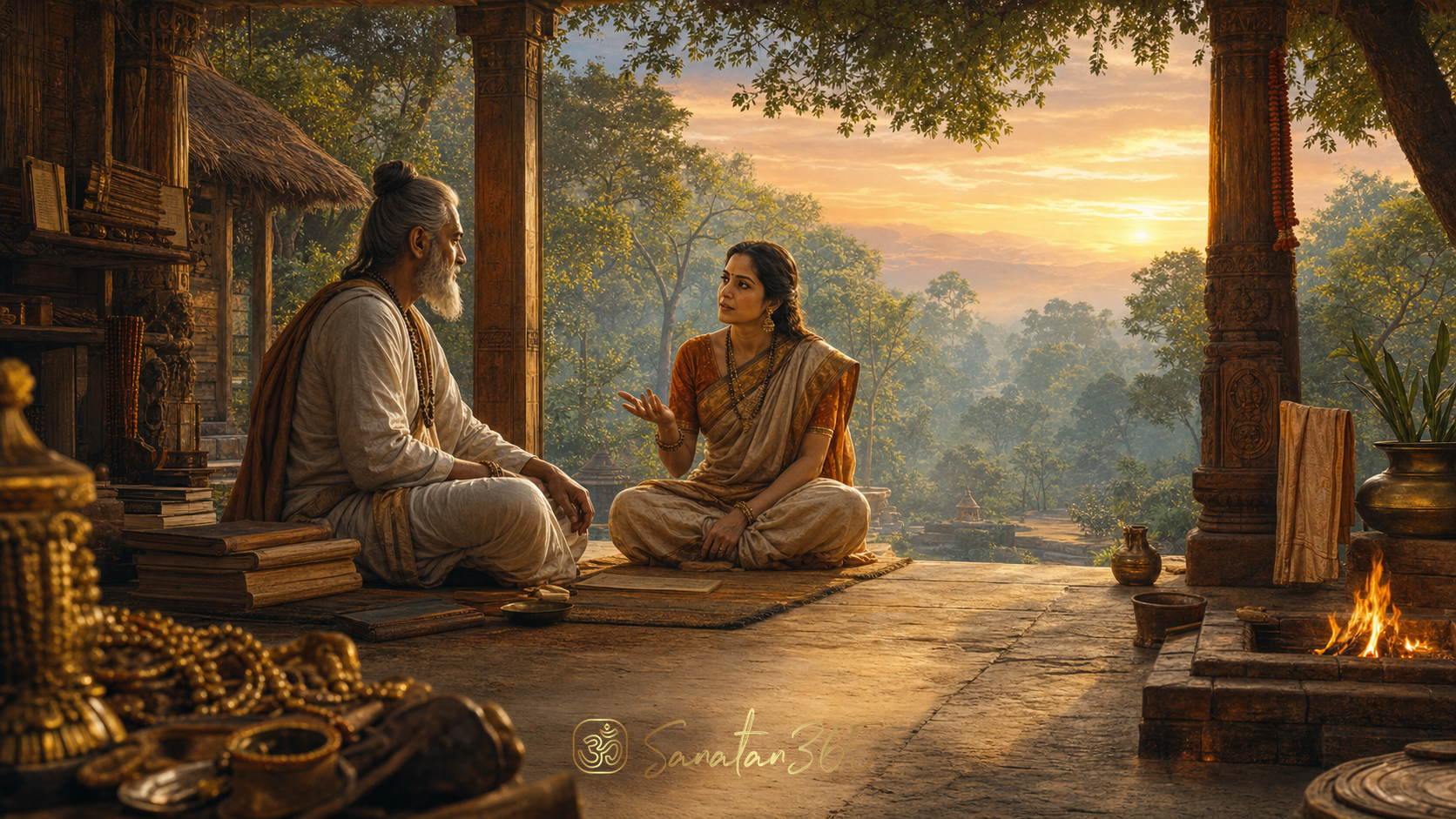
Yajnavalkya tells his two wives, Maitreyi and Katyayani, that he intends to leave household life and asks to divide his property between them. Katyayani’s response is not developed in the passage. Maitreyi, described in the tradition as a brahmavadini (ब्रह्मवादिनी, a woman devoted to inquiry into Brahman), asks the question that changes the direction of the scene.
“If, Sir, this whole earth filled with wealth were mine, would I be immortal through that?”
Yajnavalkya answers that her life would be like the life of the wealthy, but there is no hope of immortality through wealth. Maitreyi immediately replies, in essence: what should she do with that which cannot make her immortal? She asks him to teach what he knows.
The exchange matters because Maitreyi is not merely receiving a sermon. She tests the value of the proposed inheritance, identifies its boundary, and redirects the conversation. Her question is philosophical discrimination in action. In Vedanta, viveka (विवेक, discernment between the lasting and the passing) often begins exactly this way: not by despising the world, but by seeing every object clearly.
Readers can compare the two textual settings in translations of Brihadaranyaka Upanishad 2.4 and the teaching resources of the Vedanta Society of New York, which presents a detailed lecture series on the dialogue.
Key takeaway: The dialogue begins as a division of property but becomes an inquiry because Maitreyi asks what wealth can ultimately accomplish.
Why Does Maitreyi Ask Whether Wealth Can Bring Immortality?
Maitreyi’s question is sharper than the claim that “money cannot buy happiness.” Money can relieve hardship, protect a household, educate children, enable charity, and create the time needed for study. Hindu traditions do not require pretending that material conditions are irrelevant. Artha (अर्थ, material well-being and the means that sustain life) is one of the purusharthas (पुरुषार्थ, worthy aims of human life).
Yet artha is not moksha (मोक्ष, liberation). Wealth operates within change: it can be acquired, shared, lost, inherited, or exhausted. It can serve dharma (धर्म, right order and responsibility), but it cannot turn the changing personality into the deathless Self. Maitreyi does not confuse support with salvation.
This distinction protects against two opposite errors:
- Material absolutism: expecting possessions, status, or security to remove existential fear.
- Careless renunciation: using spiritual language to neglect dependants, debt, work, or honest responsibilities.
The Upanishadic question is not “Should no one own anything?” It is “Can what is owned resolve the deepest problem of the owner?” Maitreyi sees that an unlimited quantity of a limited means remains limited in kind.
That insight can shape modern decisions. A promotion may deserve sincere effort, yet it cannot define the Self. Savings may create prudent security, yet they cannot guarantee that life will obey every plan. A beautiful home can nourish family life, yet it cannot permanently protect anyone from change. Seeing these limits does not make such things worthless. It allows them to become instruments rather than identities.
The same clarity appears in the Hindu teaching on aparigraha, or non-possessiveness: the discipline is not neglect but freedom from being inwardly possessed by possessions.
Key takeaway: Wealth belongs within a responsible life, but Maitreyi refuses to ask a finite instrument for an infinite result.
What Does the Dialogue Teach About Love and the Self?
Yajnavalkya’s next teaching is famous and easily misunderstood. He says that a husband is not dear merely for the husband’s sake, nor a wife merely for the wife’s sake; each is dear for the sake of the Self. He extends the pattern to children, wealth, animals, spiritual status, worlds, gods, beings, and all things.
Read superficially, this can sound selfish, as though affection were only disguised personal gain. The wider passage points elsewhere. The ordinary ego is not the ultimate Atman. The teaching moves from divided attachment toward the ground of awareness through which anything is known, loved, or valued.
Human love usually begins with distinction: “I” love “you.” That distinction is real at the level of relationship and must never be used to erase consent, duty, or another person’s individuality. The Upanishad asks a deeper question beneath it: what makes dearness possible at all? Why does separation hurt? Why does love seek a wholeness that no changing role can permanently secure?
Yajnavalkya’s answer is that the deepest attraction is toward fullness, and that fullness is not finally outside the Self. When Atman is recognized not as a private ego but as the basis of consciousness, the beloved is no longer reduced to an object that must complete “me.” Love can become less possessive because its ground is deeper than possession.
This does not cancel ordinary forms of love. It purifies them:
- A spouse is not property.
- A child is not an extension of parental ambition.
- A teacher is not a substitute for one’s conscience.
- A community is not valuable only when it confirms one’s identity.
- The Divine is not a transaction for obtaining every desired result.
The teaching asks love to mature from grasping into recognition. One may care for the beloved more faithfully when one stops demanding that a changing human being provide unchanging completeness.
Key takeaway: “Dear for the sake of the Self” does not glorify egoism; it examines the longing for wholeness beneath attachment and invites love without possession.
How Is Atman Known in the Brihadaranyaka Upanishad?
Yajnavalkya gives Maitreyi a compact discipline: Atman is to be seen, heard, reflected upon, and meditated upon. Later Vedanta teaching often expresses this as shravana (श्रवण, attentive hearing of the teaching), manana (मनन, reasoned reflection), and nididhyasana (निदिध्यासन, sustained contemplation or assimilation).
These are not three decorative Sanskrit terms. They correct three recurring weaknesses in spiritual learning.
1. Shravana corrects uninformed speculation
Attentive hearing means approaching a trustworthy teaching in context. A seeker does not build the meaning of Atman from social-media fragments or whichever claim feels comforting. The text, teacher, commentarial tradition, and questions of fellow students all matter.
2. Manana corrects unexamined belief
Maitreyi herself models reflection. She does not accept wealth simply because it is offered, and she does not accept the teaching without questions. Manana includes testing apparent contradictions. If the Self is one, why does experience appear divided? If consciousness is not an object, how is it known? If relationships are dear for the Self, why does grief feel personal and specific?
Reason is not an enemy of reverence. In the Upanishadic classroom, sincere questioning can be an expression of reverence because truth is valued above easy agreement.
3. Nididhyasana corrects merely verbal knowledge
A person may repeat “I am Atman” while remaining ruled by fear, envy, or compulsive comparison. Sustained contemplation brings the teaching into lived perception. The practitioner notices every attempt to build an unchanging identity from changing possessions, praise, roles, and moods.
A simple modern reflection can follow the text without pretending to replace traditional study:
- Name one thing currently treated as indispensable to self-worth.
- Ask what that thing genuinely provides.
- Ask what it cannot guarantee.
- Notice the awareness in which hope, fear, and evaluation appear.
- Return to duty with less exaggeration and greater steadiness.
This resembles the discipline of sakshi bhava, witness consciousness, though each teaching should be studied in its own textual setting.
Key takeaway: Upanishadic Self-knowledge is cultivated through grounded teaching, rigorous reflection, and sustained assimilation, not through slogans.
Why Does Yajnavalkya Use the Examples of Sound, Salt, and the Ocean?
The dialogue uses concrete analogies to approach what cannot be handled as an ordinary object. When a drum, conch, or lute sounds, particular notes cannot be seized apart from the instrument and its sounding. Elsewhere in the teaching, a lump of salt dissolved in water cannot be picked out again, although its taste pervades the water.
These images show why Atman cannot be known like a chair, a planet, or a number. Every object appears to awareness. Awareness itself is not another object standing beside them. The knower cannot be fully placed in front of itself as something separate, because every act of knowing already depends on it.
The salt image also prepares the difficult teaching that, when separateness is transcended, ordinary subject-object knowing no longer applies in the same way. Yajnavalkya asks: when everything has become the Self, by what should one see what, smell what, hear what, speak to what, think what, or know what?
This does not mean an enlightened person becomes unable to recognize practical distinctions. Fire still burns; promises still matter; another person’s boundaries still deserve respect. The Upanishad is addressing ultimate knowledge, not abolishing ethical and empirical life.
Nor should the salt analogy be turned into a crude claim that individual lives are meaningless. A wave is not denied because the ocean exists. Rather, its reality is understood more completely. Its form is temporary; its substance was never separate from the water.
The meaning of Neti Neti in the Upanishads offers a complementary approach. “Not this, not this” removes every limited identification; the Maitreyi dialogue reveals the Self as the basis through which all dearness and knowing become possible.
Key takeaway: The analogies move attention from objects known to the ever-present ground of knowing, while preserving practical responsibility.
What Can Modern Householders Learn from Maitreyi?
Maitreyi’s example is especially valuable because the teaching begins inside a household, not in a cave detached from ordinary decisions. The tension between property and immortality appears at the moment of inheritance. Spiritual inquiry enters money, marriage, future planning, and identity.
Modern householders can draw five disciplined lessons.
- Ask what each pursuit can actually give. A career can offer service, mastery, and income. It cannot guarantee permanent worth.
- Keep means and ends distinct. Wealth can support study and generosity; it should not become the measure of the soul.
- Make room for serious questions. Maitreyi’s question changes the conversation because Yajnavalkya takes it seriously.
- Let love breathe. Relationships deepen when people are not forced to carry the impossible burden of completing one another.
- Practice before crisis. Reflection on change and mortality is not pessimism. It prepares a person to live more truthfully now.
The dialogue also cautions against romanticizing renunciation. Yajnavalkya’s departure belongs to the narrative and spiritual world of the text. A reader should not imitate an outward act while ignoring its ethical setting. Renunciation without responsibility can become avoidance. The inner movement available to everyone is the renunciation of false ultimacy: refusing to call wealth, reputation, or control the final source of freedom.
For diaspora families, this may mean holding cultural achievement and spiritual depth together. Education, stability, and success can honour sacrifice across generations. Maitreyi’s question ensures that these achievements remain connected to wisdom rather than becoming the only language of value.
Key takeaway: Maitreyi teaches householders to participate fully in life while refusing to mistake any changing role or possession for the deathless Self.
Conclusion
The Maitreyi Yajnavalkya dialogue endures because its opening question still reaches the centre of modern life. Human beings continually ask finite things to provide permanent safety: money, relationships, recognition, knowledge, even spiritual identity. The Upanishad does not mock these goods. It places them accurately.
Maitreyi’s courage is the courage to prefer truth over consolation. She recognizes that more possession cannot solve the problem of mortality, then asks for the knowledge by which the Self is heard, reflected upon, and realized. Yajnavalkya’s answer turns love itself into a doorway: beneath every experience of dearness lies the search for undivided fullness.
Key takeaway: Use every finite good responsibly, love without possession, and seek the Self that no change can add to or take away.
FAQ
Who was Maitreyi in the Brihadaranyaka Upanishad?
Maitreyi appears as Yajnavalkya’s wife and a serious philosophical inquirer. The tradition describes her as a brahmavadini, a woman devoted to inquiry into Brahman. Her questions drive one of the Upanishad’s most important dialogues on wealth, immortality, love, and Atman.
What did Yajnavalkya tell Maitreyi about wealth?
He told her that wealth could provide the life available to a wealthy person, but it could not give immortality. The statement identifies a limit rather than declaring wealth useless: material means can support life, but they cannot produce liberation.
What does “the husband is dear for the sake of the Self” mean?
It points beyond possessive ego toward the deeper ground of dearness and consciousness. The teaching does not erase relationships or justify selfishness. It asks why love seeks wholeness and how love changes when the beloved is not treated as property or as a tool for completing the ego.
How does the dialogue say the Self should be known?
The Self is to be heard about, reflected upon, and deeply contemplated. Vedanta commonly calls these disciplines shravana, manana, and nididhyasana. Together they join reliable teaching, reasoned inquiry, and lived assimilation.
Does the Maitreyi dialogue reject household life?
No. Its central question arises within household life and concerns the proper place of wealth. The enduring lesson is to fulfil responsibilities while understanding that possessions, roles, and relationships cannot by themselves grant liberation or permanent identity.
About the author
Sanatan365 Editorial
Bringing Sanatan Dharma to modern seekers through authentic, scripture-grounded content.