Meenakshi Amman Temple Meaning: Madurai, Divine Marriage, and Sacred Beauty
A reverent guide to Meenakshi Amman Temple in Madurai, its goddess-centered worship, Shiva-Sundareswarar union, gopurams, sacred tank, and living ritual rhythm.
Meenakshi Amman Temple is not only a monument in Madurai; it is a living map of divine beauty, sacred marriage, and Tamil devotion.
The Meenakshi Amman Temple meaning begins with Meenakshi (मीनाक्षी, Minakshi, "fish-eyed one"), a form of Goddess Parvati, and Sundareswarar (सुन्दरेश्वर, Sundaresvara, "the beautiful Lord"), a form of Lord Shiva. The temple teaches that beauty is not decoration alone. Beauty becomes sacred when it joins strength, wisdom, fertility, protection, and daily worship in one living center of dharma.
Why does Meenakshi Amman Temple matter in Hindu worship?
Meenakshi Amman Temple matters because it places the Goddess at the visible heart of a great South Indian temple city. Many Hindu temples are organized around a male deity with the Goddess as consort. Madurai reverses the usual expectation in devotional feeling: Meenakshi Amman is the queenly presence through whom the city is remembered, loved, and approached.
The temple is also known as the Meenakshi-Sundareswarar Temple, because its worship honors the divine union of Meenakshi and Shiva as Sundareswarar. Encyclopaedia Britannica describes the complex as dedicated to this union and notes that, in its present form, it was largely built in the 16th and 17th centuries, though the sacred association is traditionally older. Britannica
This matters spiritually because the temple does not present Shiva and Shakti as separate powers competing for attention. Shakti (शक्ति, shakti, "divine energy") gives form, movement, nourishment, and protection. Shiva gives stillness, consciousness, and auspicious presence. Their marriage is not merely a mythic event; it is a way of seeing the universe as relationship.
For a devotee, this means the temple can be approached through many inner doors:
- As a Shakti shrine, where the Mother is powerful, royal, and protective.
- As a Shaiva temple, where Shiva appears as Sundareswarar.
- As a marriage shrine, where divine partnership becomes a model of harmony.
- As a city temple, where worship, trade, festivals, art, and civic memory meet.
Key takeaway: Meenakshi Amman Temple matters because it makes divine beauty, feminine sovereignty, and Shiva-Shakti harmony visible in daily worship.
What is the story behind Meenakshi and Sundareswarar?
The central story says that Meenakshi was born as a princess of Madurai and later recognized as a manifestation of Parvati. Shiva came to Madurai as Sundareswarar to marry her. Their wedding became the sacred center around which the temple's ritual imagination turns.
This story is not only romantic. It carries a theological meaning. Meenakshi is not shown as passive. She is royal, capable, and sovereign. She belongs to Madurai before Sundareswarar arrives. The marriage does not erase her identity; it reveals its cosmic dimension.
That is why the temple feels different from a simple "Shiva temple." Sundareswarar is deeply honored, but the city remembers the Goddess as its presiding queen. The name Meenakshi itself is often translated as "fish-eyed," a poetic Tamil-Sanskrit image for eyes that are long, graceful, and protective. In classical Indian aesthetics, the fish also suggests alertness; a fish is imagined as never closing its eyes. In devotional reading, the Mother's gaze is watchful.
The annual Chithirai festival, traditionally celebrated in the Tamil month of Chithirai around April-May, ritually remembers the divine wedding. Britannica notes that the goddess's wedding festival is celebrated for twelve days in Chaitra, and that temple life also includes weekly and annual ritual movement of the divine images. Britannica
The story carries three practical teachings:
- Sacred power can be tender and strong at the same time.
- Marriage, in Hindu symbolism, can represent cosmic balance, not only social duty.
- A city becomes sacred when divine memory is renewed through festival, music, procession, and darshan.
Darshan (दर्शन, darshana, "sacred seeing") is central here. In a temple, devotees do not only look at the deity; they receive the deity's seeing. At Madurai, this exchange is colored by the Mother's royal gaze and Sundareswarar's auspicious presence.
Key takeaway: The Meenakshi-Sundareswarar story teaches that divine union is a harmony of power and grace, not a loss of individuality.
How does the temple architecture express Meenakshi Amman Temple meaning?
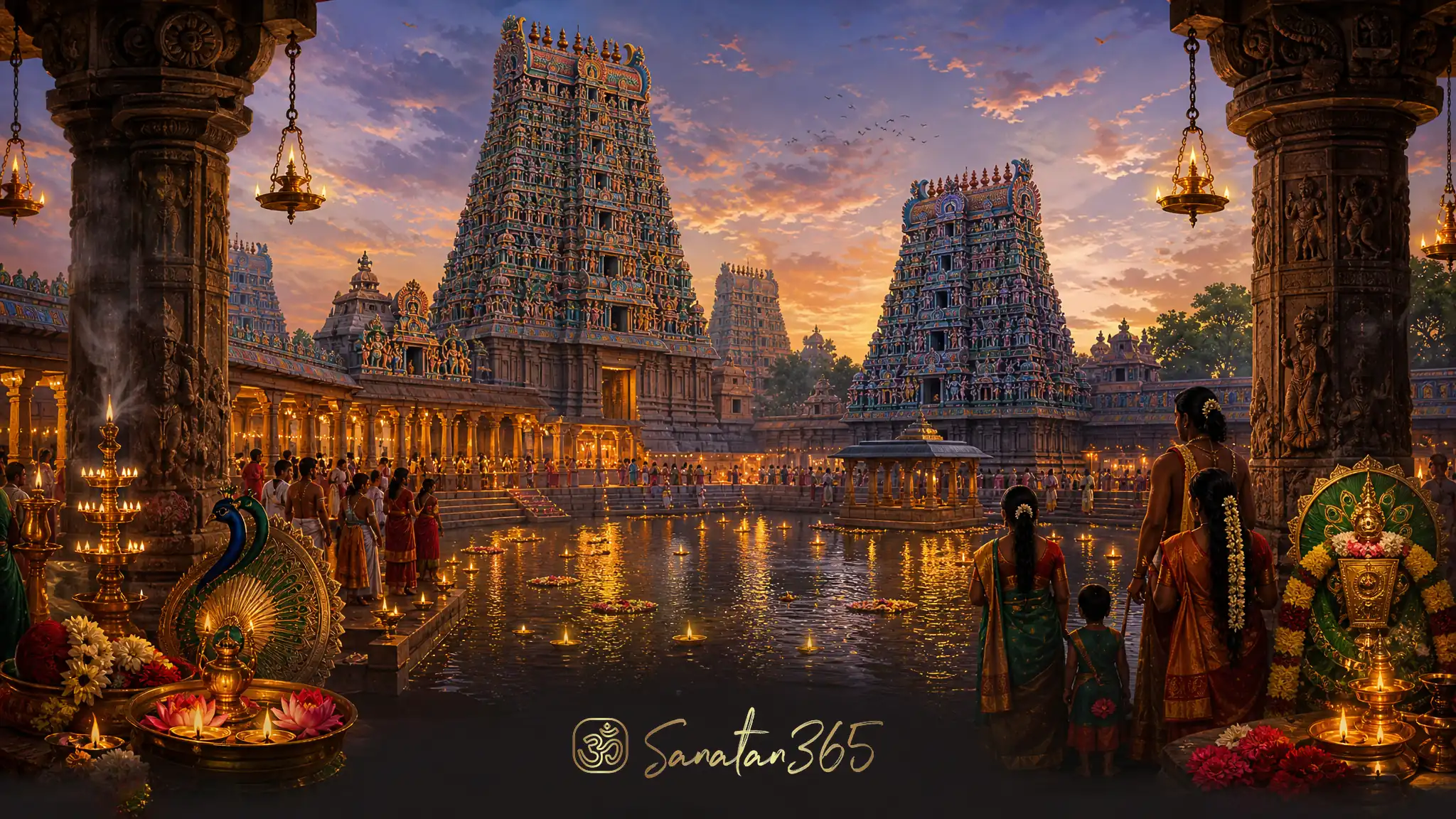
The architecture explains the theology through space. A visitor first sees the gopurams (गोपुरम्, gopuram, "gateway towers"), which rise over Madurai like sculpted mountains of sacred memory. These towers are not plain entrances. They are crowded with divine forms, guardians, celestial beings, animals, and mythic scenes.
Britannica records that the temple has 14 gopuras, with the southern tower rising more than 170 feet, and that the towers are covered with brightly painted figures. Britannica The visual effect is important. Hindu temple architecture often teaches through abundance. The divine is not presented as blank emptiness alone; it is also the overflowing fullness of life.
Inside the complex, mandapas (मण्डप, mandapa, "pillared halls") create a rhythm between movement and pause. The famous Thousand-Pillar Hall, or Aiyaram Kal Mandapa, is described by Britannica as having 985 columns carved with sacred and artistic figures. Britannica The number may be popularly remembered as a thousand, but the devotional point is clear: repeated pillars create disciplined beauty, and disciplined beauty trains attention.
The Pottamarai Kulam, often called the Golden Lotus Pond, adds another layer. Water in Hindu temple life is purification, reflection, and threshold. Before the devotee reaches the deepest shrines, the temple invites an inner softening. The pond says: do not rush from street-noise to sanctum. Let the mind become clear enough to see.
The two main shrines, Meenakshi and Sundareswarar, stand as related centers rather than decorative additions to each other. Their placement embodies the temple's central teaching: Shiva and Shakti are distinct enough to be loved personally, yet united enough to be understood cosmically.
For modern readers, this architecture offers a practical insight. Sacred space is not accidental. Doorways, towers, halls, tanks, lamps, and processions can shape the mind before a single word of philosophy is spoken.
Key takeaway: The temple's gopurams, halls, tank, and twin shrines turn theology into an embodied experience of beauty, order, and sacred relationship.
What should first-time visitors understand about Madurai Meenakshi Amman Temple?
A first-time visitor should understand that Madurai Meenakshi Amman Temple is a living temple before it is a tourist site. Its art is famous, but its heart is worship.
Madurai's old city is centered around the temple, and Britannica notes that the compact historic part of Madurai grew around Meenakshi Amman Temple. Britannica This means the temple is not isolated from daily life. Shops, streets, festivals, pilgrims, local families, and priests form one sacred ecosystem.
Respect begins with simple habits:
- Dress modestly and follow temple instructions.
- Move slowly near shrines and queues.
- Avoid treating deity images, priests, or devotees as photo objects.
- Notice when a space is for worship rather than sightseeing.
- Learn the names Meenakshi and Sundareswarar before entering.
The Tamil Nadu tourism ecosystem presents the temple as one of Madurai's central spiritual and heritage sites. Tamil Nadu Tourism But for a devotee, "heritage" is not the full word. Heritage can be admired from a distance. A living temple asks for humility.
The temple is also a reminder that Hindu practice is regional as well as pan-Indian. The same Shiva and Parvati known across India are encountered here in a distinctly Tamil form, through Madurai's language, festivals, music, architecture, and sacred geography. This is one of Sanatan Dharma's great strengths: unity does not require sameness.
Key takeaway: A respectful visitor sees Meenakshi Amman Temple as living worship first, architectural heritage second.
How is the temple connected to festivals and daily rhythm?
Meenakshi Amman Temple breathes through ritual time. Daily puja (पूजा, puja, "worship offering"), weekly observances, processions, and annual festivals keep the temple alive across the year.
The divine wedding festival is the most famous symbolic center, but the temple's meaning is not limited to one annual event. Britannica notes weekly rituals in which golden figures of Meenakshi and Sundareswarar are seated on a swing while hymns are sung, and an annual Teppa festival in which images are placed on floats at the temple tank. Britannica
These rituals show a key Hindu insight: sacred presence is not static. The deity may be awakened, dressed, praised, carried, rested, and celebrated. This does not mean the divine depends on human action. It means human beings learn devotion through loving attention.
In many temples, the day itself becomes a discipline:
- Morning opens the senses toward darshan.
- Offerings bring food, flowers, light, water, and fragrance into worship.
- Processions allow divine presence to move outward.
- Evening rituals gather the mind again before rest.
At Madurai, this rhythm is inseparable from the city. The temple calendar teaches that spiritual life is not only private meditation. It is also shared time: people gathering, singing, waiting, watching, and remembering together.
For diaspora Hindus or modern seekers who cannot visit often, the lesson still applies. One can create small rhythms at home: a lamp at a steady hour, a brief prayer to Meenakshi and Sundareswarar, a moment of silence before meals, or a weekly reading about a sacred place. The temple's scale is grand, but its discipline can become intimate.
Key takeaway: The temple's festivals and daily rituals teach that devotion becomes strong when sacred memory is repeated with love.
What spiritual lesson does Meenakshi Amman Temple offer today?
The most relevant lesson of Meenakshi Amman Temple today is that beauty can discipline the soul.
Modern life often treats beauty as entertainment, decoration, or status. The temple offers another view. Beauty can gather scattered attention. Color can become theology. Music can become prayer. Architecture can become a slow teacher. A Goddess's gaze can become a reminder that strength and compassion belong together.
The temple also offers a corrective to shallow readings of Hindu tradition. It shows a tradition where the Divine Feminine is central, not secondary. Meenakshi is queen, protector, bride, goddess, and city-heart. Sundareswarar's presence completes the union without diminishing her sovereignty.
This is why the temple is especially meaningful for families. Children may first notice the towers and colors. Adults may notice history and architecture. Devotees may notice the subtle pull of darshan. All of these are valid beginnings. A great temple welcomes the senses first, then slowly teaches the heart.
For readers using Sanatan365 as part of daily practice, this article can pair naturally with quiet darshan, mantra chanting, or a family discussion about sacred architecture. But the main invitation is older than any app: learn to see beauty as a path back to reverence.
The temple does not ask every visitor to become a historian. It asks for a softer and harder thing: enter with attention. Leave with more humility than you brought.
Key takeaway: Meenakshi Amman Temple teaches that sacred beauty is not escape from life; it is a way to reorder life around reverence.
FAQ
What is the Meenakshi Amman Temple meaning in simple words?
Meenakshi Amman Temple meaning centers on the worship of Goddess Meenakshi, a form of Parvati, and Lord Sundareswarar, a form of Shiva. It represents divine beauty, feminine sovereignty, sacred marriage, and the harmony of Shiva and Shakti in Madurai's living temple culture.
Where is Meenakshi Amman Temple located?
Meenakshi Amman Temple is located in Madurai, Tamil Nadu, in South India. The historic city of Madurai is closely centered around the temple, making it both a major pilgrimage site and a cultural landmark.
Who are Meenakshi and Sundareswarar?
Meenakshi is a goddess form of Parvati and the queenly presiding deity of Madurai. Sundareswarar is Shiva as "the beautiful Lord." Their divine wedding is one of the temple's central sacred stories.
Why are the gopurams of Meenakshi Temple famous?
The gopurams are famous because they are tall, brightly painted gateway towers covered with sculpted sacred figures. They turn the entrance into a visual teaching about divine abundance, protection, and the many forms through which Hindu devotion remembers the sacred.
Is Meenakshi Amman Temple only a historical monument?
No. It is historically and architecturally important, but it is first a living Hindu temple. Daily worship, darshan, festivals, processions, and local devotion remain central to its identity.
The single key takeaway: Meenakshi Amman Temple in Madurai teaches that divine beauty, feminine power, and Shiva-Shakti harmony can shape an entire city into a living field of devotion.
About the author
Sanatan365 Editorial
Bringing Sanatan Dharma to modern seekers through authentic, scripture-grounded content.
Related in Temples
 Temples
Vittala Temple Hampi: Reading the Stone Chariot and Sacred Courtyard
Understand Hampi’s Vittala Temple through its Garuda stone chariot, pillared halls, Vishnu devotion, and careful heritage visiting.
 Temples
Kirtimukha Meaning: The Face of Glory Above the Temple Door
The fierce face above a temple doorway is not a warning to turn away. Learn to recognize Kirtimukha, read its sacred story, and notice how…
 Temples
Somanathapura Keshava Temple: Three Shrines and the Art of Looking
Read the star-shaped plan, three Vishnu shrines and carved narratives of Somanathapura, with a respectful guide to a protected Hoysala monu…

