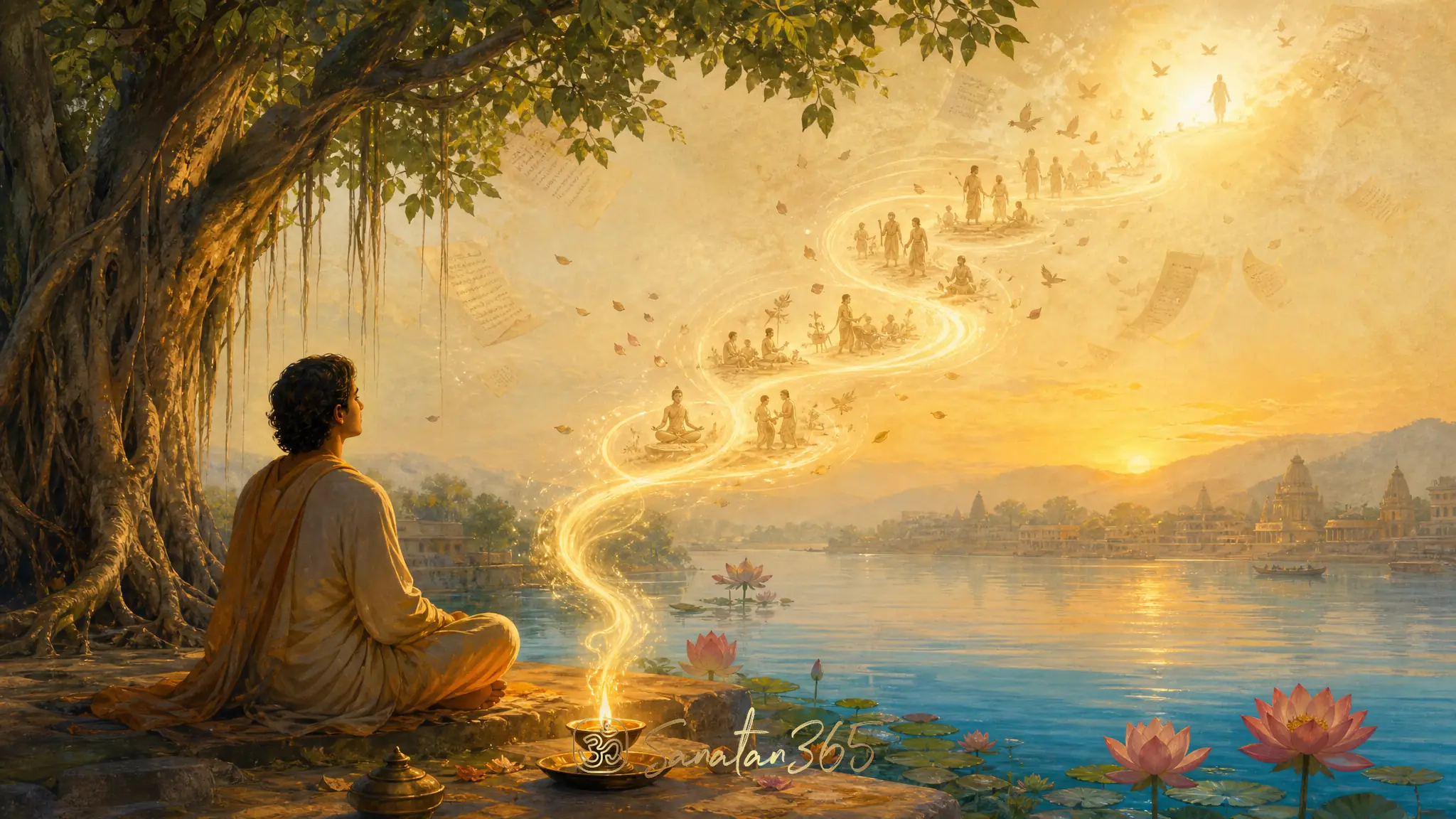
Moksha Meaning: Hindu Liberation in Daily Life
Moksha meaning explained through Hindu ideas of freedom, samsara, karma, jivanmukti, and the practical paths of devotion, knowledge, action, and meditation.
Freedom is not always the same as escape.
Moksha meaning, in Hindu thought, is liberation: freedom from samsara (संसार, the cycle of birth, death, and rebirth), freedom from bondage to ignorance, and freedom to know the deepest Self without fear. It is often described as the highest purushartha (पुरुषार्थ, aim of human life), yet it is not only a distant afterlife idea. Hindu traditions also speak of freedom that begins in the mind, conduct, devotion, and insight of daily living.
What is Moksha meaning in Hinduism?
Moksha meaning begins with the Sanskrit sense of release. Britannica defines moksha as liberation from samsara, the recurring cycle of death and rebirth, and notes that the word is connected with the root idea "to free" (Britannica). In Hindu life, this freedom is more than a change of location after death. It is release from the deeper mistake of taking the temporary self to be the whole truth.
The body changes. Roles change. Wealth comes and goes. Praise, blame, youth, old age, gain, loss, family duty, work pressure, and memory all move like weather. Hindu wisdom does not dismiss these experiences. It asks a sharper question: Who is the witness of all this change?
That question takes moksha from abstraction into practice. The seeker begins to see that bondage is not only external. Bondage is also avidya (अविद्या, ignorance), attachment, ego-identification, and the restless habit of seeking permanent security in impermanent things. Moksha is freedom from that confusion.
This is why moksha sits beside dharma (धर्म, right order and responsibility), artha (अर्थ, material means), and kama (काम, wholesome desire and beauty) in the four purusharthas. It does not insult worldly life. It completes the map of worldly life. Without moksha, dharma can become anxious duty, artha can become endless acquisition, and kama can become restless craving. With moksha as the horizon, every aim is held more lightly and more wisely.
Key takeaway: Moksha is liberation from samsara and ignorance, but it also gives daily life a deeper orientation toward inner freedom.
Why is samsara not simply "the world"?
Samsara is often translated as the cycle of birth and death, but the word also points to the flowing, repetitive pattern of conditioned existence. A person may experience samsara as the endless loop of wanting, fearing, comparing, reacting, and beginning again.
This distinction matters. If samsara is misunderstood as "the world is bad," Hindu life becomes distorted. The same tradition that speaks of liberation also honors family duty, temple worship, music, food as prasad (प्रसाद, grace-filled offering), marriage, study, service, pilgrimage, and seasonal festivals. The problem is not existence itself. The problem is bondage within existence.
Karma (कर्म, action and its consequences) helps explain that bondage. Britannica's overview of karma notes that Indian traditions connect action with future conditions and with the goal of release from birth and death (Britannica). In everyday terms, action leaves impressions. Repeated anger makes anger easier. Repeated generosity makes generosity easier. Repeated remembrance makes remembrance easier.
Samsara is therefore not only cosmic repetition. It is also psychological repetition. A family argument, a workplace slight, a social media comparison, or a private insecurity can become a small wheel. The person feels pushed by habit before wisdom has a chance to speak.
Moksha begins when the wheel is seen clearly. A moment of awareness interrupts compulsion. A prayer softens pride. A scriptural verse changes the frame. A selfless act loosens the grip of "me and mine." These are not final liberation by themselves, but they point in the direction of freedom.
Key takeaway: Samsara is not a rejection of the world; it is bondage to repetitive ignorance, craving, and karmic habit within lived experience.
How do the Upanishads frame liberation?
The Upanishads turn the search for moksha inward. Their central concern is not only ritual correctness or heavenly reward, but the knowledge of Atman (आत्मन्, the Self) and Brahman (ब्रह्मन्, ultimate reality). The deepest question becomes: What remains true when names, forms, roles, and bodily conditions change?
The Katha Upanishad gives this question a memorable form through Nachiketa, the young seeker who meets Yama, lord of death. Rather than asking only for comfort, Nachiketa asks what lies beyond death. The dialogue becomes one of the most powerful Hindu reflections on the Self, discipline, and liberation. Wisdom Library's Katha Upanishad presentation describes the text as a teaching on Atman, Brahman, and liberation through the conversation between Nachiketa and Yama (Wisdom Library).
The philosophical force of this story is simple and difficult: the seeker must choose shreyas (श्रेयस्, the truly beneficial) over preyas (प्रेयस्, the merely pleasant). Preyas is not always immoral. It may be comfortable, impressive, immediate, and socially rewarded. But shreyas asks what leads to truth.
This is a useful distinction for modern seekers. A person may choose the pleasant by reacting quickly, buying more than needed, winning an argument, or avoiding silence. The beneficial may be patience, restraint, study, apology, discipline, or meditation. Moksha is not reached by one dramatic choice alone. It is approached through many small choices where truth is preferred over compulsion.
Key takeaway: The Upanishadic path to moksha turns the seeker toward Self-knowledge and the disciplined choice of the truly beneficial.
Can moksha be lived before death?
Many people hear moksha and think only of final release after death. Hindu traditions do speak of ultimate liberation beyond rebirth, but they also preserve the idea of jivanmukti (जीवन्मुक्ति, liberation while living). This does not mean the body disappears or normal responsibilities vanish. It means a person can live in the world without being inwardly owned by ego, fear, craving, or ignorance.
A liberated-in-life person still eats, speaks, acts, rests, and may teach or serve. The difference is the inner relationship to action. Action is no longer driven by the tight demand to complete the ego. Pleasure is no longer worshipped as the final good. Pain is no longer mistaken for the destruction of the Self.
This is where the Bhagavad Gita becomes essential. In Gita 18.66, Krishna tells Arjuna to take refuge in him and promises liberation from all sin and sorrow; the Gita Supersite preserves the Sanskrit and classical commentarial tradition around this verse (Gita Supersite). Different sampradayas (सम्प्रदाय, teaching lineages) interpret the verse with their own theological depth, but the devotional message is unmistakable: liberation is not achieved by egoic self-reliance alone. Grace, surrender, and right understanding matter.
For a householder, jivanmukti may not look like withdrawal from all duties. It may look like serving without bitterness, earning without greed, enjoying without addiction, disagreeing without hatred, grieving without losing faith, and remembering the Divine amid ordinary work.
This also protects moksha from becoming spiritual bypassing. Liberation is not an excuse to neglect family, ignore ethical duties, or dismiss another person's suffering. The freer a person becomes inwardly, the more carefully they should act outwardly.
Key takeaway: Moksha can be understood as final liberation, but Hindu wisdom also honors the beginning of freedom while living.
What are the main paths to moksha?
Hindu tradition gives multiple pathways because human temperaments differ. The Hindu American Foundation summarizes four well-known paths to moksha: bhakti, jnana, karma, and raja yoga (Hindu American Foundation). These are not rigid silos. Many lives blend them.
- Bhakti yoga (भक्ति योग): the path of devotion. The heart turns toward the Divine through prayer, kirtan, mantra, worship, surrender, and loving remembrance.
- Jnana yoga (ज्ञान योग): the path of knowledge. The seeker studies, reflects, discriminates between the eternal and the temporary, and seeks direct Self-knowledge.
- Karma yoga (कर्म योग): the path of selfless action. Work is offered without clinging to results, gradually purifying ego and intention.
- Raja yoga (राज योग): the path of meditation and disciplined mind. Through concentration, ethical preparation, and inner stillness, the seeker learns to see clearly.
These paths answer different human needs. A person with a devotional temperament may soften through nama japa (नाम जप, repetition of the Divine name). A philosophical seeker may be drawn to the Upanishads and Vedanta. A service-oriented person may find freedom through seva (सेवा, selfless service). A contemplative person may need meditation, breath discipline, and silence.
The best path is not always the one that sounds most impressive. It is the one a seeker can live sincerely under proper guidance. A few minutes of honest daily practice may purify more than a grand identity built around spiritual vocabulary.
Key takeaway: Hinduism offers several paths to moksha because liberation must meet the seeker's nature, not merely their self-image.
How does moksha change everyday choices?
Moksha becomes practical when it changes how a person lives before any final spiritual claim is made. The question is not, "Am I liberated?" The more useful question is, "Where am I less bound today than yesterday?"
This can be tested in simple places:
- When criticized, can one pause before defending the ego?
- When praised, can one receive it without becoming dependent on it?
- When earning money, can one keep dharma above greed?
- When enjoying family, food, art, and festivals, can one feel gratitude without possession?
- When suffering comes, can one seek help and still remember that the Self is deeper than the condition?
- When practicing devotion, can one move from demand toward surrender?
These questions make moksha intimate. Liberation is not reduced to mood management, but the daily mind becomes the training ground. Every reaction reveals attachment. Every attachment can become a doorway into inquiry.
For diaspora families, this frame can be especially helpful. Children may first encounter moksha as a vocabulary word in a lesson or temple class. Adults may encounter it during grief, burnout, aging parents, career pressure, or a quiet sense that success alone is not enough. In both cases, moksha offers a language for freedom that does not reject life. It asks life to point beyond itself.
Key takeaway: The daily test of moksha is whether a person becomes less ruled by ego, fear, craving, and forgetfulness.
FAQ
What is the simple meaning of moksha?
Moksha means liberation or release. In Hindu thought, it usually means freedom from samsara, the cycle of birth, death, and rebirth, and freedom from ignorance of the true Self.
Is moksha the same as heaven?
No. Heaven, or svarga (स्वर्ग, heavenly realm), is usually understood as a temporary state connected with merit. Moksha is liberation from the cycle itself, not merely a pleasant place within the cycle.
Can a householder seek moksha?
Yes. Hindu tradition does not reserve spiritual freedom only for renunciants. A householder can seek moksha through dharma, devotion, selfless action, study, meditation, ethical livelihood, and detachment from ego.
What is jivanmukti meaning?
Jivanmukti means liberation while living. It refers to inner freedom even while the body and ordinary life continue.
Which path to moksha is best?
The best path depends on temperament and guidance. Bhakti, jnana, karma, and raja yoga all offer valid approaches, and many seekers combine devotion, knowledge, selfless action, and meditation.
Moksha meaning is not a rejection of life. It is the discovery that life is most wisely lived when it is no longer mistaken for the whole of freedom.
About the author
Sanatan365 Editorial
Bringing Sanatan Dharma to modern seekers through authentic, scripture-grounded content.
Related in Wisdom
 Wisdom
Anugraha Meaning: Divine Grace and Human Effort in Hindu Thought
Anugraha names grace, but not a bargain for a particular result. Explore how Hindu traditions hold divine help and human effort together.
 Wisdom
Vasudhaiva Kutumbakam Meaning: When the World Becomes One Family
Vasudhaiva Kutumbakam means that the whole earth is one family. Rooted in the Maha Upanishad, the teaching asks seekers to move beyond narr…
 Wisdom
Ananda Meaning: Bliss Beyond Passing Pleasure
Ananda is often translated as bliss, but Hindu philosophy uses the word for a fullness deeper than a pleasant mood. The Upanishads help dis…

