Ratri Sukta Meaning: The Vedic Goddess Who Shelters the Night
Read Rigveda 10.127 through its images of Night’s light, birds returning to a tree, a prayer for protection and the arrival of dawn.
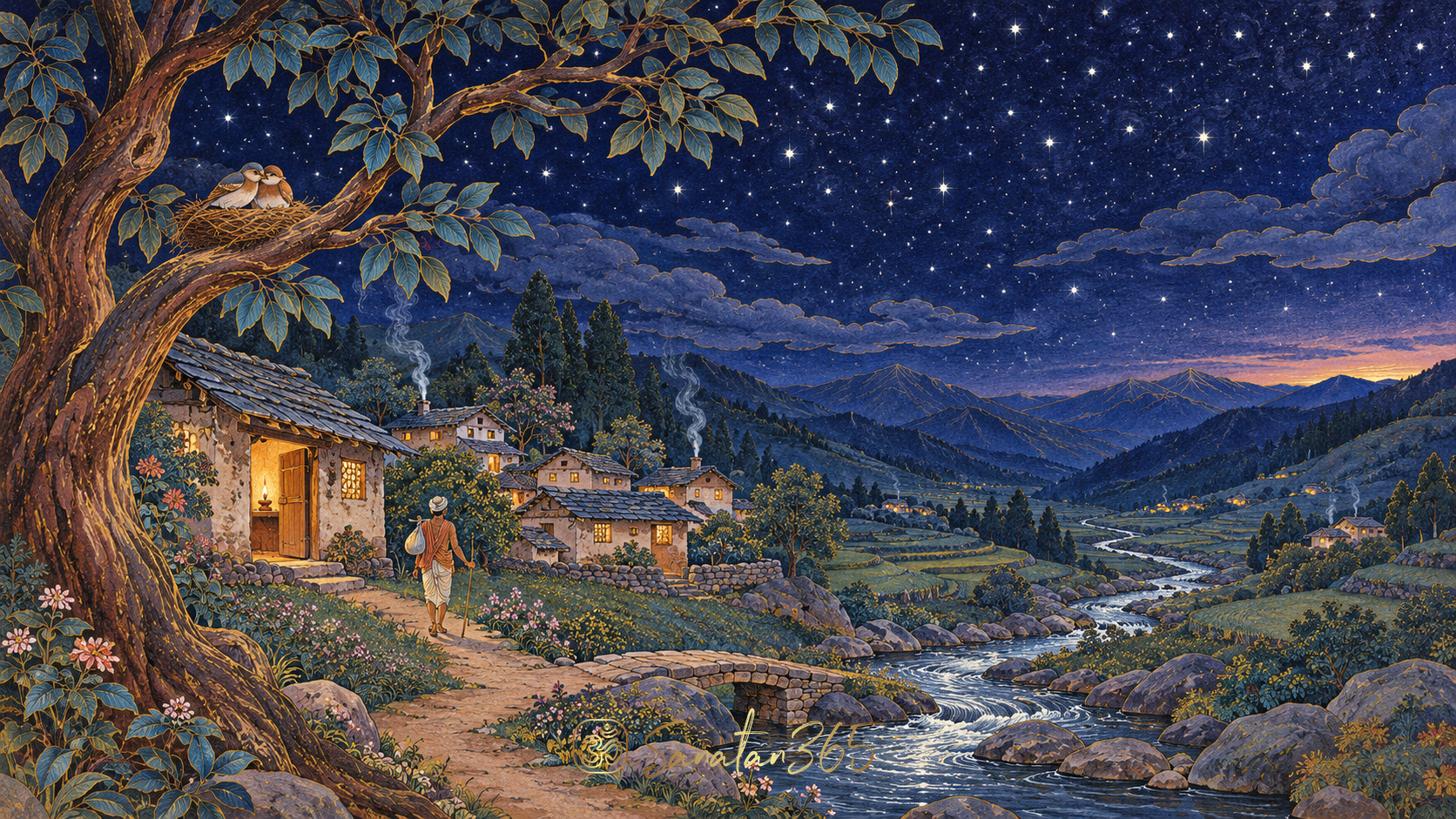
A village is settling. Birds reach their resting places, the paths grow quiet, and the poet asks Night herself to make the hours ahead easy to cross.
Ratri Sukta meaning begins with Rātrī (रात्री, Night), addressed as a goddess in the Ṛgveda (ऋग्वेद, Veda of praise verses). A sūkta (सूक्त, hymn) here is an act of address, not simply a description of the sky. Night brings her own light, gathers living beings into rest, and is asked to keep danger away. The poem gives shelter and uncertainty a place in the same evening.
What is the Ratri Sukta meaning?
The eight verses of Rigveda 10.127 speak to Night as a presence that can be welcomed, praised and asked for help. The Vedic Heritage Portal’s Sanskrit text preserves the hymn in the Shakala recension. Ralph T. H. Griffith’s English translation offers a readable way into its sequence, despite its older English diction.
There is a difference between saying that night falls and speaking to Night as she arrives. In the first case, a change in light is being recorded. In the second, a speaker has placed themselves in a relationship with what is happening. The hymn begins with the goddess looking out with many eyes. By its end, the poet is asking her to receive praise. Across those verses the setting is never merely a backdrop: the people who are about to rest depend on the night through which they must pass.
It is also worth noticing the modest scale of several images. The goddess fills high and low places, yet the poem finds room for a bird and a tree. It does not need a separate miniature world to explain the vast one. A creature finding a place to settle is already a way of showing what the goddess’s arrival means.
A reader encountering the hymn for the first time can follow three movements: watch Night arrive, watch the world settle, and hear the prayer that arises from that settling. Those movements keep the goddess at the centre even when the verses turn their attention to ordinary creatures.
Key takeaway: The poem addresses Night as a goddess whose arrival changes how living beings occupy the world.
How can Night drive away darkness with light?
The second verse gives Night light of her own. The first has already spoken of her many eyes, an image that naturally invites a reading in terms of stars. The visual force of the passage comes from bringing together things that might seem opposed: the darker sky and the points of light that become visible within it. The verse does not require the reader to treat darkness and light as belonging to wholly separate worlds.
Imagine looking toward an orchard at dusk. During the day its edge may be apparent from every detail. Later, one familiar outline can orient the entire view. A window, a bright point in the sky or a strip of open ground makes relationships visible that were less noticeable in the full light of afternoon. This is an illustration of the reading, not an additional scene found in the hymn.
It would be easy to turn the goddess into a simple emblem of comfort. The text gives a more interesting account. Night can offer a light by which to recognize the world without making it as open to view as it was at noon. The prayer for protection later in the hymn would lose some of its point if every shadow were already harmless.
Nor do the goddess’s many eyes require an illustration with literal faces or eyes across the sky. The power of the poetry is that the night itself can seem watchful. A painter might express that through small, steady lights above a village, while a reader might simply notice that the verse speaks of seeing at the very moment when human sight is becoming less certain.
Key takeaway: Night’s light belongs to her own character; it need not cancel the vulnerability that darkness can bring.
Why do birds and villages matter to the hymn?
In verse four, the poet compares taking shelter in Night with birds finding a resting place in a tree. In verse five, villagers, walking creatures and flying creatures settle. Griffith’s version even includes hunting falcons in the picture. The village is part of an inhabited world, sharing the change of hour with animals whose movements are ordinarily quite different from its own.
The bird image brings out something that can be missed in a quick reading. A tree is not just a point on a landscape. It offers branches, cover and a place to pause. The bird need not own or control the whole tree for the shelter to matter. The human speakers likewise place themselves within a night they did not make and cannot manage in every detail. What they ask for is a way to inhabit it.
The gathering of different creatures does not mean they all sleep at the same time or that the poem is making a claim about animal behaviour. It is a poetic view of the world drawing in from the movements of the day. The creatures are named because they make that change perceptible: wings come to rest, the village finds its dwellings, and the paths hold fewer travellers.
The poem also makes it possible to read the village without idealizing it. The people will need protection, and their homes do not remove every uncertainty. The evening is held together by the ordinary things that offer refuge. A doorway, a tree and the place to which one returns are sufficient to carry that idea.
For a companion reading, the Rigvedic goddess of dawn brings a different movement into view. The comparison helps because it starts from the details of two sacred figures, rather than asking one goddess to stand for every aspect of the cycle.
Key takeaway: The return of birds and villagers gives a human scale to the goddess’s shelter.
What protection does the poet ask of Night?
Verse six asks that wolves and the thief be kept away and that Night be easy to pass through. The dangers are named plainly. They belong to the speaker’s concern for a world where darkness changes what can be seen and how easily a threat can be noticed. Protection is therefore central to the hymn, not an incidental request added after a peaceful description.
A careful distinction follows from that detail. A prayer for safety expresses a need. It does not supply a promise that anyone who reads the verse will avoid every harm. The directness of the request is part of its dignity. The poet can speak of Night’s radiance and still ask for help with the hours ahead. The reverence is strong enough to contain that practical concern.
Nor does the list invite a reader to look for a hidden danger behind each image. Wolves and theft are already concrete enough. A reading that treats them only as symbols of a person’s inner faults risks losing the texture of the actual request. Conversely, a reader may reflect on the uncertainties of their own evening, provided that reflection is identified as an application and does not replace the hymn’s words.
One gentle way to read the verse today is to distinguish the things that call for action from the things that cannot be settled before resting. A person may close a gate, check that someone arrived safely or leave a light for a returning member of the household. The verse itself gives none of those instructions. The examples simply make the difference between care and total control easier to see.
The closing verse presents praise as something Night is invited to accept. That makes the hymn more than a list of hazards to be removed. It returns the speaker to attention and reverence for the presence they have been addressing throughout.
Key takeaway: The prayer takes danger seriously without making fear the whole meaning of Night.
How do Night and Dawn make room for each other?
Verse three places Night in relation to her sister Dawn, Uṣas (उषस्, dawn). Later, Griffith’s verse seven turns toward Morning and uses the image of a debt being cleared. These passages give the poem a horizon beyond the present darkness. Night can be honoured as a goddess without being asked to last forever.
The sister relationship offers a different picture from a contest in which one side must defeat the other to deserve praise. The passage is often easiest to understand by following the changes that it shows: Night arrives, a place for Dawn is prepared, and darkness passes. The two figures are distinct, but their distinction gives shape to a shared rhythm. The approaching morning does not make the prayer to Night pointless.
This matters to the way the poem can be read aloud or discussed. It is tempting to jump straight to a single message such as “darkness always ends.” The hymn has already taken the reader through light, refuge and a specific request for protection. The coming dawn is meaningful because the intervening hours have been given a life and value of their own.
A small reading practice is to place the Sanskrit text beside the English rendering and mark where each new image enters. A reader can distinguish a word they see in the source, a translator’s choice and a thought that arises while reading. The guide to reading Hindu scripture in translation offers a practical way to keep those three levels clear. That distinction leaves room for personal reflection without mistaking it for a line in the text.
The poem closes with praise still directed to Night. An evening reading can therefore end where the hymn places the reader: attentive to the place of shelter that is available now, rather than waiting for morning before allowing the present hour any dignity.
Key takeaway: Dawn gives the poem a horizon, while Night remains worthy of praise in her own right.
FAQ
Who is Ratri in the Rigveda?
Ratri is Night addressed as a goddess. In Rigveda 10.127 she is depicted as an arriving and luminous presence, associated with the return of creatures to rest and invoked for protection through the night.
How many verses are in the Ratri Sukta discussed here?
The Shakala text of Rigveda 10.127 contains eight verses. “Ratri Sukta” in this article refers to that specific hymn; the text and numbering should be checked when a collection uses a similar title.
Are the goddess’s many eyes literally stars?
Stars are a natural poetic reading of the many eyes, especially alongside the goddess’s light in the next verse. The image need not be turned into a rigid visual rule or a claim that the verse assigns a name to each star.
Does the hymn prescribe a bedtime ritual?
The eight verses praise Night and ask for protection; they do not set out a household bedtime procedure. Reading them in the evening can be a personal choice. This article does not prescribe a recitation count or make promises about sleep or safety.
About the author
Sanatan365 Editorial
Bringing Sanatan Dharma to modern seekers through authentic, scripture-grounded content.
Related in Deities
 Deities
Pushan: The Vedic Deity of Paths, Cattle, and Care
Meet Pushan through Vedic prayers for a knowledgeable guide, protected cattle, reliable movement, and the safe return of what has strayed.
 Deities
Mitra Vedic Deity: Friendship, Trust, and Sacred Order
The Rig Veda praises Mitra as a sustainer of human community and sacred order. Read his hymn through trust, watchful care, and dependable a…
 Deities
Savitr Deva Meaning: Golden Hands and the Rhythm of Life
Meet Savitr, the Vedic divine impeller whose golden hands set life in motion and whose hymns honour rest as well as activity.

