Sama Veda Meaning: Why the Veda of Melody Is Sung
Discover the Sama Veda meaning, its relationship with the Rig Veda, why its verses became sacred song, and how its living chant tradition preserves disciplined listening.
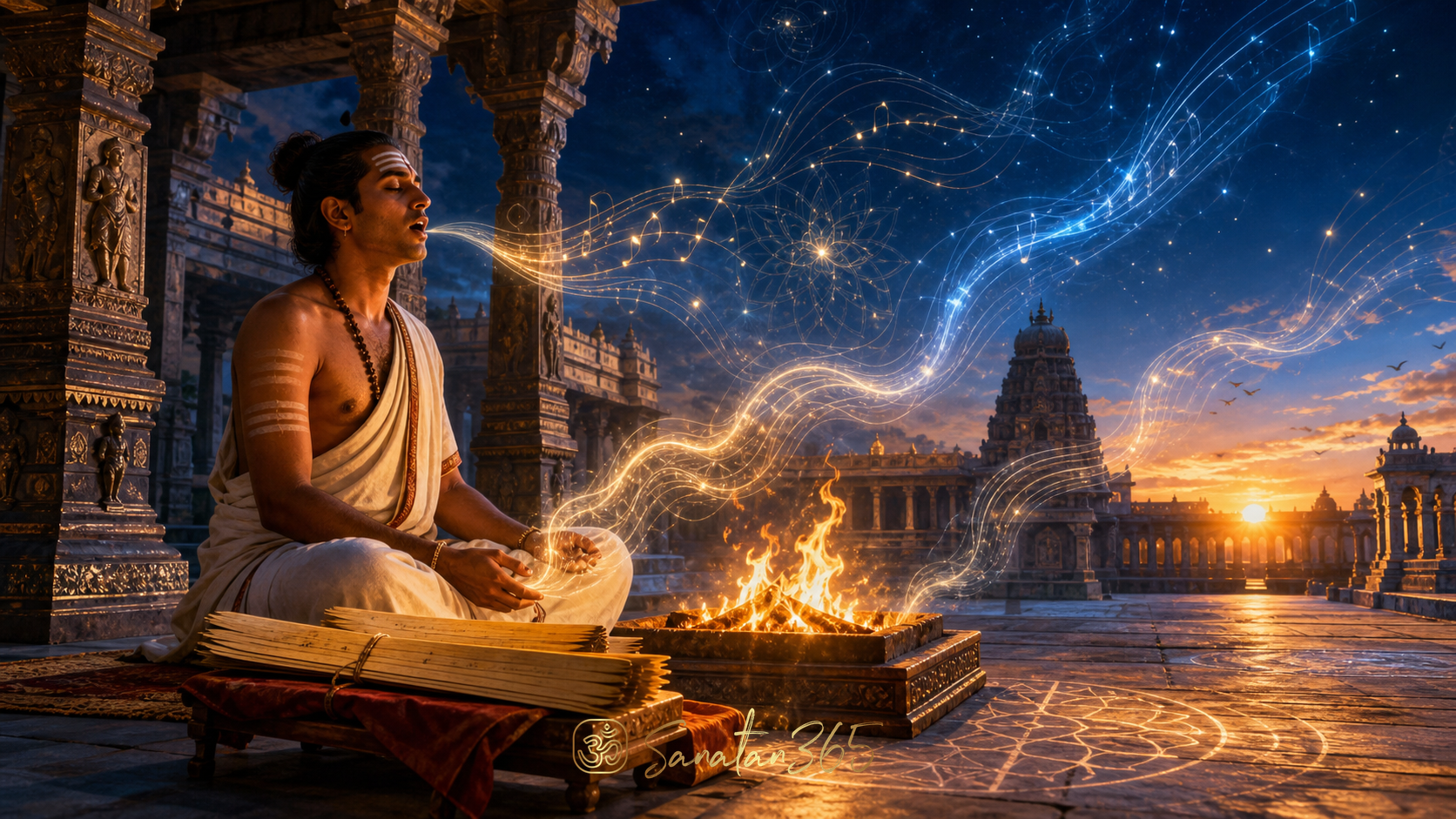
Before Indian music had stages, notation software, or concert halls, sacred knowledge was already being carried by the trained human voice. Sama Veda meaning begins here: the Sama Veda (सामवेद, “Veda of melodies” or “knowledge of chants”) is one of the four Vedas, arranging sacred verses for liturgical singing. It turns revealed words into measured sound so that worship is not only understood by the mind but embodied through breath, pitch, memory, and disciplined listening.
Most of its verses are drawn from the Rig Veda, yet the Sama Veda is not merely a copied anthology. Its distinctive purpose lies in how verses are musically shaped for ritual performance. The text preserves a profound Hindu insight: sacred speech changes the worshipper when it is received with the right tone, attention, lineage, and responsibility.
What Is the Sama Veda Meaning in the Four Vedas?
The Sama Veda meaning is best understood through the word saman (सामन्, a sacred melody or chant). Veda (वेद, sacred knowledge) comes from a root associated with knowing. Together, the name points to knowledge carried as song. The Sama Veda belongs to shruti (श्रुति, “that which is heard” or revealed), the foundational category of Hindu scripture transmitted through carefully maintained oral traditions.
The four Vedas serve related but distinct ritual and contemplative functions:
- The Rig Veda gathers hymns addressed to deities such as Agni, Indra, Soma, and Ushas.
- The Sama Veda recasts selected verses as chants for ritual singing.
- The Yajur Veda supplies prose formulas and directions used in sacrificial performance.
- The Atharva Veda preserves hymns, prayers, reflections, and rites connected with a wide field of life.
These descriptions are simplified; each Veda contains multiple layers and associated texts. Still, they reveal why the Sama Veda is distinctive. Its central concern is not new narrative material. It is the ritual life of the voiced verse.
The text is traditionally linked with the udgatri (उद्गातृ, the priest who sings Samavedic chants) in the Vedic sacrifice. This role demands more than a pleasing voice. It requires exact training in pitch, duration, sequence, breath, and inherited procedure. The sound is not ornament added after meaning. Sound is part of the sacred action.
Key takeaway: The Sama Veda is sacred knowledge organized for singing, where disciplined vocal form is inseparable from ritual purpose.
Why Are Sama Veda Verses Sung Rather Than Simply Read?
Samavedic verses are sung because Vedic ritual treats sound as an action. A spoken instruction can describe an offering; a properly transmitted chant participates in the offering itself. Melody orders breath and attention, joins several ritual roles into one rhythm, and gives the words a form stable enough to travel across generations.
This does not mean any tune can be attached to any verse. Samavedic chant follows inherited patterns. The term svara (स्वर, a voiced tone or pitch) refers here to tonal distinctions that guide recitation. Later Indian musical traditions developed rich systems of notes and melody, and the Sama Veda is often honoured as an ancient source in the cultural memory of Indian music. Yet it would be careless to claim that a modern raga performance is simply the same thing as a Vedic saman. Ritual chant and classical concert music have related histories but different purposes, rules, and settings.
Singing also protects memory. Melody gives the mind a structured path. A change in pitch or length can become audible to a trained teacher in a way that a quiet reading error might not. Repetition within a lineage makes the body itself an archive: the student remembers through ear, tongue, diaphragm, posture, and attentive correction.
UNESCO’s account of the tradition of Vedic chanting emphasizes the value of elaborate recitation techniques in preserving texts with remarkable precision. The recognition does not turn the tradition into a museum object. It points to the living discipline of teachers and students who sustain it.
Key takeaway: Sama Veda verses are sung because melody makes sacred words ritually active, memorable, and accountable to oral lineage.
How Is the Sama Veda Connected to the Rig Veda?
The connection is close: the great majority of verses in the Sama Veda are also found in the Rig Veda. Many are addressed to Agni, Indra, and Soma, particularly in contexts connected with the Soma sacrifice. The important difference is arrangement and use. A Rig Vedic verse belongs to the structure of a hymn; in the Sama Veda, it may be placed within a sequence designed for chanting during a particular ritual moment.
An analogy can help, provided it is not taken too literally. A poem printed on a page and the same poem set within a carefully inherited musical composition contain the same words, but they do not create the same experience. The musical setting establishes pace, emphasis, breath, expectation, and communal coordination. In the Samavedic setting, these are not artistic choices made for novelty. They are transmitted ritual forms.
The Sama Veda is commonly described through two broad textual arrangements. The Purvarcika (पूर्वार्चिक, earlier collection of verses) groups material substantially by deity and ritual association. The Uttararcika (उत्तरार्चिक, later collection) arranges verses in sequences connected more directly with liturgical performance. Various shakhas (शाखा, branches or recensional traditions) preserve their own textual and chanting details.
This relationship also teaches something about originality in sacred tradition. Modern culture often values novelty above continuity. The Sama Veda shows another kind of creativity: faithful transformation. It receives verses already revered and places them within a new ritual architecture without pretending to own them.
Readers interested in another Vedic mode of inquiry can explore the Nasadiya Sukta’s questioning vision of creation. The contrast is illuminating: one text confronts cosmic mystery through a hymn of inquiry, while the Sama Veda foregrounds the disciplined musical life of revealed verse.
Key takeaway: The Sama Veda shares words with the Rig Veda but gives those words a distinct liturgical identity through sequence, melody, and performance.
What Do Samavedic Notes and Chanting Preserve?
Samavedic notation preserves more than a general direction to “sing.” Marks, syllabic extensions, and performance traditions guide how a verse moves. In some chant forms, additional vocal elements called stobha (स्तोभ, inserted chant syllables) help shape the musical structure. These features may look unfamiliar to a reader expecting scripture to be plain prose or poetry, but they reveal scripture designed for the ear.
The oral discipline preserves at least four things:
- Textual accuracy: words and syllables are guarded through repeated correction.
- Tonal form: pitch movements belong to the received chant, not personal improvisation.
- Ritual timing: the chant aligns with a particular stage and action.
- Teacher-student continuity: knowledge remains connected with living instruction.
Different surviving Samavedic branches and regional lineages may not sound identical. Variation does not automatically mean corruption. Hindu traditions often preserve unity through rigorous local forms rather than through one flattened universal style. What matters is that a lineage can account for its method and transmit it responsibly.
This also explains why recordings, books, and transliterations are useful but incomplete. They can introduce a listener to the beauty of the tradition. They cannot notice a student’s breath, correct a subtle tonal movement, explain ritual eligibility, or transmit the full discipline of a shakha. Digital access can support preservation, but it should not create false mastery.
Key takeaway: Samavedic chanting preserves words, tones, ritual coordination, and a living chain of correction between teacher and student.
How Can Modern Seekers Approach the Sama Veda Respectfully?
A modern seeker can begin with listening, context, and humility. The Sama Veda need not be treated as inaccessible, but specialist Vedic recitation should not be imitated casually from a short clip. Respect means distinguishing appreciation from authorization and curiosity from competence.
A responsible beginning may include:
- Read a reputable translation alongside a concise scholarly introduction.
- Listen to recordings identified by lineage or institution rather than anonymous remixes.
- Learn the basic relationship between Rig Vedic verse and Samavedic chant.
- Ask a qualified teacher before attempting formal recitation.
- Support communities and institutions preserving oral transmission.
- Avoid turning sacred chant into background audio stripped of context.
For families in the diaspora, respectful exposure can be simple. Children can learn that the Vedas were preserved through trained listening long before printing. They can compare a spoken sentence and a sung phrase, noticing how melody changes memory, without pretending to perform a formal saman. A temple or cultural centre may host a lecture-demonstration by a trained practitioner.
The practice of svadhyaya, sacred study and self-observation, offers a useful ethical frame. Study is not consumption. It asks the learner to become patient, accurate, and worthy of what is being received.
Key takeaway: Respectful approach begins by listening carefully, naming one’s limits, and seeking living guidance before formal recitation.
Why Does Sacred Sound Matter Beyond Ritual Performance?
The Sama Veda’s deepest modern relevance is not the claim that everyone should become a Vedic chanter. It is the reminder that sound forms consciousness. Words spoken repeatedly become mental habits. Tone can dignify truth or distort it. Breath can support attention or expose agitation. Listening can become hospitality.
Sacred sound also resists the modern habit of treating language as disposable. Online speech is fast, abundant, and often detached from responsibility. Samavedic discipline moves in the opposite direction: a syllable deserves care; a pitch carries obligation; transmission requires accountability; silence around the sound matters too.
This insight can enter ordinary life without copying a restricted ritual. A person can pronounce a familiar prayer carefully rather than rushing. A family can sing an aarti together with attention to meaning. A student can listen fully before answering. A devotee can recognise that volume is not devotion and novelty is not depth.
The Sama Veda also shows that tradition can be both precise and alive. Preservation is not achieved by freezing a manuscript behind glass. It happens when one generation gives time, correction, trust, and reverence to the next. The human voice remains central because transmission is relational.
Key takeaway: Beyond ritual, the Sama Veda teaches that responsible sound requires disciplined speech, deep listening, and gratitude toward the source.
FAQ
What is the Sama Veda in simple words?
The Sama Veda is one of the four Vedas and is especially associated with sacred melodies used in Vedic ritual. It arranges verses, mostly known from the Rig Veda, for disciplined chanting.
Why is the Sama Veda called the Veda of music?
It is often called the Veda of music because its verses are shaped as saman, sacred chants. This does not mean it is a modern music textbook; its melodies belong to specific liturgical and oral traditions.
Is the Sama Veda copied from the Rig Veda?
Most Sama Veda verses have Rig Vedic counterparts, but “copied” misses their distinct purpose. The Sama Veda reorganizes and musically elaborates verses for ritual singing, giving them a different performative role.
Can anyone learn Sama Veda chanting from recordings?
Recordings can support appreciation and preliminary listening, but formal Samavedic recitation traditionally requires guidance from a qualified teacher within a living lineage. This protects pronunciation, pitch, context, and ritual discipline.
Did the Sama Veda create Indian classical music?
The Sama Veda is deeply honoured in histories of Indian sacred sound and music, but it is safer to speak of influence and cultural ancestry than to claim that the complex later systems of raga developed directly from one text alone.
The Sama Veda asks modern readers to hear knowledge differently. Its single key takeaway is this: sacred words become living tradition when voice is trained by humility, listening is shaped by care, and each generation receives sound as a trust rather than a possession.
About the author
Sanatan365 Editorial
Bringing Sanatan Dharma to modern seekers through authentic, scripture-grounded content.
Related in Scriptures
 Scriptures
Antaryamin Meaning: The Inner Controller in the Brihadaranyaka Upanishad
The Brihadaranyaka Upanishad describes Antaryamin as the immortal inner presence dwelling within earth, life, mind, and every being while r…
 Scriptures
Maitri Upanishad: The Meaning of Sixfold Yoga
The Maitri Upanishad presents a sixfold yoga that joins breath restraint, sensory withdrawal, meditation, concentration, inquiry, and absor…
 Scriptures
Kaivalya Upanishad Meaning: Shiva and the Self Beyond Isolation
The Kaivalya Upanishad presents liberation as recognition of the complete Self, joining devotion to Shiva, disciplined meditation, and Veda…

