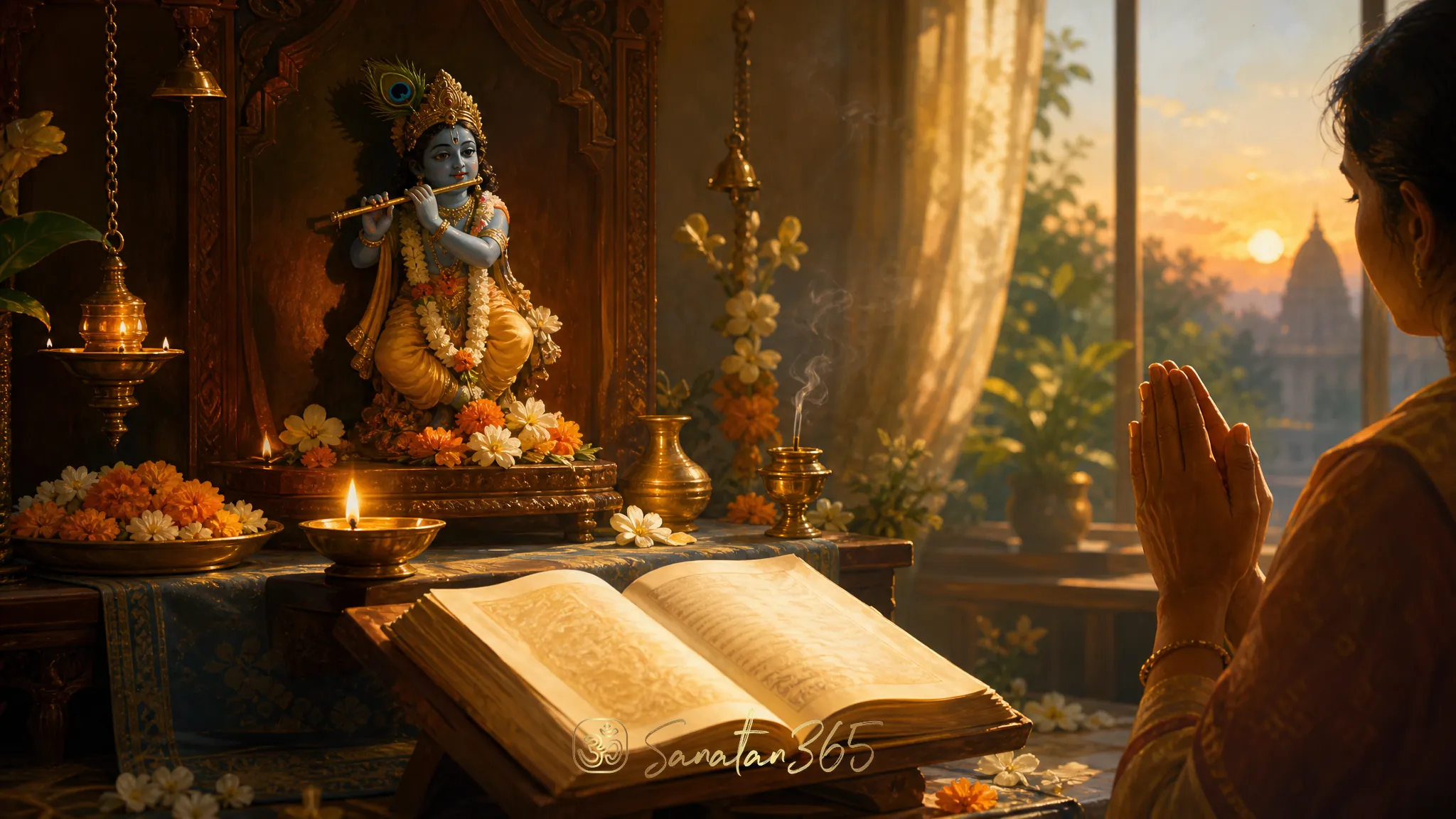
Shraddha Meaning: Faith as Living Trust in Hindu Practice
A clear guide to shraddha in Hindu thought: what it means, how the Bhagavad Gita understands faith, and how living trust shapes daily practice.
Faith is often treated as a belief someone either has or lacks. In Hindu practice, shraddha (श्रद्धा, living faith or reverent trust) is more active than that: it is the inner confidence that lets a person learn, practice, question sincerely, and keep returning to dharma with steadiness.
The Shraddha meaning most relevant to daily spiritual life is not blind acceptance. It is trust joined with attention, humility, and disciplined practice. The Bhagavad Gita presents shraddha as a force that shapes the whole person, especially in chapter 17, where Krishna says that a person's faith reflects their inner nature. This makes shraddha both deeply personal and deeply practical: what we trust, honor, repeat, and serve slowly forms the direction of life.
What Is the Shraddha Meaning in Hindu Practice?
Shraddha comes from the Sanskrit root sense of placing the heart upon something worthy. In everyday English it is often translated as faith, but the word carries a fuller meaning: trust, sincerity, reverence, and committed attention. It is not merely an opinion about the Divine. It is a way of standing before life.
There is also an important distinction. The word śrāddha can refer to ancestral rites, especially ceremonies offered for departed family members; Britannica notes this ritual meaning and distinguishes it from the similar word śraddhā, meaning faith or belief. In this article, shraddha means the second sense: living faith, not the ancestor rite. Britannica
In Hindu life, shraddha appears in many forms:
- A student listens to a guru with respect but still asks sincere questions.
- A family lights a diya before beginning the day, trusting that small acts shape the heart.
- A devotee chants a mantra even when the mind is restless.
- A seeker studies scripture slowly, allowing meaning to mature over time.
Shraddha is therefore not opposed to intelligence. It gives intelligence a direction. It tells the mind, "This is worth returning to. This deserves patience."
Key takeaway: Shraddha is faith as reverent trust in action, not passive belief without thought.
Why Does the Bhagavad Gita Place So Much Weight on Shraddha Meaning?
The Bhagavad Gita treats shraddha as one of the forces that determines spiritual character. In chapter 17, Arjuna asks Krishna about people who act with faith but without following scriptural discipline. Krishna replies by describing three kinds of faith shaped by the three gunas (गुण, qualities of nature): sattva (clarity), rajas (restless passion), and tamas (inertia or confusion).
One of the chapter's central teachings is Bhagavad Gita 17.3:
"A person's faith is according to their inner nature; one is made of faith. Whatever one's faith is, that indeed one is."
This is a profound statement because it does not treat faith as decoration added to life. It says faith is formative. A person becomes shaped by what they trust, admire, worship, and repeatedly give attention to. The Gita's Sanskrit uses śraddhāmayaḥ, meaning "made of faith" or "pervaded by faith." Gita.pub
This teaching also prevents a shallow reading of shraddha. Faith is not automatically pure just because it feels sincere. Krishna shows that faith can be sattvic, rajasic, or tamasic. It can become clear and compassionate, or it can become anxious, ego-driven, or confused. The question is not only "Do I have faith?" The sharper question is: "What kind of faith is forming me?"
That is why shraddha requires viveka (विवेक, discernment). The seeker must examine:
- Does this faith make the mind clearer?
- Does it make conduct more truthful and compassionate?
- Does it deepen humility rather than pride?
- Does it connect devotion with dharma?
In Bhagavad Gita 4.39, Krishna also connects shraddha with knowledge: the person with faith, dedication, and self-control gains knowledge. Faith is not the enemy of knowledge; it is the condition that lets disciplined learning ripen. Bhagavad Gita 4.39
Key takeaway: The Gita teaches that faith shapes the person, so shraddha must be sincere, discerning, and aligned with dharma.
How Is Faith in Hinduism Different from Blind Belief?
Faith in Hinduism is often closer to tested trust than blind belief. The tradition contains many paths: bhakti (भक्ति, devotion), jnana (ज्ञान, knowledge), karma yoga (कर्म योग, disciplined action), dhyana (ध्यान, meditation), mantra, puja, pilgrimage, and scriptural study. These are not held together by one single emotional style. They are held together by the conviction that sincere practice transforms the practitioner.
Blind belief says, "Do not question." Shraddha says, "Question with reverence, practice with steadiness, and let experience mature." This difference matters.
In the Upanishadic style of learning, students ask penetrating questions. In the Bhagavad Gita, Arjuna questions Krishna intensely before surrendering to the teaching. His final clarity does not come from passive obedience; it comes through dialogue, reflection, and receiving wisdom with trust.
That is why Hindu practice often combines:
- Shravana (श्रवण, listening to sacred teaching).
- Manana (मनन, reflection and reasoning).
- Nididhyasana (निदिध्यासन, deep contemplation).
- Anushthana (अनुष्ठान, committed practice).
Shraddha supports all four. Without faith, listening becomes cynical, reflection becomes scattered, contemplation becomes dry, and practice becomes irregular. But without reflection, faith can become mechanical. The balance is essential.
For a modern seeker in Mumbai, Dallas, London, Singapore, or a small town in Gujarat, this balance is especially important. Many people inherit rituals from family but later need to understand their meaning. Shraddha allows them to honor inheritance without turning it into empty habit. It also allows them to ask questions without treating tradition as a museum object.
Key takeaway: Hindu shraddha is not anti-questioning; it is reverent inquiry joined with disciplined practice.
What Does Shraddha Look Like in Daily Life?
Shraddha becomes visible in small, repeated acts. It does not need dramatic display. In many Hindu homes, faith is carried through ordinary rhythm: bathing before puja, offering water to a tulsi plant, touching elders' feet, chanting a short mantra, reading one verse of the Gita, or pausing before a meal to remember gratitude.
These acts matter because they train attention. A person who bows each morning is not merely completing a cultural form. The gesture reminds the body and mind that life is not centered only on personal desire. A person who chants with steadiness learns patience with distraction. A person who gives dana (दान, selfless giving) learns that wealth is not only for possession but also for service.
Shraddha also matters in difficult moments. When grief, uncertainty, or failure comes, faith does not magically remove pain. Hindu wisdom is careful here: spiritual practice should not be turned into a promise that life will always become easy. Instead, shraddha gives the heart a way to remain anchored.
A daily practice of shraddha may include:
- Reading one verse from the Bhagavad Gita and sitting with its meaning.
- Lighting a diya with a clear sankalpa (संकल्प, sacred intention).
- Chanting a chosen mantra slowly, without rushing.
- Doing one act of seva (सेवा, selfless service) without seeking praise.
- Offering food mentally as prasad (प्रसाद, blessed offering) before eating.
- Ending the day with gratitude for one lesson learned.
These practices are simple, but simplicity is not weakness. Sanatan Dharma often works through repetition. What is repeated with sincerity becomes part of character.
Key takeaway: Shraddha is strengthened by small daily acts that turn faith into habit, attention, and service.
How Can Shraddha Stay Clear Instead of Becoming Superstition?
The Gita's threefold teaching on faith is useful because it shows that faith needs refinement. Not every intense feeling is sattvic. Not every inherited practice is understood. Not every fear-based habit deserves to be called devotion.
Clear shraddha grows through three safeguards.
First, it stays connected to dharma. If a belief makes someone cruel, arrogant, dishonest, or fearful, it needs correction. Dharma is not only ritual correctness; it includes truthfulness, compassion, self-restraint, responsibility, and reverence for life.
Second, it seeks understanding. A person may begin with family tradition, but maturity asks for learning. Why is a mantra chanted? What does a vrata (व्रत, sacred vow or observance) cultivate? What does a deity's form symbolize? Questions like these do not weaken shraddha. They prevent it from becoming hollow.
Third, it avoids guaranteed claims. Hindu practice can support clarity, devotion, courage, and inner steadiness, but it should not be presented as a mechanical formula that guarantees wealth, marriage, health, or success. When faith becomes transactional, it easily turns rajasic: anxious, restless, and bargaining. Sattvic shraddha is steadier. It trusts the practice while accepting that karma, time, and Divine grace are subtle.
For diaspora families, this is especially relevant. Children may ask why a ritual matters. A weak answer says, "Because we said so." A stronger answer says, "This practice helps us remember gratitude, discipline, and the sacred presence in daily life." Shraddha survives across generations when it is explained with warmth and lived with integrity.
Key takeaway: Shraddha stays healthy when it is guided by dharma, strengthened by learning, and freed from fear-based promises.
How Can a Beginner Cultivate Shraddha Without Forcing It?
Shraddha cannot be manufactured by pressure. It grows through honest contact with practice. A beginner does not need to pretend certainty. A better starting point is sincerity: "I do not understand everything yet, but I am willing to learn and practice respectfully."
Begin with one stable practice rather than many scattered ones. A person might choose five minutes of mantra japa (जप, meditative repetition), one Gita verse per day, weekly temple darshan, or a simple morning diya. The point is not performance. The point is steady relationship.
Then add reflection. After practice, ask:
- What changed in my attention?
- Did this make me more patient or truthful today?
- What question arose that I should study further?
- Did I practice from devotion, fear, habit, or ego?
This turns faith into a living mirror. It also protects the practitioner from spiritual vanity. Shraddha is not proven by how many rituals someone performs. It is shown by how practice softens the heart, clarifies conduct, and deepens responsibility.
Community helps too. Satsanga (सत्संग, company of truth or noble association) gives faith a supportive environment. A person who studies alone may become inconsistent; a person who practices only in a group may become dependent on mood. The best rhythm often combines personal discipline, family tradition, temple life, and thoughtful study.
Key takeaway: Beginners can cultivate shraddha through one consistent practice, honest reflection, and good spiritual company.
FAQ
What is the Shraddha meaning in simple words?
Shraddha means living faith, reverent trust, and sincere commitment. In Hindu practice, it is the inner confidence that helps a person learn, practice, serve, and stay connected to dharma.
Is shraddha the same as blind belief?
No. Shraddha is not blind belief. It includes trust, but it also welcomes reflection, learning, and discernment. The Bhagavad Gita shows that faith should be refined so it becomes clear and sattvic.
What does Bhagavad Gita 17.3 teach about faith?
Bhagavad Gita 17.3 teaches that a person is shaped by their faith. What someone deeply trusts, values, and follows becomes part of their character and direction in life.
How can I build shraddha in daily life?
Start with one steady practice: light a diya, chant a mantra, read one Gita verse, offer seva, or sit quietly in gratitude. Practice with sincerity, then reflect on whether it is making your conduct clearer and kinder.
Is shraddha only about religion?
In Hindu thought, shraddha is spiritual, but it also affects ordinary life. It shapes how someone learns, serves, keeps promises, honors elders, handles difficulty, and returns to dharma when distracted.
Shraddha is the trust that turns wisdom into practice. It does not ask the seeker to stop thinking; it asks the seeker to think, act, and live with reverence. When faith is joined with discernment, discipline, and compassion, it becomes one of the quiet powers by which Sanatan Dharma enters daily life.
About the author
Sanatan365 Editorial
Bringing Sanatan Dharma to modern seekers through authentic, scripture-grounded content.
Related in Wisdom
 Wisdom
Anugraha Meaning: Divine Grace and Human Effort in Hindu Thought
Anugraha names grace, but not a bargain for a particular result. Explore how Hindu traditions hold divine help and human effort together.
 Wisdom
Vasudhaiva Kutumbakam Meaning: When the World Becomes One Family
Vasudhaiva Kutumbakam means that the whole earth is one family. Rooted in the Maha Upanishad, the teaching asks seekers to move beyond narr…
 Wisdom
Ananda Meaning: Bliss Beyond Passing Pleasure
Ananda is often translated as bliss, but Hindu philosophy uses the word for a fullness deeper than a pleasant mood. The Upanishads help dis…

