Tirupati Balaji Temple Meaning: Venkateswara, the Seven Hills, and Surrender
A clear guide to Tirupati Balaji temple meaning, Sri Venkateswara, the Seven Hills, Vaishnava worship, darshan, offerings, and the deeper discipline of surrender.
The climb to Tirumala is not only a journey to a famous temple. It is a movement from ordinary desire toward a disciplined act of surrender.
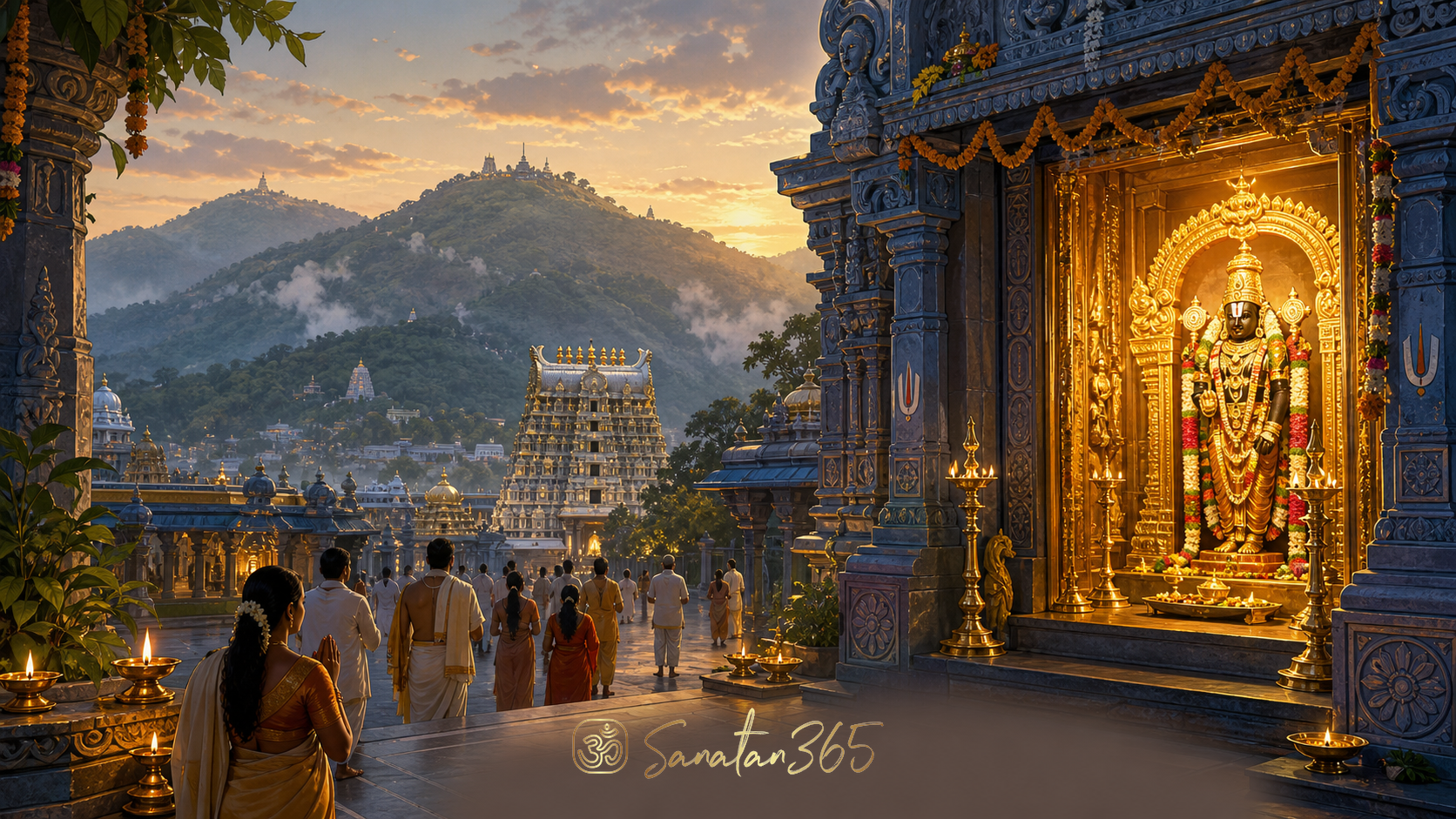
Tirupati Balaji temple meaning begins with Sri Venkateswara, also called Srinivasa, Balaji, and Venkatachalapati: a form of Lord Vishnu worshipped at Tirumala as the compassionate preserver who receives the burdens, prayers, vows, and gratitude of devotees. The temple's sacred geography, darshan (दर्शन, blessed seeing), offerings, and daily worship all point to one inner teaching: a seeker approaches the Divine with humility, receives grace, and returns to life with steadier dharma.
What Is Tirupati Balaji Temple Meaning?
Tirupati Balaji temple meaning rests on the name and presence of the deity. "Tirupati" refers to the sacred city and pilgrimage region in Andhra Pradesh, while "Tirumala" is the hill town where the main shrine stands. "Balaji" is a beloved North Indian name for Sri Venkateswara, the presiding deity of the temple. The official Tirumala Tirupati Devasthanams history identifies him by names such as Sri Venkateswara, Srinivasa, Balaji, and Venkatachalapati, and places his abode at Tirumala in sacred memory (TTD Temple History).
The word Venkateswara is often understood devotionally as the Lord of Venkata, the sacred hill. In Vaishnava tradition, he is not approached as an abstract idea alone. He is approached as a living divine presence who stands before the devotee as protector, witness, and receiver of surrender. This is why millions call him "Govinda" with affection rather than distance.
The temple meaning also includes kshetra (क्षेत्र, sacred field). A kshetra is not merely a building. It is a place where land, memory, mantra, ritual, architecture, and collective devotion gather spiritual force over centuries. Tirumala is revered as such a kshetra because the hill, sanctum, tank, offerings, and pilgrim route all work together as a field of devotion.
Key takeaway: Tirupati Balaji is meaningful because Sri Venkateswara is experienced as Vishnu's grace made approachable through darshan, vow, and daily worship.
Why Are the Seven Hills Important?
Tirumala is often called the Seven Hills because the hill range is traditionally linked with Adishesha, the cosmic serpent associated with Lord Vishnu. The seven peaks create the feeling that the temple is not isolated from nature; it rises out of a sacred landscape. Pilgrims do not simply arrive at a monument. They enter a geography shaped by ascent.
This ascent matters spiritually. In Hindu practice, climbing toward a shrine can become a bodily form of prayer. The feet, breath, fatigue, chanting, and waiting all become part of sadhana (साधना, disciplined spiritual practice). The devotee may arrive carrying personal worries, family duties, or a vow. The hill path teaches that surrender is not passive. It requires effort, patience, and steadiness.
The Seven Hills also deepen the Vaishnava symbolism. Lord Vishnu is often associated with preservation, order, and cosmic balance. Adishesha represents support and cosmic steadiness. When devotees climb Tirumala, the landscape itself suggests being held by a larger order. This is one reason the temple is loved not only by scholars of Vaishnavism but by ordinary families who return generation after generation.
The official TTD history also preserves the connection between Sri Venkateswara and Lord Varahaswami, noting the sacred presence of Varaha at Tirumala before Venkateswara's abode (TTD Temple History). That memory reminds devotees that Tirumala is layered. Vishnu is worshipped through more than one form, and each form teaches protection in a different way.
Key takeaway: The Seven Hills make Tirumala a pilgrimage of ascent, where the body learns humility before the mind speaks of surrender.
Who Is Sri Venkateswara?
Sri Venkateswara is worshipped as a form of Lord Vishnu, the preserver in the Hindu understanding of cosmic order. Devotees also call him Srinivasa, Balaji, Govinda, and Venkatachalapati. Each name carries a slightly different devotional intimacy. "Srinivasa" suggests the dwelling place of Sri, the grace and auspiciousness associated with Lakshmi. "Govinda" is a name that feels close to the heart, often chanted in queues, homes, and temple courtyards.
The deity is especially loved as one who is present for the struggles of Kali Yuga (कलियुग, the current age marked by confusion and moral decline). This does not mean every prayer becomes a transaction. Rather, it means the devotee can bring the whole human condition to the Lord: debt, illness, marriage hopes, career anxiety, gratitude, repentance, and longing for inner steadiness.
Venkateswara worship therefore has a striking balance. It is grand in architecture, ornaments, festivals, and crowds, yet intimate in feeling. A devotee may stand before the Lord for only a few seconds during darshan, but those seconds can carry years of prayer. The meaning is not measured by the length of the viewing. It is measured by the concentration of faith.
In Vaishnava practice, surrender is called sharanagati (शरणागति, taking refuge). The devotee does not abandon responsibility. Instead, the devotee places the fruits of action before the Divine and returns to duty with less ego. That is why Tirupati Balaji is not only a temple of wishes. It is a temple of reorientation.
Key takeaway: Sri Venkateswara represents Vishnu's preserving grace as a personal refuge for devotees living in a demanding age.
How Do Darshan and Offerings Express Surrender?
Darshan (दर्शन, blessed seeing) is central to Tirupati. In ordinary seeing, the viewer controls the gaze. In temple darshan, the devotee is also seen by the deity. This mutuality changes the meaning of the visit. One does not only inspect a sacred image. One stands before presence.
The long wait for darshan is part of the teaching. It reduces hurry. It places people of many backgrounds in a shared rhythm of devotion. Families chant, elders rest, children watch, and the mind slowly moves from impatience to anticipation. The final glimpse of Sri Venkateswara is brief, but the preparation stretches across the whole experience.
Offerings at Tirumala also express surrender. A devotee may offer money, hair, food, flowers, or service. The meaning is not that God needs human possessions. The offering loosens the devotee's grip on possession. In Hindu ritual language, samarpana (समर्पण, offering or dedication) is the act of placing something before the Divine and allowing it to be purified by intention.
The famous laddu prasadam is also part of this devotional world. Prasada (प्रसाद, grace-filled offering returned from the deity) is not ordinary food in the devotee's mind. It is received with reverence because it marks a relationship: the devotee offers, the deity blesses, and the offering returns as grace.
This is why vows at Tirupati should be understood carefully. A vow is not a bargain with the Divine. At its best, it is a promise to become more disciplined, grateful, and truthful. When the vow is fulfilled, the devotee returns not only to "pay back" but to remember that life itself is received.
Key takeaway: Darshan and offerings at Tirupati train the devotee to see, be seen, offer, receive, and return to life with gratitude.
What Is the Role of Vaikhanasa Agama Worship?
Tirupati's daily worship follows an inherited Vaishnava ritual discipline. TTD describes Vaikhanasa Agama as a tradition attributed to Sage Vikhanasa and spread by disciples such as Atri, Bhrigu, Kashyapa, and Marichi (TTD Arjitha Sevas). Agama (आगम, sacred ritual scripture or tradition) gives structure to temple worship: purification, offerings, timing, priestly discipline, and the sequence of service to the deity.
This matters because a great temple cannot run on emotion alone. Devotion needs form. The lamps must be lit, the deity must be awakened, the flowers must be offered, the food must be prepared, and the sanctum must be served according to inherited rules. Ritual order protects devotion from becoming random.
The daily rhythm includes services such as Suprabhatam, the morning awakening hymn associated with the Lord's day of worship. For devotees, this rhythm suggests that the Divine is served like a living royal presence. The deity is awakened, adorned, worshipped, fed, celebrated, and ceremonially rested. This is not because the Divine is limited by human needs. It is because bhakti (भक्ति, devotion) expresses love through care.
Vaikhanasa worship also keeps continuity between past and present. A modern pilgrim may arrive by bus, train, flight, or online booking. Yet inside the temple rhythm, the deeper grammar remains ancient: mantra, lamp, water, flower, food, and reverent sound.
Key takeaway: Vaikhanasa Agama gives Tirupati worship its disciplined structure, showing that devotion becomes stronger when love is served through order.
How Should a Devotee Understand the Tirupati Pilgrimage Today?
A Tirupati pilgrimage can be approached in three layers: preparation, darshan, and return.
First, preparation means arriving with clarity. The devotee can choose a simple sankalpa (संकल्प, sacred intention): gratitude for family, strength for duty, forgiveness for mistakes, or steadiness in dharma. The clearer the intention, the less the pilgrimage becomes only a rushed checklist.
Second, darshan means accepting the temple's rhythm. Crowds, queues, security, noise, and brief timing can frustrate the ego. Yet the same conditions can teach patience. The point is not to demand a perfect spiritual mood. The point is to remain inwardly respectful even when the outer process feels difficult.
Third, return means carrying the blessing into conduct. A visit to Sri Venkateswara should ideally produce some change: more truthfulness, more generosity, better family responsibility, cleaner speech, or a steadier daily prayer. Without this return into conduct, pilgrimage can remain only memory.
For diaspora families, Tirupati also holds identity value. Even when one cannot visit often, learning the meaning of Venkateswara, the Seven Hills, darshan, and prasada helps children understand that Hindu temple practice is not superstition or spectacle. It is a refined way of training attention, gratitude, humility, and sacred relationship.
There is also a practical lesson here. The temple receives vast crowds because devotion is not only private. Hindu life has always included public sacred rhythms: yatra (यात्रा, pilgrimage), utsava (उत्सव, festival), seva (सेवा, service), and shared prasada. Tirupati teaches that the individual heart can be lifted by a collective river of faith.
Key takeaway: The modern Tirupati pilgrimage is most meaningful when the devotee returns from darshan with a clearer intention for daily life.
Conclusion
Tirupati Balaji temple meaning is not limited to fame, wealth, crowds, or a few seconds of darshan. At its heart, the temple teaches sharanagati: the humble act of taking refuge in Sri Venkateswara while continuing one's duties with renewed discipline.
The Seven Hills teach ascent. The sanctum teaches presence. The offerings teach release. The daily rituals teach order. The prasada teaches grace. Together they make Tirumala one of the most powerful living symbols of Vaishnava devotion.
Key takeaway: To understand Tirupati Balaji is to understand surrender as a living discipline: climb, see, offer, receive, and return better than before.
FAQ
What is the main Tirupati Balaji temple meaning?
The main meaning is devotion to Sri Venkateswara, a form of Lord Vishnu, through darshan, surrender, offerings, and disciplined worship. The temple teaches that the devotee can bring worldly burdens before the Divine and return to life with humility and steadier dharma.
Why is Lord Venkateswara called Balaji?
Balaji is a beloved devotional name widely used by many devotees, especially in North India, for Sri Venkateswara of Tirumala. Other names include Srinivasa, Govinda, and Venkatachalapati, each expressing a different devotional relationship with the same deity.
What do the Seven Hills of Tirumala represent?
The Seven Hills are traditionally connected with Adishesha, the cosmic serpent associated with Lord Vishnu. Spiritually, the climb through the hills represents ascent, patience, effort, and the movement from ordinary worry toward surrender.
What is darshan at Tirupati?
Darshan means blessed seeing. At Tirupati, it refers to standing before Sri Venkateswara in the sanctum and receiving the Lord's presence through sight. Even a brief darshan can feel powerful because the pilgrim has prepared through waiting, chanting, intention, and devotion.
Is Tirupati only about asking for wishes?
No. Many devotees do pray for help, but the deeper meaning is not bargaining. Tirupati teaches gratitude, vow, offering, discipline, and surrender. A fulfilled prayer should ideally lead to better conduct, not only personal satisfaction.
About the author
Sanatan365 Editorial
Bringing Sanatan Dharma to modern seekers through authentic, scripture-grounded content.
Related in Temples
 Temples
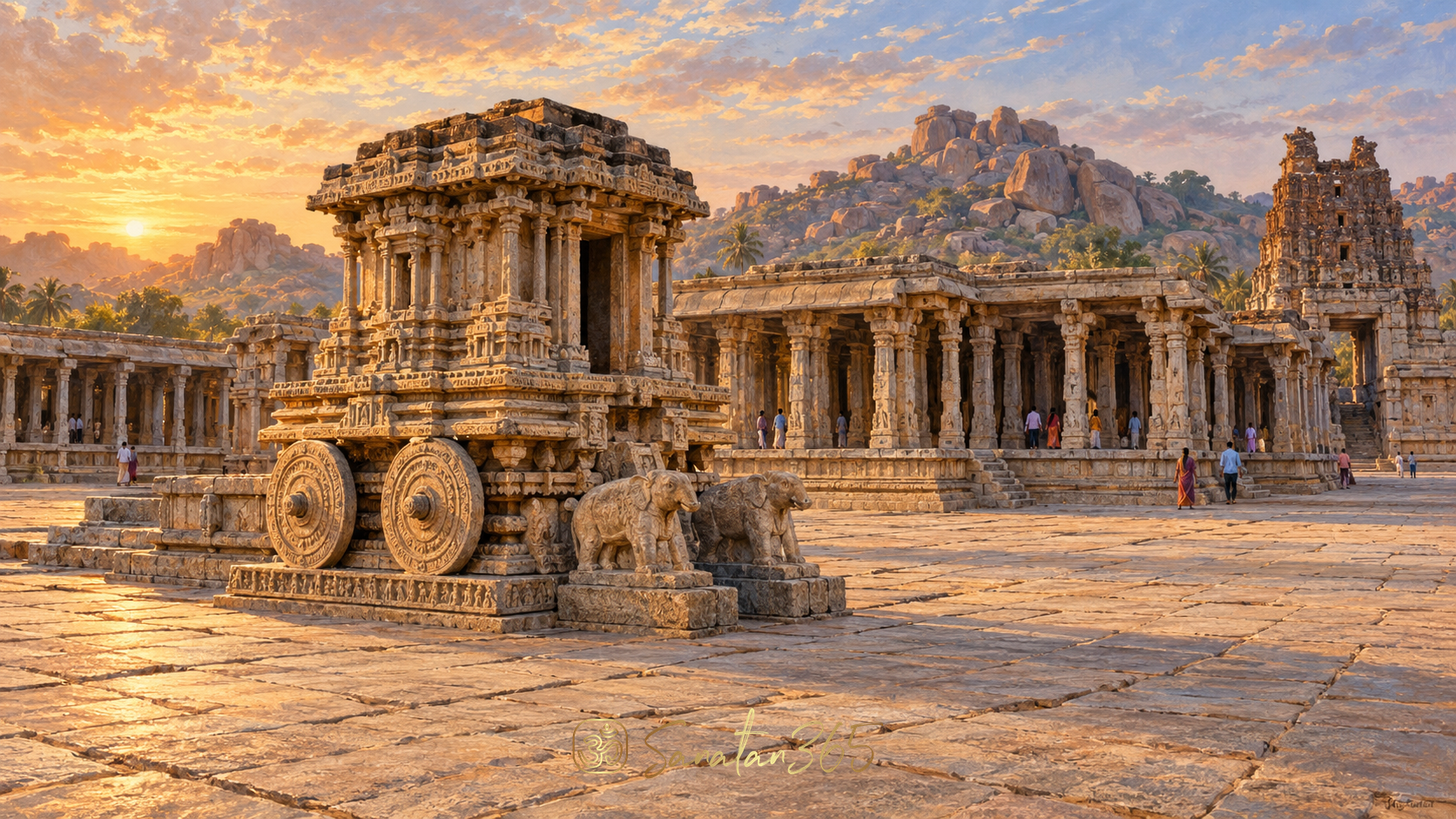
Vittala Temple Hampi: Reading the Stone Chariot and Sacred Courtyard
Understand Hampi’s Vittala Temple through its Garuda stone chariot, pillared halls, Vishnu devotion, and careful heritage visiting.
 Temples
Kirtimukha Meaning: The Face of Glory Above the Temple Door
The fierce face above a temple doorway is not a warning to turn away. Learn to recognize Kirtimukha, read its sacred story, and notice how…
 Temples
Somanathapura Keshava Temple: Three Shrines and the Art of Looking
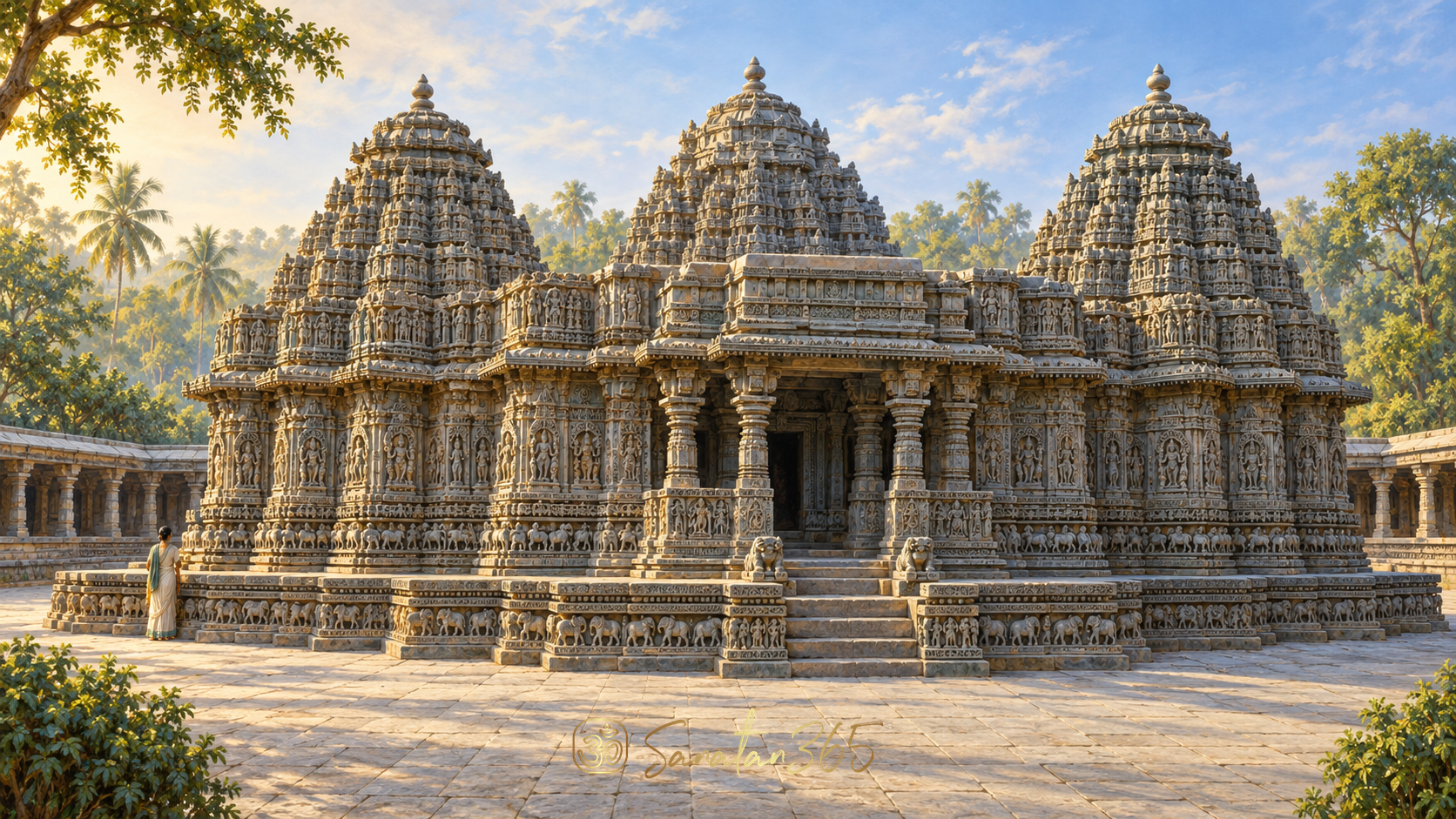
Read the star-shaped plan, three Vishnu shrines and carved narratives of Somanathapura, with a respectful guide to a protected Hoysala monu…