Vanaprastha Meaning: Hindu Retirement, Elderhood, and Inner Freedom
Vanaprastha is the Hindu life stage of graceful withdrawal, spiritual practice, and wise elderhood after the duties of household life begin to loosen.
The forest in Vanaprastha is not only a place; it is a change in the center of gravity.
Vanaprastha meaning begins with vana (वन, forest) and prastha (प्रस्थ, going forth or dwelling): the Hindu life stage in which a person gradually steps back from the central duties of household life and turns more deliberately toward reflection, service, spiritual practice, and preparation for inner freedom. In the classical four ashramas, Vanaprastha follows grihastha (गृहस्थ, householder life) and prepares the mind for deeper detachment without rejecting family love.
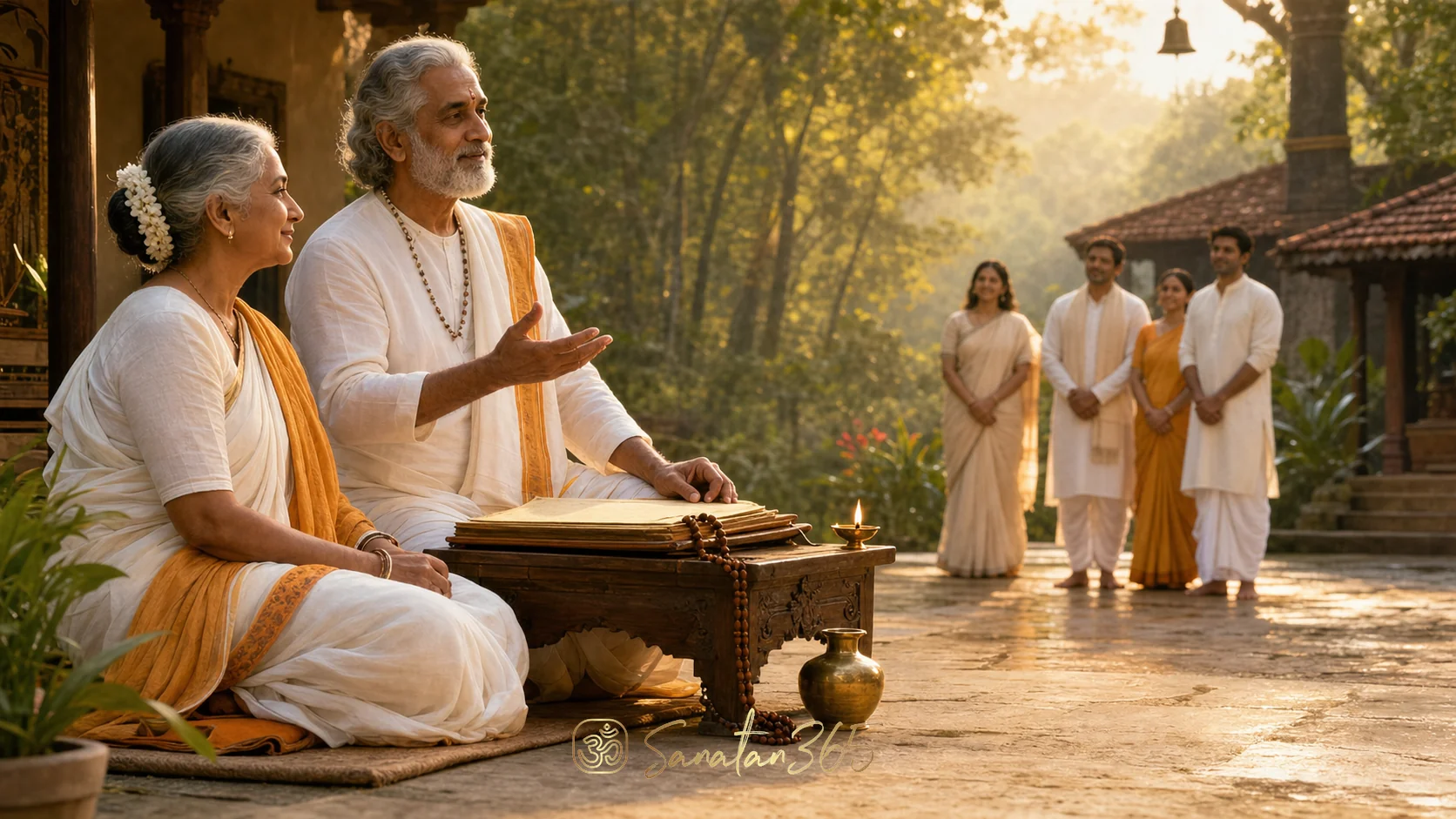
For modern seekers, Vanaprastha is less about abandoning home and more about aging with dharma, handing responsibility to the next generation, simplifying desire, and becoming a source of steadiness. It asks a difficult question: after years of building, earning, parenting, and proving, can life ripen into wisdom?
What Is Vanaprastha Meaning in the Four Ashramas?
Vanaprastha meaning becomes clear only inside the wider ashrama (आश्रम, life-stage discipline) system. Hindu thought often describes human life through four broad stages: brahmacharya (ब्रह्मचर्य, disciplined student life), grihastha (householder life), vanaprastha (forest-dweller or retiring life), and sannyasa (संन्यास, renunciation). Britannica's overview of ashrama summarizes Vanaprastha as the forest-dweller stage, traditionally associated with withdrawal from material concerns, solitude, and yogic or ascetic practice.
That framework is not a mechanical schedule. It is a map of dharma changing with age and responsibility. A student must learn. A householder must protect, earn, nourish, and serve. A Vanaprasthi, one who enters Vanaprastha, begins to release the need to control everything. A renunciate, if called to that path, lives for liberation with much deeper detachment.
The beauty of the ashrama system is that it does not treat aging as decline alone. It sees later life as a spiritual opportunity. The person who has seen wealth, affection, ambition, success, disappointment, birth, illness, and death can become less reactive and more inwardly free.
Key takeaway: Vanaprastha is the stage where life slowly moves from possession to perspective.
Why Does Vanaprastha Follow Grihastha?
Grihastha is powerful because it carries real obligations. The householder supports family, community, learning, worship, guests, and social life. Hindu tradition never treats household life as spiritually inferior by default. It is one of the great fields where dharma is practiced through patience, truthfulness, generosity, and responsibility.
Vanaprastha follows because no role should become an ego-prison. A parent must eventually stop being the only decision-maker. A founder must eventually allow successors to lead. An elder must shift from command to counsel. In many families, suffering begins when love remains but control does not loosen.
The Hindu American Foundation's Understanding Hinduism explains Vanaprastha as the stage in which one allows the next generation to take charge of ordinary affairs, reflects on deeper questions, and engages more strongly in spiritual practice. That is a gentle but profound social teaching: elderhood is not disappearance; it is a transformation of presence.
In practical terms, Vanaprastha asks a person to move from:
- Owning every outcome to blessing the next generation's growth.
- Being needed for every decision to being available for wise counsel.
- Accumulating more to simplifying what is enough.
- Social status to spiritual maturity.
- Constant doing to deeper seeing.
This is why Vanaprastha is not laziness. It may be one of the most disciplined stages of life. The discipline is no longer only waking early, earning, managing, and providing. It is learning how not to interfere, how not to cling, and how not to measure worth only through productivity.
Key takeaway: Vanaprastha protects the family from over-control and protects the elder from becoming trapped in old identity.
Does Vanaprastha Literally Mean Going to the Forest?
The word suggests the forest, and some traditional descriptions do speak of retreating to a forest life. But Hindu interpretation has long recognized both literal and symbolic meanings. The forest represents distance from noise, reduced dependence on social approval, and a life closer to contemplation.
In ancient society, the forest was not merely scenery. It was a place of tapas (तपस्, disciplined spiritual heat), study, austerity, and encounter with the deeper self. To go toward the forest meant to loosen the grip of the marketplace, court, household schedule, and public identity.
For a modern person in Mumbai, Delhi, Bengaluru, London, New Jersey, Singapore, or Dubai, the forest may be partly interior. It may mean a smaller calendar, fewer possessions, less argument, more silence, regular svadhyaya (स्वाध्याय, self-study and sacred study), and more time for japa (जप, repeated remembrance of a mantra or Divine name). It may also mean spending time in pilgrimage towns such as Varanasi, Rishikesh, Tirupati, Madurai, or Vrindavan when life permits.
This symbolic reading must not become an excuse for irresponsibility. Vanaprastha is not a dramatic escape from duties that still belong to the person. It begins after core household responsibilities have matured or begun to transfer. The spirit is gradual withdrawal, not sudden abandonment.
Key takeaway: The Vanaprastha forest is both outer and inner: a movement away from excess noise toward disciplined clarity.
What Duties Belong to Vanaprastha in Modern Life?
The duties of Vanaprastha are quieter than the duties of youth, but they are not smaller. They require maturity because they are often invisible.
First, Vanaprastha asks for handover. This can mean financial planning, clear family communication, mentorship at work, documenting responsibilities, and allowing younger adults to make real decisions. Many elders say they want the next generation to grow, but still correct every small choice. Vanaprastha asks them to guide without occupying the whole space.
Second, it asks for simplification. The goal is not forced poverty for everyone. It is freedom from endless expansion. A person may still live at home, love family, enjoy beauty, and participate in community. But the inner question changes from "How much more can I have?" to "What truly supports dharma now?"
Third, it asks for spiritual rhythm. This may include daily prayer, study of the Bhagavad Gita or Upanishads, temple visits, mantra japa, service, meditation, and honest reflection on mortality. The rhythm should be steady enough to reshape the mind, not just decorative.
Fourth, it asks for service through wisdom. Elders can become teachers, mediators, donors, guardians of family stories, listeners for the young, and protectors of ethical memory. In a world that often prizes speed over judgment, spiritually mature elders are a form of social wealth.
Fifth, it asks for emotional tapas. The Vanaprasthi must learn not to demand constant attention, not to use sacrifice as a weapon, and not to turn memory into bitterness. The real test of elderhood is whether one's presence gives peace.
Key takeaway: Modern Vanaprastha is a disciplined transition from control to counsel, consumption to simplicity, and busyness to spiritual depth.
How Is Vanaprastha Different from Retirement?
Retirement usually describes the end or reduction of paid work. Vanaprastha describes a deeper reorientation of life. A person may retire from a job and still remain restless, possessive, and status-hungry. Another person may continue light work but live in the spirit of Vanaprastha by reducing ego, mentoring others, and deepening spiritual life.
This distinction matters because modern retirement can become either boredom or entertainment. Vanaprastha offers a third possibility: ripening.
In ordinary retirement, the question may be, "What will I do with my time?" In Vanaprastha, the question becomes, "What kind of consciousness should this stage cultivate?" Time is not merely to be filled. It is to be sanctified.
The classical ashrama system also connects life stages to purushartha (पुरुषार्थ, the four aims of life): dharma (ethical order), artha (material security), kama (rightful enjoyment), and moksha (liberation). The elder years turn more directly toward moksha, but not by despising the earlier aims. They become integrated. Wealth becomes generosity. Pleasure becomes gratitude. Family becomes blessing. Memory becomes understanding.
This is especially relevant in diaspora families where elders may live between languages, countries, and changing family structures. Vanaprastha can help them see that their dignity does not depend only on being obeyed. It may also come from transmitting values with patience: reverence, truth, restraint, hospitality, seva (सेवा, selfless service), and remembrance of the Divine.
Key takeaway: Retirement ends a job; Vanaprastha begins a spiritual elderhood.
How Can a Family Honor Vanaprastha Without Forcing It?
Vanaprastha works best when the whole family understands its dignity. It should never become a way to push elders aside. Nor should elders use it to avoid necessary care, legal clarity, health decisions, or emotional repair.
A family can honor Vanaprastha through practical and respectful steps:
- Invite elders into counsel, not constant management.
- Discuss responsibilities before crisis forces the conversation.
- Preserve family stories, recipes, prayers, pilgrimage memories, and ethical lessons.
- Encourage daily spiritual practice without mocking it as old-fashioned.
- Support healthy boundaries so younger adults can grow and elders can rest.
- Make space for seva, study groups, satsang (सत्संग, company of truth), and temple life.
- Speak about aging with reverence, not embarrassment.
The younger generation also has a dharma here. Modern life often treats elders as either dependents or obstacles. Hindu wisdom offers a more refined view: elders can become anchors of continuity when respected rightly. Their role is not to dominate the future, but to give the future roots.
At the same time, elders deserve compassion when withdrawal is difficult. Identity does not loosen in a single day. Someone who spent forty years providing, deciding, protecting, or building may feel invisible when those roles fade. Vanaprastha should be approached with patience, humor, honesty, and love.
Key takeaway: A family honors Vanaprastha by letting elders become wise guides without making them feel discarded.
A Simple Vanaprastha Practice for Modern Seekers
One does not need to wait for a formal age to learn from Vanaprastha. Its spirit can begin earlier as a weekly practice of detachment.
Try this simple rhythm:
- Choose one morning each week for silence before screens.
- Read a short passage from the Bhagavad Gita, an Upanishad, or a trusted spiritual teacher.
- Ask: "What responsibility should I carry fully, and what control should I release?"
- Offer one act of seva without seeking recognition.
- Simplify one possession, habit, or resentment.
- Bless one younger person without correcting them.
This is not a performance of holiness. It is training for freedom. The mind that practices small releases will be more prepared for large releases.
Vanaprastha also teaches a powerful lesson to younger readers: build a life that can one day be handed over. Do not tie your identity so tightly to authority, wealth, praise, or activity that later life feels like a theft. Live in such a way that elderhood can become luminous.
Conclusion key takeaway: Vanaprastha meaning is the art of stepping back without becoming absent, simplifying without becoming bitter, and aging into wisdom rather than merely aging in years.
FAQ
What is Vanaprastha meaning in simple words?
Vanaprastha meaning is the Hindu life stage of gradual retirement from central household duties, with more focus on spiritual practice, reflection, service, and wise guidance for the next generation.
Is Vanaprastha the same as leaving home forever?
Not necessarily. Some traditional descriptions speak of forest life, but modern Vanaprastha is often symbolic: simplifying life, reducing control, deepening sadhana (साधना, spiritual discipline), and allowing younger family members to lead.
At what age does Vanaprastha begin?
Classical discussions often connect it with later life, especially after household duties mature or grandchildren arrive. In modern practice, the exact age matters less than readiness, responsibility, and gradual handover.
Can women follow Vanaprastha?
Yes. The spiritual principle of Vanaprastha can guide women and men. It is about elderhood, detachment, wisdom, and spiritual deepening, not only a male social role.
What is the difference between Vanaprastha and Sannyasa?
Vanaprastha is gradual withdrawal while still connected to family and society. Sannyasa is deeper renunciation, where worldly attachments are formally released for a life centered on liberation.
About the author
Sanatan365 Editorial
Bringing Sanatan Dharma to modern seekers through authentic, scripture-grounded content.
Related in Modern Life
 Modern Life
Spiritual Comparison: Practising Without Keeping Score
A practical Hindu reflection on learning from others without turning devotion into a competition of hours, pilgrimages or visible achieveme…
 Modern Life
Reading Hindu Stories With Children: Wonder, Questions, and Care
A practical family reading guide: choose one retelling, welcome questions, honour regional versions, and let a story lead to one small act…
 Modern Life
Reading Hindu Scripture in Translation: A Thoughtful Beginning
How to distinguish a translated verse from a commentary, compare editions responsibly, and build an attentive reading habit without claimin…