108 Meaning in Hinduism: Mala Beads, Mantra, and Sacred Practice
A clear guide to 108 meaning in Hinduism, including japa mala beads, mantra repetition, Upanishadic tradition, temple practice, and respectful daily use.
One number appears quietly in many Hindu homes, temples, and prayer corners: 108.
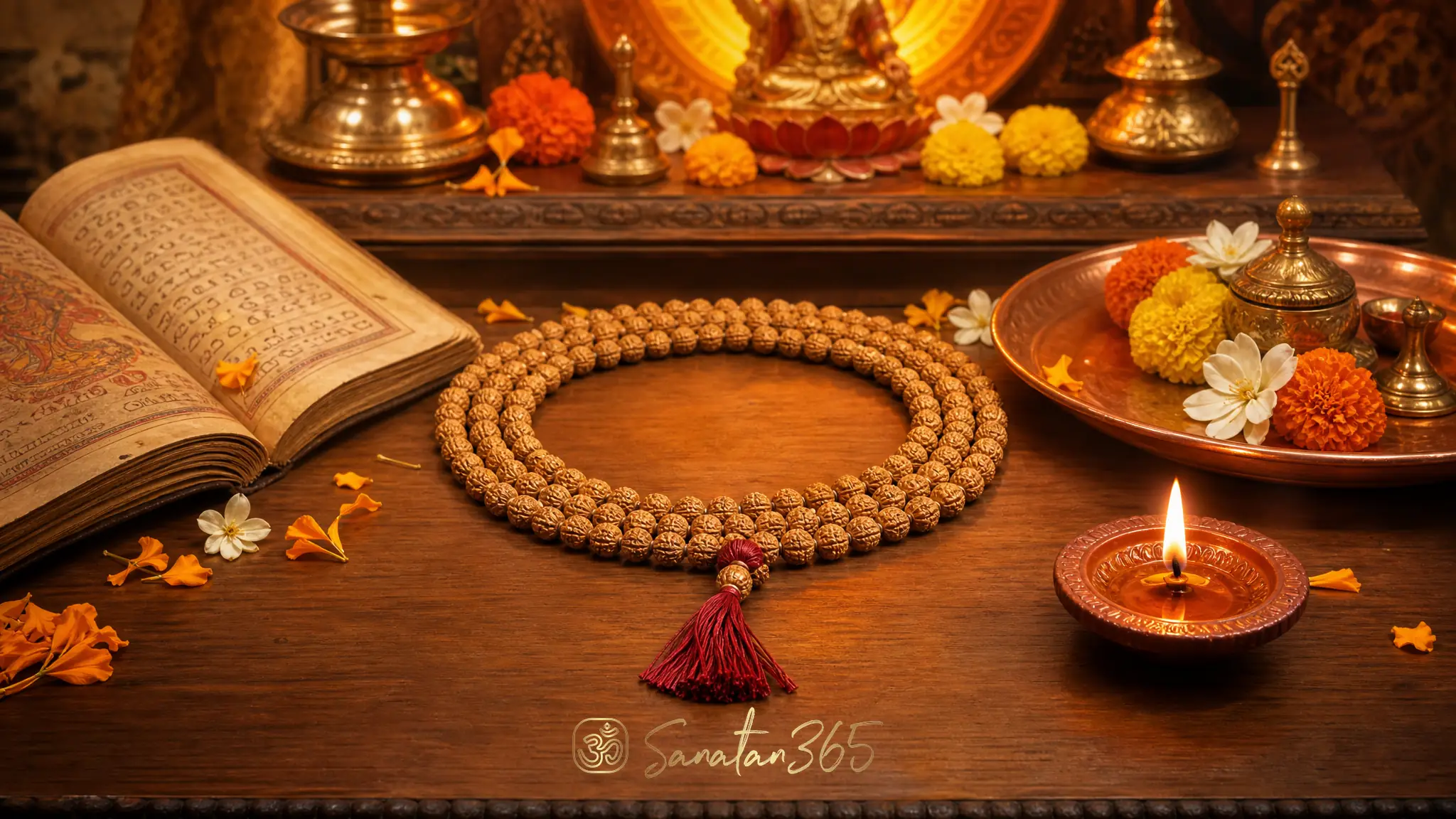
108 meaning in Hinduism begins with sacred repetition. In Hindu practice, 108 is closely associated with japa (जप, repeated recitation), mala (माला, prayer beads), mantra (मन्त्र, sacred sound or formula), and the disciplined return of attention to the Divine. A 108-bead mala helps the devotee count mantra repetitions without turning prayer into arithmetic. The number also appears in traditional lists such as 108 Upanishads, temple names, deity names, and forms of ritual remembrance.
What is 108 meaning in Hinduism?
108 meaning in Hinduism is best understood as a sacred number used to organize remembrance, discipline, and symbolic completeness. It is not a magic code that automatically produces a result. It is a devotional structure. When a seeker chants a mantra 108 times, walks through 108 names, or turns a 108-bead mala, the number gives the practice a complete round.
The most visible example is the japa mala. Britannica describes japa mala as Hindu prayer beads used in devotional recitation, and its broader discussion of ritual objects notes that Brahmanic and Buddhist rosaries commonly have 108 beads. This does not mean every Hindu practice requires 108. It means 108 became a widely recognized count for sustained repetition.
The number also carries a feeling of sacred fullness. Many traditions speak of 108 names of a deity, 108 forms of worship, or 108 steps in a temple setting. The number can mark a complete offering of attention. For a family at home, this may be as simple as chanting one chosen mantra on a mala. For a temple or festival community, it may appear in a longer litany, abhisheka (अभिषेक, ritual bathing), or nama-smarana (नामस्मरण, remembrance of the divine name).
The key is humility. Hindu tradition gives numbers symbolic depth, but it does not reduce devotion to calculation. A distracted 108 repetitions are not automatically deeper than one sincere remembrance. The count supports the heart. It does not replace the heart.
Key takeaway: 108 is a sacred count that helps Hindu practice become complete, steady, and repeatable without making devotion mechanical.
Why do japa malas often have 108 beads?
A japa mala often has 108 counting beads because the number allows a full round of mantra practice. A devotee moves bead by bead, repeating the mantra once per bead, while the fingers and breath help the mind stay present. The mala usually also has a meru (मेरु, summit or guru bead), which marks the starting and ending point. Many practitioners do not cross the meru; they turn the mala around and begin another round.
This physical rhythm matters. The mind can wander easily during prayer. A mala gives the body a quiet role in returning attention. Each bead becomes a small reminder: come back to the mantra, come back to the name, come back to awareness.
In Vaishnava homes, malas may be made of tulasi beads. In Shaiva practice, rudraksha beads are common. Some malas use sandalwood, crystal, lotus seed, or other materials according to lineage and family tradition. Britannica's overview of ritual objects notes tulasi beads in Vaishnava rosaries and lotus seeds or other materials in Shaiva settings. The material can shape the devotional association, but the essential practice remains japa.
There are also smaller malas with 54 or 27 beads, which are fractions of 108. These are often used for shorter practice, travel, or repeated rounds. A person using 27 beads may complete four rounds to reach 108. This flexibility matters because Hindu practice is lived through real households, workdays, illness, travel, and family duties. The discipline should support life, not become a source of pride.
For beginners, the most important instruction is simple: use the mala respectfully, keep it clean, and let each bead slow the mind. If a family has specific rules from a guru, sampradaya (सम्प्रदाय, lineage), or elder, those rules should be followed.
Key takeaway: A 108-bead mala turns mantra practice into a complete, embodied round of remembrance.
How is 108 connected with mantra repetition?
108 is connected with mantra repetition because it gives japa a stable container. A mantra can be repeated mentally, softly, or aloud. Without a count, the mind may stop quickly or drift into distraction. With 108 repetitions, the seeker enters a defined practice: begin, continue, complete, bow.
The word mantra is often explained as a sacred sound-form that protects or steadies the mind. In Hindu practice, mantras may invoke Shiva, Vishnu, Devi, Ganesha, Hanuman, Surya, a guru, or the formless Absolute. Some are short, like Om Namah Shivaya. Some are Vedic, like the Gayatri Mantra. Some are longer stotras or nama-japa forms.
Repetition changes the relationship with the sound. The first few repetitions may feel like ordinary speech. After many beads, the sound begins to shape breath and attention. The fingers move. The voice softens. The mind has fewer chances to run outward. This is why 108 is not only a number. It is a period of staying.
Still, Hindu teachers often warn against treating mantra like a transaction. Mantra is not a button for guaranteed wealth, romance, health, or control over events. It is a sacred discipline that should be held with shraddha (श्रद्धा, living faith or reverent trust), clarity, and ethical conduct. A mantra repeated with greed, fear, or harm in mind is spiritually confused, even if the count is correct.
For daily practice, a seeker can begin with one round of 108 repetitions or a smaller count done consistently. If a mantra has initiation rules, pronunciation rules, or lineage restrictions, one should follow a qualified teacher. If it is a commonly sung divine name or simple prayer used in family tradition, one can begin gently with reverence.
Key takeaway: 108 mantra repetitions give the mind enough time to settle into sacred sound, but sincerity and dharma matter more than counting alone.
Does 108 have a scriptural connection?
108 has several traditional connections, and one of the best known is the list of 108 Upanishads. The Upanishads (उपनिषद्, teachings received near the teacher) are philosophical texts associated with the Vedas. They explore Atman, Brahman, knowledge, meditation, liberation, and the nature of reality. A traditional list of 108 Upanishads is associated with the Muktika Upanishad, and many modern collections follow that canonical list.
This should be stated carefully. Not all Upanishads have equal historical age, authority, or prominence in every school. The principal Upanishads, such as Isha, Kena, Katha, Prashna, Mundaka, Mandukya, Taittiriya, Aitareya, Chandogya, Brihadaranyaka, and Shvetashvatara, receive especially wide attention in Vedantic study. The broader 108 list reflects a traditional sacred ordering, not a claim that every text is used identically in every lineage.
The number also appears in names and devotional lists. Many devotees recite ashtottara shatanamavali (अष्टोत्तर शतनामावली, a litany of 108 names) for a deity. There may be 108 names of Ganesha, Shiva, Vishnu, Lakshmi, Durga, Hanuman, or other revered forms, depending on the tradition. These names are not merely labels. Each name is a doorway into a quality: compassion, strength, protection, wisdom, abundance, courage, stillness, or grace.
This pattern shows how Hindu sacred numerology works at its best. A number does not stand alone. It becomes meaningful when joined to recitation, memory, scripture, worship, and transformation.
For readers studying sacred texts, the number 108 can become an invitation to move from fascination to practice. It is good to know the symbolism. It is better to read one verse deeply, chant one name sincerely, or sit with one teaching until it changes conduct.
Key takeaway: 108 is linked with traditional scriptural and devotional lists, especially the 108 Upanishads and 108 names of deities, but it should be handled with context rather than exaggeration.
What are the symbolic explanations for 108?
There are many symbolic explanations for 108, and they should be held as interpretive traditions rather than rigid proofs. Some explain 108 through astronomy, some through mathematics, some through yoga, and some through temple practice. Different teachers and communities emphasize different meanings.
One common explanation is that 108 suggests wholeness: 1 as the Divine or unity, 0 as emptiness or completeness, and 8 as infinity or the directions of space. Another sees it through the relationship of 12 zodiac signs and 9 grahas (ग्रह, celestial influences), producing 108 as 12 times 9. Others connect 108 with 27 nakshatras (नक्षत्र, lunar mansions) multiplied by 4 padas (पाद, quarters), again giving 108.
These explanations are meaningful because they place human practice inside cosmic order. The mala in the hand becomes a small reflection of a larger universe. The seeker does not chant as an isolated ego. The seeker chants as part of rita (ऋत, cosmic order), dharma (धर्म, sustaining order), and the rhythm of time.
But symbolic explanations can become weak if they are used carelessly. Some online claims about 108 are repeated without sources or stretched into certainty. A careful Hindu approach does not need exaggeration. It can say: this number has long-standing sacred associations; it appears in practice, text, ritual, and symbolism; and its deepest value is proven through the steadiness it brings to sadhana (साधना, spiritual discipline).
For diaspora families, this distinction is useful. Children may ask, "Why 108?" A good answer can include symbolism without pretending that only one explanation exists. The family can say, "Many traditions understand it as a sacred complete number. We use it to complete one round of prayer."
Key takeaway: 108 has many symbolic explanations, but its practical meaning is clearest when it helps a seeker complete a sincere round of sadhana.
How can someone use 108 respectfully at home?
Someone can use 108 respectfully at home by choosing a simple practice, keeping the intention clean, and completing the count without hurry. The setting does not need to be elaborate. A clean place, a chosen mantra, a mala, and a few minutes of undistracted attention are enough to begin.
A gentle home practice may look like this:
- Wash hands and sit in a clean, quiet place.
- Place the mala in the right hand or according to family tradition.
- Begin with a short prayer to the chosen deity, guru, or the Divine.
- Hold one bead and repeat the mantra once.
- Move bead by bead without crossing the meru bead.
- When the round is complete, sit quietly for a few breaths.
- Offer gratitude and carry the quality of the mantra into conduct.
The last step matters. If the mantra invokes peace, speech should become more peaceful. If it invokes Hanuman, service and courage should grow. If it invokes Lakshmi, prosperity should remain joined with generosity and dharma. If it invokes Shiva, stillness should become visible in how one responds to irritation.
Respect also means avoiding spiritual display. A mala used for japa is not merely an accessory. Some families and lineages are comfortable wearing malas; others keep practice malas private. Follow the tradition you have received. If you are learning from outside a family lineage, begin modestly and avoid treating sacred objects as fashion.
It is also acceptable to start smaller. A parent with young children, a student in exams, or a working professional may begin with 11, 21, or 27 repetitions. Consistency is often better than a large count done once and abandoned. Over time, 108 can become a weekly or daily rhythm.
Key takeaway: Respectful use of 108 means clean intention, steady repetition, humility with sacred objects, and conduct that reflects the prayer.
Why does 108 still matter for modern seekers?
108 still matters because modern life scatters attention. Many people live in a constant stream of alerts, tabs, deadlines, and emotional noise. A 108-bead mala is almost the opposite of that pattern. It asks the hand to slow down, the breath to steady, and the mind to return to one sacred sound again and again.
This is not nostalgia. It is disciplined attention. The older structure remains useful because human distraction has not disappeared. A seeker may use a traditional mala at a home altar in Chennai, a small travel mala in a Mumbai train, a quiet corner in New Jersey, or a temple hall in London. The geography changes. The need for remembrance remains.
108 also teaches completion without aggression. It is a count with a beginning and an end. When the round is complete, the seeker does not need to force an experience. The practice can close with gratitude. This is a gentle lesson for modern ambition: not every sacred act needs to be optimized, tracked, posted, or turned into a performance.
For families, 108 can become a shared doorway into Sanatan Dharma. Children can count beads, learn one mantra meaning, place flowers near a mala, or listen while elders chant. Adults can use one round as a boundary between work and evening worship. Elders can pass down the stories of which mala belonged to whom and which name sustained the family through difficulty.
The number matters because it is memorable. But the practice matters more because it is transformative. The highest use of 108 is not collecting facts about it. It is letting one full round of remembrance make speech kinder, desire cleaner, and attention steadier.
Key takeaway: 108 remains relevant because it gives modern seekers a simple, embodied way to return from distraction to sacred remembrance.
FAQ
What is the basic 108 meaning in Hinduism?
108 meaning in Hinduism refers to a sacred count used in japa, mala beads, mantra repetition, deity names, and traditional scriptural lists. It often represents a complete round of devotional practice.
Why are there 108 beads in a mala?
Many Hindu malas have 108 counting beads so a devotee can complete one full round of mantra japa. The mala helps the fingers, breath, and attention stay connected to the mantra.
Do I have to chant a mantra 108 times?
No. 108 is a respected traditional count, but beginners may start with smaller counts such as 11, 21, 27, or 54. If a guru or family tradition gives a specific instruction, follow that guidance.
Is 108 only a Hindu number?
No. 108 is sacred in several Dharmic traditions, including Hindu, Buddhist, and Jain settings. In Hinduism, it is especially visible through japa mala, mantra, deity names, and Upanishadic lists.
Can I wear a 108-bead mala?
Some traditions allow wearing certain malas, while others keep a japa mala private for practice. The respectful approach is to follow your family, guru, or lineage guidance and avoid treating sacred beads as casual decoration.
The single key takeaway: 108 meaning in Hinduism is not about superstition. It is a sacred structure for completing remembrance, steadying attention, and turning a simple count into living devotion.
About the author
Sanatan365 Editorial
Bringing Sanatan Dharma to modern seekers through authentic, scripture-grounded content.
Related in Numerology
 Numerology
Number 6 Meaning in Hinduism: Six Seasons and Six Tastes
Six seasons and six tastes show how Hindu cultural traditions organize change and variety. Learn their meaning without turning a sacred num…
 Numerology
Number 8 Meaning in Hinduism: Ashta, Balance, and Sacred Order
Explore the meaning of number 8 in Hinduism through ashta symbolism, the eight directions, Ashta Lakshmi, and disciplined balance without r…
 Numerology
Number 4 Meaning in Hinduism: Directions, Foundations, and Sacred Order
In Hindu thought, four often names a complete field: directions, aims of life, stages of life, and the steady work of building a balanced f…

