Number 8 Meaning in Hinduism: Ashta, Balance, and Sacred Order
Explore the meaning of number 8 in Hinduism through ashta symbolism, the eight directions, Ashta Lakshmi, and disciplined balance without reducing sacred patterns to guaranteed luck.
Eight does not carry one fixed message across all of Sanatan Dharma. Its meaning emerges through aṣṭa (अष्ट, eight): eight directions that make space feel whole, eight forms of Lakshmi that broaden prosperity beyond money, and eight-limbed disciplines that organize spiritual practice.
The number 8 meaning in Hinduism is therefore best understood as structured completeness, balance, and the gathering of many dimensions into one ordered whole. Eight may be sacred or auspicious in a particular text, ritual, temple, or lineage, but it is not a universal promise of luck. Context gives the number its meaning.
What Is the Number 8 Meaning in Hinduism?
The Sanskrit word aṣṭa means “eight.” Hindu traditions frequently use numbered groups as tools of memory and contemplation. A list of eight does more than count objects: it can map a field of experience, preserve a teaching in an ordered form, or show that one reality has several related dimensions.
This makes eight a number of completeness through arrangement. Four cardinal directions describe east, south, west, and north. Add the four intermediate directions, and the horizon becomes an eightfold field. A single idea of prosperity can appear narrow; eight forms of Lakshmi can reveal nourishment, courage, knowledge, continuity, and other kinds of flourishing. A general aspiration toward yoga becomes more disciplined when expressed through an eight-limbed framework.
Number symbolism in Hindu thought is rarely a standalone code. The same number may serve different purposes in cosmology, ritual, iconography, philosophy, and devotional poetry. Readers should therefore ask three questions:
- Which text, community, or practice uses this group of eight?
- What does each member of the group mean?
- What larger whole does the group help a devotee understand?
This approach avoids two opposite mistakes. One is dismissing sacred numbers as meaningless decoration. The other is treating every appearance of eight as proof of a single hidden force. Hindu traditions usually preserve something richer: a number becomes meaningful because it gives intelligible shape to a teaching.
The wider pattern resembles the way five is used for elements, senses, and offerings. The article on the meaning of number 5 in Hinduism shows that a sacred number is not a universal fortune formula; it is a framework whose significance depends on what is being classified.
Key takeaway: Eight signifies an ordered completeness in many Hindu settings, but its precise meaning comes from the teaching or practice in which it appears.
Why Do the Eight Directions Matter in Hindu Cosmology?
The most immediate eightfold pattern is spatial. Hindu cosmology, temple architecture, ritual planning, and sacred art may recognize eight directions: the four cardinal directions and the four points between them. Together they are called aṣṭa-dik (अष्ट-दिक्, the eight directions).
Traditional accounts associate these directions with dikpālas (दिक्पाल, guardians of direction). Lists can vary by source and period, but a common arrangement names Indra in the east, Agni in the southeast, Yama in the south, Nirrti in the southwest, Varuna in the west, Vayu in the northwest, Kubera in the north, and Ishana in the northeast. The purpose is not to imagine space as empty territory divided among competing gods. It is to perceive the world as ordered, inhabited, and worthy of reverence.
Directional symbolism shapes attention in several ways:
- Orientation: A person knows where an altar, doorway, procession, or sacred image stands in relation to a larger field.
- Protection: Guardians at boundaries represent vigilance and the preservation of order.
- Wholeness: No corner is treated as spiritually invisible; cardinal and intermediate spaces belong to the same cosmos.
- Relationship: Human action occurs within a world already filled with forces, duties, and sacred presence.
Temple plans and ritual diagrams may use directional deities according to their own āgama (आगम, lineage-specific body of ritual teaching) and architectural conventions. One should not assume that every shrine displays the same list or arrangement. Regional traditions, sectarian lineages, and historical periods can differ.
The Brihadaranyaka Upanishad uses dialogues about deities, directions, bodily functions, and the ground of experience to move inquiry from multiplicity toward deeper unity. It does not offer a modern chart of “number meanings,” but it demonstrates a characteristically Hindu method: enumerate the world carefully, then ask what sustains the many.
The eight directions can become a contemplative reminder. Ethical life does not operate only where others are watching. Dharma extends toward every “direction” of relationship: family, work, strangers, nature, memory, responsibility, private thought, and public action.
Key takeaway: The eight directions express a cosmos that is complete, relational, and morally inhabited rather than empty space.
What Does Ashta Lakshmi Teach About Prosperity?
Aṣṭa Lakṣmī (अष्टलक्ष्मी, eight forms of Lakshmi) is a devotional grouping that presents prosperity as more than cash or possessions. The exact names and ordering can vary, but widely known forms include Adi Lakshmi, Dhana Lakshmi, Dhanya Lakshmi, Gaja Lakshmi, Santana Lakshmi, Dhairya or Veera Lakshmi, Vijaya Lakshmi, and Vidya Lakshmi. The broader theology begins with Lakshmi as the Hindu goddess of wealth, good fortune, beauty, and abundance, summarized in Encyclopaedia Britannica's overview of Lakshmi.
Together, these forms widen the meaning of śrī (श्री, auspicious abundance, beauty, dignity, and flourishing). Their symbolism may include:
- spiritual grounding and primordial grace;
- material resources used responsibly;
- grain, nourishment, and food security;
- royal dignity, strength, and social wellbeing;
- continuity, family care, and future generations;
- courage and steadiness;
- worthy achievement;
- learning, insight, and skill.
This does not mean every devotee must use one standardized list. Ashta Lakshmi worship is especially visible in some South Indian traditions and modern devotional settings, while Lakshmi is honoured through many other names, hymns, and forms across India and the diaspora. Diversity should be preserved rather than forced into one universal scheme.
The eightfold framework offers an ethical correction to narrow ideas of wealth. Money without knowledge can be misused. Achievement without courage may collapse under pressure. Grain without generosity can coexist with hunger. Family continuity without respect does not create a flourishing home. Prosperity becomes auspicious when its dimensions support one another and serve life.
This reading also protects devotion from transactional claims. Worship does not guarantee a fixed financial result. Lakshmi devotion can cultivate gratitude, care, discipline, generosity, and a reverent relationship with resources. Outcomes still depend on circumstances, action, social conditions, and many causes beyond a person's control.
A household reflection inspired by Ashta Lakshmi may ask:
- Is there enough nourishment, and is food shared without waste?
- Are learning and skill treated as forms of wealth?
- Does financial planning serve dignity rather than fear or display?
- Is courage available when an ethical choice costs something?
- Does personal success increase the capacity to support others?
Key takeaway: Ashta Lakshmi teaches that true prosperity is multidimensional and becomes sacred through wisdom, courage, nourishment, continuity, and generosity.
Where Else Do Eightfold Patterns Appear in Hindu Tradition?
Eightfold groupings appear across Hindu thought, but they should not be blended into one interchangeable system. Each has its own purpose.
The eight limbs of yoga
Patanjali's Yoga Sutra 2.29 names aṣṭāṅga (अष्टाङ्ग, eight-limbed) yoga: yama, niyama, asana, pranayama, pratyahara, dharana, dhyana, and samadhi. These limbs move from ethical restraint and personal observance through posture, breath, sensory discipline, concentration, meditation, and absorption. The sequence can be checked against the Yoga Sutras translation archive, while remembering that translations of technical Sanskrit terms differ.
The number eight matters because the path is integrated. Meditation is not isolated from conduct, and posture is not the whole of yoga. Readers can explore the framework in Ashtanga Yoga and Patanjali's eight limbs.
Eight-petalled lotuses and sacred diagrams
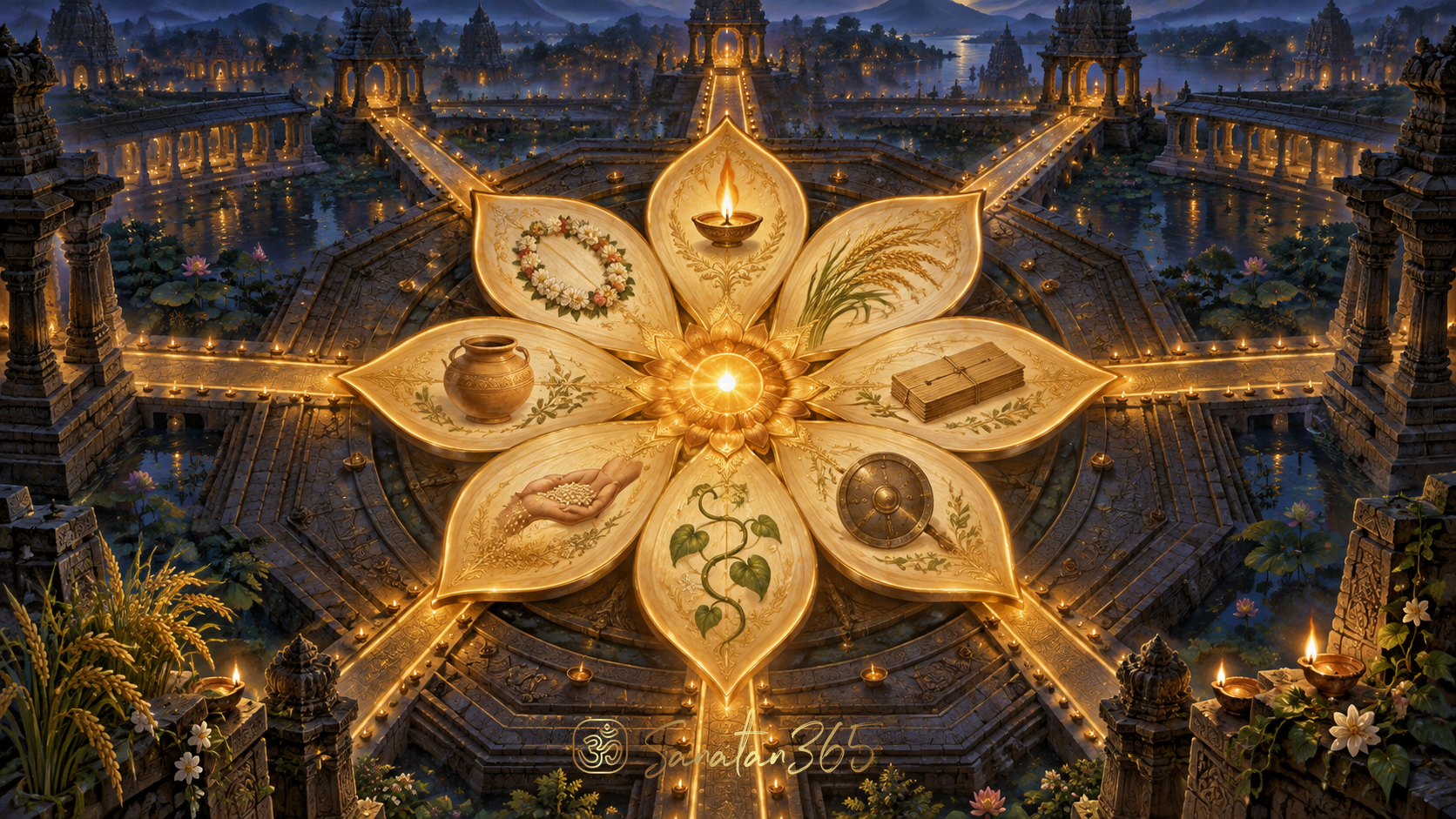
An eight-petalled lotus may appear in yantras, mandalas, temple ornament, and contemplative imagery. A lotus represents emergence, beauty, and spiritual unfolding; eight petals can mark directions, powers, or a surrounding field. The symbolism depends on the specific diagram and lineage. One should not copy a sacred design without understanding its ritual context.
Eight forms, powers, or attendants
Texts and traditions also describe groups such as eight forms of Shiva, eight siddhis, eight Bhairavas, eight Matrikas in some classifications, or eight kinds of wealth and excellence. The lists vary, and similar names can carry different meanings in different sources.
The lesson is methodological. Numbered teachings help practitioners remember complexity without losing relationship. Eight becomes a container: it holds several aspects together so they can be contemplated as a whole.
This is different from claiming that every group of eight secretly predicts the same event. Ashtanga Yoga is a discipline, Ashta Lakshmi is a devotional theology of abundance, and directional guardians organize sacred space. Their shared number invites comparison, but it does not erase their differences.
Key takeaway: Hindu eightfold systems often organize a complete field of practice or meaning, while each system retains its own textual and devotional identity.
Is Number 8 Lucky in Hinduism?
There is no single Hindu rule declaring eight universally lucky or unlucky. Auspiciousness depends on context, calendar, ritual purpose, family custom, regional tradition, and the interpretive system being used.
Some contemporary numerology systems associate eight with Saturn or Shani, discipline, delay, responsibility, authority, and karmic consequence. Such readings belong to particular numerological traditions; they should be presented as interpretations, not scientific facts or guaranteed forecasts. A birth date containing eight does not sentence someone to hardship, nor does choosing an “eight” date guarantee success.
Classical jyotiṣa (ज्योतिष, the Hindu tradition of astral calculation and interpretation) is also more complex than reducing a life to one digit. A responsible practitioner considers multiple factors and avoids fear-based certainty. Numerology should never replace financial, medical, legal, or mental-health advice.
The sacred examples explored here point beyond the simple question “Is eight lucky?” The eight directions ask whether life is properly oriented. Ashta Lakshmi asks whether prosperity is whole and ethical. Ashtanga Yoga asks whether practice includes conduct, body, breath, and mind. These are invitations to disciplined reflection, not vending machines for fortune.
A number can still carry personal devotional value. Someone may choose eight lamps, eight repetitions, or an eight-petalled design because a family tradition or authorized ritual prescribes it. The practice is meaningful when grounded in that context, approached reverently, and kept free from exaggerated promises.
Key takeaway: Eight may be auspicious in particular Hindu traditions, but it is not a universal guarantee of luck, wealth, or destiny.
How Can Sacred Number Symbolism Be Used Responsibly?
Sacred number symbolism is most useful when it deepens understanding and conduct. It becomes unreliable when detached from sources and sold as certainty.
Four principles keep interpretation grounded:
- Begin with context. Identify the scripture, ritual, temple, teacher, or regional tradition behind a group of eight.
- Study the members, not only the count. Ashta Lakshmi becomes meaningful through what each form reveals; Ashtanga Yoga becomes meaningful through actual ethical and contemplative discipline.
- Respect variation. Lists and names may differ without one community being “wrong.”
- Reject guaranteed claims. A sacred pattern can guide reflection, but it cannot promise wealth, health, marriage, or professional success.
A simple contemplative exercise can translate the symbolism into daily life. Draw an eight-petalled flower and assign one grounded value to each petal: truth, nourishment, learning, courage, generosity, restraint, service, and gratitude. At the end of a week, note which values received attention and which were neglected. This is not a traditional ritual or a prediction tool. It is a modern reflection inspired by the principle that wholeness needs several dimensions.
Devotees wishing to perform a formal Ashta Lakshmi puja, work with a yantra, or undertake lineage-specific mantra practice should learn from a qualified teacher or trusted temple tradition. Sacred diagrams and mantras are not merely aesthetic objects; their use can involve pronunciation, initiation, installation, and ritual rules.
Eight finally teaches a form of humility. A list may feel complete, yet the Divine is never exhausted by a list. Numbered teachings give the mind a structure through which to approach vastness. The structure is valuable precisely because it points beyond itself.
Key takeaway: Responsible number symbolism uses eight as a disciplined map for reflection while respecting sources, variation, and the limits of prediction.
Conclusion
The meaning of eight in Hinduism is not hidden in the digit alone. It appears when eight directions make space whole, when eight forms of Lakshmi reveal the many dimensions of prosperity, and when eight limbs of yoga unite ethics, body, breath, attention, and realization.
Across these settings, ashta gives order to multiplicity. It reminds the devotee that sacred life is rarely one-dimensional. Prosperity needs wisdom. Practice needs ethics. Space needs orientation. Symbolism needs context.
Key takeaway: Number 8 in Hinduism represents structured completeness most faithfully when its eight parts are understood together and lived without superstition or guaranteed claims.
FAQ
What does the number 8 symbolize in Hinduism?
It often symbolizes structured completeness through eightfold groups such as the eight directions, Ashta Lakshmi, and the eight limbs of yoga. The exact meaning depends on the relevant text, ritual, or tradition.
What does ashta mean in Sanskrit?
Aṣṭa (अष्ट) means “eight.” It appears in compound terms such as Ashta Lakshmi, Ashta Dikpala, and Ashtanga, meaning eight forms of Lakshmi, eight directional guardians, and eight-limbed practice respectively.
Is number 8 lucky in Hindu numerology?
Some numerology traditions treat eight as significant and associate it with discipline, responsibility, or Saturn. Hindu traditions do not share one universal rule that eight always brings luck or difficulty, and no number guarantees an outcome.
Who are the Ashta Lakshmi?
Ashta Lakshmi are eight devotional forms of Goddess Lakshmi representing dimensions of flourishing such as spiritual grounding, resources, grain, courage, learning, continuity, dignity, and worthy success. Names and ordering can vary by tradition.
Why are there eight directions in Hindu tradition?
The four cardinal and four intermediate directions create an eightfold map of space. Directional guardians and related symbolism express orientation, protection, relationship, and the idea that the entire cosmos participates in sacred order.
About the author
Sanatan365 Editorial
Bringing Sanatan Dharma to modern seekers through authentic, scripture-grounded content.
Related in Numerology
 Numerology
Number 4 Meaning in Hinduism: Directions, Foundations, and Sacred Order
In Hindu thought, four often names a complete field: directions, aims of life, stages of life, and the steady work of building a balanced f…
 Numerology
Number 5 Meaning in Hinduism: Pancha, the Senses, and Sacred Balance
The number 5 in Hinduism gathers a recurring pattern: five elements, five senses, five offerings, and disciplines that connect the human be…
 Numerology
Number 3 Meaning in Hinduism: Trimurti, Triguna, and AUM
Why does three recur across Hindu thought? Explore the Trimurti, Triguna, AUM, three worlds, three times, and the deeper principle that mak…

