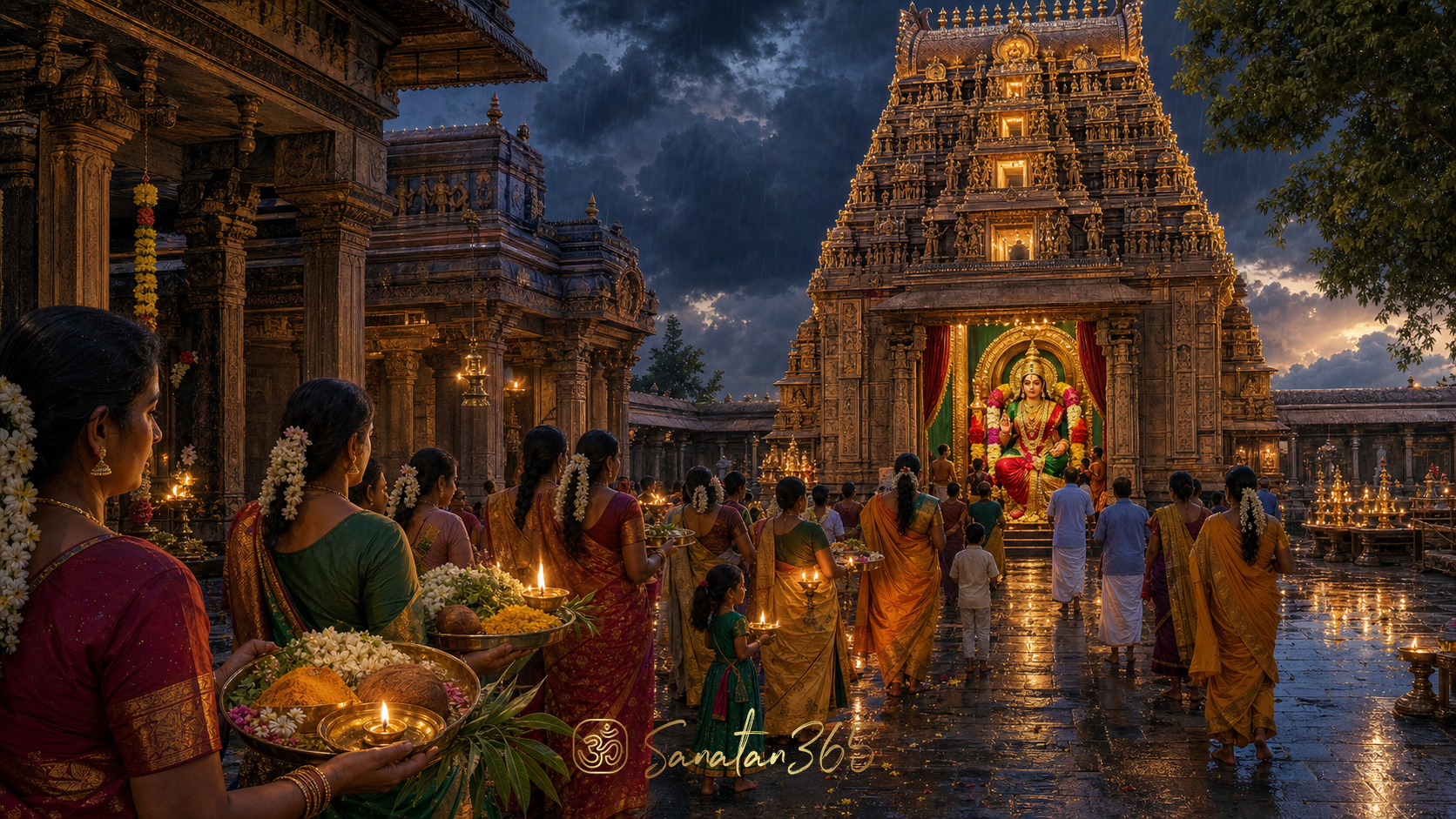
Aadi Velli 2026: Meaning, Dates, and Tamil Goddess Worship
A reverent guide to Aadi Velli 2026, the sacred Fridays of Tamil Aadi, with dates, meaning, regional traditions, and a simple home worship practice.
Five Fridays can give an entire month a devotional rhythm. In Tamil homes and Amman temples, Aadi Velli 2026 turns Friday into a recurring invitation to honour the Divine Mother through lamps, flowers, food offerings, song, and disciplined gratitude.
Aadi Velli (ஆடி வெள்ளி, Āṭi Veḷḷi, “Friday in Aadi”) refers to every Friday in the Tamil month of Aadi, which falls across July and August. These Fridays are especially associated with Shakti (शक्ति, śakti, “divine power”) and with regional forms of the Goddess lovingly addressed as Amman (அம்மன், “Mother”). In 2026, the observance begins as Aadi opens in mid-July and continues across five Fridays. Customs vary by family and temple; the heart of the practice is reverence, not ritual competition.
What Is the Meaning of Aadi Velli 2026?
The Tamil word Velli means Friday. In Hindu devotional calendars, Friday is widely associated with the Goddess, prosperity, auspiciousness, and the cultivation of beauty with restraint. Aadi intensifies that weekly association. It is a monsoon-season month in Tamil Nadu, marked by several observances connected with the Goddess, water, fertility, community protection, and renewal.
Aadi Velli is therefore not one isolated festival day. It is a weekly vrata (व्रत, vrata, “a chosen religious observance or discipline”) repeated through Aadi. Some devotees fast according to health, family custom, and guidance from elders; others keep a simpler discipline by eating sattvic food, lighting a lamp, visiting an Amman temple, or offering a sweet dish at home.
The Divine Mother may be worshipped as Mariamman, Durga, Lakshmi, Parvati, Meenakshi, Kamakshi, or another beloved local form. This diversity does not fragment the observance. It shows how one sacred principle is encountered through distinct family lineages, village traditions, temple histories, and personal relationships.
The Tamil month also carries a strong regional identity. Government tourism material describes Aadi observances as an important part of Tamil Nadu's living festival culture, while the Ministry of Tourism notes the importance of Aadi in festivals such as Aadi Thiruvathirai and Aadi Perukku (Incredible India; Utsav, Ministry of Tourism). Aadi Velli belongs to this larger seasonal world, even though its household forms can be quiet and intimate.
Key takeaway: Aadi Velli is a recurring Friday discipline of honouring the Divine Mother during Tamil Aadi, expressed through regional forms rather than one mandatory ritual.
When Are the Five Aadi Velli 2026 Dates?
In the commonly used Tamil calendar alignment for 2026, Aadi spans mid-July to mid-August. The five Fridays are:
- 17 July 2026 — the opening Friday of Aadi
- 24 July 2026
- 31 July 2026
- 7 August 2026
- 14 August 2026 — also close to the concluding phase of Aadi
Local temple calendars may label the beginning or ending boundary according to sunrise, solar ingress, and established regional panchang practice. A panchang (पञ्चाङ्ग, pañcāṅga, “five-limbed Hindu calendar”) brings together tithi, weekday, nakshatra, yoga, and karana; a Tamil solar-month observance may not map perfectly onto a generic civil-calendar listing. For a temple visit, special abhishekam, or vowed fast, devotees should confirm the local temple notice rather than treating a national list as a substitute for local timekeeping.
That regional precision is a strength. Sanatan Dharma allows sacred time to be lived through place. Chennai, Madurai, Coimbatore, Jaffna, Singapore, Kuala Lumpur, Durban, London, and Toronto may share the same Friday while adapting the actual gathering to local sunrise, work schedules, and temple access.
The five-Friday pattern also offers a practical advantage: devotion can deepen gradually. One Friday may focus on gratitude, another on courage, another on care for family, another on service, and the last on carrying the month's discipline into ordinary life.
Key takeaway: Use the five civil dates as a planning guide, but follow the calendar and timings observed by the devotee's own temple or family tradition.
Why Is the Tamil Month of Aadi Linked with the Goddess?
Aadi arrives with the transformation of the land. The monsoon is not uniform across Tamil Nadu, but the season still evokes water, agricultural hope, heat giving way to rain, and dependence on forces larger than human control. Tamil festival culture responds to that reality through river observances, village-Goddess worship, processions, vows, communal food, and temple festivals.
The Goddess in these traditions is not merely decorative. She represents protection, nourishment, moral courage, abundance, and the fierce capacity to restore balance. Shakta traditions understand Shakti as the active power through which life and consciousness become manifest. At the village level, Amman devotion is also embodied in relationships: a mother who protects, a guardian of community boundaries, and a presence approached with both affection and seriousness.
This helps explain the prominence of lamps, turmeric, kumkum, neem leaves, flowers, and prepared food. Each object carries layered regional meaning:
- Deepam (दीपम्, dīpam, “sacred lamp”) makes attention visible. Lighting it marks a shift from routine activity to worship.
- Kumkum (कुङ्कुम, kuṅkuma, vermilion powder) is offered as an auspicious sign associated with Devi.
- Turmeric signifies purity, protection, fertility, and household wellbeing in many South Indian customs.
- Neem leaves appear especially in Mariamman traditions, where they hold ritual and cultural associations with protection and seasonal wellbeing. They should not be presented as a substitute for medical care.
- Flowers and food express beauty, hospitality, and the return of what has been received to its sacred source.
Regional Goddess traditions should not be flattened into a single pan-Indian script. A Mariamman temple festival can feel different from Friday worship of Lakshmi at home, and both can remain authentic. The value lies in approaching the inherited form with attention and humility.
Readers interested in the sacred geography of Tamil Goddess worship may also explore Meenakshi Amman Temple in Madurai, while the earlier guide to Kolam Meaning: Why Tamil Homes Draw Sacred Patterns at the Threshold shows how Tamil homes turn daily space into an offering.
Key takeaway: Aadi links devotion to season, land, protection, and the nourishing power of the Divine Mother in distinctly Tamil forms.
How Is Aadi Friday Worship Practised at Home?
There is no need to imitate a temple festival inside a small home. A simple practice is often more sustainable and more reverent. The following outline is suitable only as a general guide; family sampradaya (सम्प्रदाय, sampradāya, “living tradition or lineage”) and elder guidance take precedence.
A simple Aadi Velli home practice
- Prepare the space. Clean the prayer area and bathe or wash before worship. Place an image or murti of the family's chosen form of the Goddess at the centre. The altar should have a clear sacred focal point, not be treated as decoration.
- Make a small kolam. If appropriate to the household, draw a rice-flour kolam near the threshold or prayer area. A modest design made attentively is enough.
- Light a lamp safely. Offer one or two oil lamps where children, pets, cloth, and moving air cannot create a hazard. Never leave a flame unattended.
- Offer simple materials. Flowers, turmeric, kumkum, fruit, or a home-cooked sweet may be offered according to custom and dietary needs.
- Recite a known prayer. This may be Lalita Sahasranama, Durga stotra, Lakshmi ashtottara, an Amman song, or simply the divine name taught in the family. Accuracy and sincerity matter more than length.
- Sit in silence. After the recitation, spend a few minutes observing the qualities being invoked: courage without aggression, care without control, and abundance without greed.
- Share prasada. Prasada (प्रसाद, prasāda, “grace received through a blessed offering”) can be shared with family, neighbours, or anyone welcomed into the home.
- Complete one act of service. Support a meal, help an elder, care for an animal, reduce household waste, or contribute to a trusted local cause. Devotion matures when worship changes conduct.
Fasting is optional, not a test of worthiness. Children, older adults, pregnant people, people with diabetes or other health conditions, and anyone taking medication should not adopt food restrictions without appropriate professional advice. A vrata can be expressed through restraint in speech, reduced consumption, prayer, or service when fasting is unsuitable.
Key takeaway: A lamp, a clear sacred focal point, a short prayer, and one act of service can form a complete and responsible Aadi Velli practice.
How Do Temple and Diaspora Traditions Differ?
In Tamil Nadu, devotees may attend special abhishekam (अभिषेकम्, abhiṣekam, “ritual bathing of a sacred image”), alankaram (अलङ्कारम्, alaṅkāram, “sacred adornment”), archana, or evening lamp worship. Amman temples may hold larger crowds, music, food distribution, and community vows. The exact programme belongs to the temple, and visitors should follow its dress, queue, photography, and offering rules.
Diaspora communities often preserve the Friday rhythm while adapting the hour. A temple may hold the main programme after work, combine several regional languages, or invite families to sponsor lamps and food. Homes may use locally available flowers and ingredients. Such adaptation is not a lesser form of devotion; it is how a living tradition remains rooted while crossing geography.
Three principles help maintain integrity across settings:
- Keep the subject clear. Aadi Velli is a Tamil Goddess observance, even when explained to a multilingual congregation.
- Avoid fear-based claims. Worship should not be marketed as protection guaranteed by a purchase, donation, or exact ritual performance.
- Respect temple authority. Online lists can help with planning, but local priests and published temple calendars govern local observance.
The observance can also welcome interested seekers without exclusion. Participation should be guided by respect, not by tests of identity. Sanatan tradition is diminished when devotion becomes a contest over who is “real” enough to approach the Divine Mother.
Key takeaway: Diaspora adaptation can preserve Aadi Velli faithfully when it retains the Tamil context, follows local temple guidance, and avoids transactional or fear-based devotion.
What Can the Five Fridays Teach Beyond the Ritual?
Repeated observance is valuable because it resists the desire for instant transformation. One Friday rarely settles every fear or habit. Five Fridays create a small school of attention.
A devotee might dedicate the sequence to five qualities:
- Gratitude for what nourishes life.
- Courage to meet a necessary responsibility.
- Discernment about where energy is being wasted.
- Compassion expressed through a concrete act.
- Steadiness that continues after Aadi ends.
This approach does not replace inherited worship. It draws out its ethical meaning. Turmeric and kumkum offered at the altar should be matched by speech that protects dignity. A lamp lit before Amman should be matched by clearer conduct at home. Food offered as prasada should awaken concern for those who lack food.
Aadi Velli 2026 is timely because its structure is both ancient and practical: return on Friday, begin again, and let repetition refine intention. The result need not be dramatic. A calmer home, a repaired relationship, a sustained prayer habit, or a more generous use of resources may be the most truthful sign that worship has entered daily life.
Key takeaway: The deepest fruit of five Fridays is not ritual display but steadier gratitude, courage, discernment, compassion, and service.
Conclusion
Aadi Velli gathers Tamil season, Goddess devotion, household discipline, and temple community into five sacred Fridays. Its forms are diverse, but its direction is coherent: honour the Divine Mother, receive the season with humility, and turn reverence into responsible action.
Key takeaway: Keep Aadi Velli simple enough to sustain and deep enough to shape conduct after the lamp is extinguished.
FAQ
What does Aadi Velli mean?
Aadi Velli means “Friday in Aadi.” It refers to each Friday during the Tamil month of Aadi and is especially associated with worship of Amman, Shakti, and regional forms of the Divine Mother.
What are the Aadi Velli 2026 dates?
The five Fridays are 17 July, 24 July, 31 July, 7 August, and 14 August 2026 under the commonly used Tamil calendar alignment. Confirm temple-specific timings locally.
Which Goddess is worshipped on Aadi Velli?
The form varies by family and region. Devotees may worship Mariamman, Durga, Lakshmi, Parvati, Meenakshi, Kamakshi, or their family Goddess. No single form is mandatory for every household.
Is fasting compulsory on Aadi Friday?
No. Some devotees fast according to custom, while others keep a simpler discipline of prayer, sattvic food, service, or restraint. Health and professional advice should take priority over food restriction.
Can Aadi Velli be observed outside Tamil Nadu?
Yes. Tamil diaspora families and temples observe it worldwide, adapting flowers, ingredients, and programme times while preserving its Tamil context and Goddess-centred devotional purpose.
About the author
Sanatan365 Editorial
Bringing Sanatan Dharma to modern seekers through authentic, scripture-grounded content.

