Kolam Meaning: Why Tamil Homes Draw Sacred Patterns at the Threshold
Kolam is Tamil Nadu's daily threshold art: an ephemeral pattern of dots and lines that joins beauty, auspiciousness, hospitality, skill, and renewal.
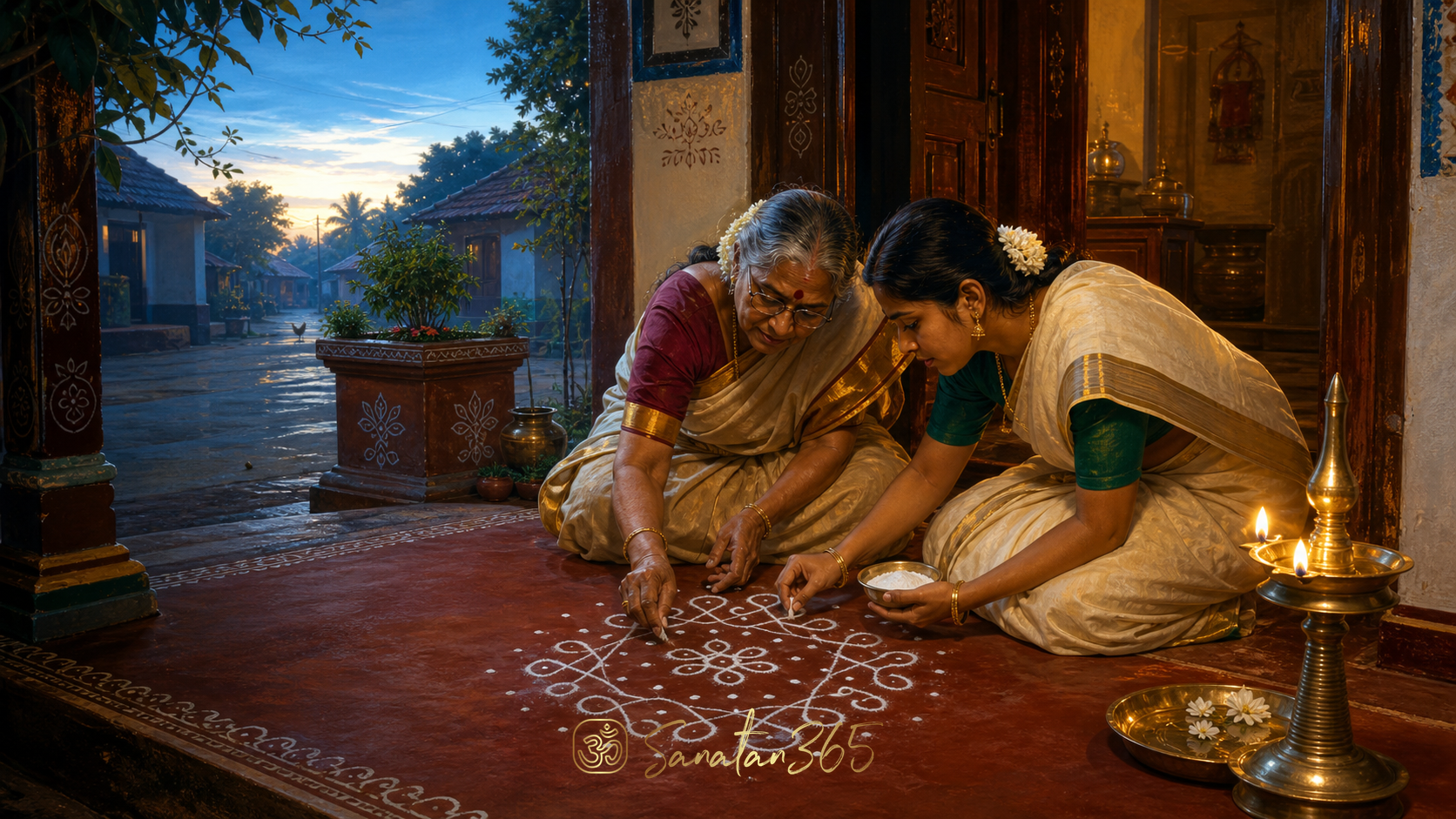
Before many Tamil homes fully wake, the threshold has already become a place of attention. A hand releases fine white powder in a measured stream; dots become loops, and the ground receives a pattern that may last only until footsteps, wind, or rain reshape it. Kolam (கோலம், an ornamental and auspicious floor pattern) is not simply decoration. Its meaning joins hospitality, disciplined skill, daily renewal, and the sacred importance of the boundary between home and world.
Traditionally drawn with rice flour or white powder, kolam appears in countless forms, from a few morning lines to intricate geometries for Margazhi, Pongal, weddings, and temple occasions. The design is meant to be made, inhabited, and eventually remade. Its impermanence is not a flaw. It is part of the practice.
What Is the Kolam Meaning in Tamil Culture?
In everyday Tamil usage, kolam can refer to beauty, form, appearance, or a decorative design. As a household practice, it usually means a pattern drawn on the ground at an entrance, courtyard, or other significant space. The Tamil Nadu Tourism overview of kolam describes it as an iconic Tamil tradition commonly created with rice flour and associated with auspiciousness and prosperity.
Yet no single English word contains the whole practice. “Floor art” captures its visual craft but can miss its ritual timing. “Decoration” can miss the discipline of preparing the threshold. “Sacred geometry” may fit some patterns but can make an everyday domestic action sound more esoteric than it is. Kolam is best understood as a living cultural practice in which art, household order, welcome, memory, and devotion overlap.
Many kolams begin with pulli (புள்ளி, dots) arranged as a grid. Lines curve around the dots, connect them, or weave into a continuous path. Other designs are freer: flowers, lamps, birds, lotuses, conches, or festival motifs. Some are spare and monochrome. Others use kaavi (காவி, red-ochre pigment) borders or colored powders.
The person drawing does not merely fill a prepared outline. She or he judges distance, pressure, rhythm, symmetry, and the flow of powder in real time. Knowledge is often transmitted by watching relatives, practising small grids, remembering pattern sequences, and gradually developing a confident hand.
Key takeaway: Kolam is a daily Tamil threshold practice in which visual beauty and auspicious household attention become one act.
Why Is Kolam Drawn at the Threshold?
A threshold is neither fully inside nor fully outside. It is where family members depart and return, guests are received, deliveries arrive, neighbors pause, and the public street meets private life. Because this boundary carries both practical and symbolic weight, tending it becomes a way of tending the relationship between the household and the wider world.
Sahapedia's study of kolam in Tamil culture describes the threshold as a meeting point of interior and exterior and situates kolam among women's ephemeral ritual arts across India. The design marks the entrance as cared for and receptive. It can communicate that the home is awake, ordered, and ready to welcome what is auspicious.
Preparation matters as much as the completed image. Traditionally, the area is swept and, in some settings, lightly dampened before drawing. Cleaning removes yesterday's dust and pattern. The new kolam then gives form to a fresh beginning. This sequence turns repetition into renewal: the same place is respectfully prepared again, but the design need not be identical.
The threshold also makes kolam public without placing it in a gallery. A design may be admired by neighbors, crossed by children, interrupted by a bicycle, softened by humidity, or eaten at the edges by small creatures when edible rice flour is used. Its life unfolds in relationship. It is offered to a shared environment rather than preserved as a private possession.
This explains why wear does not necessarily “ruin” a kolam. The pattern has already fulfilled part of its purpose by shaping the morning and marking the entrance. Tomorrow brings another opportunity to clean, remember, improvise, and begin.
Key takeaway: The threshold gives kolam its power as a practice of welcome, boundary care, and daily renewal.
Why Are Rice Flour, Dots, and Continuous Lines Used?
Rice flour is closely associated with traditional kolam, although modern practitioners also use stone powder, chalk powder, limestone-based white powder, or colored materials depending on place, weather, convenience, and occasion. Rice is a staple and a sign of nourishment in much of South India. Using an edible material at the entrance has also been interpreted as a small gesture of sharing with ants, birds, and other tiny beings.
That ecological interpretation should be expressed with care. Not every household uses edible flour today, and not every practitioner explains the custom in exactly the same way. Materials change, urban surfaces change, and family teachings differ. The broader principle remains meaningful: beauty at the threshold need not be separated from generosity and coexistence.
The dot grid provides both structure and freedom. A beginner can count spacing and follow a repeated unit. An experienced artist can visualize complex symmetries and adjust them to an uneven patch of ground. In sikku kolam, looping lines weave around dots and often form an unbroken network. The result can resemble a path that turns, crosses, encloses, and returns without losing continuity.
It is tempting to assign one universal philosophical meaning to every loop or number of dots, but living traditions resist such simplification. A specific pattern may carry a family explanation, a local name, a festival association, or no verbal interpretation at all. Sometimes its meaning lies in the making: concentration, embodied memory, proportion, and a few quiet minutes before the day's demands begin.
Mathematical interest in kolam is genuine. Dot arrays, symmetry, repetition, algorithms, and continuous paths make the designs valuable for studying pattern logic. But mathematics does not cancel devotion or domestic knowledge. The same line can be a geometric solution, an inherited art, a meditative rhythm, and an auspicious welcome.
Key takeaway: Kolam materials and geometries unite nourishment, skilled memory, pattern logic, and creative variation without requiring one fixed symbolism.
How Is Kolam Different from Rangoli, Muggu, and Alpana?
Across India, communities create related forms of floor and threshold art with regional names, materials, techniques, and ritual contexts. The broad English label “rangoli” is sometimes used for all of them, but respectful description preserves local distinctions.
- Kolam is strongly associated with Tamil Nadu and Tamil communities. Daily white patterns, dot grids, and looping line traditions are especially characteristic.
- Muggu is widely used in Telugu-speaking Andhra Pradesh and Telangana. Dot-based threshold designs and large festival forms are prominent.
- Rangoli is a broad term familiar across many regions, often associated with colorful powders and festive motifs, though practices vary greatly.
- Alpana in Bengal is traditionally painted with a rice-paste preparation and includes distinctive ritual motifs.
- Aipan in Uttarakhand is commonly created in white on a red ground for ritual spaces and occasions.
- Mandana in Rajasthan and Madhya Pradesh often uses white designs on an earth-toned or red surface.
These are related practices, not interchangeable brand names. Each has its own vocabulary and lineage. Even within Tamil Nadu, kolam changes across households, communities, rural and urban settings, and generations. A small weekday pattern in Chennai, an expansive Margazhi design in a village street, and a Tamil diaspora kolam on a washable board may all be authentic responses to different circumstances.
Migration has encouraged creative adaptation. Apartment corridors may prohibit loose powder. Cold or wet climates may make outdoor drawing impractical. Practitioners use reusable mats, boards, chalk markers, rice paste, or indoor entrance spaces. Adaptation is not automatically loss; it can be the means by which practice continues. The key is to retain respect, context, and learning rather than reducing kolam to an exotic visual trend.
Key takeaway: Kolam belongs to a wider family of Indian floor arts, but its Tamil vocabulary, techniques, and daily threshold context deserve precise recognition.
When Do Families Make Special Kolams?
For many practitioners, kolam is daily. Special times invite greater scale, color, detail, or symbolic motifs. The Tamil month of Margazhi (மார்கழி, roughly mid-December to mid-January) is especially associated with elaborate early-morning kolams. Cooler dawns, devotional observances, temple music, and neighborhood participation give the practice a distinctive seasonal presence.
Pongal (பொங்கல், the Tamil harvest festival) also brings large celebratory designs. Pots, sugarcane, the sun, cattle, grain, flowers, and overflowing abundance may appear according to local and family custom. The kolam helps frame the festival space and honor the relationships that sustain food and community.
Other occasions can include Tamil New Year, Deepavali, weddings, naming ceremonies, vrata observances, temple festivals, and household pujas. The exact design is not governed by one pan-Tamil manual. Families learn what is appropriate through local tradition and elders.
That variety protects the practice from becoming static. A ritual art remains alive because people remember forms, teach technique, respond to context, and create within inherited boundaries. The goal is not to identify one “most authentic” kolam and dismiss the rest. It is to recognize which details belong to which place and occasion.
Key takeaway: Daily kolam establishes continuity, while Margazhi, Pongal, and family ceremonies invite expanded creativity and communal celebration.
How Can a Beginner Draw a Simple Kolam Respectfully?
A beginner does not need to imitate a master design. Respect begins with naming the tradition, learning from Tamil practitioners, and choosing a simple pattern that can be completed attentively.
- Prepare the place. Sweep a small, safe area near the entrance. If loose powder could make a shared corridor slippery, use a board or another suitable surface.
- Choose the material. Rice flour honors a traditional method where practical. Kolam powder or chalk can be easier for early practice. Avoid materials that may harm animals, stain common property, or create unsafe dust.
- Make a small dot grid. Begin with three rows of three dots, evenly spaced. Large grids magnify spacing errors and can discourage a new learner.
- Practise the flow. Hold a small pinch of powder and let it fall between thumb and forefinger. Draw short straight lines and curves before attempting the pattern.
- Loop around the dots. Use one continuous line if possible, curving around each dot and returning to the beginning. The first goal is steady attention, not perfection.
- Observe before correcting. Unevenness teaches where spacing or pressure changed. Constantly wiping every imperfect line can interrupt learning.
- Credit the tradition. If sharing the design publicly, call it kolam and acknowledge its Tamil context. Learning is more respectful than treating the pattern as anonymous “boho” decoration.
Children and adults of any background can learn when the practice is approached with humility. In many homes, women have been its principal knowledge holders; recognizing that labor and artistry matters. Respect also means not turning gendered history into a rule that only one gender may participate today.
The final design may be modest, but the practice is already substantial: clean a boundary, steady the hand, remember a pattern, make beauty, and release the result to the day.
Key takeaway: A respectful beginner starts small, learns the Tamil context, uses safe materials, and treats attention as more important than display.
Conclusion
Kolam transforms an ordinary patch of ground into a daily act of relationship. It links inside and outside, inherited knowledge and fresh improvisation, geometric order and living impermanence. Its lines welcome without needing to last. Its repetition preserves tradition without demanding that every morning look the same.
To understand kolam meaning is therefore to see more than the finished pattern. The sweeping, pinching, counting, curving, teaching, crossing, fading, and beginning again are all part of the art.
Key takeaway: Kolam makes the threshold a place where care becomes visible and every day receives a deliberate beginning.
FAQ
What does kolam mean?
Kolam is a Tamil term for an ornamental form or pattern. In household practice, it commonly refers to auspicious floor designs drawn at thresholds with rice flour or white powder.
Why is kolam drawn in front of the house?
The entrance is the meeting place of home and outside world. Drawing kolam there marks the threshold as clean, cared for, welcoming, and ready for an auspicious new day.
Is kolam always made with rice flour?
No. Rice flour is traditional and culturally significant, but practitioners also use kolam powder, chalk, stone powder, colored powder, rice paste, or reusable surfaces according to context.
What is a pulli kolam?
A pulli kolam begins with a grid of dots. Lines may connect the dots or loop around them to form symmetrical geometric patterns. Pulli means dot in Tamil.
Is kolam the same as rangoli?
They are related Indian floor-art traditions, and rangoli is sometimes used as a broad label. Kolam has distinct Tamil forms, vocabulary, daily threshold contexts, and especially strong dot-grid and looping-line traditions.
About the author
Sanatan365 Editorial
Bringing Sanatan Dharma to modern seekers through authentic, scripture-grounded content.
Related in Rituals
 Rituals
Vastra Offering Meaning: Why Clothing Is Offered in Puja
The offering of cloth turns ordinary care into sacred hospitality. Understand vastra in Hindu worship without confusing expense with devoti…
 Rituals
Madhuparka Meaning: Sweetness and Sacred Hospitality
Read madhuparka as a ceremonial honey mixture of welcome, exploring textual recipes, guest reception and its distinction from panchamrita.
 Rituals
Samavartana Meaning: Returning Home After Sacred Study
Samavartana marks the completion of traditional study through a ceremonial bath and return. Its lasting question is how learning becomes re…

