Ashtanga Yoga Meaning: Patanjali's Eight Limbs of Inner Discipline
Ashtanga Yoga is Patanjali's eight-limbed path of yoga: ethics, observance, posture, breath, sense discipline, concentration, meditation, and samadhi.
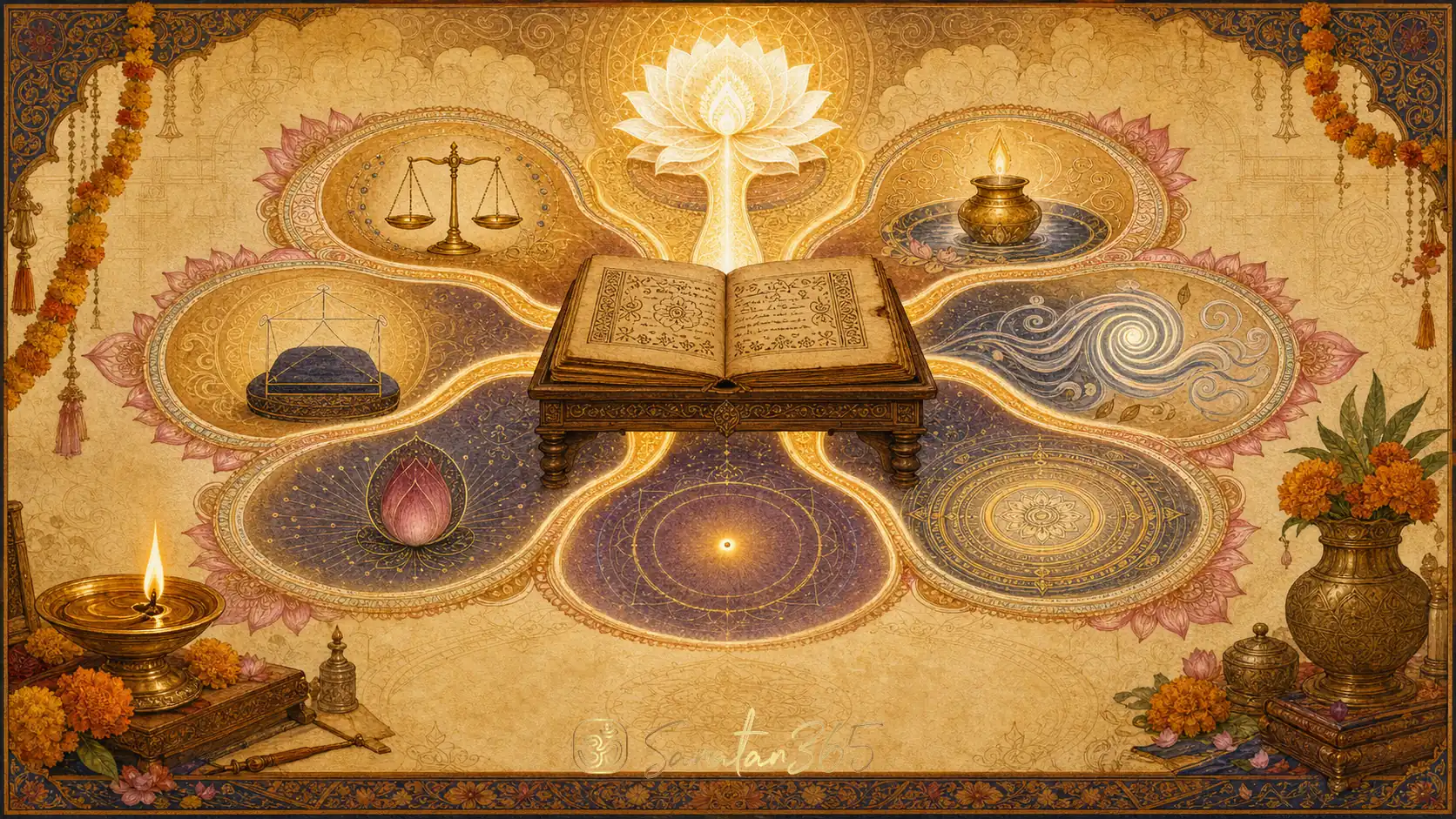
Yoga is often introduced through posture, but Patanjali's map begins much wider than the body. Ashtanga Yoga meaning refers to ashta (अष्ट, eight) and anga (अङ्ग, limb): the eight limbs of yoga named in the Yoga Sutras as yama, niyama, asana, pranayama, pratyahara, dharana, dhyana, and samadhi. In simple terms, Ashtanga Yoga is a complete discipline for purifying conduct, steadying the body, refining breath, gathering the senses, training attention, entering meditation, and resting in deep spiritual absorption.
This matters especially during Yoga Week, as International Day of Yoga is observed globally on June 21 and the United Nations describes yoga as a holistic approach to health and well-being. But the Hindu scriptural view of yoga is not limited to wellness. In Patanjali's Yoga Sutras, yoga is a sacred psychology of freedom: the gradual calming of scattered consciousness until the inner witness becomes clear.
What Is Ashtanga Yoga Meaning in the Yoga Sutras?
The clearest scriptural starting point is Yoga Sutra 2.29, where Patanjali lists the eight limbs: yama, niyama, asana, pranayama, pratyahara, dharana, dhyana, and samadhi. A traditional English rendering from the Internet Sacred Text Archive describes them as self-restraint, fixed observance, posture, regulation of energy, control of the senses, concentration, meditation, and realization. The same structure is also widely taught in modern yoga schools as the "eight limbs of yoga."
The word Ashtanga should be understood carefully here. In this article, it means Patanjali's eight-limbed path, not only the modern physical style commonly called Ashtanga Vinyasa Yoga. The two are related through the wider yoga tradition, but they are not identical. Patanjali's Ashtanga Yoga is not a sequence of athletic postures. It is an integrated path of ethical, devotional, mental, and contemplative refinement.
The inner aim appears near the beginning of the text. Yoga Sutra 1.2 is often translated as "yoga is the stilling of the fluctuations of the mind." In Sanskrit terms, citta (चित्त, mind-field or consciousness) becomes steady as vritti (वृत्ति, mental movement or fluctuation) is restrained through nirodha (निरोध, stilling or disciplined cessation). That definition makes the eight limbs easier to understand: each limb removes a different form of restlessness.
- Yama disciplines harmful outward behavior.
- Niyama purifies the seeker's inner habits.
- Asana steadies the body.
- Pranayama refines breath and prana.
- Pratyahara gathers the senses inward.
- Dharana trains attention.
- Dhyana matures attention into meditation.
- Samadhi completes meditation in absorbed clarity.
Key takeaway: Ashtanga Yoga is Patanjali's full map for moving from scattered living to steady awareness.
Why Do the Eight Limbs Begin With Ethics?
Many modern readers expect yoga to begin with flexibility. Patanjali begins with yama (यम, restraint or ethical discipline) and niyama (नियम, observance or inner discipline) because unsteady conduct creates an unsteady mind.
The five yamas are traditionally listed as ahimsa (अहिंसा, non-harming), satya (सत्य, truthfulness), asteya (अस्तेय, non-stealing), brahmacharya (ब्रह्मचर्य, wise conservation of energy), and aparigraha (अपरिग्रह, non-grasping). These are not merely social rules. They reduce agitation at its roots. A person who harms, lies, steals, overindulges, or clings must carry the mental noise of those actions.
The five niyamas are shaucha (शौच, purity), santosha (सन्तोष, contentment), tapas (तपस्, disciplined effort), svadhyaya (स्वाध्याय, self-study and sacred study), and Ishvara pranidhana (ईश्वरप्रणिधान, surrender to the Divine). These observances turn the seeker inward without making spiritual life abstract. They make the home, body, speech, and daily routine part of practice.
This ethical beginning also protects yoga from becoming ego training. Without yama and niyama, posture can feed pride, breathwork can feed power-seeking, and meditation can become escape. With them, every later limb rests on humility.
For a family or diaspora reader, this is one of Patanjali's most practical teachings. A child's first yoga lesson may not be a pose. It may be telling the truth gently, sharing without greed, sitting with contentment, or remembering the Divine before beginning homework. In that sense, Ashtanga Yoga belongs as much in the kitchen, classroom, and workplace as it does on a mat.
Key takeaway: Patanjali places ethics first because the mind cannot become still while life is built on harm, falsehood, or grasping.
How Do Asana and Pranayama Fit Into Ashtanga Yoga Meaning?
Asana (आसन, posture or seat) is the third limb, not the whole of yoga. Patanjali's famous instruction in Yoga Sutra 2.46 describes posture as sthira-sukham asanam: steady and easeful. The point is not performance. The point is a body capable of sitting, breathing, praying, studying, and meditating without constant disturbance.
This does not reduce the value of physical yoga. It deepens it. A posture becomes yogic when it creates steadiness instead of display. A simple seated posture practiced with awareness may serve Patanjali's aim more directly than a difficult pose done with restlessness.
Pranayama (प्राणायाम, regulation or expansion of vital breath) follows asana. Prana (प्राण, life-force or vital energy) is not merely oxygen, though breath is its most accessible doorway. When breathing becomes slow, attentive, and balanced, the nervous system settles and attention becomes more available. This is why many Hindu and yogic traditions treat breath as a bridge between body and mind.
During global Yoga Week, public events often emphasize shared movement and accessible breathing practices. That can be valuable. But Patanjali reminds seekers to place these practices inside a larger sacred frame. Asana and pranayama are not isolated wellness techniques; they prepare the person for inwardness.
A simple daily approach can follow this order:
- Begin with one yama or niyama as the day's intention.
- Sit or move in a steady, easeful way.
- Let the breath become slower without force.
- Close with a moment of gratitude or remembrance.
Key takeaway: In Ashtanga Yoga, posture and breath are sacred preparations for a steadier, more inward mind.
What Is Pratyahara, Dharana, and Dhyana?
The middle and inner limbs are where Patanjali's psychology becomes especially subtle.
Pratyahara (प्रत्याहार, withdrawal or gathering of the senses) does not mean hatred of the world. It means the senses stop dragging the mind outward without discrimination. A person may still see, hear, work, cook, study, and speak, but the mind is less enslaved by every sound, screen, appetite, or opinion.
In modern life, pratyahara may be the most neglected limb. Constant notification, comparison, and stimulation keep attention scattered. A gentle practice of pratyahara could be as simple as eating one meal without a screen, chanting quietly before checking messages, or walking near a temple or garden without photographing every moment.
Dharana (धारणा, concentration) is the next limb. The mind is placed on one chosen focus: a mantra, the breath, a sacred image, a moral reflection, or the presence of the Divine. At first, the mind wanders repeatedly. Dharana is the respectful return.
Dhyana (ध्यान, meditation) is more continuous. The repeated return of dharana becomes an unbroken flow of attention. Many readers know this difference from daily life. Reading one sentence while distracted is not the same as entering a book deeply. Looking at a diya while thoughts race is not the same as resting awareness in its flame. Dhyana is that deeper continuity.
These limbs are not reserved for monks. A parent can practice pratyahara by pausing before reacting. A student can practice dharana by studying with full attention. A devotee can practice dhyana by letting japa (जप, mantra repetition) become steady instead of mechanical.
Key takeaway: The inner limbs train attention to move from sensory scattering toward sustained contemplative awareness.
What Does Samadhi Mean in Patanjali's Path?
Samadhi (समाधि, absorption or integration) is the eighth limb and the culmination of the path. It is not a dramatic mood or a claim of superiority. In the Yoga Sutras, samadhi points to deep collectedness in which the separation between attention and its sacred focus becomes profoundly quiet.
Different Hindu traditions explain samadhi with different theological and philosophical nuance. Some emphasize the distinction of purusha (पुरुष, witnessing consciousness) from prakriti (प्रकृति, nature or material process). Some devotional traditions speak more in terms of surrender, grace, and absorption in the Divine. A careful reader need not flatten those differences. The common thread is that ordinary ego-noise becomes transparent.
Samadhi also helps correct a common misunderstanding. The eight limbs are often drawn as a ladder, but they also function like a living body. Ethics support meditation. Meditation strengthens ethics. Breath supports concentration. Concentration makes breath subtler. Surrender transforms effort. Effort makes surrender sincere.
For most householders, the practical lesson is not to chase extraordinary states. The lesson is to honor direction. If daily life becomes less harmful, speech becomes more truthful, the body becomes steadier, breath becomes calmer, senses become less scattered, and attention becomes more prayerful, the path is already alive.
Key takeaway: Samadhi is the ripening of yoga into absorbed clarity, but the path is lived through every limb, every day.
How Can a Modern Seeker Practice the Eight Limbs Today?
Ashtanga Yoga becomes useful when it leaves the page and enters routine. The Yoga Sutras are concise, but their discipline is spacious enough for householders, students, professionals, elders, and seekers in the Indian diaspora.
One simple weekly rhythm can make the eight limbs tangible:
- Monday: Practice ahimsa through gentler speech.
- Tuesday: Practice satya by removing one small exaggeration.
- Wednesday: Practice shaucha by cleaning a prayer space or study space.
- Thursday: Practice svadhyaya by reading a few verses from a sacred text.
- Friday: Practice asana and pranayama without comparison.
- Saturday: Practice pratyahara by reducing one unnecessary stimulation.
- Sunday: Practice dharana and dhyana through mantra, breath, or silent prayer.
This is not a replacement for a teacher, lineage, or deeper study. It is a beginning. Patanjali's genius is that the path can be understood at many levels. A beginner sees eight helpful practices. A serious student sees a disciplined psychology of liberation. A devotee sees the mind made ready for Divine remembrance.
The most important point is balance. If a person practices posture but ignores speech, the path is incomplete. If a person reads philosophy but never disciplines attention, the path is incomplete. If a person meditates but remains harsh at home, the path is incomplete. The eight limbs keep correcting each other.
Key takeaway: A modern seeker practices Ashtanga Yoga by bringing ethics, body, breath, attention, and devotion into one coherent daily discipline.
FAQ
What is the simple Ashtanga Yoga meaning?
Ashtanga Yoga means the eight-limbed path of yoga taught by Patanjali. The eight limbs are yama, niyama, asana, pranayama, pratyahara, dharana, dhyana, and samadhi.
Is Ashtanga Yoga the same as modern Ashtanga Vinyasa Yoga?
Not exactly. Patanjali's Ashtanga Yoga is the scriptural eight-limbed path. Modern Ashtanga Vinyasa Yoga is a physical practice system that draws from the broader yoga tradition but should not be confused with the full eight-limb framework.
Why are yama and niyama important?
Yama and niyama create the ethical and inner foundation for yoga. Without non-harming, truthfulness, purity, contentment, self-study, and surrender, deeper practices can become restless or ego-driven.
Which Yoga Sutra lists the eight limbs?
Yoga Sutra 2.29 lists the eight limbs: yama, niyama, asana, pranayama, pratyahara, dharana, dhyana, and samadhi.
Can householders practice Ashtanga Yoga?
Yes. Householders can practice the eight limbs through truthful speech, disciplined routine, steady posture, mindful breath, sense restraint, focused work, meditation, and remembrance of the Divine in daily life.
Ashtanga Yoga is not a narrow technique but a complete discipline of life. Its single key takeaway is this: Patanjali's eight limbs invite the seeker to make conduct, body, breath, senses, attention, meditation, and surrender part of one sacred movement toward inner steadiness.
About the author
Sanatan365 Editorial
Bringing Sanatan Dharma to modern seekers through authentic, scripture-grounded content.
Related in Scriptures
 Scriptures
Amritabindu Upanishad Meaning: The Mind, Bondage, and Freedom
A close reading of the Amritabindu Upanishad on attachment, the one Self, and the difference between collecting teachings and understanding…
 Scriptures
Tattva Bodha Meaning: Four Qualifications for Clear Self-Inquiry
A beginner-friendly reading of Tattva Bodha, its four qualifications, six inner disciplines, and careful distinction between preparation an…
 Scriptures
Nirvana Shatakam Meaning: Six Verses of Self-Inquiry
Read the six verses of Nirvana Shatakam as careful Advaita self-inquiry, understand Shivoham, and distinguish contemplative freedom from ne…