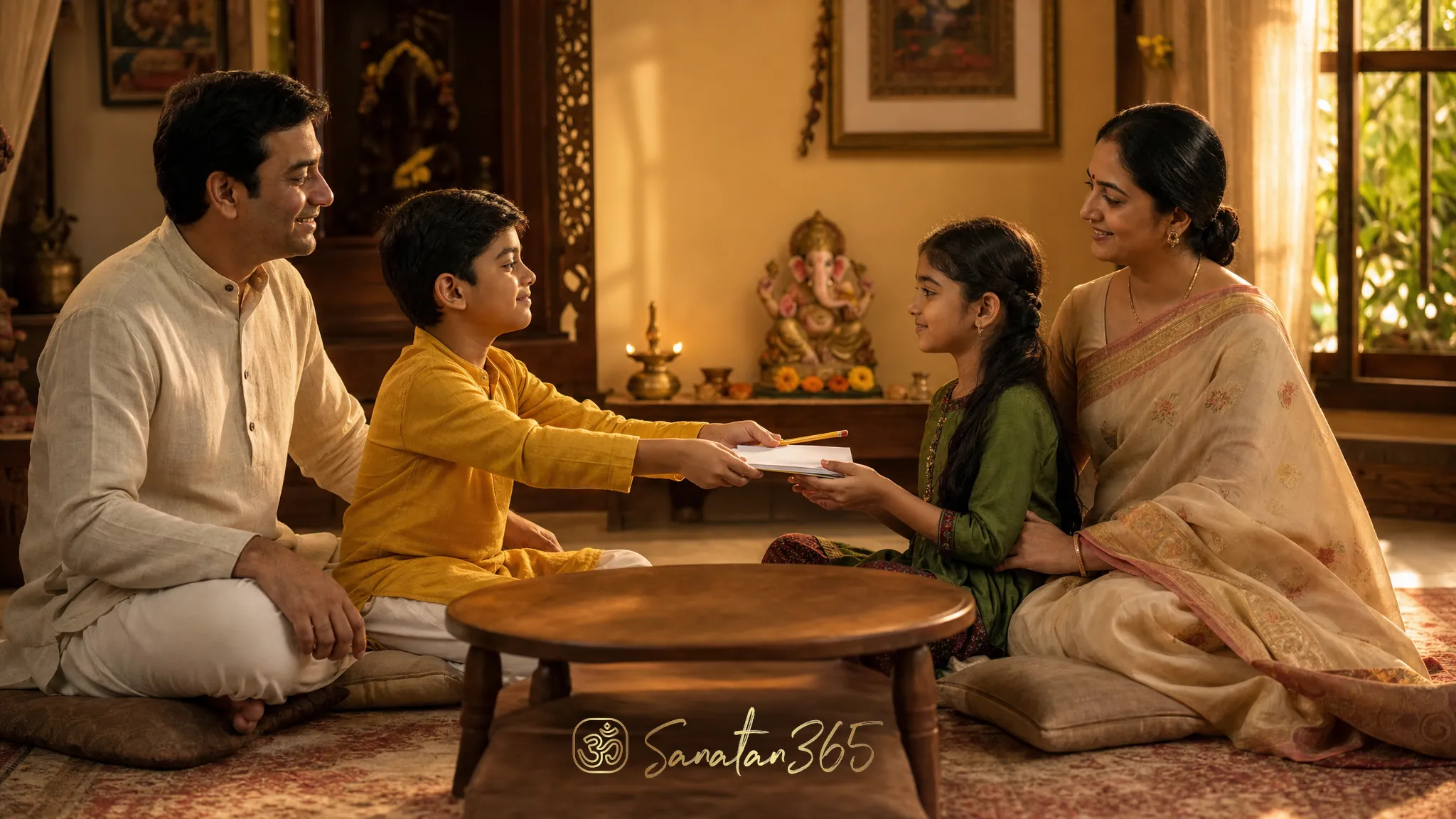
Asteya Meaning for Kids: A Hindu Lesson on Honesty, Contentment, and Care
A gentle guide to asteya meaning for kids, showing how non-stealing in Hindu ethics includes honesty, respect for time, contentment, and care.
A child can learn asteya before learning any Sanskrit word for it.
Asteya meaning for kids begins with asteya (अस्तेय, non-stealing): not taking what has not been freely given. In Hindu ethics, asteya is wider than stealing an object. It includes respecting another person's time, trust, ideas, attention, and belongings. Patanjali lists asteya among the five yamas (यम, ethical restraints) in Yoga Sutra 2.30, alongside ahimsa, satya, brahmacharya, and aparigraha. For children, asteya becomes a simple daily lesson: use what is yours, ask before taking, return what you borrow, and let contentment guide desire.
This makes asteya a practical family virtue, not only a rule against theft. It trains honesty, patience, gratitude, and care.
What Is Asteya Meaning for Kids?
Asteya meaning for kids can be explained in one sentence: do not take what belongs to someone else, and do not take more than your rightful share.
The Sanskrit word joins "a," meaning not, with "steya," meaning stealing. The Centre for Yoga Studies explains Yoga Sutra 2.30 as naming asteya among the yamas, the restraints that guide conduct before deeper yogic practice. Hindupedia's overview of asteya also connects the word with non-stealing and its place in Patanjali's yoga teaching. These sources show that asteya is not a small social habit. It is part of the ethical foundation of spiritual life.
For a child, however, the teaching should not begin with fear. It should begin with clarity:
- This toy is mine.
- That toy is yours.
- If I want to use yours, I ask.
- If you say no, I respect it.
- If I borrow it, I return it with care.
This is not only politeness. It is dharma (धर्म, right order and responsibility) made visible in small actions. A child who learns asteya learns that other people have dignity. Their things, time, feelings, and work are not available for grabbing.
Asteya also protects the child's own mind. When a child takes secretly, the heart becomes restless. There may be fear of being caught, shame, defensiveness, or the habit of hiding. When the child asks, waits, and returns, the mind stays lighter.
Key takeaway: Asteya teaches children that honesty begins by respecting what belongs to others.
Why Does Non-Stealing in Hinduism Include More Than Objects?
Non-stealing in Hinduism is not limited to taking money, sweets, pencils, or toys. It also includes subtler forms of taking.
A child may not steal an object, yet still take more than is fair. This can happen when one child dominates every game, interrupts constantly, copies another child's homework, grabs credit for a group project, or wastes a parent's time after making a promise. These examples should be taught gently, not with harsh labels. The goal is moral awareness, not humiliation.
Asteya asks a deeper question: "Am I taking something that was not truly given?"
That question can apply to:
- Objects: taking a toy, book, snack, pen, or game without asking.
- Time: making others wait repeatedly after agreeing to be ready.
- Attention: interrupting every conversation because one wants to be the center.
- Effort: copying homework or claiming credit for another child's work.
- Trust: hiding the truth after borrowing or breaking something.
- Shared resources: taking the biggest portion without caring whether others have enough.
This wider view helps children understand that asteya is connected to Satya Meaning, the practice of truthfulness. A child who takes secretly often needs a second mistake to hide the first. Asteya and satya protect each other: non-stealing keeps actions clean, and truthfulness keeps speech clean.
Asteya is also connected to Ahimsa Meaning, because stealing can hurt others. If a child takes another child's lunch, the harm is obvious. If a child copies homework, the harm may be less visible, but it weakens trust and effort. If a child grabs every turn in a game, friendship becomes strained.
Parents and teachers can make this concrete by asking calm questions:
- Was it yours to take?
- Did the other person freely agree?
- Did everyone get a fair turn?
- Did your action make someone's heart heavy?
- What can you do now to repair it?
These questions are better than shouting because they teach the child to think. A frightened child may obey for one day. A thoughtful child begins to carry dharma inside.
Key takeaway: Asteya includes objects, time, credit, trust, and fairness because Hindu ethics trains the whole character.
How Can Parents Teach Asteya Without Shame?
Asteya should be taught with firmness and warmth together. Children need clear boundaries, but they also need a path back after a mistake.
The first step is to separate the action from the child's identity. A parent can say, "Taking the pencil without asking was wrong," instead of, "You are bad." This matters. Hindu family teaching should help a child grow in conscience, not become trapped in shame.
The second step is repair. If a child takes something, the child can return it, apologize, replace it when possible, or do a small act of service. Repair teaches that karma (कर्म, action and consequence) is not fatalistic. New action can correct old action. For a child-friendly explanation, see Karma Meaning for Kids.
The third step is to notice the desire behind the action. A child may steal because of envy, fear, pressure, excitement, or the feeling that asking will bring a no. Asteya does not only say, "Do not take." It also asks, "Why did the wanting become so strong?"
Parents can use a simple three-part conversation:
- Name the action: "You took Riya's eraser without asking."
- Name the value: "In our home, we practice asteya. We do not take what is not freely given."
- Name the repair: "Please return it, say sorry, and ask next time."
This approach is especially useful for younger children because it is repeatable. The child begins to hear asteya as a family word, not as a lecture.
Stories also help. Prahlad's faith, Shabari's patience, Sudama's humility, and Yudhishthira's struggles with truth can all open conversations about desire, honesty, and dharma. The story should not become a threat. It should become a mirror.
Children also learn asteya by watching adults. If adults boast about cutting lines, copying content, cheating a system, wasting someone else's time, or taking credit unfairly, children absorb that lesson quickly. If adults return extra change, acknowledge help, ask before borrowing, and apologize when wrong, children see asteya embodied.
Key takeaway: Asteya becomes teachable when correction includes repair, not shame.
What Are Simple Asteya Practices for Home and School?
Asteya grows through small repeated habits. Families do not need a formal lesson every day. They need a culture where asking, returning, sharing, and fairness are normal.
Here are practical asteya exercises for children:
- The ask-before-taking rule: before using another person's item, ask clearly and wait for the answer.
- The return-better rule: borrowed books, toys, pencils, and clothes should return clean and cared for.
- The fair-share rule: when food, games, or turns are shared, check whether everyone received enough.
- The credit rule: if someone helped, say so. Do not pretend another person's idea was yours.
- The time-respect rule: when someone is waiting, make a sincere effort to be ready.
- The honest-homework rule: ask for help, but do not copy and claim it as your own.
- The lost-and-found rule: if something is found, try to return it instead of keeping it.
These practices are simple, but they train deep qualities. They teach a child that the world is not only "mine" and "not mine." It is a field of relationships. Every object belongs within trust. Every shared space asks for care.
Teachers can use asteya in classrooms without making it religiously narrow. The value is universal while remaining rooted in Sanatan Dharma. A classroom asteya chart might include:
- We ask before borrowing.
- We return what we use.
- We do our own work.
- We give credit.
- We leave shared spaces clean.
In diaspora homes, asteya can also become a way to connect children with Sanskrit words through lived examples. A child may remember the word because it appears when a sibling borrows a toy, when a parent returns a library book, or when the family discusses fairness at dinner.
Key takeaway: Children understand asteya best when it becomes a daily habit, not a once-a-year moral lecture.
How Does Asteya Teach Contentment?
Asteya is closely linked with contentment because stealing often begins with restless wanting.
A child sees another child's toy and wants it immediately. A student sees another student's answer and wants the result without doing the work. A sibling sees a larger piece of prasad (प्रसाद, blessed offering) and wants more than the fair share. None of this makes the child wicked. It means desire has become faster than wisdom.
Asteya slows desire down.
It teaches the child to pause and ask:
- Do I really need this?
- Can I ask respectfully?
- Can I wait?
- Can I enjoy what I already have?
- Can I feel happy for another person?
This is where asteya meets santosha (सन्तोष, contentment), one of the niyamas (नियम, personal observances) in the wider yoga tradition. The yamas guide how one relates to others. The niyamas guide inner discipline. Together, they help a child build a peaceful character.
Contentment does not mean children should never want anything. Wanting a book, toy, sweet, or prize is natural. The lesson is that desire should not become entitlement. A child can want something and still remain respectful. A child can feel disappointed and still avoid taking. A child can admire another person's success and still do honest work.
This is a powerful lesson for modern life. Children now grow up surrounded by screens, ads, rankings, and comparison. Asteya gives them a quiet inner rule: not everything desired must be possessed. Not every shortcut is worth taking. Not every chance to grab is dharmic.
Key takeaway: Asteya trains contentment by teaching children to pause before desire becomes unfair action.
How Is Asteya Connected to Inner Peace?
Asteya gives children a clean heart.
When a child knows, "I did not take what was not mine," there is a kind of strength in the mind. The child can meet others without hiding. The child can sleep without fear. The child can build friendships on trust.
This is why asteya belongs in spiritual education. It is not only about social order. It is about inner order. A child who respects boundaries slowly learns to respect the sacred boundary inside the heart too. That child becomes less ruled by greed, comparison, and fear.
Asteya also supports family peace. In many homes, small conflicts come from small takings: a charger borrowed and not returned, a sibling's food eaten, a notebook used carelessly, a promise ignored, a turn taken unfairly. When asteya becomes a shared value, the home becomes calmer because trust has fewer daily wounds.
For older children, the lesson can expand into digital life:
- Do not copy online work and call it your own.
- Do not use someone's photo without permission.
- Do not take another person's joke, design, or idea without credit.
- Do not waste others' attention with dishonest messages.
- Do not treat digital things as less real simply because they are easy to copy.
This prepares children for a world where stealing is not always physical. Asteya becomes a guide for schoolwork, friendships, creative work, and online behavior.
The final teaching is gentle: when a mistake happens, return. Return the object. Return the credit. Return the truth. Return to dharma.
Key takeaway: Asteya creates inner peace because a truthful, respectful child has less to hide and more trust to build.
FAQ
What is asteya meaning for kids in simple words?
Asteya means non-stealing. For kids, it means not taking what is not yours, asking before borrowing, returning things carefully, giving credit, and respecting other people's time and trust.
Is asteya only about stealing objects?
No. Asteya includes objects, but it also includes time, attention, ideas, credit, shared resources, and trust. Copying homework, taking all the turns, or claiming someone else's idea can also go against asteya.
How can parents teach asteya after a child makes a mistake?
Parents can name the action calmly, explain the value, and guide repair. A child can return the item, apologize, replace what was damaged, or give proper credit. The goal is correction with dignity.
Is asteya part of yoga?
Yes. Patanjali's Yoga Sutra 2.30 lists asteya as one of the five yamas, the ethical restraints that support yoga practice. It is a foundation for truthful and disciplined living.
How does asteya help children spiritually?
Asteya helps children build honesty, contentment, self-control, and respect for others. It keeps the mind lighter because the child does not need to hide, defend, or fear being discovered.
Asteya is one of the simplest Hindu lessons to practice and one of the deepest to live. A child begins by returning a pencil, asking before borrowing, or giving credit for an idea. Over time, the same habit becomes a character: honest hands, fair speech, respectful desire, and a heart that knows how to live without grabbing.
Key takeaway: Asteya teaches children that what is not freely given should not be taken, and what has been borrowed should return with care.
About the author
Sanatan365 Editorial
Bringing Sanatan Dharma to modern seekers through authentic, scripture-grounded content.

