Karma Meaning for Kids: A Gentle Hindu Lesson on Actions and Choices
A clear, family-friendly guide to karma meaning for kids, explaining action, intention, responsibility, and dharma without fear or superstition.
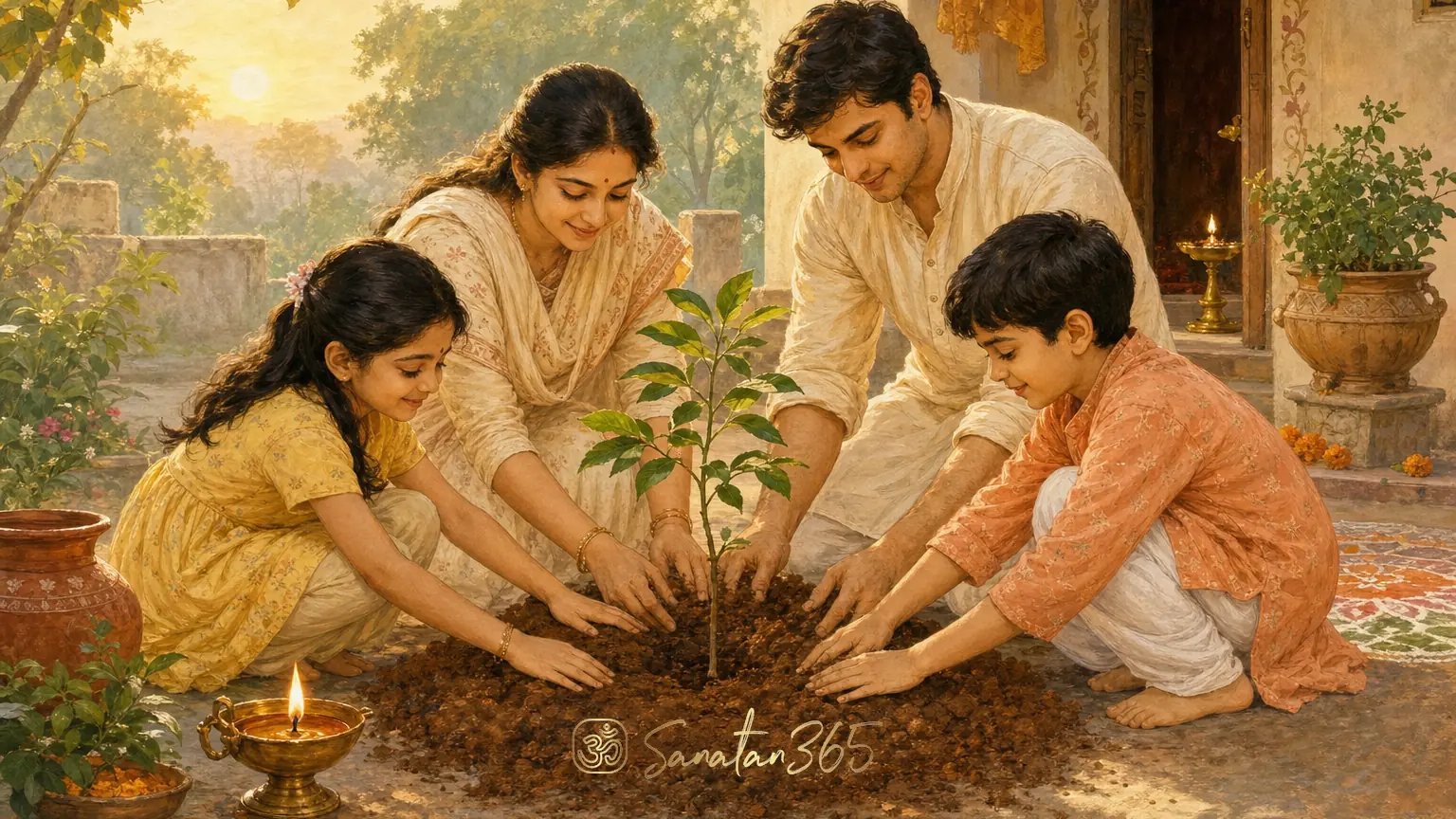
A child understands karma most clearly when the lesson begins with a seed, not a warning.
Karma meaning for kids is simple: karma (कर्म, action) means that our choices matter. In Hindu thought, karma is not a threat or a magic punishment. It is the teaching that actions, words, thoughts, and intentions leave effects. Some effects appear quickly, like a kind word making a friend smile. Some unfold slowly, like daily practice building patience. For children, the best first lesson is responsibility with hope: every day gives a chance to plant better seeds.
This guide explains karma in a family-friendly way, connects it with dharma (धर्म, right way of living), and offers practical examples parents can use without creating fear.
Key takeaway: Karma helps children see that small choices shape character, relationships, and future habits.
What Is Karma Meaning for Kids?
Karma meaning for kids can be explained as "what we do, say, think, and choose." The Sanskrit word karma comes from a root connected with doing or action. In everyday teaching, it points to the law of cause and effect: actions have consequences, and those consequences help shape life.
A helpful child-level definition is:
Karma means every action plants a seed. A kind seed can grow into trust, peace, and friendship. A careless seed can grow into hurt, confusion, or a lesson we need to learn.
This does not mean every difficult moment in a child's life is their fault. That would be spiritually careless and emotionally harmful. Hindu teaching is more nuanced. A child may face things caused by other people's choices, family situations, nature, or circumstances beyond anyone's control. Karma should never be used to blame someone for suffering. For children, karma should be taught as a way to build awareness: "What can I choose now? What kind of seed am I planting?"
BAPS describes karma as the Hindu law of cause and effect that holds a person responsible for actions and their effects. That responsibility is not meant to crush the heart. It is meant to awaken maturity.
Parents can use ordinary examples:
- If a child practices reading daily, reading becomes easier.
- If a child speaks kindly, friendships become warmer.
- If a child lies, trust becomes weaker and needs repair.
- If a child shares, the home feels more loving.
- If a child throws a toy in anger, someone may get hurt and the toy may break.
The lesson is not "be perfect." The lesson is "notice, learn, repair, and choose again."
Key takeaway: Karma is best introduced to children as responsibility, not fear.
How Are Karma and Dharma for Kids Connected?
Karma and dharma for kids should be taught together. Karma is action and consequence. Dharma is the right, caring, truthful way to act according to one's role, situation, and inner conscience. For a child, dharma may mean telling the truth, respecting elders, protecting younger siblings, studying with attention, caring for animals, keeping promises, and apologizing when wrong.
If karma is the seed, dharma is the wisdom that helps a child choose which seed to plant.
A child may ask, "How do I know the right action?" A family can answer through simple questions:
- Is this truthful?
- Is this kind?
- Is this fair?
- Will this hurt someone unnecessarily?
- If I make a mistake, can I repair it honestly?
These questions translate dharma into everyday life. They also prevent karma from becoming mechanical. Hindu ethics does not reduce life to a scorecard of points. Intention matters. Context matters. Humility matters.
The Bhagavad Gita 2.47 gives one of the most famous teachings on action:
karmaṇy evādhikāras te mā phaleṣu kadācana
Your right is to action alone, never to its fruits.
For children, this can be explained gently: do your sincere best, but do not become upset just because the result is not fully in your control. A child can study carefully before an exam, play fairly in a match, or speak kindly to a friend. The final result may still depend on many factors. Dharma asks the child to act well anyway.
This is a powerful lesson for school life. A child who learns karma only as reward and punishment may become anxious. A child who learns karma with dharma learns effort, honesty, patience, and resilience.
Key takeaway: Dharma teaches children how to choose good actions; karma teaches that those actions matter.
What Are Simple Karma Examples for Children?
Simple karma examples for children should be concrete, everyday, and emotionally safe. Avoid frightening statements like "something bad will happen to you." Use examples that connect action with visible results.
1. The homework example
A child who completes homework with attention may understand the lesson better. The immediate fruit may be confidence. The deeper fruit may be discipline. If the child ignores homework repeatedly, the result may be confusion in class. The karmic lesson is not shame. It is: habits grow from repeated actions.
2. The friendship example
If a child includes a lonely classmate in a game, the class becomes warmer. That kindness may return as friendship, but even if it does not, the child has strengthened a generous heart. Karma includes inner effects, not only outer rewards.
3. The anger example
If a child shouts at a sibling, the sibling may feel hurt. The room becomes tense. Later, the child may feel regret. Repairing the karma means apologizing, listening, and trying a calmer response next time.
4. The environment example
If children water a plant, avoid wasting food, and keep a shared space clean, they see that small actions protect life around them. This is a beautiful way to teach karma without abstraction: care produces visible growth.
5. The speech example
Words have karma too. A teasing word can stay in someone's memory. A sincere word can give courage. Children often understand this quickly because they know how words feel.
These examples also help parents avoid a common mistake: using karma only after a child does something wrong. Karma should also be celebrated when a child does something right. "You helped without being asked. See how peaceful the room feels now? That is good action bearing fruit."
For families using spiritual learning tools, Sanatan365 includes Daily Lessons on Sanatan Dharma and stories for children that can support this kind of values-first discussion at home. The point is not to lecture children, but to give them language for choices they are already making every day.
Key takeaway: Children learn karma best through visible examples: habits, speech, friendship, effort, and care.
How Can Parents Teach Karma Without Fear?
Teaching karma without fear is essential. A child should not hear karma as "the universe is waiting to punish me." That creates anxiety, not wisdom. In Sanatan Dharma, karma is deep and subtle. For young children, the safe teaching is practical: actions shape the heart and influence what happens around us.
Parents can follow five principles.
1. Start with agency, not blame
Say, "What can we do now?" rather than "This happened because of your karma." The first opens the door to growth. The second can close the heart.
2. Separate consequence from identity
A child who lies is not "a bad child." The action was wrong, trust was affected, and repair is needed. This distinction keeps the lesson moral without becoming cruel.
3. Include intention
If a child accidentally spills water while trying to help, the response should be different from a child throwing water in anger. Karma includes intention. This teaches fairness.
4. Emphasize repair
Karma is not only about what has already been done. It is also about what can be done next. Apology, service, honesty, and changed behavior are new actions.
5. Model the teaching
Children watch adults closely. If parents shout about kindness, the lesson becomes confused. If parents apologize after losing patience, children see dharma in action.
A gentle family phrase can help: "Pause, see the seed, choose again." This phrase gives children a simple mental step before reacting.
The Hindu American Foundation's overview of karma explains karma as action and consequence across moral life, while also placing it within broader ideas such as dharma and moksha (मोक्ष, liberation). For children, those larger ideas can wait. The first doorway is simple awareness.
Key takeaway: Karma should make children more thoughtful and hopeful, not frightened or ashamed.
What Does Karma Teach About Mistakes and Forgiveness?
Karma teaches that mistakes matter, but it also teaches that new action is always possible. This is especially important for children. If karma is taught as fixed fate, a child may feel trapped. If karma is taught as living responsibility, a child learns courage.
In family life, three words are useful: notice, repair, continue.
- Notice: "I spoke harshly." "I ignored my work." "I hurt my friend."
- Repair: "I will apologize." "I will tell the truth." "I will help fix what I damaged."
- Continue: "I can choose better next time."
This rhythm protects both accountability and tenderness. A child learns that wrong action should not be hidden, but it also need not define the whole person.
The Bhagavad Gita repeatedly returns to disciplined action, self-mastery, and devotion as ways human beings grow. Its teaching is not that life becomes perfect when one acts well. Rather, it asks the seeker to act with steadiness, offer effort sincerely, and keep refining the mind.
For children, that refinement may look like:
- taking one deep breath before answering in anger
- admitting a mistake before being forced
- finishing a small duty before play
- helping at home without needing praise
- choosing not to join teasing when others laugh
These are small acts, but they shape saṃskāra (संस्कार, inner impressions or formative values). Over time, repeated actions become tendencies. Tendencies become character. Character influences destiny.
Forgiveness also belongs here. If a child apologizes sincerely, adults should not keep repeating the mistake forever. Otherwise the child learns despair, not dharma. Karma includes consequences, but loving guidance helps transform consequences into wisdom.
Key takeaway: The karma lesson is incomplete unless children also learn repair, forgiveness, and fresh effort.
How Can a Family Practice the Karma Lesson Daily?
A family can practice the karma lesson daily without turning the home into a classroom. The best spiritual education often happens in tiny moments.
Try these simple practices:
- The morning seed question: Ask, "What good seed can we plant today?" A child may choose kindness, focus, truth, or helping.
- The evening reflection: Ask, "Which action today made the home or classroom better? Which action needs repair?"
- The three-breath pause: Before reacting, take three slow breaths and ask, "What will this action grow?"
- The repair habit: Make apology specific: "I am sorry I grabbed the toy. Next time I will ask."
- The gratitude link: When good comes, notice the effort behind it: "Your practice helped you improve."
- The service action: Choose one small seva (सेवा, selfless service) each week, such as feeding birds, helping a grandparent, cleaning a shared space, or sharing food.
Regional Hindu homes may express these values differently. A family in Gujarat may connect the lesson with seva at a mandir. A Tamil family may connect it with daily discipline around study and prayer. A diaspora family may use bedtime stories to preserve values across cultures. The forms can differ; the principle remains steady.
Parents can also use stories. Prahlad's devotion, Yudhishthira's struggle with truth, Shabari's patient love, and Sudama's humility all offer windows into action, intention, and inner character. The story should not be reduced to "good people get prizes." Many sacred stories are subtler. They show that dharma may require patience, courage, and trust even before outer results are visible.
Key takeaway: Karma becomes real for children when families turn it into daily reflection, repair, service, and storytelling.
FAQ
What is karma meaning for kids in one sentence?
Karma means that every action, word, thought, and intention plants a seed that can shape habits, relationships, and future experiences.
Is karma a punishment?
No. Karma is better understood as action and consequence. It should not be used to frighten children or blame people for suffering. For kids, karma is a lesson in responsibility and thoughtful choices.
How is karma different from dharma?
Karma means action and its effects. Dharma means the right, truthful, caring way to live. Dharma helps a child choose better karma.
Can bad karma be repaired?
Hindu teaching emphasizes new action. A mistake can be followed by apology, honesty, service, discipline, and better choices. Repair is an important part of moral growth.
How can parents teach karma at home?
Use everyday examples: sharing, homework, truthfulness, apology, caring for plants, and kind speech. Keep the tone hopeful, practical, and free from fear.
The deepest lesson of karma for children is not that life is a perfect reward system. It is that life is responsive. Actions matter. Words matter. Intentions matter. Repair matters. A child who learns this early receives one of Sanatan Dharma's most practical gifts: the confidence that every day offers a chance to act with more awareness.
Key takeaway: Teach karma as the hopeful discipline of planting better seeds through better choices.
About the author
Sanatan365 Editorial
Bringing Sanatan Dharma to modern seekers through authentic, scripture-grounded content.
Related in Lessons
 Lessons
Ashtavakra and Bandin: Wisdom Beyond Appearance
The Ashtavakra and Bandin story in the Mahabharata follows a young scholar who enters King Janaka's court, answers prejudice with learning,…
 Lessons
Gargi Vachaknavi: The Upanishadic Voice of Fearless Inquiry
Gargi Vachaknavi stands in the Brihadaranyaka Upanishad as a formidable questioner whose disciplined dialogue with Yajnavalkya reveals cour…
 Lessons
Andal: The Poet-Saint Who Made Longing a Path of Devotion
Discover Andal, the Tamil poet-saint whose Tiruppavai transformed sacred longing, shared song, and wholehearted surrender into a living pat…

