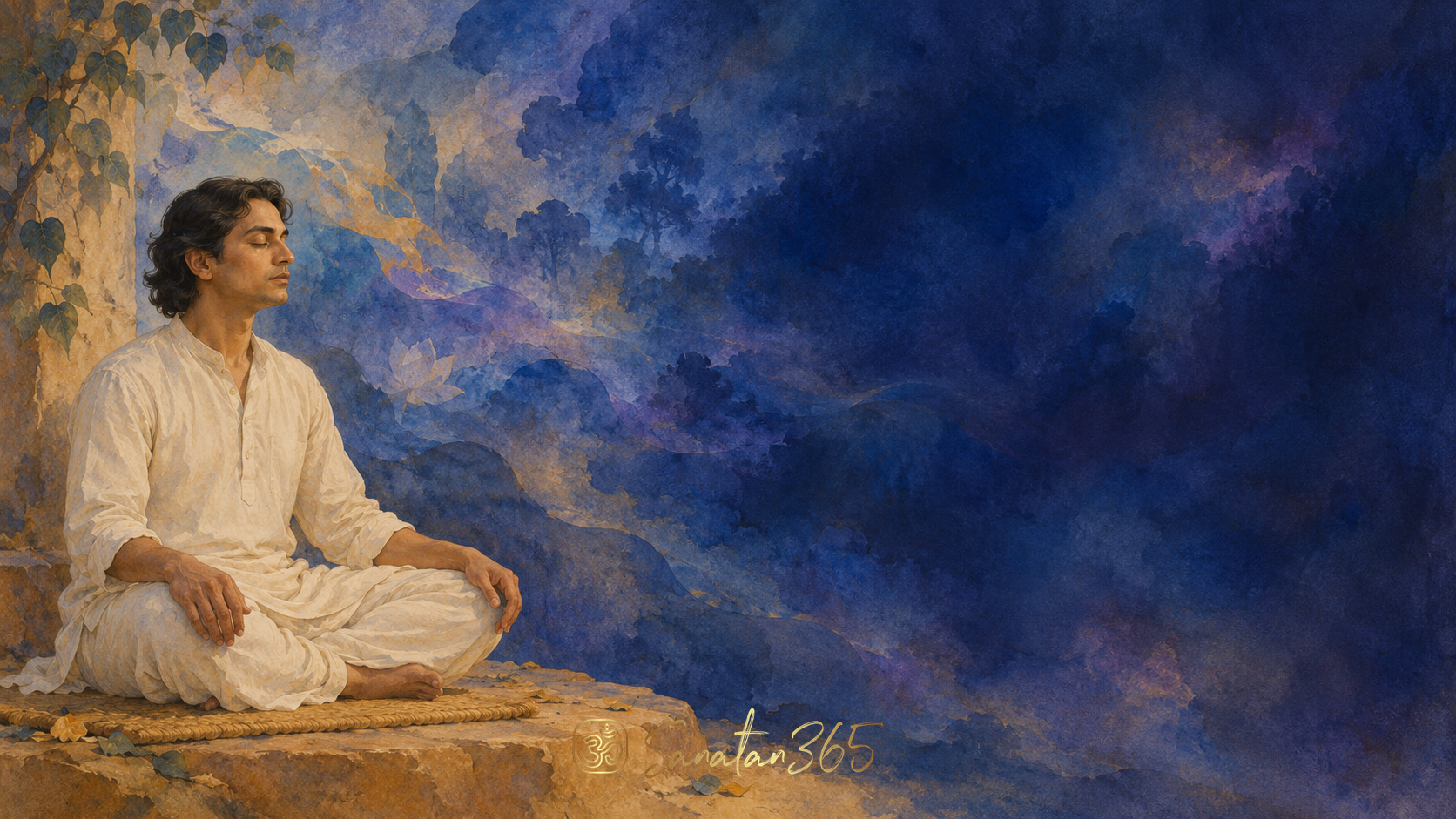
Chidakasha Dharana Meaning: Awareness of the Inner Space
Understand the space experienced with closed eyes, how observation differs from visualization, and a gentle introduction to this yogic concentration practice.
Closing the eyes does not always produce a blank screen. Darkness, shifting colour, remembered forms, and the wish to make something happen may all become noticeable.
Chidakasha dharana meaning is concentration on the inner space of consciousness. Chidakasha (चिदाकाश, the space of consciousness) joins chit (चित्, consciousness) with akasha (आकाश, space); dharana (धारणा, concentration) means holding attention to a chosen field. In the Bihar Yoga tradition, this can include observing the space experienced with closed eyes, later stabilizing a chosen image, and returning to spacious awareness. It is not a requirement to see visions or proof of supernatural ability.
The important question is not how spectacular an inner image becomes. It is whether attention can remain patient, clear, and unforced.
What is the Chidakasha dharana meaning?
The expression describes both a contemplative idea and a field of practice. The idea is that consciousness need not remain occupied only with objects outside the body. The practice gives attention a subtler setting: the inward space noticed when the eyes close and external visual activity recedes.
This is not a claim that a measurable chamber exists inside the forehead. “Space” is a teaching image and a description of lived experience. An outward landscape has trees, distance, and a horizon. An inward field may seem dark, luminous, changing, or almost featureless. The practitioner learns to attend to that field without immediately making a story about it.
The distinction helps prevent a common misunderstanding. Chidakasha meditation is not simply closing the eyes and waiting for entertainment. The discipline lies in the manner of attending, including when nothing interesting appears. Ordinary darkness is not an inferior result that must be replaced by colour.
A published Bihar School of Yoga class on chidakasha dharana, taught by Swami Amritananda Saraswati, describes a progression from observing appearances to maintaining one image and finally relinquishing that image. This sequence matters: observation and deliberate visualization are related, but they are not identical tasks.
Concentration is not the same as strain
A chosen field gives attention direction. It does not require tightening the eyelids, pushing the gaze upward, or treating every distraction as a failure. The class itself refers to relaxed eyes and eyelids before stabilizing a chosen image. For a reader new to the subject, relaxation is a more useful starting point than a demand for extraordinary inner clarity.
The broader distinction between concentration and meditation is explored in dharana as preparation for meditation. Here the specific concern is what serves as the field of attention: not a candle outside the body, but the inward space experienced with closed eyes.
Key takeaway: Chidakasha is the inward field of awareness; dharana is the discipline of attending to it, not a contest to produce unusual sights.
What is actually observed behind closed eyes?
The published class explicitly allows darkness, light, colour, and different forms to appear. Some may be static; others may change. Its initial instruction is to observe without analysis or judgment. This is a practical contrast with the impulse to name every appearance and immediately decide what it means.
A practitioner might notice a faint patch of colour, remember a familiar face, or become aware that attention has moved into planning dinner. These are different experiences. They need not be collapsed into one category of sacred revelation. Likewise, a quiet field with no clear imagery remains a valid setting for observation.
Descriptions of inner experience vary, and an article cannot establish the origin or spiritual significance of a reader's particular image. The teaching tradition may discuss appearances within its own account of consciousness, but a brief private experience does not authorize predictions, diagnoses, or declarations about spiritual attainment.
Notice the experience before its explanation
Consider three different statements:
- “A changing blue patch was noticeable.”
- “Attention moved toward a remembered place.”
- “The blue patch proves that a spiritual centre has awakened.”
The first two describe an experience. The third adds an interpretation that the experience alone cannot establish. Chidakasha offers an opportunity to keep that distinction clear. Respect for the tradition does not require certainty about every fleeting appearance.
This can also change the way a practitioner responds to a disappointing session. Instead of saying, “Nothing happened,” the observation might be, “The field remained dark, and attention repeatedly returned to a conversation.” That is a more precise account. It notices both the field and the movement of attention without inventing progress.
A modest personal note can record duration, comfort, and whether attention was forced. It need not catalogue every colour or construct a private dictionary of omens. The purpose of such a note is honest recollection, not ranking one session above another.
There is also no obligation to continue an uncomfortable inward exercise. Opening the eyes, noticing the room, and returning to an ordinary activity are sensible ways to stop. A calm ending is not a failure to remain faithful to the practice.
Key takeaway: Describe what was noticed before assigning meaning; neither darkness nor vivid imagery measures spiritual worth.
How does observation differ from visualization?
Observation receives what is present. Visualization deliberately introduces or sustains an image. Both can appear in yogic teaching, but confusing them makes instructions difficult to follow.
In the 1981 class, the first stage allows appearances to arise. The second asks the practitioner to choose one comfortable visual object and keep returning to its same form. The third moves beyond that selected form toward awareness of inner space. This is a particular taught progression, not a rule that every meditation method must follow.
The difference can be understood through a simple comparison. Looking at clouds means attending to forms already present. Remembering a particular flower means intentionally calling up a chosen form. Neither task is inherently more sacred; they ask something different of attention.
The class includes possibilities such as a flower, a colour, a statue, or the image of a teacher. Guru (गुरु, spiritual teacher) belongs to the devotional language of that teaching. A reader should not interpret the mention as a requirement to invent a teacher's presence or imagine receiving authoritative instructions from an inner image.
A selected image is a support, not a message
When a teacher gives a visualization practice, the form serves a stated purpose within that method. It should not become a shortcut to claims of special knowledge. An image of a sacred figure can be treated reverently while remaining an image used in practice.
Similarly, devotional inward worship is not interchangeable with every concentration exercise. Manasa puja, or worship offered inwardly, has an explicitly devotional structure. Chidakasha dharana concerns attention to inner space and, in some stages, a chosen visual support. Their overlap does not erase their different intentions.
The official Bihar Yoga meditation catalogue describes Dharana Darshan, by Swami Niranjanananda Saraswati, as including space-based concentration practices, visualization, and common obstacles. It also states that the book is intended for readers already familiar with meditation fundamentals and with some mastery of pratyahara (प्रत्याहार, withdrawal or gathering of the senses). That qualification deserves attention before advanced instructions are treated as a casual beginner exercise.
A reader can therefore learn the meaning without trying to reproduce the whole sequence immediately. Understanding a map is different from being prepared to travel every part of it.
Key takeaway: Spontaneous observation and deliberately maintained imagery are different stages or methods; learn which task a qualified teacher is actually asking for.
How can beginners approach inner-space awareness gently?
The following is a conservative introduction to noticing, not a reproduction of the complete chidakasha dharana sequence. It does not include advanced visualization, breath manipulation, or instructions to pursue altered states. Readers seeking the full method should learn it from a suitably trained teacher.
The first aim is modest: become familiar with the difference between attending gently and trying to manufacture an experience. A chair is acceptable for this introductory exercise. There is no need to force a floor posture or remain still through pain.
- Choose a settled setting. Sit comfortably somewhere it is safe to pause. Keep the body supported and the face relaxed.
- Notice ordinary contact. Feel the seat beneath the body and the feet or legs resting. Let breathing continue naturally without counting or holding it.
- Close the eyes only if comfortable. Notice the field experienced behind them. Avoid squeezing the eyelids or directing the eyes upward with effort.
- Observe briefly. Darkness or changing impressions need not be improved. If attention drifts, gently return to noticing the field rather than criticizing the distraction.
- End deliberately. Reconnect with the seat, sounds, and surrounding room. Open the eyes and allow a moment before standing or returning to work.
A minute or two may be enough for an initial acquaintance. This is an editorial suggestion for keeping the introduction short, not a traditional duration prescription or a promised threshold for results.
Three useful adjustments
If the eyes feel strained, stop the inward looking and open them. If sitting becomes uncomfortable, change position rather than using pain as a measure of determination. If inward attention becomes unsettling, return to external surroundings and discuss future practice with a qualified teacher.
Meditation is not medical treatment, and a short article cannot assess individual suitability. Persistent distress or troubling experiences warrant appropriate professional support, not the claim that discomfort must be a sign of spiritual progress.
The exercise also does not require a perfectly silent home. A reader in Mumbai, a student in Bengaluru, or someone living abroad may hear traffic or family activity. For this gentle introduction, those sounds can simply remind the person of the surroundings before attention returns to the chosen field. Advanced practice arrangements belong to the teacher's instructions, not assumptions made here.
There is no need to add a candle, fragrance, a recording, or a symbolic chart. A plain, comfortable setting makes it easier to distinguish the actual task from accessories. When a living tradition prescribes specific supports, those can be learned in their proper context.
Key takeaway: Begin with brief, comfortable noticing; learn the complete method with guidance rather than increasing intensity to chase a result.
How does this practice fit within a living yoga tradition?
Chidakasha dharana is presented in the Bihar Yoga tradition as part of a larger discipline of concentration and meditation. It should not be detached from preparation, a teacher's explanation, and the gradual development of attention.
The official catalogue places space-based concentration beside other established practices, rather than presenting it as an isolated trick. It describes Dharana Darshan as adapting practices drawn from traditional yogic literature for modern practitioners. This supports a careful account of its context without pretending that every modern exercise has one identical ancient script or that all Hindu schools teach the same sequence.
The practical and philosophical meanings should also be kept in proportion. “Space of consciousness” can point toward an expansive understanding of awareness in the teaching tradition. The beginner's task remains much simpler: recognize a field of experience and attend without unnecessary forcing. Grand language does not require grand claims about a first session.
A different question from inner silence
An inner-space practice asks how attention relates to the inward visual field. A practice concerned with observing thought may ask how thoughts arise and pass. These questions can support each other, but they are not the same reader question. Antar Mouna's approach to inner silence offers context for the latter without replacing the specific space-based focus described here.
A useful teacher will make the distinction concrete: what is the object of attention, what should be left alone, when does the instruction change, and how should the practice end? These questions are more valuable than asking when impressive colours will appear.
The discipline can also encourage honesty outside the sitting period. Before reacting to an impression, a person may pause to separate what was noticed from what was assumed. This is an everyday reflection inspired by the method, not a guaranteed psychological effect or a substitute for other forms of care.
The single concluding lesson is straightforward: inward attention becomes more meaningful when observation remains precise and ambition remains modest. Learning to notice without instantly claiming knowledge is itself a worthwhile discipline.
Key takeaway: Honour the tradition through preparation, clear instruction, and truthful observation, not through claims of extraordinary experience.
FAQ
What does chidakasha dharana mean in simple English?
It means concentrating on the inner space of consciousness. Chidakasha names that inward space; dharana names the discipline of holding attention. In the Bihar Yoga teaching described here, practice can move from observing appearances to a chosen image and then back to spacious awareness.
Is chidakasha meditation the same as visualization?
Not entirely. Observation notices what is present, while visualization deliberately introduces or maintains a form. The published class includes both, at different stages. A beginner's introduction to noticing should not be mistaken for the complete staged method.
What if only darkness appears when the eyes close?
Darkness can be the field being observed. Colours and images are not compulsory, and their absence does not prove failure. The relevant question is whether attention can remain comfortable and unforced, not whether the session produces a spectacle.
Does a colour or image prove that a chakra has awakened?
No particular appearance establishes that conclusion on its own. Chakra (चक्र, a subtle centre in yogic teaching) belongs to a wider traditional framework. A fleeting image should not be treated as a diagnosis, prediction, or certificate of spiritual attainment.
Can a beginner learn the whole practice from an article?
An article can explain the meaning and offer a brief introduction to noticing. The full method, especially advanced concentration and visualization, is better learned with qualified guidance. The official description of Dharana Darshan explicitly assumes prior familiarity with meditation fundamentals.
About the author
Sanatan365 Editorial
Bringing Sanatan Dharma to modern seekers through authentic, scripture-grounded content.
Related in Meditation
 Meditation
Antar Mouna Meaning: Inner Silence Without Fighting Thought
Understand inner silence in Satyananda Yoga, its sensory and thought-awareness stages, and a responsible beginning that does not demand a b…
 Meditation
Ajapa Japa Meaning: The Mantra Remembered with Every Breath
Ajapa japa means remembrance that continues without deliberate repetition. Yogic traditions connect it with the natural rhythm of breath an…
 Meditation
Manasa Puja Meaning: The Hindu Practice of Inner Worship
Manasa Puja is worship performed inwardly: the devotee visualizes the sacred presence and offers water, flowers, light, food, and reverence…

