Daily Aarti Singing with Goswami Tulsidas: Light, Song, and Bhakti at Home
A practical, devotional guide to daily aarti singing, the meaning of offering light, and how Sanatan365’s Goswami Tulsidas experience can support a steady home practice.
A small flame can change the emotional weather of a home.
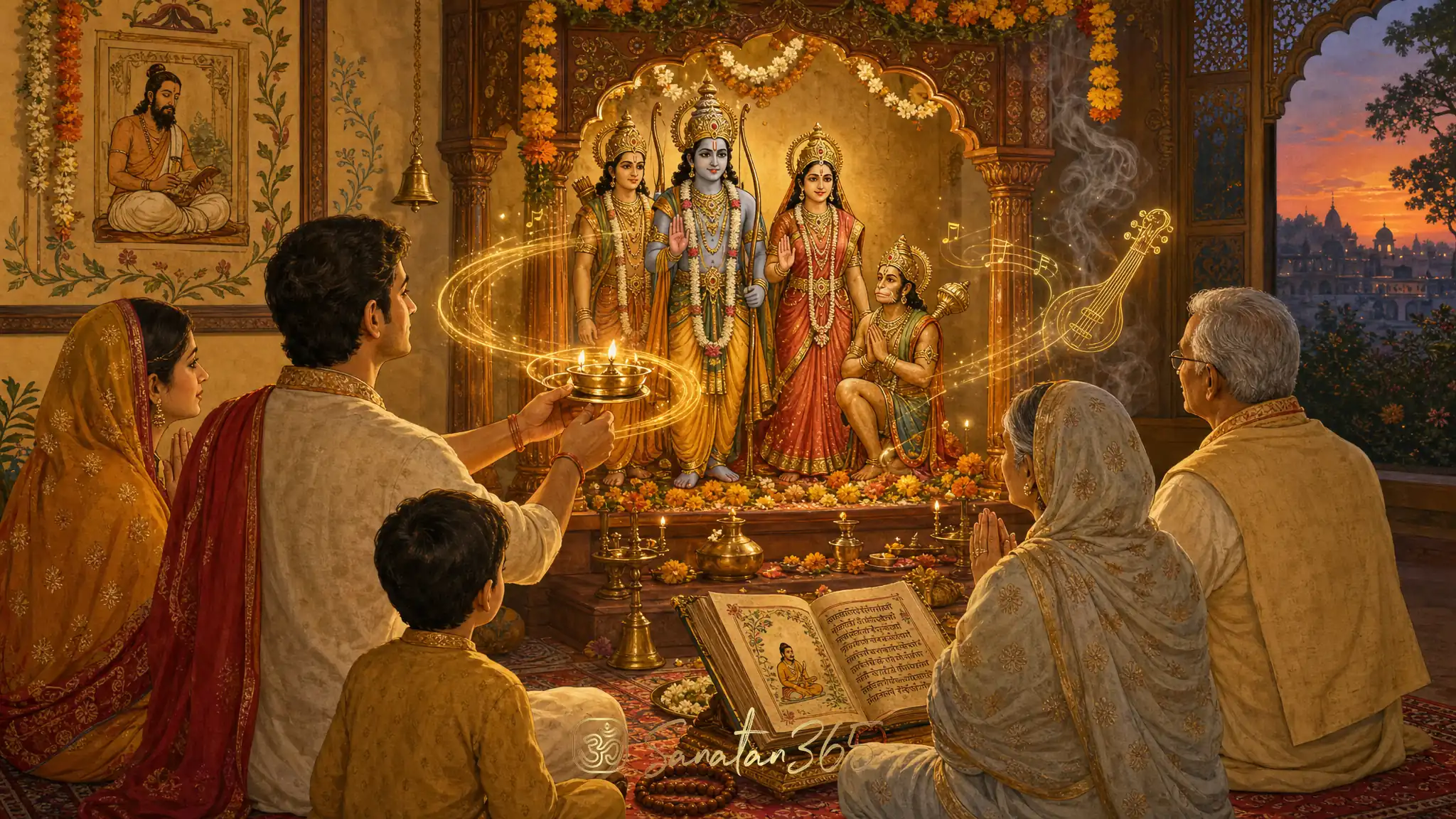
Daily Aarti Singing is the practice of offering light, song, and attention to the Divine each day. In Hindu worship, aarti (आरती, ārati, offering of light) is usually performed by circling a lamp before a deity while singing a hymn or prayer. The act is simple, but its meaning is deep: the devotee offers fire, voice, gratitude, and presence. On Sanatan365, Daily Aarti Singing with Goswami Tulsidas is designed to help seekers make this sacred rhythm easier to keep at home.
What is Daily Aarti Singing?
Daily Aarti Singing is a daily devotional practice in which the seeker offers a lit lamp before the Divine while singing praise with reverence. The lamp is usually made of ghee, oil, or camphor, and the song may be addressed to a chosen deity, guru, or sacred form. Encyclopaedia Britannica describes arti as the waving of lighted lamps before an image of a deity or honored person, often with chanting or hymn singing, and notes that it is one of the most frequently observed parts of temple and private worship (Britannica).
This matters because aarti is not only a ritual gesture. It trains attention. The hands move the lamp, the voice sings, the eyes rest on the sacred image, and the mind returns from scattered concerns to devotion. In a few minutes, the whole person participates.
Key takeaway: Daily Aarti Singing turns devotion into a full-body practice of light, sound, gratitude, and focus.
In many homes, aarti happens in the morning, evening, or both. Some families sing together. Some seekers perform it quietly before work. Some diaspora households use it as a way to keep children connected to a living Hindu rhythm even when temples are far away. The form varies, but the inner movement is the same: from distraction toward remembrance.
Why is Daily Aarti Singing linked with bhakti?
Daily Aarti Singing belongs naturally to bhakti (भक्ति, bhakti, loving devotion). Bhakti is not only emotion; it is devotion made steady through remembrance, service, surrender, and love. Aarti gives bhakti a daily shape. Instead of waiting for a rare spiritual mood, the seeker returns to the lamp and song again and again.
The Harvard Pluralism Project explains that Hindu worship often includes offerings connected with the elements, including fire in the form of the oil lamp offering called arati (Pluralism Project). This elemental quality is important. Earth appears through flowers and sandalwood. Water may be offered for purification. Fragrance rises through incense. Sound appears through mantra or hymn. Fire becomes the visible heart of the ritual.
When the flame is moved before the deity, the worshipper is not informing the Divine of anything. The Divine does not need a lamp. The lamp is for the devotee. It teaches: let the heart become luminous, let the ego soften, let attention become steady, let gratitude become visible.
Key takeaway: Aarti is bhakti made visible through flame and audible through song.
Aarti also carries a shared cultural memory. In temples, the sound of bells, conch, cymbals, and collective singing can make aarti feel like the whole community is turning toward the sacred together. At home, the scale is smaller, but the principle remains powerful. Even one lamp on one small altar can become a center of devotion.
Why does Goswami Tulsidas matter for aarti practice?
Goswami Tulsidas is remembered as one of the great poet-saints of North Indian bhakti. Britannica notes that Tulsidas was a Vaishnavite poet whose Ramcharitmanas, a retelling of the Rama story in Awadhi, became one of the most beloved devotional works in North India (Britannica). His poetry helped bring the story and virtues of Lord Rama into household devotion, public recitation, and everyday moral imagination.
This is why Tulsidas is a meaningful guide for aarti singing. His devotional world is not abstract. It is musical, poetic, and close to home. It speaks to the family shrine, the village gathering, the temple courtyard, the inner conscience, and the seeker who wants devotion to become daily conduct.
On Sanatan365, Daily Aarti Singing with Goswami Tulsidas treats him as the feature-specific ritual specialist for aarti, not as a general open conversation guide. That distinction matters. The experience is built around the daily ritual of singing and offering light, drawing from the spirit of bhakti associated with Tulsidas while keeping the practice accessible for modern users.
Key takeaway: Goswami Tulsidas represents a devotional tradition where poetry, song, Rama-bhakti, and daily worship meet.
For many families, the name Tulsidas also evokes the Hanuman Chalisa, the Ramcharitmanas, and a devotional culture where song is not entertainment alone. It is remembrance. Aarti in this spirit does not ask for performance-level singing. It asks for sincerity.
How can a seeker practice Daily Aarti Singing at home?
Aarti can be kept simple. The practice should feel reverent, not burdensome. A gentle home sequence may look like this:
- Prepare the space. Clean the altar or sacred corner. Place flowers, water, or incense if available.
- Light the lamp safely. Use a diya, ghee lamp, oil lamp, or camphor according to household tradition and safety.
- Begin with stillness. Take a few quiet breaths and form a sankalpa (संकल्प, sankalpa, sacred intention), such as gratitude, clarity, or devotion.
- Sing the aarti. Let the words carry the heart. Correct melody is helpful, but devotion is more important than vocal perfection.
- Circle the flame respectfully. Many traditions move the lamp clockwise before the deity, usually in gentle circular motions.
- Receive the light. After the offering, devotees often pass their hands over the flame and touch the eyes or head, receiving the blessing symbolically.
- Close with pranam. Offer a bow, a short prayer, or a moment of silence.
Key takeaway: Aarti becomes sustainable when it is simple enough to repeat and sacred enough to matter.
For beginners, three to seven minutes is enough. A daily practice that survives is better than an elaborate plan that collapses after two days. Families may choose one fixed aarti and repeat it until children learn the rhythm. Seekers living alone may keep a small evening lamp and sing softly. Those who travel can listen, sing, or mentally offer the light when a physical lamp is not practical.
Sanatan365’s Daily Aarti Singing feature can support this rhythm by giving the user a guided devotional structure through Goswami Tulsidas. It is especially useful for seekers who want aarti to become a habit but need help with consistency, pronunciation, or ritual confidence.
What should Daily Aarti Singing feel like, not just look like?
Aarti can become mechanical if the outer form is kept but the inner attention is absent. The goal is not to complete a task. The goal is to turn toward the sacred with steadiness.
A few inner attitudes help:
- Gratitude: The flame becomes a way to say, "May this day be received as grace."
- Humility: The singer does not perform for applause; the voice is offered.
- Attention: The mind may wander, but the lamp, bell, and song bring it back.
- Family warmth: If children are present, the tone should be welcoming, never harsh.
- Consistency: A small daily offering builds more depth than occasional intensity.
In this sense, Daily Aarti Singing is close to other Hindu daily practices such as Daily Mantras, meditation, and puja. Each practice gathers the mind in a different way. Mantra refines sound and repetition. Meditation steadies awareness. Aarti uses light, song, and gesture to make devotion visible.
Key takeaway: The best aarti is not the loudest or most ornate; it is the one offered with steady attention and a soft heart.
There is also a practical caution. Fire should be handled responsibly, especially around children, curtains, pets, or crowded spaces. Aarti is sacred, and safety is part of reverence. If a physical flame is not possible, a seeker may still sing with devotion and return to the full ritual when conditions allow.
How does Sanatan365 keep the practice modern without making it shallow?
Modern spiritual tools should not flatten tradition. They should reduce friction while preserving dignity. Daily Aarti Singing with Goswami Tulsidas is valuable because it can help a user approach aarti with structure instead of confusion: what to sing, how to begin, what the act means, and how to return tomorrow.
The feature also fits a wider daily rhythm inside Sanatan365. A seeker may begin with Daily Live Temple Darshan, practice Daily Mantras Chanting with Sage Narada Muni, sit with Daily Meditation with Maharshi Patanjali, and close the day with Daily Aarti Singing with Goswami Tulsidas. Each feature has a different devotional function. Together, they support a daily spiritual habit rather than a one-time content experience.
This is not meant to replace the temple, the family elder, the guru, or the living community of worship. It is a companion for the modern seeker: someone in an apartment, a hostel, a city far from home, or a diaspora household trying to keep the lamp of tradition alive with care.
Key takeaway: Sanatan365 is most useful when it helps users practice more consistently, not when it becomes a substitute for living devotion.
For users on supported plans, Daily Aarti Singing with Goswami Tulsidas can become a gentle anchor: a few minutes of sacred sound and light that closes the gap between intention and practice. The point is not to make devotion dependent on a screen. The point is to help a seeker begin, remember the meaning, and return to the altar with more confidence the next day.
FAQ
What is Daily Aarti Singing?
Daily Aarti Singing is the daily practice of offering a lamp before the Divine while singing a devotional hymn. It joins light, sound, gesture, and prayer into one act of bhakti.
Why is a lamp used in aarti?
The lamp represents light, clarity, and offering. In Hindu worship, fire is one of the sacred elements used in puja, and aarti offers that light before the deity with reverence.
Do I need to sing perfectly for aarti to count?
No. Aarti is an offering, not a performance. Clear pronunciation and melody can improve with time, but sincerity, attention, and respect are more important than vocal skill.
Who is Goswami Tulsidas in Sanatan365’s Daily Aarti Singing feature?
Goswami Tulsidas is the feature-specific ritual specialist for Daily Aarti Singing on Sanatan365. He is associated with Rama-bhakti, devotional poetry, and household worship traditions.
Can beginners practice aarti at home?
Yes. Beginners can start with a clean altar, a safe lamp, one short hymn, and a few minutes of focused devotion. A simple daily practice is better than an elaborate ritual done rarely.
Daily Aarti Singing with Goswami Tulsidas reminds the modern home of an old truth: when light is offered with love, even a few minutes can become worship.
About the author
Sanatan365 Editorial
Bringing Sanatan Dharma to modern seekers through authentic, scripture-grounded content.
Related in Features
 Features
AI Adi Shankaracharya Guide: Viveka and the Practice of Clear Judgment
Explore viveka, the Vedantic discipline of discernment, and learn how the AI Adi Shankaracharya guide can support thoughtful reflection wit…
 Features
AI Venkateswara Guide: Patience, Stewardship, and Responsible Hope
Explore Sri Venkateswara's devotional lessons on patience, stewardship, and responsible hope, with practical reflection through Sanatan365'…
 Features
AI Vaishno Devi Guide: Faith, Courage, and the Divine Mother's Grace
Explore Vaishno Devi's living symbolism of faith, courage, and maternal grace, with practical ways to bring these teachings into daily deci…

