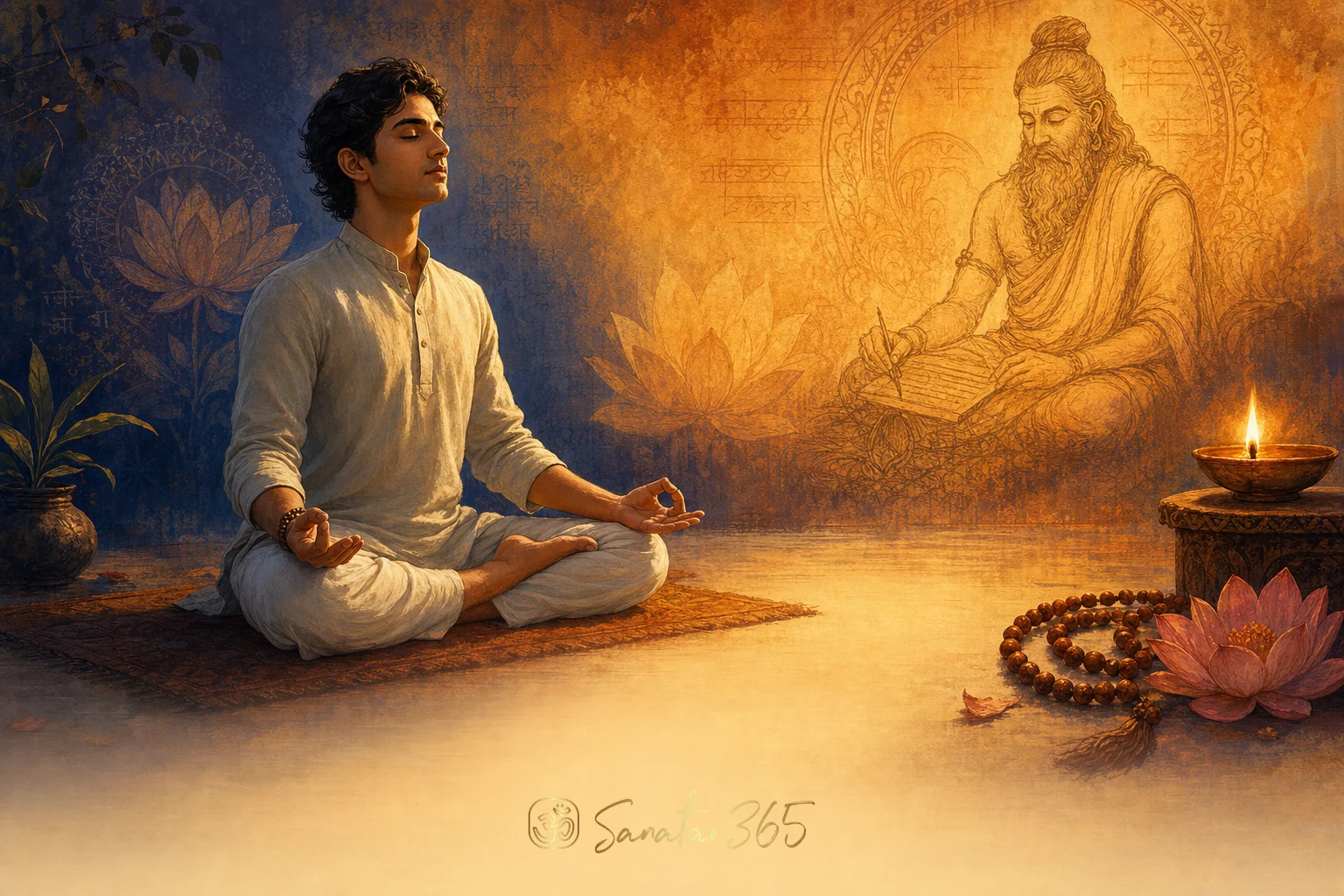
Daily Meditation with Maharshi Patanjali: A Hindu Practice for Steady Awareness
A clear guide to Daily Meditation with Maharshi Patanjali, connecting Yoga Sutra wisdom with a gentle everyday meditation routine.
A meditation practice becomes easier to trust when it is treated less like a performance and more like returning a lamp to stillness.
Daily Meditation with Maharshi Patanjali is Sanatan365's guided way to approach dhyana (ध्यान, steady meditation) through the spirit of the Yoga Sutras: sit, steady the mind, observe gently, and return without harshness. In Hindu thought, meditation is not merely relaxation. It is a disciplined softening of mental turbulence so awareness can become clearer, steadier, and more sattvic (सात्त्विक, clear and harmonious). For modern seekers, the value is simple: a short daily practice can become a sacred pause that reorients the day.
This guide explains the Patanjali-inspired foundation of meditation, a practical daily routine, and how Sanatan365's Daily Meditation with Maharshi Patanjali can help users build consistency without turning spiritual practice into pressure.
Key takeaway: Daily meditation works best when it is steady, humble, and repeatable.
What Is Daily Meditation with Maharshi Patanjali?
Daily Meditation with Maharshi Patanjali is a feature-centered practice in Sanatan365 that helps users approach meditation through a classical Hindu yoga lens. Product truth identifies Maharshi Patanjali as the specialist avatar for Daily Meditation, not an open conversation guide. That distinction matters. The experience is designed around a focused ritual: come in, receive a meditation-oriented flow, practice with attention, and let the day become quieter from within.
In the Yoga Sutras, Patanjali defines yoga with the famous phrase: yogaś citta-vṛtti-nirodhaḥ, often translated as the stilling or calming of the movements of the mind. The exact philosophical interpretation varies across teachers, but the practical direction is clear: yoga trains attention. The mind does not become an enemy; it becomes something lovingly disciplined.
Meditation in this context is connected with dharana (धारणा, concentration) and dhyana. Yoga Sutra 3.1 describes dharana as fixing attention on a chosen place or object, while 3.2 presents dhyana as the continuous flow of that attention. A helpful overview from the Hindu American Foundation explains Patanjali's role in the Yoga Sutras and the classical yoga tradition. The Himalayan Academy text of Patanjali's Yoga Sutras also preserves a full sutra-based reference for deeper readers.
Sanatan365's meditation feature should be understood in that light. It is not a promise of instant peace. It is a daily container for abhyasa (अभ्यास, repeated practice), the patient return to steadiness.
A user can treat it as:
- A morning spiritual reset before work or school.
- A quiet evening bridge between activity and rest.
- A devotional pause before mantra, aarti, or study.
- A family-friendly habit that teaches attention without force.
- A simple doorway into Patanjali's deeper yoga psychology.
Key takeaway: The feature is best used as a daily practice container, not as a quick spiritual shortcut.
Why Does Patanjali Matter in Hindu Meditation Practice?
Patanjali matters because the Yoga Sutras give meditation a disciplined map. Many people hear the word meditation and imagine closing the eyes until thoughts disappear. Patanjali's system is subtler. It recognizes that attention is trained gradually through posture, breath awareness, ethical life, concentration, and insight.
In the eight-limbed path, often called ashtanga yoga (अष्टाङ्ग योग, eight-limbed yoga), dhyana is the seventh limb. It does not float alone. It follows yama (ethical restraint), niyama (personal discipline), asana (stable posture), pranayama (breath regulation), pratyahara (drawing the senses inward), and dharana. This progression protects meditation from becoming merely aesthetic. A calm seat is supported by a truthful life.
For everyday users, this does not mean one must master every limb before beginning. It means meditation becomes more fruitful when supported by ordinary dharma: honesty, moderation, kindness, cleanliness, study, and devotion. A distracted day can still end with a sincere sitting. A restless mind can still be trained through repetition.
Patanjali also gives a compassionate principle in Yoga Sutra 1.12: steadiness comes through abhyasa and vairagya (वैराग्य, non-attachment). Practice means showing up. Non-attachment means not clinging to today's result. One day the meditation feels clear; another day it feels noisy. Both can belong to the path.
This is especially useful for modern seekers in India and the diaspora. Many carry full schedules, family duties, digital overload, and emotional demands. A Patanjali-inspired approach does not shame ordinary life. It gives the mind a way to return.
Key takeaway: Patanjali's gift is a disciplined but humane map for training attention.
How Can a Daily Meditation Routine Begin Simply?
A strong Daily Meditation with Maharshi Patanjali habit can begin with ten sincere minutes. The routine does not need drama. It needs rhythm.
A practical sequence may look like this:
- Choose a consistent time. Morning before phone use is ideal for many people, but evening is also valid.
- Create a clean seat. Use a mat, cushion, or chair where the spine can remain comfortably upright.
- Begin with sankalpa. Sankalpa (संकल्प, sacred intention) can be as simple as: "May this practice bring clarity and kindness."
- Settle the breath. Let inhalation and exhalation become slower without forcing them.
- Choose one focus. Breath, a sacred word, a divine name, or a visual point can support dharana.
- Return gently. When the mind wanders, return without self-criticism.
- Close with gratitude. Offer the practice inwardly before entering the rest of the day.
Sanatan365's Daily Meditation experience can serve as the guided container for this. It gives users a clear place to begin rather than leaving them to assemble a practice from scattered advice. For seekers who already use Daily Mantras or Daily Aarti, meditation can also prepare the mind before sound and devotion.
One useful principle: keep the practice small enough to repeat. A five-minute daily sitting is better than a dramatic one-hour effort that happens once and disappears. Patanjali's method honors continuity. The mind learns from repetition.
Families can adapt the routine too. A parent may sit for ten minutes while a child sits for two. A household may keep one quiet lamp, one bell, or one short closing prayer. The goal is not to make everyone identical. The goal is to let spiritual steadiness become part of the home atmosphere.
Key takeaway: Start smaller than ambition demands, then let consistency deepen naturally.
What Should a Seeker Do When the Mind Wanders?
The wandering mind is not proof of failure. It is the material of meditation.
In a Patanjali-inspired practice, the first victory is noticing. If the mind runs toward a task list, memory, worry, or fantasy, awareness has already awakened enough to observe it. The next step is return. This return may happen a hundred times in one sitting. That is still practice.
A gentle formula helps:
- Notice the thought.
- Name it softly: planning, remembering, judging, worrying.
- Relax the face, shoulders, and breath.
- Return to the chosen focus.
- Continue without making a story about failure.
This matters because many beginners expect meditation to feel peaceful immediately. When it does not, they assume they are not spiritual enough. Patanjali's framework is more patient. Citta-vritti (चित्त-वृत्ति, movements of the mind) are observed and gradually quieted through steady discipline, not through force.
The Bhagavad Gita also speaks to this human difficulty. In chapter 6, Arjuna says the mind is restless and hard to restrain. Krishna acknowledges the challenge and points toward practice and detachment. This pairing mirrors the Patanjali principle: keep returning, and do not cling to instant success.
Daily Meditation with Maharshi Patanjali can be especially helpful here because guided structure reduces the burden of deciding what to do next. The user does not need to evaluate every moment. The practice itself becomes the handrail.
Key takeaway: A wandering mind is not the opposite of meditation; returning from wandering is the training.
How Does Daily Meditation Fit with Devotion and Modern Life?
Hindu meditation does not need to be separated from bhakti (भक्ति, devotion), japa (जप, repetition of a sacred name or mantra), or daily seva (सेवा, service). For many seekers, meditation makes devotion more attentive. A calmer mind can chant with more sincerity, listen to aarti with more presence, and meet family duties with more patience.
This is where the Sanatan365 habit layer becomes meaningful. A user may begin with Daily Meditation with Maharshi Patanjali, continue into mantra chanting with Sage Narada Muni, and later take live darshan from a temple stream. The app's strength is not that every feature replaces traditional practice. It is that the features help modern users keep a thread of practice alive across busy days.
For example:
- A student may use meditation before study to settle attention.
- A parent may use it before the household wakes.
- A working professional may use it after commuting to release agitation.
- A diaspora family may use it to keep children gently connected with Hindu practice.
- An elder may use it as a quiet devotional companion before evening prayer.
Care is necessary: meditation should not be marketed as medical treatment or a guaranteed cure for anxiety, depression, trauma, or illness. It can support spiritual steadiness, but anyone facing serious distress should seek qualified professional help and trusted human support. Sanatan365's role is devotional and spiritual, not clinical.
Used wisely, the feature becomes a bridge. It brings classical practice into a modern interface while keeping reverence for the source tradition.
Key takeaway: Meditation deepens daily devotion when it supports life rather than escaping from it.
How Can Users Get the Most from Daily Meditation with Maharshi Patanjali?
The best use of Daily Meditation with Maharshi Patanjali is simple: make it a daily appointment with the inner life.
These guidelines help:
- Do not chase experiences. Lights, visions, and unusual sensations are not the goal. Steadiness matters more.
- Keep one practice window. Repetition teaches the body and mind when to become quiet.
- Pair it with one small virtue. After meditation, choose one dharmic action for the day: patience, truthfulness, gratitude, or restraint.
- Use the same seat when possible. Sacred rhythm grows through place as well as time.
- Let missed days become returns, not guilt. If the habit breaks, begin again the next day.
- Connect practice with study. Reading a short passage from the Yoga Sutras or the Bhagavad Gita can give the sitting philosophical depth.
A feature is only useful when it becomes lived practice. Sanatan365 can provide structure, reminders, and a spiritually grounded interface, but the user's sincerity gives the practice its soul. Patanjali's wisdom is not mechanical. It asks for patience, humility, and repetition.
For a modern seeker, that may be the most compassionate message: one does not need a perfect life to begin meditation. One needs a seat, a breath, a sincere intention, and the willingness to return.
Key takeaway: The feature becomes powerful when it is attached to a repeatable daily rhythm and one dharmic intention.
FAQ
Is Daily Meditation with Maharshi Patanjali a conversation feature?
No. In Sanatan365 product truth, Maharshi Patanjali is the specialist avatar for Daily Meditation, not a real-time conversation guide. The feature is best understood as a guided meditation practice rooted in Patanjali-inspired yoga wisdom.
What is dhyana in simple terms?
Dhyana (ध्यान) means steady meditation or continuous attention. In the Yoga Sutras, it follows dharana, the act of holding attention on a chosen focus. For beginners, dhyana begins by returning gently to the breath, mantra, or sacred focus again and again.
How long should a beginner meditate each day?
A beginner can start with five to ten minutes daily. Consistency matters more than length. Once the routine feels natural, the sitting can gradually become longer.
Can Daily Meditation with Maharshi Patanjali replace medical or mental health care?
No. Meditation may support spiritual steadiness, but it is not medical treatment. Anyone facing serious anxiety, depression, trauma, or crisis should seek qualified professional help and trusted loved ones.
How does meditation connect with mantra and aarti?
Meditation can make mantra and aarti more attentive. A quiet sitting before japa or aarti helps the mind become less scattered, so devotion is offered with greater presence.
About the author
Sanatan365 Editorial
Bringing Sanatan Dharma to modern seekers through authentic, scripture-grounded content.
Related in Features
 Features
AI Adi Shankaracharya Guide: Viveka and the Practice of Clear Judgment
Explore viveka, the Vedantic discipline of discernment, and learn how the AI Adi Shankaracharya guide can support thoughtful reflection wit…
 Features
AI Venkateswara Guide: Patience, Stewardship, and Responsible Hope
Explore Sri Venkateswara's devotional lessons on patience, stewardship, and responsible hope, with practical reflection through Sanatan365'…
 Features
AI Vaishno Devi Guide: Faith, Courage, and the Divine Mother's Grace
Explore Vaishno Devi's living symbolism of faith, courage, and maternal grace, with practical ways to bring these teachings into daily deci…

