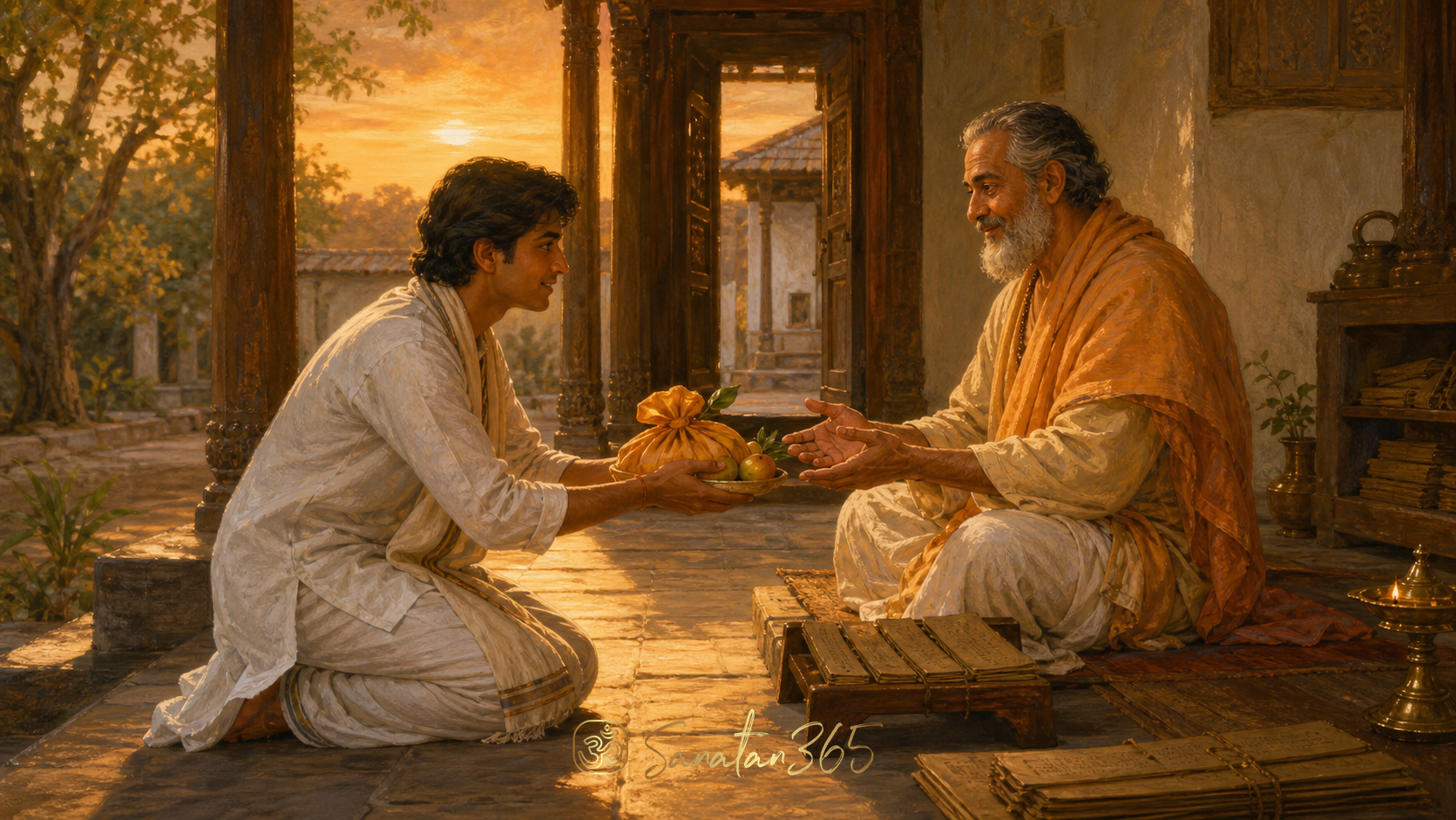
Dakshina Meaning: Sacred Giving, Gratitude, and Reciprocity
Dakshina is a traditional offering made after sacred teaching or ritual. Its deeper meaning joins gratitude with ethical reciprocity and responsible support.
A sacred teaching may be offered freely, yet receiving it still creates a responsibility: gratitude should become action.
The dakshina meaning in Hindu tradition is an offering made in acknowledgment of sacred learning, ritual service, or guidance. Dakṣiṇā (दक्षिणा, an honorarium or grateful offering) may take the form of money, food, cloth, service, or another fitting gift. It is not simply a price attached to spirituality. At its best, dakshina expresses humility, reciprocity, and a commitment to help worthy knowledge and practice continue.
What Is the Dakshina Meaning in Hindu Tradition?
Dakshina belongs to a family of Hindu ideas about giving, but it has a distinct context. It commonly follows something received: a teacher has shared knowledge, a priest has conducted a rite, or a sacred institution has sustained a practice. The offering acknowledges that time, discipline, learning, and material support made that service possible.
Older Sanskrit usage includes a fee or present given to an officiating priest after a yajña (यज्ञ, sacred offering or fire ritual). Sanskrit dictionaries also record meanings such as reward, honorarium, donation, or gift to a teacher. The forms varied across periods and communities, so no single object defines dakshina. Its recurring structure is more important: something of value has been received, and the recipient answers with respect.
This distinguishes dakshina from a casual tip. A tip often evaluates a service after a commercial exchange. Dakshina ideally begins from reverence and relationship. It says, “What was received matters, and its source should be honored.”
It also differs slightly from dāna (दान, generous giving or charity). Dana can be offered broadly to a person, cause, community, temple, or those in need without being tied to a specific teaching or rite. Dakshina more often responds to guidance, learning, or ritual service. In practice, the words can overlap, and regional usage is not uniform.
Key takeaway: Dakshina is best understood as grateful reciprocity after sacred learning, guidance, or ritual, not merely as a payment label.
Why Does Sacred Learning Invite an Offering?
Knowledge is not produced by the moment in which it is spoken. A teacher's explanation may rest on decades of study, disciplined practice, memorization, reflection, and responsibility toward a lineage. A ritual may require preparation, materials, precise recitation, and pastoral care for a family. Dakshina recognizes the invisible labor behind the visible moment.
The Taittiriya Upanishad presents a celebrated convocation address to students completing their study. It instructs them to speak truth, practice dharma, continue learning, honor parents and teachers, and give with faith, modesty, discernment, and understanding. The passage does not reduce giving to a mechanical fee. It places generosity within a larger ethical life.
That framework matters. A gift without respect can humiliate. A large gift offered for status can inflate the giver's ego. An offering made under fear can conceal coercion. The Upanishadic emphasis turns attention toward the inner quality of giving: śraddhā (श्रद्धा, trusting reverence), hrī (ह्री, modesty or moral sensitivity), and saṃvid (संविद्, understanding or thoughtful awareness).
The offering therefore serves several purposes:
- It gives material support to the teacher, priest, temple, or tradition.
- It trains the recipient of knowledge not to take care and learning for granted.
- It converts appreciation from a private feeling into a responsible act.
- It helps knowledge move from one generation to the next.
- It reminds both giver and receiver that sacred work carries duties.
None of this means wisdom can be bought. Payment may secure access to a course or compensate someone's work, but it cannot purchase realization, character, or divine grace. Those unfold through study, practice, conduct, and grace itself.
Key takeaway: Dakshina supports the human conditions that allow sacred knowledge to continue while reminding the learner that gratitude carries responsibility.
What Is Guru Dakshina?
Guru dakshina is the offering made by a śiṣya (शिष्य, student or disciple) to a guru (गुरु, a weighty or venerable teacher), often after a period of learning or at a meaningful completion point. The familiar phrase belongs to the guru–shishya paramparā (गुरु–शिष्य परम्परा, teacher–student lineage), where knowledge is transmitted through sustained relationship rather than information alone.
The offering need not be cash. Depending on context and the teacher's guidance, it may be:
- financial support given transparently;
- food, cloth, books, or useful materials;
- service to the place of learning;
- support for another student's education;
- disciplined application of the teaching;
- a commitment to preserve and share knowledge responsibly.
The last two forms are especially significant. If a student learns truthfulness but continues to deceive, an expensive gift cannot repair the contradiction. If someone receives a practice of compassion but uses spiritual status to diminish others, the outer offering has lost its center. Ethical embodiment is not a substitute for fair material support, but material support is not a substitute for transformation either.
Stories about guru dakshina should also be read with discernment. The Mahabharata account of Ekalavya, for example, has generated long debate about authority, exclusion, loyalty, and the cost demanded from a learner. It should not be flattened into a cheerful instruction that every request from a teacher must be obeyed. Sacred narratives often preserve moral tension precisely so later generations will think deeply.
A healthy teacher–student relationship does not erase consent, dignity, or moral judgment. Reverence is not servility. A true offering should not require harm, secrecy, exploitation, or the surrender of responsible conscience.
Key takeaway: Guru dakshina honors a living relationship of learning, but its authentic expression remains accountable to dharma, consent, and the student's ethical growth.
How Is Dakshina Offered After Puja or Ritual?
In household and temple contexts, dakshina may be offered to a purohita (पुरोहित, priest who conducts rites) after puja, samskara, recitation, or another observance. Families often place the offering respectfully on a tray or in an envelope, sometimes with fruit, cloth, flowers, or other customary items. Local practice varies across North and South India, Bengal, Maharashtra, Gujarat, and diaspora communities.
The practical principle is straightforward: discuss expectations clearly before a planned rite whenever possible. Ritual materials, travel, preparation, and the priest's time all have real costs. Clarity protects both sides from embarrassment. A mutually understood honorarium does not make the rite spiritually empty; it can be an honest way of supporting skilled religious service.
At the same time, language matters. A compulsory charge advertised as voluntary giving can create confusion. A family should be able to ask:
- What materials are included?
- Is there a customary honorarium or a fixed service amount?
- Are travel expenses separate?
- Can the family give additional dakshina if it wishes?
- Is a receipt available for a temple or institutional donation?
These questions do not show irreverence. They create transparency, which is part of dharmic conduct. A priest or institution also has a duty not to exploit grief, fear, or anxiety. No one should be pressured with claims that a larger payment guarantees divine favor, removes karma, cures illness, or controls a future outcome.
For readers learning about other daily practices, the meaning of arghya shows how even a simple water offering can unite material simplicity with attentive reverence. The meaning of naivedya similarly explains how food becomes part of sacred hospitality and sharing.
Key takeaway: Ritual dakshina is strongest when reverence and financial clarity coexist, with no fear-based promise attached to the amount.
How Much Dakshina Should Someone Give?
There is no universal figure that fits every teacher, ritual, region, or household. The fitting amount depends on the context, local custom, the giver's means, the time and work involved, and any amount agreed in advance. A modest offering made honestly is not spiritually inferior to a lavish one.
Five questions can guide the decision:
- Was an amount already agreed? Honor a clear commitment.
- What labor and expense were involved? Consider preparation, travel, materials, and time.
- What can the giver afford without neglecting essential duties? Sacred giving should not force a household into debt.
- Is the offering transparent? Use appropriate institutional channels and request documentation when needed.
- What form is genuinely useful? Money may be most helpful, but books, meals, service, or sponsorship can be appropriate when welcomed.
Giving beyond one's means for appearance contradicts the humility dakshina is meant to cultivate. So does using a tiny token to avoid fair compensation when someone has performed substantial work. The middle path is neither display nor miserliness; it is thoughtful proportion.
In diaspora settings, customary amounts from India may not map directly onto local living costs. Communities can address this by publishing clear suggested ranges, distinguishing required fees from optional gifts, and maintaining assistance for families with limited means. Such systems protect access while respecting labor.
Key takeaway: The right dakshina is sincere, proportionate, transparent, and considerate of both the giver's responsibilities and the receiver's work.
What Does Dakshina Teach in Modern Life?
Dakshina offers a correction to the habit of treating all knowledge as instantly available and therefore valueless. Digital abundance can hide the teachers, editors, translators, librarians, artists, priests, donors, and institutions who preserve what appears on a screen. Gratitude becomes mature when it helps sustain them.
The principle can be practiced without pretending every modern exchange is ancient. A student may pay a fair course fee and still offer gratitude. A reader may buy a scholar's book rather than rely only on pirated copies. A devotee may volunteer at a temple while also supporting trained staff. A community may fund translations so younger generations can study responsibly.
Modern dakshina can take practical forms:
- compensate teachers fairly for prepared work;
- donate to transparent scholarship or preservation projects;
- sponsor access for students who cannot pay;
- credit sources instead of presenting inherited knowledge as personal invention;
- care for shared spaces after receiving hospitality;
- apply a teaching with integrity and acknowledge its lineage.
These actions keep reciprocity from becoming sentiment alone. They also prevent a false opposition between spirituality and material life. Teachers and ritual specialists need food, housing, healthcare, tools, and time like anyone else. Supporting them responsibly can be an expression of respect, provided money is never treated as a guarantee of spiritual rank or miraculous results.
The deeper measure is not the visibility of the gift but the quality of the relationship it protects. Dakshina asks whether receiving has made a person more grateful, more responsible, and more willing to sustain what is good.
Key takeaway: In modern life, dakshina means supporting the people and structures that preserve worthwhile knowledge while practicing what has been learned.
Conclusion
Dakshina turns gratitude into reciprocity. It honors a teacher, priest, ritual, or lineage without claiming that wisdom or grace can be purchased. Its healthiest forms are freely understood, materially fair, ethically transparent, and proportionate to the giver's means.
Key takeaway: The deepest dakshina is an offering that sustains worthy knowledge and shows, through both support and conduct, that the gift of learning was truly received.
FAQ
What is the simple meaning of dakshina?
Dakshina is a respectful offering or honorarium given after receiving sacred teaching, guidance, or ritual service. It may be money, useful goods, service, or another fitting expression of gratitude.
Is dakshina the same as a fee?
Not exactly. A fee is an agreed price for a service. Dakshina traditionally carries the additional meaning of reverence and reciprocity. In contemporary practice, a fixed fee and an optional dakshina may coexist, but they should be described clearly.
What is the difference between dana and dakshina?
Dāna (दान, generous giving) is a broad category of charity or donation. Dakshina is more specifically associated with something received, especially teaching, guidance, or ritual service. Usage can overlap across regions and traditions.
Can guru dakshina be non-monetary?
Yes. It may include service, books, food, support for other students, care for an institution, or faithful application of the teaching. The form should be appropriate, welcomed, and free from harm or coercion.
Should someone borrow money to give dakshina?
No general Hindu principle requires a person to neglect essential household duties or enter debt for display. A sincere, proportionate offering within one's means is more consistent with humility and responsible giving.
About the author
Sanatan365 Editorial
Bringing Sanatan Dharma to modern seekers through authentic, scripture-grounded content.
Related in Practices
 Practices
Parayana Meaning: Giving Sacred Reading a Steady Place
Understand parayana as sustained devotional reading or recitation, with distinctions from study and mantra repetition and a respectful way…
 Practices
Smarana Meaning: Remembering the Divine Between Daily Tasks
Smarana is devotional remembrance. Explore its scriptural context, its relationship with chanting, and gentle ways to remember the Divine d…
 Practices
Upasana Meaning: Why Worship Is a Practice of Drawing Near
Upasana means drawing near to the Divine through sustained attention. Explore how sacred symbols, daily worship and inward recollection bel…