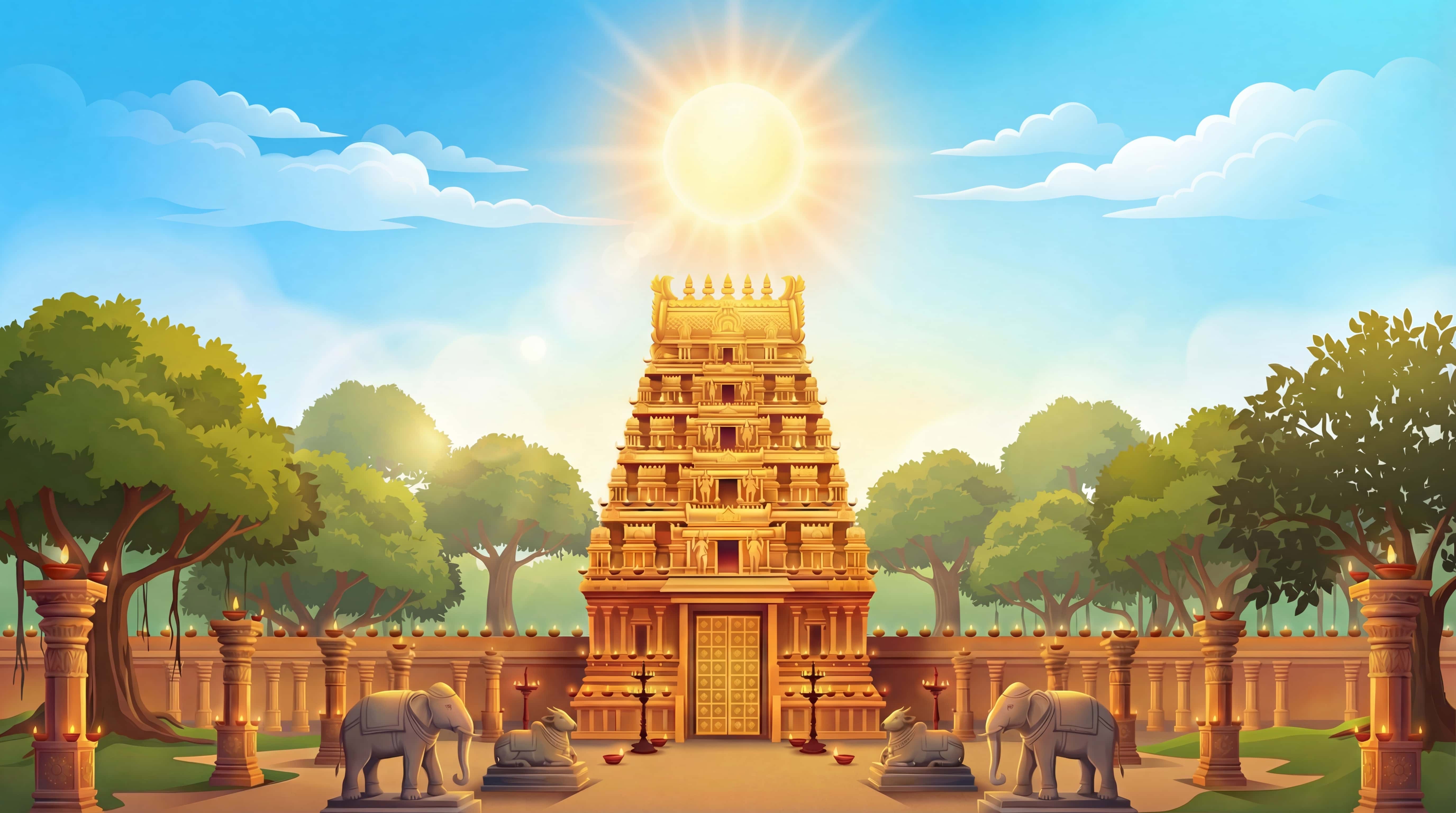
Devi Suktam Meaning: When the Goddess Speaks as the Universe
The Devi Suktam of Rig Veda 10.125 presents Vak Ambhrini's realization of the Divine Feminine as sacred speech, cosmic power, and the presence sustaining all life.
A Vedic seer does not merely praise the Goddess in the Devi Suktam. She speaks from a realization in which the Goddess declares, “I am” throughout the universe.
The Devi Suktam meaning centers on the Divine Feminine as vāk (वाक्, sacred speech), conscious power, and the presence that supports gods, people, earth, heaven, and every act of knowing. Found in Rig Veda 10.125, its eight mantras are attributed to the rishika Vak Ambhrini. The hymn is both intimate and immense: the voice of one seer opens into the voice of reality itself.
What Is the Devi Suktam Meaning in Rig Veda 10.125?
The Devi Suktam, also called the Vak Sukta, is the 125th hymn of the Rig Veda's tenth maṇḍala (मण्डल, book or section). A sūktam (सूक्तम्, “well-spoken hymn”) is a Vedic group of mantras addressed to or revealing a particular divine reality. Here, that reality is Vak, sacred speech, experienced not as a human invention but as a power woven through consciousness and creation.
The hymn contains eight verses. In the first person, its speaker says that she moves with the Rudras, Vasus, Adityas, and other deities; sustains cosmic powers; grants insight and strength; pervades earth and heaven; and breathes forth like the wind while holding existence together. Readers can compare the full English rendering in the Rig Veda translation of Hymn 10.125 and individual verse notes in the Rig Veda translation archive.
This language does not reduce Devi to a single object within the cosmos. It presents her as Shakti (शक्ति, divine power or capacity): the power by which seeing, breathing, worship, knowledge, courage, and order become possible. Later Shakta traditions would develop rich theological languages around the supreme Goddess, but this Vedic hymn already gives the Divine Feminine a striking cosmic voice.
The hymn should also be read with humility. Translations vary because Vedic Sanskrit is layered, compressed, and tied to oral tradition. “Speech” in this context is broader than ordinary conversation. Vak includes expression, revelation, intelligibility, and the power through which meaning becomes present.
Key takeaway: The Devi Suktam reveals the Goddess as sacred speech and conscious power active within the whole of existence.
Who Was Rishika Vak Ambhrini?
The seer associated with the hymn is Vak Ambhrini, traditionally understood as the daughter of Rishi Ambhrina. A ṛṣikā (ऋषिका, female seer) is not simply an author in the modern literary sense. In the Vedic understanding, a rishi or rishika “sees” mantra: disciplined awareness receives or realizes a truth and gives it precise sacred expression.
That distinction helps explain the hymn's unusual first-person voice. Vak Ambhrini is not making a boast about her individual personality. The traditional reading is that the seer's limited identity has opened into a direct recognition of the universal Devi. The repeated “I” belongs to the divine reality shining through awakened speech.
This matters for two reasons.
First, the hymn preserves the authority of a woman seer in the Rig Vedic corpus. It should not be turned into a modern slogan or detached from its sacred setting; its own power is enough. Vak Ambhrini stands within the Vedic tradition as a knower whose insight is transmitted as śruti (श्रुति, revealed sacred teaching that is “heard”).
Second, the hymn demonstrates that revelation is not merely information about the Divine. It can be a transformation of perspective. The speaker no longer sees separate powers scattered across the world. She sees one conscious potency moving through their diversity.
This movement from separation toward unity resembles a recurring insight in the Upanishads, though the vocabulary and setting differ. The Isha Upanishad's teaching on wholeness and action, for example, asks the seeker to perceive the Divine inhabiting all that moves. The Devi Suktam expresses a comparable vastness through the living voice of Vak.
Key takeaway: Vak Ambhrini's “I” is best understood as realized divine identity, not personal self-importance.
Why Does the Goddess Speak as Vak, or Sacred Speech?
Human beings often treat speech as a tool: they think first, then use words to convey a private thought. Vedic reflection sees a deeper mystery. Before speech communicates, it makes meaning shareable. It names relationships, carries memory, orders ritual, teaches dharma, and allows insight to pass from one generation to another.
Vak is therefore not merely sound. She is the sacred possibility of meaningful expression.
The Devi Suktam links this power with nourishment, wisdom, sovereignty, and action. The Goddess moves among many deities without being confined to any one of them. She enables the listener to hear, the seer to know, and the worshipper to offer. One verse warns that those who fail to recognize her dwell without understanding, while another presents her as the one who makes a person powerful, wise, or a rishi according to her will.
This does not justify using speech to dominate others. Sacred speech carries responsibility. If words participate in a divine power, careless falsehood, humiliation, gossip, and manipulation are not small matters. They misuse the very faculty that can transmit truth and restore relationship.
The connection between speech and illumination also appears in the Gayatri Mantra's prayer for clear intelligence. Gayatri asks that the divine radiance inspire the intellect; Devi Suktam reveals the conscious power through which insight becomes expression. Together, they suggest that true eloquence begins with clarity, restraint, and alignment.
A practical examination of speech may ask:
- Is what is about to be said true?
- Is it necessary in this moment?
- Can it be expressed without needless harm?
- Does silence serve better?
- Will the words increase clarity or merely discharge emotion?
These questions turn theology into daily discipline without reducing a Vedic hymn to a productivity technique.
Key takeaway: To honour Vak is to treat speech as a sacred power that requires truth, discernment, and care.
How Do the Eight Verses Move from the Gods to the Whole Universe?
The hymn's eight mantras unfold in a clear expansion. They can be read as four movements rather than as isolated declarations.
1. Devi moves with the divine powers
The opening verses name Rudras, Vasus, Adityas, Vishvadevas, Mitra, Varuna, Indra, Agni, the Ashvins, Soma, Tvashtar, Pushan, and Bhaga. Devi is not presented as a rival who cancels these deities. She moves with them, bears them, and sustains their work.
This is an important protection against sectarian reading. The hymn celebrates unity within divine plurality. It does not require disrespect toward any deity or path.
2. Devi is sovereign and gathers what is precious
The third verse famously describes the speaker as queen, gatherer of treasures, knower, and first among those worthy of worship. “Treasure” need not be read only as material wealth. In the hymn's setting it also suggests insight, order, capability, and the resources by which a worthy offering becomes possible.
Sovereignty here means an integrating power. Devi coordinates rather than merely controls.
3. Devi lives within ordinary capacities
The hymn then turns toward eating, seeing, breathing, and hearing. These are daily acts, so familiar that they disappear from attention. Devi Suktam restores wonder to them. Conscious life is not self-produced; it is received moment by moment through powers larger than the ego.
This is where the hymn becomes personally demanding. If the same sacred potency enables every person's breath and awareness, dignity cannot be reserved for a preferred group. Reverence must influence how people speak, serve, and share the world.
4. Devi exceeds every boundary
The final verses become cosmological. The Goddess empowers protection, generates the Father at the summit of the world, has her source in the cosmic waters, reaches across beings, and moves like the wind while holding worlds together.
The movement is deliberate: from named gods, to ritual and knowledge, to the senses, to earth, heaven, waters, wind, and all existence. What first appears as sacred speech is revealed as the power of manifestation itself.
Key takeaway: The eight verses expand from divine plurality and human experience into a vision of Devi pervading the cosmos.
Is the Devi Suktam About One Goddess or the Divine Feminine?
Different Hindu traditions may chant and interpret the hymn through distinct devotional lenses. Shakta worshippers may hear it as the voice of Mahadevi (महादेवी, the Great Goddess). A devotee may associate its majesty with Durga, while another may emphasize Saraswati through Vak or see the universal Shakti present in many forms.
The hymn itself uses a cosmic first-person voice and does not confine that voice to one later iconographic form. That breadth should be preserved. It allows a devotee to honour a beloved form without claiming that another form is inferior.
The principle is similar to understanding a symbol without exhausting the Divine through that symbol. The meaning of Goddess Saraswati's symbols can deepen appreciation for wisdom, music, and learning, while the Devi Suktam points toward the more encompassing power by which wisdom and expression arise at all.
This distinction also prevents a common mistake: treating “the feminine” as only a social stereotype. The Devi Suktam's power is not passive, ornamental, or limited to one human role. She nourishes, teaches, protects, orders battle, generates, and pervades. Divine femininity here includes intelligence, authority, force, abundance, and transcendence.
At the same time, the hymn should not be used to flatten every goddess into an interchangeable image. Durga, Lakshmi, Saraswati, Kali, and other forms carry their own stories, practices, and theological meanings. Unity does not erase sacred particularity.
Key takeaway: The hymn supports a vision of universal Devi while leaving room for many reverent devotional interpretations.
How Can Someone Approach the Devi Suktam Respectfully Today?
The safest beginning is attentive study rather than hurried performance. Vedic recitation depends on exact sound, accent, and lineage. Those wishing to chant the Sanskrit should learn from a qualified teacher or a reliable traditional recording, especially because Vedic svara, or tonal accent, matters.
Someone approaching the hymn may use this simple sequence:
- Read a complete translation. Compare more than one rendering where a line seems difficult.
- Learn the context. Remember Rig Veda 10.125, Vak Ambhrini, and the identity of Vak as sacred speech.
- Listen before chanting. Notice pronunciation, pacing, and tonal movement from a trusted source.
- Reflect on one verse. Ask what it changes about the understanding of speech, breath, dignity, or divine presence.
- Practise truthful speech. Let study bear fruit in restraint, accuracy, kindness, and courage.
- Avoid transactional promises. The hymn is not a guaranteed mechanism for wealth, power, healing, or control.
Those who do not have access to formal recitation instruction can still study the meaning with reverence. Quietly reading a translation, offering a lamp before a respectfully chosen murti or sacred symbol, and reflecting on responsible speech can be a sincere beginning. The goal is not performance for display but a more truthful relationship with word and awareness.
The hymn can also guide family conversation. Parents may ask children how words can protect or harm, how listening differs from waiting to speak, and why truth needs compassion. Such questions preserve the hymn's ethical force without pretending that a short explanation replaces traditional learning.
Key takeaway: Respectful engagement combines accurate study, careful listening, disciplined speech, and freedom from guaranteed claims.
Conclusion
The Devi Suktam begins with a voice and ends with a universe held together. Through Vak Ambhrini, sacred speech recognizes itself as the power moving with gods, sustaining human capacities, filling earth and heaven, and breathing through creation.
Its enduring insight is not that the individual ego should become grander. It is that the ego can become transparent to a reality immeasurably larger than itself. When speech is treated as sacred, words become more truthful. When consciousness is treated as received, life becomes less possessive. When Devi is recognized in many powers and forms, devotion can become both deep and generous.
Key takeaway: The Devi Suktam teaches that the Divine Feminine is not outside the world alone; she is the conscious power by which the world can be known, expressed, and sustained.
FAQ
What is the Devi Suktam?
The Devi Suktam is Rig Veda 10.125, an eight-verse hymn also known as the Vak Sukta. It presents the Goddess as sacred speech and the cosmic power moving through deities, human awareness, earth, heaven, and all existence.
Who composed or saw the Devi Suktam?
The hymn is attributed to Rishika Vak Ambhrini. In Vedic tradition, a rishika is a female seer of mantra, so she is understood as realizing and voicing the hymn rather than composing it only as personal literature.
Is Devi Suktam dedicated to Durga?
Many devotees may hear or worship its universal Devi through Durga, but Rig Veda 10.125 speaks in the broad voice of Vak and cosmic divine power. Traditions may connect the hymn with Mahadevi, Durga, Saraswati, or Shakti while respecting its expansive Vedic meaning.
What does Vak mean in the Devi Suktam?
Vak means speech, but in the hymn it signifies more than ordinary words. It includes sacred expression, revelation, meaningful order, and the conscious power through which knowledge can be communicated.
Can beginners chant the Devi Suktam?
Beginners can respectfully study translations and listen to reliable recitations. Because Vedic pronunciation and tonal accents matter, formal chanting is best learned from a qualified teacher rather than copied casually from uncertain text or audio.
About the author
Sanatan365 Editorial
Bringing Sanatan Dharma to modern seekers through authentic, scripture-grounded content.
Related in Scriptures
 Scriptures
Tattva Bodha Meaning: Four Qualifications for Clear Self-Inquiry
A beginner-friendly reading of Tattva Bodha, its four qualifications, six inner disciplines, and careful distinction between preparation an…
 Scriptures
Nirvana Shatakam Meaning: Six Verses of Self-Inquiry
Read the six verses of Nirvana Shatakam as careful Advaita self-inquiry, understand Shivoham, and distinguish contemplative freedom from ne…
 Scriptures
Atharva Veda Meaning: Household Prayer and Cosmic Questions
The Atharva Veda brings household concerns, communal hopes, and questions about existence into sacred speech. Learn its scope and how to re…