Goddess Saraswati Meaning: Veena, Swan, Wisdom, and Clear Speech
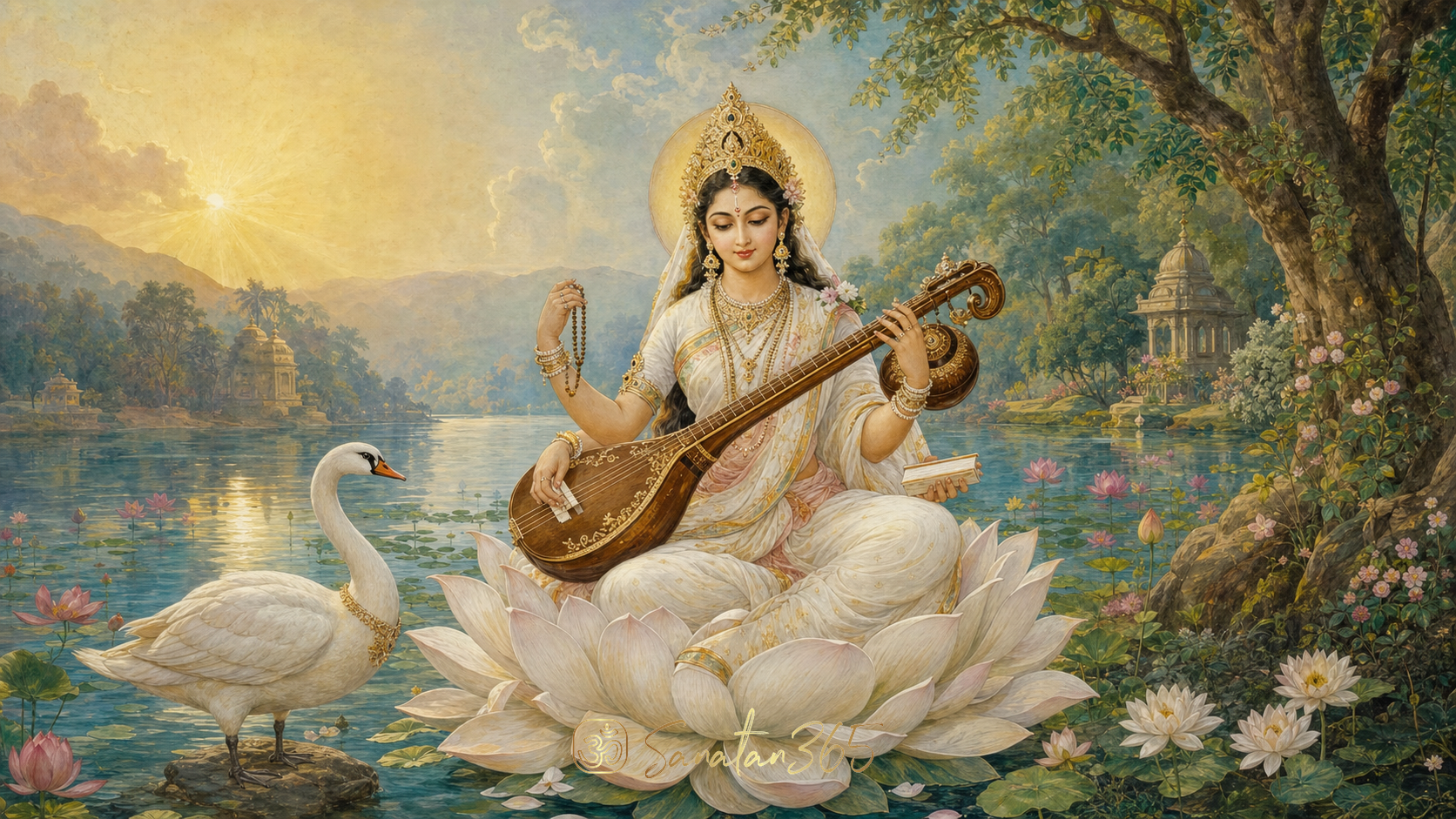
Goddess Saraswati is revered as the Hindu goddess of learning, music, speech, and refined wisdom. Her veena, swan, book, mala, lotus, and white garments turn knowledge into a disciplined way of living.
Before learning becomes achievement, it is first a way of becoming clear.
Goddess Saraswati meaning is the Hindu understanding of knowledge as purity, music, disciplined speech, memory, creativity, and wisdom. Saraswati (सरस्वती, Sarasvati, "she who flows") is revered as the goddess of learning, the arts, language, and refined intelligence. Her veena, swan, book, mala, white lotus, and simple white garments are not decorative details. They teach that true knowledge should tune the mind, purify speech, sharpen discernment, and make human life more graceful.
What Is Goddess Saraswati Meaning in Hindu Tradition?
Goddess Saraswati meaning begins with flow. The name Saraswati is linked with flowing water, speech, and inspiration, and early Vedic references remember Saraswati both as a sacred river and as a divine power of nourishment, clarity, and praise. In later Hindu worship, she becomes especially associated with vidya (विद्या, knowledge), vani (वाणी, speech), kala (कला, art), and viveka (विवेक, discernment).
This shift from river to speech is spiritually natural. A river must keep moving to remain alive. Speech must stay truthful to remain sacred. Knowledge must stay humble to remain useful. Saraswati gathers all three into one image: the flowing power that cleans the mind and lets insight move through words, music, study, and teaching.
Britannica identifies Saraswati as a Hindu goddess of learning and the arts, and many worship traditions also honor her through music, poetry, education, and language Britannica. The Hindu American Foundation's symbolism guide presents her familiar objects as teachings on knowledge, discipline, purity, and harmony Hindu American Foundation.
For students, Saraswati is not only the deity prayed to before exams. For musicians, she is not only the patron of performance. For writers, teachers, parents, and seekers, she represents a deeper question: what kind of person does knowledge create?
This is why her symbolism pairs naturally with other Hindu teachings on inner refinement. A seeker who studies the meaning of the Self in Atman Meaning meets a related discipline: knowledge should turn attention inward, not only outward. A reader who studies Shanti Mantra Meaning sees the same reverence for sound, speech, and peace. Saraswati stands at the meeting point of both: insight within, expression without.
Key takeaway: Saraswati is the Hindu image of knowledge that flows, refines, and becomes wise action.
Why Does Saraswati Hold a Veena?
The veena is the most recognizable part of Saraswati's iconography. It is a classical stringed instrument, and in her hands it represents music, rhythm, harmony, and refined expression. But the veena also teaches something quieter: life becomes beautiful when the inner strings are tuned.
A string that is too loose cannot create music. A string that is too tight may snap. Saraswati's veena points toward the middle discipline of learning: effort without harshness, creativity without disorder, emotion without loss of clarity.
This is why Saraswati veena meaning matters beyond music. A family can be tuned by speech. A classroom can be tuned by patience. A mind can be tuned by daily study. A spiritual practice can be tuned by attention. The veena does not merely symbolize art; it symbolizes the art of proportion.
In many Hindu homes, children are encouraged to begin study with a short prayer to Saraswati because learning is not treated as a dry transaction. It is a sacred relationship between teacher, student, memory, language, and humility. The veena reminds the learner that skill must become grace, not pride.
Key takeaway: Saraswati's veena teaches harmony between discipline, creativity, speech, and emotion.
What Does the Swan Mean in Saraswati Symbolism?
Saraswati is often shown with a hamsa (हंस, swan or goose), a bird associated in Hindu thought with discrimination and purity. In devotional explanation, the hamsa is said to represent the ability to separate what is nourishing from what is not. Whether taken literally, symbolically, or poetically, the teaching is clear: wisdom is not the same as collecting information.
The modern world often rewards speed of reply. Saraswati rewards clarity of judgment. The swan asks: Can the mind distinguish fact from noise? Can speech separate truth from ego? Can a student learn without becoming arrogant? Can a devotee remain gentle while becoming intelligent?
This is the heart of Saraswati swan meaning. The swan is not there to make the scene pretty. It shows viveka, the power to choose the true, the useful, and the pure. A person may know many things and still lack discernment. Saraswati's swan quietly corrects that imbalance.
In Vedantic vocabulary, viveka often means discrimination between the lasting and the passing, the Self and the not-Self, wisdom and appearance. Saraswati's symbolism brings that lofty teaching into everyday life: choose better words, better books, better company, better attention.
Key takeaway: The swan represents discernment, the wisdom to separate insight from distraction.
Why Are the Book, Mala, Lotus, and White Garments Important?
Saraswati's book usually represents sacred knowledge, study, memory, and the written word. It may be understood as the Vedas, scriptures, learning, or the wider discipline of education. In her hand, a book does not mean information hoarding. It means knowledge preserved, contemplated, and transmitted responsibly.
The mala (माला, prayer beads) represents concentration, repetition, and inner discipline. A musician repeats scales. A student reviews lessons. A devotee repeats mantra. A writer returns to the blank page. A seeker sits again with the same question. Saraswati's mala honors that repeated effort.
The white lotus suggests purity rising from the waters of life. The lotus grows from mud but opens cleanly toward light. In Saraswati's image, it teaches that knowledge should not make a person cold or distant. It should help one rise above confusion while remaining rooted in the world.
Her white garments are equally important. White is associated with sattva (सत्त्व, clarity, balance, purity). In Saraswati worship, white and soft yellow often appear as colors of simplicity, learning, and spring. The message is not luxury. It is lucidity.
Together, these symbols form a complete path:
- The book asks the mind to study.
- The mala asks attention to become steady.
- The lotus asks character to remain pure.
- The white clothing asks knowledge to become sattvic.
- The veena asks expression to become harmonious.
- The swan asks judgment to become clear.
Key takeaway: Saraswati's objects show that learning needs study, repetition, purity, harmony, and discernment.
How Is Saraswati Worshipped on Vasant Panchami and Beyond?
Vasant Panchami, also called Saraswati Puja in many regions, is one of the best-known festivals connected with the goddess. It falls on the fifth day of the bright fortnight of Magha and is widely associated with the arrival of spring, yellow garments, offerings, books, musical instruments, and prayers for learning. Hindu American Foundation notes that Vasant Panchami is closely linked with Saraswati worship and new beginnings in learning HAF Vasant Panchami.
In Bengal, Bihar, Assam, Odisha, and parts of North India, Saraswati Puja often takes place in homes, schools, colleges, and community pandals. Students place books near the deity and pray for learning with humility. In many South Indian traditions, especially during Navaratri, books and instruments are kept for worship, and Vidyarambham (विद्यारम्भम्, beginning of learning) marks a child's formal start in writing or study.
These regional forms are different, but the core is shared. Learning is treated as sacred before it becomes professional. Speech is purified before it becomes public. Music is offered before it becomes performance. Children are taught that education is not only for earning; it is for becoming.
The diaspora has carried Saraswati worship into temples, schools, music classes, and family shrines across the world. A child in New Jersey, a student in London, a vocalist in Chennai, and a family in Kolkata may all approach Saraswati differently, yet they meet the same ideal: may learning be clear, humble, and beneficial.
This also explains why Saraswati worship often feels gentle rather than severe. The devotee does not approach her only to request marks, rank, or success. The deeper prayer is for buddhi (बुद्धि, awakened intelligence), smriti (स्मृति, right memory), and vak shuddhi (वाक् शुद्धि, purity of speech). In a classroom, that may mean patience with difficult study. In a music room, it may mean respect for riyaz (रियाज़, daily practice). In a family, it may mean teaching children that words can bless, wound, confuse, or heal.
Key takeaway: Saraswati Puja turns education, music, and speech into acts of reverence.
What Can Saraswati Teach Modern Seekers?
Saraswati's deepest teaching may be this: the tongue must be educated as much as the mind.
Modern life gives people endless chances to speak quickly, react publicly, and consume fragments of knowledge. Saraswati asks for slower refinement. Is the word true? Is it necessary? Is it kind? Is it well-timed? Does it add clarity, or does it thicken confusion?
For students, Saraswati teaches that disciplined attention is sacred. For parents, she teaches that a child's learning needs reverence, not only pressure. For professionals, she teaches that intelligence without ethics can become cleverness without wisdom. For artists, she teaches that beauty should lift consciousness. For spiritual seekers, she teaches that silence and speech both need purity.
Her teaching also challenges a common mistake: treating spirituality and intellect as separate worlds. Saraswati shows that study can be devotional when it is honest, art can be spiritual when it is uplifting, and speech can be a form of worship when it carries truth with restraint. This is close to the spirit of Japa Meditation Meaning, where repetition trains attention until sound becomes inwardly steady. Saraswati extends that steadiness into every sentence one speaks.
This is why Goddess Saraswati meaning remains fresh. She is not only a school-day deity. She is a lifelong guide to right learning:
- Read deeply instead of only skimming.
- Practice daily instead of waiting for inspiration.
- Speak truth without cruelty.
- Listen before answering.
- Let art refine the heart.
- Let knowledge reduce ego, not inflate it.
In Sanatan Dharma, wisdom is not measured only by what one knows. It is measured by what one becomes through knowing. Saraswati's image makes that standard visible.
Key takeaway: Saraswati teaches modern seekers to turn information into discernment, discipline, and graceful speech.
FAQ
What is Goddess Saraswati meaning in simple words?
Goddess Saraswati meaning is the Hindu understanding of knowledge, learning, music, speech, creativity, and wisdom as sacred powers. She represents clear thought, disciplined study, refined expression, and pure speech.
What does Saraswati's veena symbolize?
Saraswati's veena symbolizes music, harmony, art, and inner tuning. It teaches that learning should bring balance to the mind, emotion, speech, and action.
What does the swan mean with Goddess Saraswati?
The swan, or hamsa, represents discernment and purity. It points to the wisdom of separating truth from noise, useful knowledge from distraction, and humble learning from ego.
Why is Saraswati worshipped on Vasant Panchami?
Vasant Panchami is widely associated with Saraswati Puja, the coming of spring, and fresh beginnings in learning. Students, artists, teachers, and families pray for knowledge, creativity, and clear speech.
Is Goddess Saraswati only for students?
No. Students naturally pray to Saraswati, but her meaning is wider. She guides anyone who studies, teaches, writes, sings, speaks, creates, or seeks wisdom with humility.
The single key takeaway: Goddess Saraswati teaches that knowledge becomes sacred when it flows as clear speech, disciplined learning, beautiful art, and humble discernment.
About the author
Sanatan365 Editorial
Bringing Sanatan Dharma to modern seekers through authentic, scripture-grounded content.
Related in Deities
 Deities
Savitr Deva Meaning: Golden Hands and the Rhythm of Life
Meet Savitr, the Vedic divine impeller whose golden hands set life in motion and whose hymns honour rest as well as activity.
 Deities
Indra Deva Meaning: The Vajra, Rain, and Responsible Power
Indra links the thunderbolt and released waters with a demanding question: what is strength for? Read his Vedic imagery and later lessons w…
 Deities
Agni Deva Meaning: Sacred Fire and the Divine Messenger
Meet Agni as the Vedic priest and messenger, read the first Rig Veda hymn, and understand sacred fire without reducing a living deity to a…