Dhwaja Stambha Meaning: The Sacred Flagstaff Before a Hindu Temple
Dhwaja Stambha meaning explained through the sacred flagstaff's place in Hindu temple architecture, festival ritual, deity emblems, and the devotee's approach to darshan.
Before the sanctum appears, a tall column often announces that a Hindu temple is more than a building: it is a living place of worship.
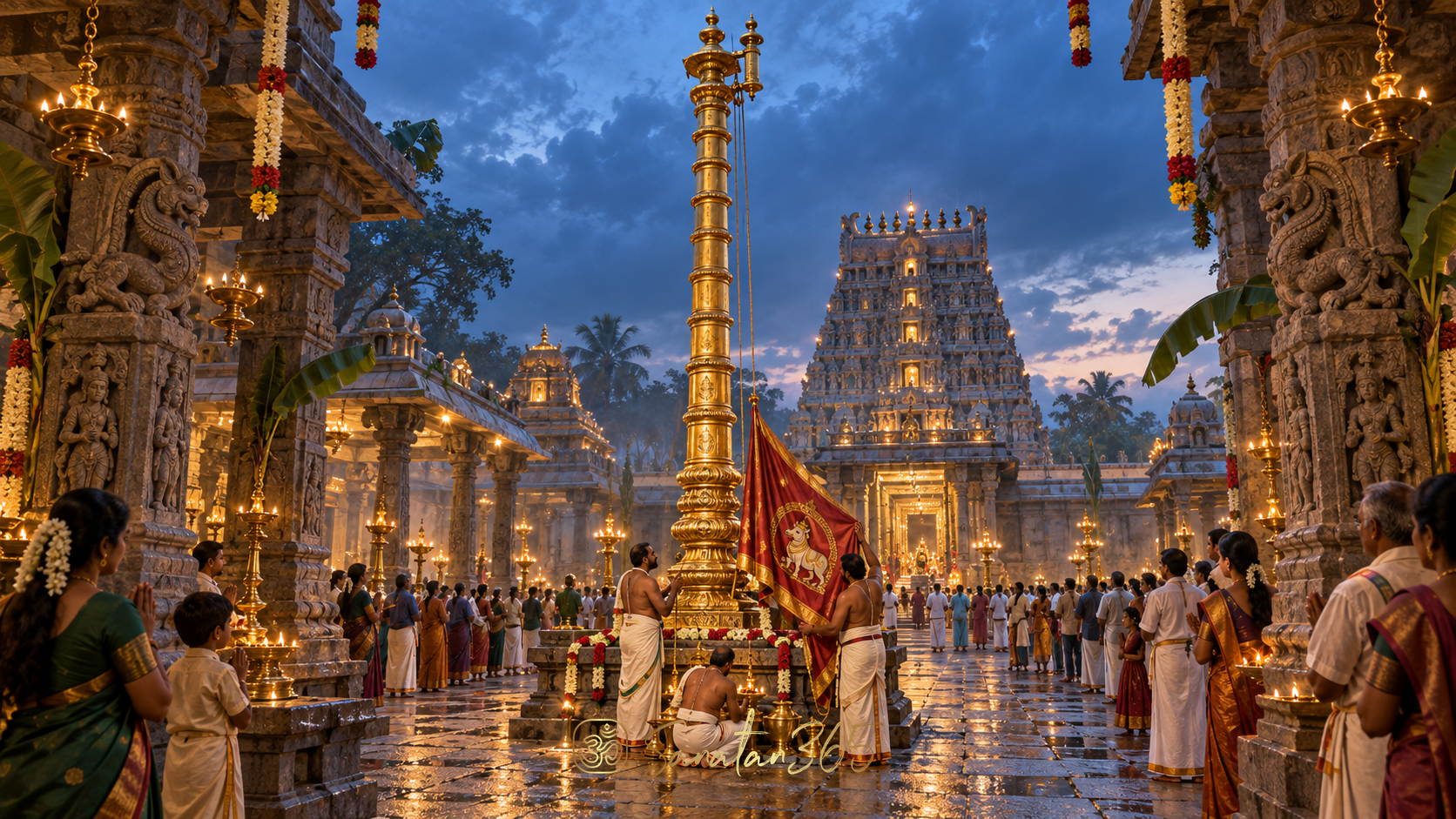
Dhwaja Stambha meaning begins with dhvaja (ध्वज, flag or emblem) and stambha (स्तम्भ, pillar). Also written Dhwaja Stambha, Dwajasthambam, or kodimaram in regional usage, it is the consecrated flagstaff found on the approach to the sanctum in many Hindu temples, especially across South India. It identifies the temple's sacred presence, supports festival flag-hoisting, and helps mark the devotee's movement from the outer world toward darshan (दर्शन, reverent seeing of the Divine).
Its precise design, placement, ritual treatment, and symbolism vary by temple and tradition. It should therefore be understood first through what can be observed and documented: sacred architecture, consecration, deity emblems, and festival practice. More elaborate symbolic explanations may be meaningful within particular lineages, but they are not necessarily universal.
Key takeaway: The dhwaja stambha is a consecrated temple flagstaff that joins architecture, identity, festival time, and devotional attention.
What is the Dhwaja Stambha meaning in a Hindu temple?
A dhwaja stambha is not an ordinary civic flagpole placed near a religious building. It belongs to the ritual life of the temple. Its name joins the idea of a flag or identifying emblem with that of a stable upright support. In many temples, the staff stands prominently in an axial relationship with the main shrine, making it one of the first sacred elements a visitor encounters after passing through an entrance or gateway.
The flagstaff may communicate several functions at once:
- Sacred identity: it marks the precinct as belonging to a particular temple and its presiding deity.
- Ritual readiness: it provides the place where a festival flag can be raised in a formal act called dhvajarohana (ध्वजारोहण, ceremonial flag-hoisting).
- Processional orientation: it helps organize the space through which worshippers, priests, and festival processions move.
- Devotional transition: it invites a visitor to slow down, recollect the deity, and approach the inner shrine attentively.
Descriptions of dhvajastambha in architectural and religious reference literature consistently identify it as a temple flagstaff, though interpretations of its inner symbolism differ (Wisdom Library). The visible fact is simple: the staff belongs to a coordinated sacred setting rather than standing as isolated ornament.
This is why the dhwaja stambha should not be reduced to a superstition or to a single hidden meaning. Like the gopuram and sacred architecture of Meenakshi Amman Temple, a temple element gains meaning through placement, worship, community memory, and repeated use.
Key takeaway: Its meaning comes from the union of form and practice, not from one symbolic explanation alone.
Where does the sacred flagstaff stand in temple architecture?
In many South Indian temple plans, the dhwaja stambha stands along the central approach to the principal sanctum. A visitor may encounter it near the bali pitha (बलिपीठ, ritual offering pedestal) and before the inner shrine. Exact order and distance vary because temples differ in period, region, denomination, available space, and later expansion.
The staff's placement creates a strong visual line. Gateway, courtyard, flagstaff, halls, and sanctum can guide the eye and body inward. This ordering is not merely aesthetic. Hindu temple architecture often coordinates movement with changing degrees of sacred attention. The visitor leaves the bustle of the street, crosses thresholds, encounters guardians and ritual markers, and gradually approaches the presiding murti.
That spatial rhythm can be felt at large temple complexes where architecture unfolds across multiple enclosures. The Srirangam Ranganathaswamy Temple offers a powerful example of a temple-town whose gateways, enclosures, courtyards, and inner worship spaces structure an extended approach to the Divine. A dhwaja stambha participates in this broader architectural grammar: it helps locate the visitor within a path rather than merely decorating it.
Materials also vary. The central structural core may be wood or another strong material, while visible surfaces can be clad in metals such as copper or brass and sometimes finished with gold-coloured plating. Some staffs are segmented or ornamented; others are comparatively restrained. Climate, temple resources, ritual manuals, craft traditions, and conservation history all shape the final form.
No visitor should assume that every Hindu temple must have an identical flagstaff. Northern, eastern, western, and Himalayan temple traditions can organize sacred space differently. Even within South India, Shaiva, Vaishnava, Shakta, and other temples may follow distinct Agama (आगम, transmitted ritual and temple tradition) or local conventions.
Key takeaway: The dhwaja stambha is best read as one part of an ordered sacred approach whose form varies across living temple traditions.
How is a Dhwaja Stambha made and consecrated?
Construction alone does not make a temple flagstaff ritually complete. The staff is prepared, installed, and consecrated according to the procedures followed by the temple's authorized priests, ritual specialists, trustees, and craftspeople. Those procedures should not be improvised from a general online guide because details differ across Agamic and regional traditions.
At a practical level, making and maintaining a dhwaja stambha may involve:
- selecting and preparing a suitable structural core;
- adding protective and ornamental metal cladding;
- aligning the staff within the established temple plan;
- installing deity-specific or temple-specific emblems;
- conducting purification, invocation, and consecration rites;
- inspecting the structure periodically for weathering and safety.
This combination of craft and ritual is important. A sacred object in a public temple must be structurally sound as well as ritually meaningful. Wood can deteriorate, metal can corrode, joints can weaken, and cladding can require restoration. Conservation therefore calls for both technical competence and sensitivity to worship continuity.
The same principle appears in the consecration of a murti through Prana Pratishtha: physical preparation and ritual responsibility are related, but they are not interchangeable. A qualified tradition determines the rites; skilled artisans and engineers protect the material form.
Popular writing sometimes presents every ring, panel, or proportion of a flagstaff as if it carried one fixed cosmic code. Such readings may belong to a local teacher, text, or lineage, but responsible explanation identifies them as interpretations rather than universal facts. The safest approach is to ask the temple itself what its flagstaff means within that temple's practice.
Key takeaway: Consecration joins inherited ritual authority with careful craftsmanship and continuing stewardship.
Why is the temple flag raised before major festivals?
The dhwaja stambha becomes especially visible during utsava (उत्सव, a sacred festival or celebratory observance). In many temple festivals, a formal flag-hoisting announces that the festival period has begun. The rite may be called dhvajarohana, kodiyettam, or a related regional name.
This is not merely publicity. The raised flag changes the community's sense of time. Ordinary days give way to a defined sacred interval filled with processions, special worship, music, offerings, lamps, recitation, and collective participation. The flag can identify the presiding deity through an emblem and signal that the temple's festival discipline is now active.
Contemporary reporting on Kerala temple festivals still records kodiyettam as the act that formally begins celebrations. For example, coverage of Thrissur Pooram describes ceremonial flag-hoisting at participating temples as the opening of the festivities (The Hindu). Temple-festival documentation likewise describes multiple ritual modes associated with the flag-hoisting ceremony (Thrissur Pooram Festival).
The duration and closing rites differ. Some festivals conclude with a formal lowering of the flag, indicating that the intensified ritual period has ended. The community then returns to the temple's regular cycle, carrying the festival's blessings and responsibilities into daily life.
For diaspora temples, flag-hoisting can also gather a geographically dispersed community. A familiar emblem raised above a temple courtyard makes sacred time visible to children and adults who may live far from their ancestral regions. The ritual can preserve continuity without pretending that every temple performs it in exactly the same way.
Key takeaway: Festival flag-hoisting turns the dhwaja stambha into a public marker that sacred time has begun.
What do deity emblems on the flagstaff signify?
A temple flag may carry an emblem associated with its presiding deity or tradition. A Vaishnava context may use Garuda-related imagery; a Shaiva context may use Nandi-related imagery; other temples may display a vehicle, weapon, animal, symbol, or insignia recognized within their own worship tradition.
These emblems are not random branding. They make the temple's devotional identity visible. In Hindu iconography, a vahana (वाहन, deity's vehicle or associated being) can express qualities connected with the deity and help worshippers recognize a sacred relationship. Yet one should avoid turning an emblem into a rigid code. Its interpretation should be grounded in the temple's own liturgy, iconography, and teaching.
The flag itself may be temporary while the stambha remains. That contrast is meaningful: the permanent staff stands ready through the year, while particular banners appear for particular ritual moments. Stability and movement meet in one place. The pillar holds; the cloth rises, moves with the wind, and makes the festival visible from a distance.
Different spellings can also signal regional history rather than doctrinal disagreement. Sanskrit transliteration often gives dhvaja stambha; English signage may say Dhwaja Stambha or Dwajasthambam; Tamil temples may use kodimaram; Malayalam usage often includes kodimaram and kodiyettam. The living diversity of names reflects the breadth of temple culture.
Key takeaway: Deity emblems identify a temple's devotional relationship, while regional names show how one sacred form lives in many languages.
How should a devotee approach the Dhwaja Stambha before darshan?
Temple etiquette should begin with observation, not assumption. Some devotees pause, bow, or offer namaskara (नमस्कार, reverential salutation) near the flagstaff. Others move quietly onward according to the temple's flow. In some places, barriers, processional routes, or local rules determine where visitors may stand.
A respectful approach includes five simple habits:
- Follow posted and spoken guidance. Temple priests and staff know the local ritual order.
- Do not touch, tie objects to, or circle the staff unless the temple permits it. A practice seen elsewhere may not belong here.
- Keep the central route clear. Festival and daily worship may require space for priests, offerings, and processions.
- Pause without obstructing others. A brief inward recollection can prepare the mind for darshan.
- Treat photography rules seriously. Sacred precincts are not simply visual backdrops.
The flagstaff can become a practical threshold for attention. A visitor may use the moment to set aside hurried conversation, notice the temple's presiding deity, and remember why darshan is sought. This resembles the disciplined reverence expressed through Pranama, the Hindu practice of bowing: the outer gesture matters most when it carries humility rather than display.
Families can explain the dhwaja stambha to children in simple words: “This sacred flagstaff tells us whose temple we are entering and helps announce special festival days.” That answer is accurate without burdening a child with doubtful claims. Further symbolism can be introduced through the temple's own stories and teachers.
Key takeaway: The best etiquette is attentive, locally informed, and free from performative or invented ritual.
FAQ
What does Dhwaja Stambha mean?
Dhvaja means flag or emblem, and stambha means pillar. Dhwaja Stambha therefore means a flagstaff or flag pillar, specifically the consecrated staff placed in the sacred layout of many Hindu temples.
Is a Dhwaja Stambha found in every Hindu temple?
No. It is especially prominent in many South Indian temple traditions, but Hindu temple architecture varies greatly by region, period, denomination, and local practice. Its absence does not make a temple incomplete or less sacred.
What is Dhvajarohana?
Dhvajarohana means ceremonial flag-hoisting. In many temples, it marks the formal opening of an annual or major festival period and may be followed by days of special worship and processions.
Why is the Dhwaja Stambha placed before the sanctum?
Its position helps mark the axial approach to the principal shrine, displays the temple's sacred identity, supports festival ritual, and invites devotees to gather their attention before darshan. Exact placement differs from temple to temple.
Should devotees worship or touch the Dhwaja Stambha?
Devotees should follow the specific temple's customs. A respectful bow or pause may be customary, but touching, tying offerings, circumambulating, or performing another act should never be assumed without local permission.
The dhwaja stambha stands where architecture becomes announcement. It tells the approaching devotee that a sacred presence is being served here, that festivals have a visible beginning, and that the movement toward darshan calls for attention. Its enduring pillar and changing flag hold together continuity and celebration, craft and consecration, temple identity and community participation.
Key takeaway: The Dhwaja Stambha is a living temple threshold: a consecrated flagstaff that prepares space, time, and attention for worship.
About the author
Sanatan365 Editorial
Bringing Sanatan Dharma to modern seekers through authentic, scripture-grounded content.
Related in Temples
 Temples
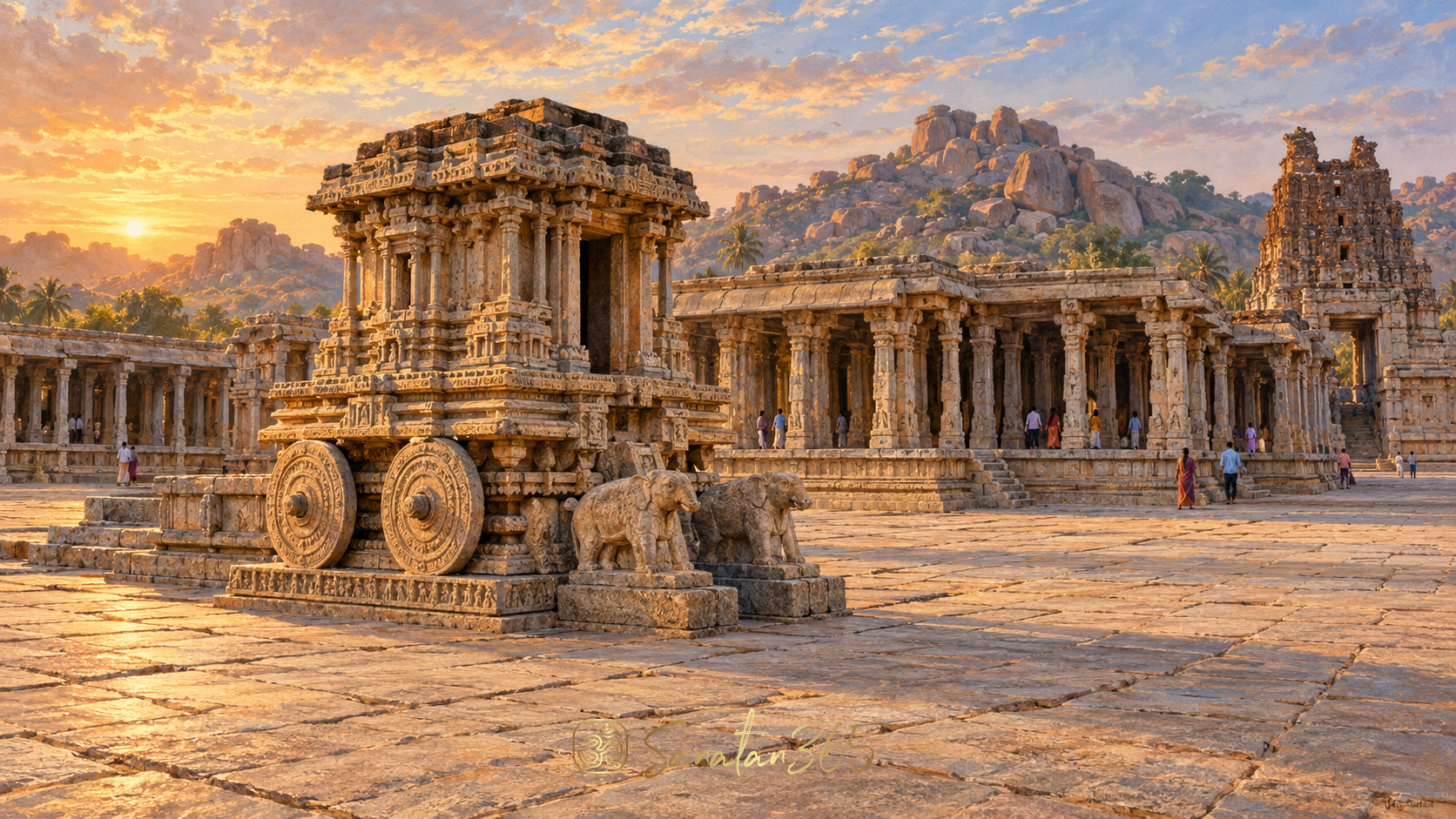
Vittala Temple Hampi: Reading the Stone Chariot and Sacred Courtyard
Understand Hampi’s Vittala Temple through its Garuda stone chariot, pillared halls, Vishnu devotion, and careful heritage visiting.
 Temples
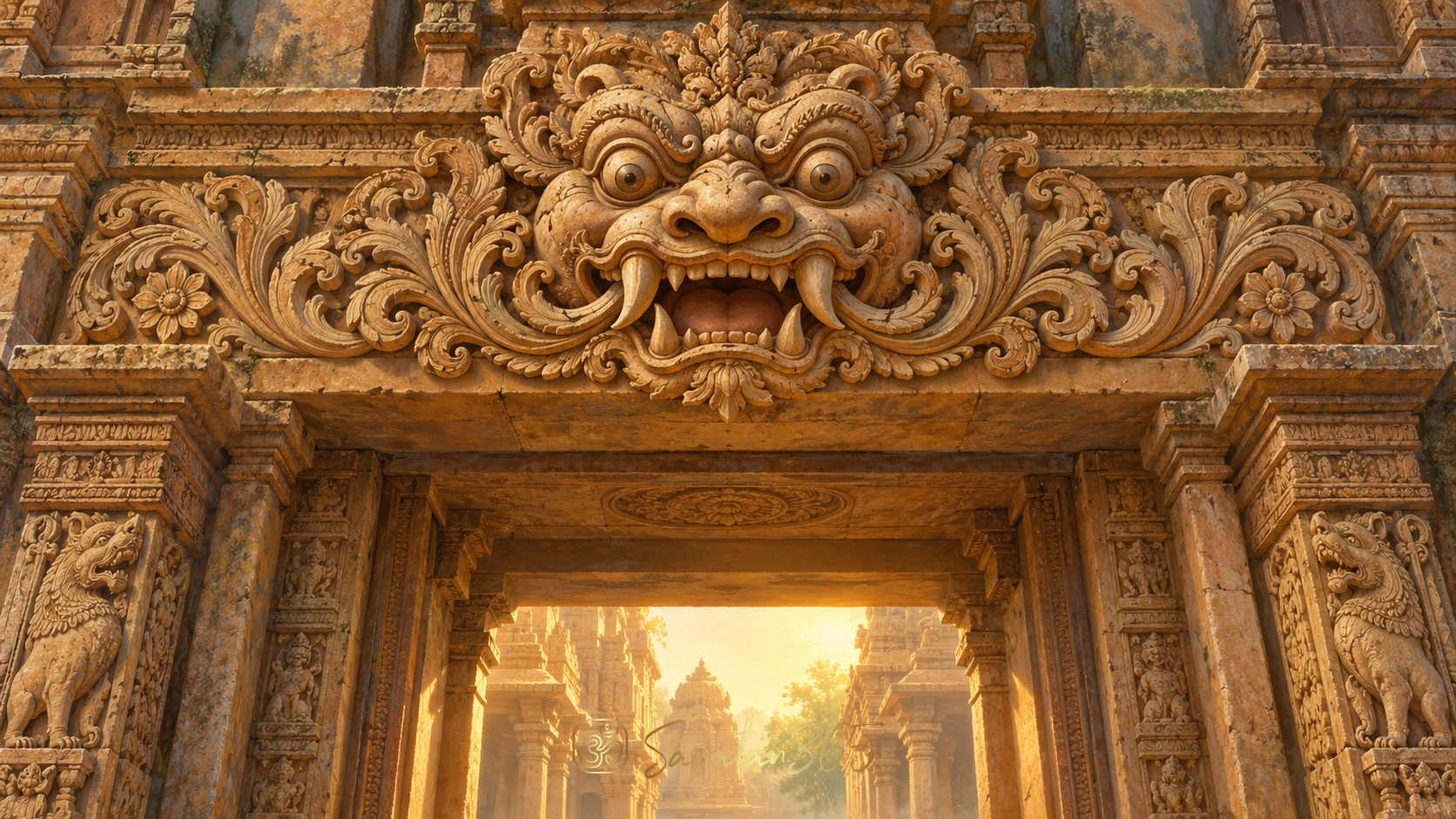
Kirtimukha Meaning: The Face of Glory Above the Temple Door
The fierce face above a temple doorway is not a warning to turn away. Learn to recognize Kirtimukha, read its sacred story, and notice how…
 Temples
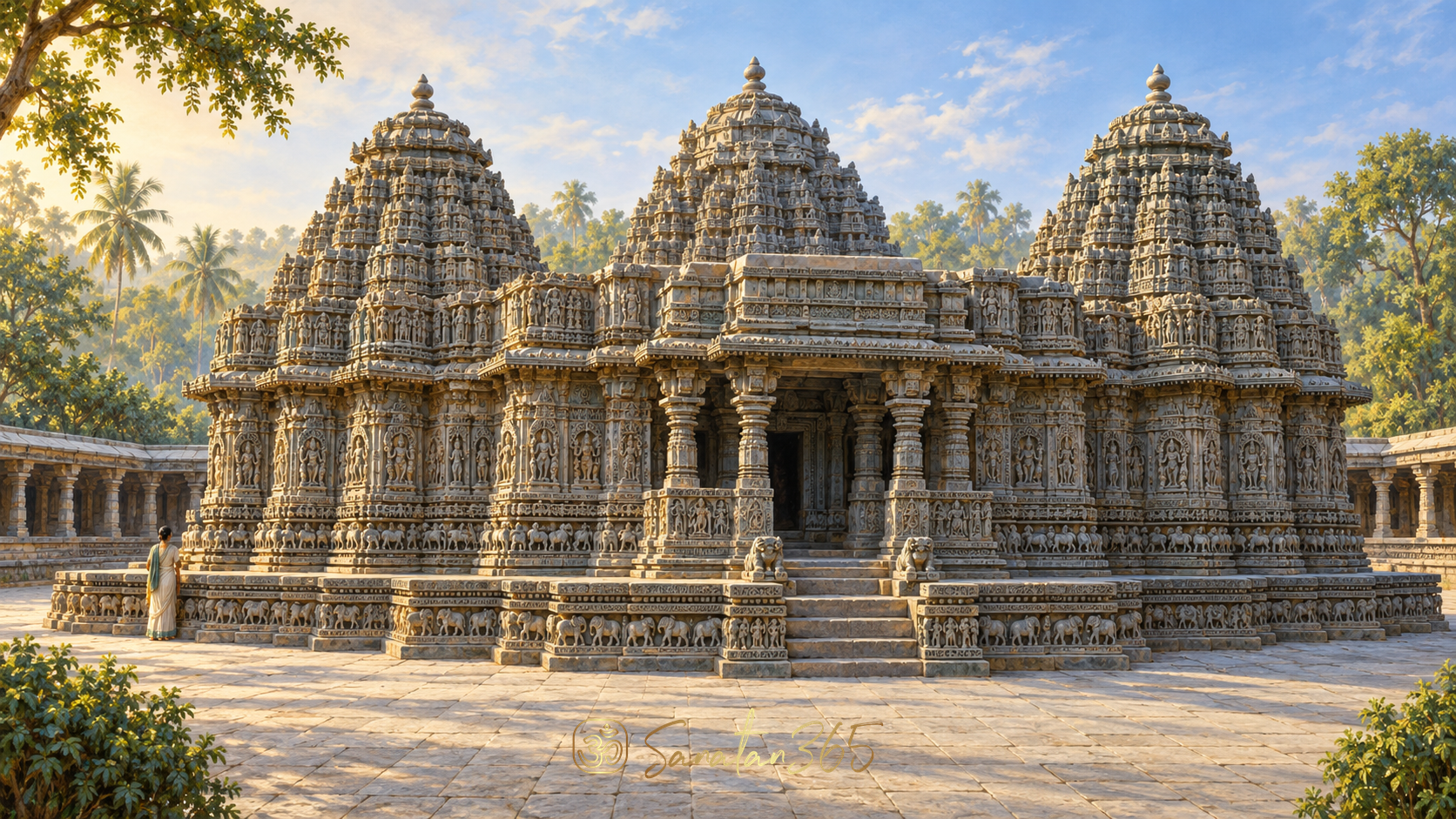
Somanathapura Keshava Temple: Three Shrines and the Art of Looking
Read the star-shaped plan, three Vishnu shrines and carved narratives of Somanathapura, with a respectful guide to a protected Hoysala monu…

