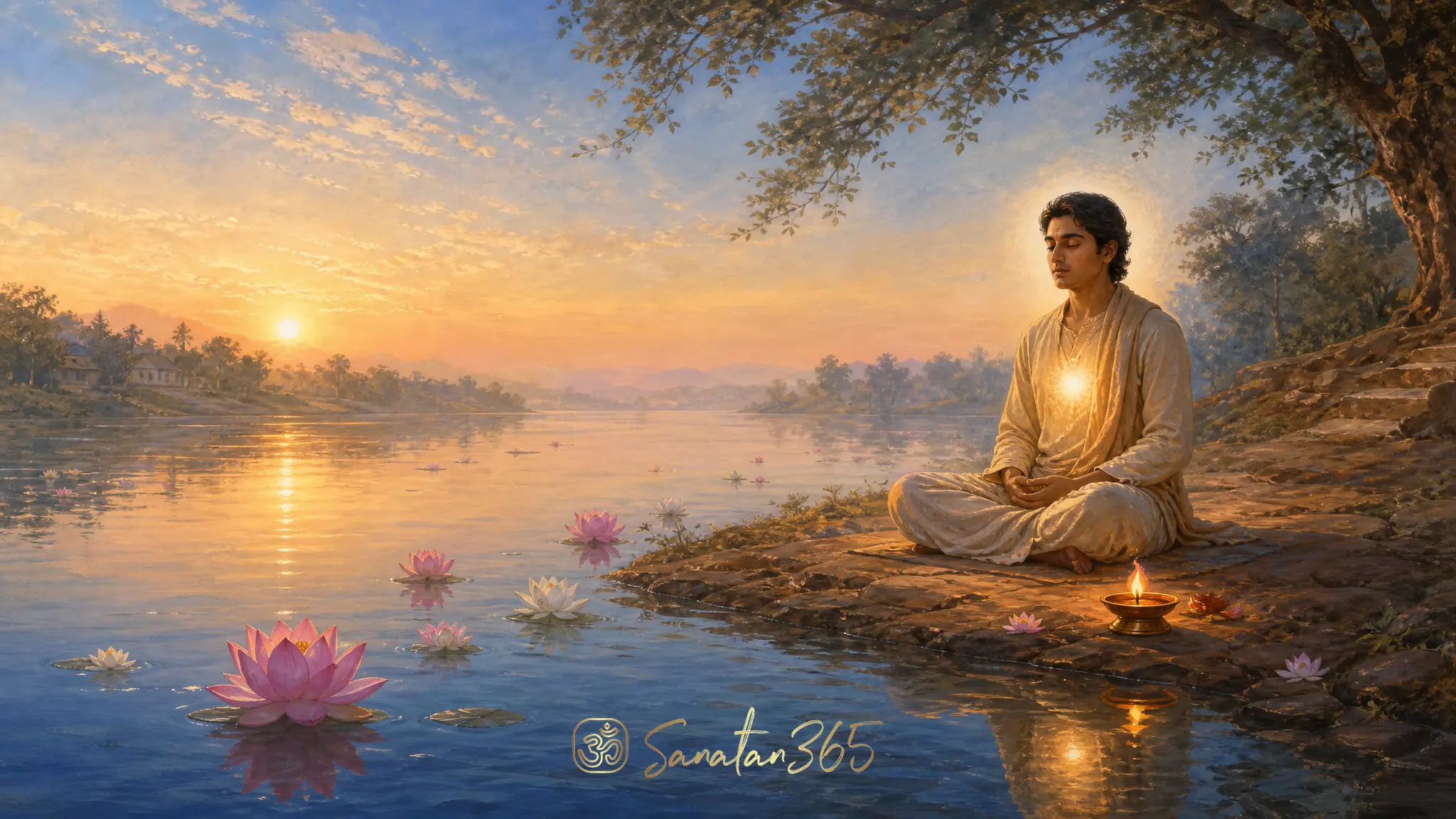
Dhyana Meaning: Hindu Meditation as Steady Awareness, Not Empty Escape
Dhyana is the Hindu discipline of steady meditative awareness: a movement from scattered attention toward inner clarity, self-knowledge, and devotion-rooted presence.
Meditation in the Hindu tradition is not an escape from life; it is a disciplined way of seeing life without the usual noise of reaction.
The Dhyana meaning begins with dhyāna (ध्यान, sustained meditation or contemplation): the practice of steadying awareness until the mind rests in a chosen sacred focus. In Hindu thought, dhyana is not merely relaxation. It is part of yoga (योग, disciplined union), a bridge between concentration and deeper absorption, and a way to understand the Self, duty, devotion, and the Divine with greater clarity.
What is the Dhyana meaning in Hindu meditation?
The clearest Dhyana meaning is sustained meditative awareness. Patanjali’s Yoga Sutras places dhyana after dhāraṇā (धारणा, concentration) and before samādhi (समाधि, deep absorption). In the classical sequence, dharana gathers the mind around one focus; dhyana keeps that flow unbroken; samadhi is when the boundary between meditator, meditation, and object becomes profoundly quiet. A traditional rendering of Yoga Sutras 3.2 describes dhyana as the continuous flow of cognition toward the chosen object (Sacred Texts).
This makes dhyana different from casual stillness. A person may sit quietly while the mind wanders through memory, worry, and desire. Dhyana begins when attention becomes steady enough to remain with what is sacred: a mantra, the breath, a form of the Divine, an ethical truth, or the witnessing awareness itself.
In everyday language, Hindu meditation is often described as “making the mind silent.” The older teaching is subtler. The mind is not attacked or hated. It is trained, purified, and made transparent. Just as a lamp gives steady light when protected from strong wind, awareness becomes luminous when restlessness is gently reduced. The Bhagavad Gita uses this lamp image in its sixth chapter on meditation (Gita Supersite).
Key takeaway: Dhyana is not blankness; it is an unbroken current of attention toward what is true, sacred, and spiritually clarifying.
How does dhyana fit inside the wider path of yoga?
To understand dhyana, it helps to see it inside aṣṭāṅga yoga (अष्टाङ्ग योग, the eight-limbed path) described by Patanjali. The limbs move from outer discipline to inner refinement:
- Yama: ethical restraints such as ahiṃsā (अहिंसा, non-harming) and satya (सत्य, truthfulness).
- Niyama: inner observances such as śauca (शौच, purity) and svādhyāya (स्वाध्याय, self-study or sacred study).
- Āsana: steady posture.
- Prāṇāyāma: disciplined breath regulation.
- Pratyāhāra: drawing the senses inward.
- Dhāraṇā: concentration.
- Dhyāna: sustained meditation.
- Samādhi: deep absorption.
This order matters. Dhyana is not isolated from conduct. A person who lies, harms, consumes without restraint, or lives in constant agitation will struggle to sit peacefully because daily life keeps feeding inner turbulence. The yogic path says meditation becomes stable when the whole life begins to support it.
That is why dhyana in Hinduism is not only a technique. It is an ethical and spiritual ecosystem. Posture helps. Breath helps. But truthfulness, simplicity, devotion, food habits, speech, and service also shape whether the mind can settle.
The same principle appears in devotional traditions. A bhakta (भक्त, devotee) may meditate on Krishna, Shiva, Devi, Rama, or the guru not as an abstract exercise but as a relationship. The chosen form gives the heart a loving center. Attention becomes steady because it is warmed by reverence.
Key takeaway: Dhyana is the inner limb of yoga, but it depends on outer life becoming calmer, cleaner, and more aligned with dharma.
What does the Bhagavad Gita teach about Hindu meditation?
The Bhagavad Gita presents meditation with practical realism. In chapter 6, Krishna teaches Arjuna to sit in a clean place, keep the body steady, regulate the mind, and practice moderation in food, sleep, and activity. This is not mystical vagueness. It is a disciplined daily method.
A famous verse says:
“As a lamp in a windless place does not flicker, such is the yogi of controlled mind, practicing union with the Self.” Bhagavad Gita 6.19
The image is tender and exact. The goal is not to extinguish the lamp. The goal is to protect its flame from restless winds. In the same way, dhyana protects awareness from compulsive distraction.
The Gita also refuses to romanticize the difficulty. Arjuna honestly says the mind is restless, turbulent, strong, and hard to control. Krishna agrees, then gives the remedy: abhyāsa (अभ्यास, repeated practice) and vairāgya (वैराग्य, wise non-attachment). This teaching is psychologically mature. The mind is not mastered by one dramatic session. It becomes steadier by returning, again and again, without despair.
For modern seekers, this is one of the most useful parts of the tradition. A distracted meditation is not a failed meditation if the practitioner notices the distraction and returns. The return is the training. Each gentle return from thought to mantra, breath, or divine remembrance deepens the groove of awareness.
Key takeaway: The Gita teaches dhyana as steady practice, moderation, and repeated return, not as instant perfection.
How is dhyana practiced in daily Hindu life?
Dhyana can be practiced in many legitimate ways across Hindu traditions. The outer form may differ, but the inner principle remains steady awareness.
Common forms include:
- Mantra dhyana: repeating a mantra such as Oṃ (ॐ), Oṃ Namaḥ Śivāya (ॐ नमः शिवाय), or a guru-given mantra while resting awareness in sound and meaning.
- Mūrti dhyana: meditating on a sacred image or mūrti (मूर्ति, consecrated form), not as an idol in the crude sense, but as a visible support for divine presence.
- Breath awareness: observing the natural rhythm of prāṇa (प्राण, life-force carried through breath) until attention becomes steady.
- Scriptural contemplation: holding a verse from the Gita, Upanishads, or bhakti poetry in the mind and allowing its meaning to become inwardly clear.
- Witness meditation: observing thoughts, emotions, and sensations from the standpoint of sākṣī (साक्षी, the witnessing awareness).
A simple daily sequence may be enough:
- Choose a clean, quiet place.
- Sit with the spine comfortably upright.
- Offer a short prayer or sankalpa (संकल्प, sacred intention).
- Keep one focus: breath, mantra, divine form, or sacred verse.
- When the mind wanders, return gently.
- End with gratitude and carry one quality into action.
Regional practice varies. In Varanasi, meditation may be woven into Shiva remembrance near the Ganga. In Vrindavan, it may become Krishna bhakti through nāma-japa (नाम जप, repetition of the Divine Name). In Tamil Nadu or Karnataka, the contemplative rhythm may sit beside temple recitation, stotra chanting, or the quiet discipline of a household shrine. Diaspora families may practice before work or school, using a small home altar or a few minutes of mantra before the day begins.
Key takeaway: Dhyana can be simple, but it should be consistent: one place, one focus, repeated with sincerity.
What is the difference between dhyana, japa, and mindfulness?
The words overlap, but they are not identical.
Japa (जप, repeated recitation) is the disciplined repetition of a mantra or divine name. It may be spoken aloud, whispered, or repeated mentally. Japa can become dhyana when the repetition becomes steady and inwardly absorbed. A person may begin with counting beads on a mālā (माला, prayer beads), then gradually move into deeper silence.
Mindfulness usually means present-moment awareness without judgment. It can be valuable, but dhyana in Hindu practice often includes a sacred object, philosophical aim, or devotional relationship. The attention is not only present; it is oriented toward self-knowledge, divine remembrance, and transformation.
Dhyana is therefore more than calm observation. It can include mantra, devotion, inquiry, and sacred meaning. It asks not only, “Am I aware of this moment?” but also, “What is the nature of the one who is aware? What should this awareness become in conduct? How does this attention connect me with dharma?”
This is why dhyana naturally links with bhakti, satya, and mantra practice such as daily mantra chanting. Meditation deepens life when it changes how a person speaks, chooses, serves, and loves.
Key takeaway: Japa may lead into dhyana, mindfulness may resemble part of dhyana, but Hindu meditation carries a wider spiritual aim: clarity, devotion, and self-knowledge.
What are the benefits and limits of dhyana?
Traditional texts praise meditation because it steadies the mind, refines conduct, and opens the seeker toward deeper truth. Modern readers should understand these benefits with humility rather than exaggerated promises.
Dhyana may support:
- steadier attention;
- calmer reactions;
- deeper devotional feeling;
- better self-observation;
- more thoughtful speech;
- a stronger sense of spiritual rhythm;
- patience during difficulty.
Dhyana begins when attention stops running in every direction and returns to one sacred center. Its final value is not a special experience but a clearer life: steadier awareness, softer speech, deeper devotion, and action aligned with dharma.
But Hindu tradition does not present meditation as a replacement for responsibility. A person facing serious mental distress should seek qualified professional help and support from trusted loved ones. Spiritual practice can accompany care, but it should not be used to avoid necessary treatment or human assistance.
The deeper purpose of dhyana is not performance. It is not to collect impressive experiences, visions, or claims of power. The Gita repeatedly turns the seeker toward steadiness, humility, and action without attachment. Real meditation should make a person more truthful, compassionate, and useful in the world.
A good test is simple: after practice, is there slightly less harshness in speech? Slightly more patience with family? Slightly more capacity to act without agitation? If yes, dhyana is entering life rather than remaining a private mood.
Key takeaway: Dhyana is valuable when it makes awareness steadier and conduct kinder; it should never be treated as a substitute for necessary medical or emotional care.
FAQ
What is the simple Dhyana meaning?
Dhyana means sustained meditation or contemplation. In Hindu yoga, it is the steady flow of awareness toward one sacred focus, such as a mantra, the breath, a divine form, or the Self.
Is dhyana the same as meditation?
Dhyana is often translated as meditation, but it is more specific than casual relaxation. It means disciplined, continuous awareness that moves beyond scattered thought toward spiritual clarity.
How long should a beginner practice dhyana?
A beginner may start with 5 to 10 minutes daily. Consistency matters more than duration. A short practice repeated every day usually builds a stronger foundation than occasional long sessions.
Can dhyana be practiced with mantra japa?
Yes. Japa, or repeated mantra recitation, is one of the most accessible gateways into dhyana. When the mantra becomes steady and the mind rests in its sound and meaning, japa naturally deepens into meditation.
Does dhyana belong only to monks and advanced yogis?
No. While advanced states require discipline, the basic practice of dhyana can support householders, students, professionals, and elders. Hindu tradition has long allowed meditation to live inside daily duty, family life, and devotion.
About the author
Sanatan365 Editorial
Bringing Sanatan Dharma to modern seekers through authentic, scripture-grounded content.
Related in Meditation
 Meditation
Ajapa Japa Meaning: The Mantra Remembered with Every Breath
Ajapa japa means remembrance that continues without deliberate repetition. Yogic traditions connect it with the natural rhythm of breath an…
 Meditation
Manasa Puja Meaning: The Hindu Practice of Inner Worship
Manasa Puja is worship performed inwardly: the devotee visualizes the sacred presence and offers water, flowers, light, food, and reverence…
 Meditation
Abhyasa Meaning: How Steady Practice Changes the Mind
Understand abhyasa meaning in Yoga, why Patanjali pairs steady practice with non-attachment, and how to build a sustainable daily disciplin…