Four Friends Panchatantra Story: Why the Second Rescue Matters
The deer is free, but the story is not over. Follow the four friends as the tortoise needs a second rescue, and see how care becomes a coordinated plan.
The deer escapes, the crow takes wing and the mouse slips out of sight. It looks as though the rescue is complete. Then the hunter sees the tortoise.
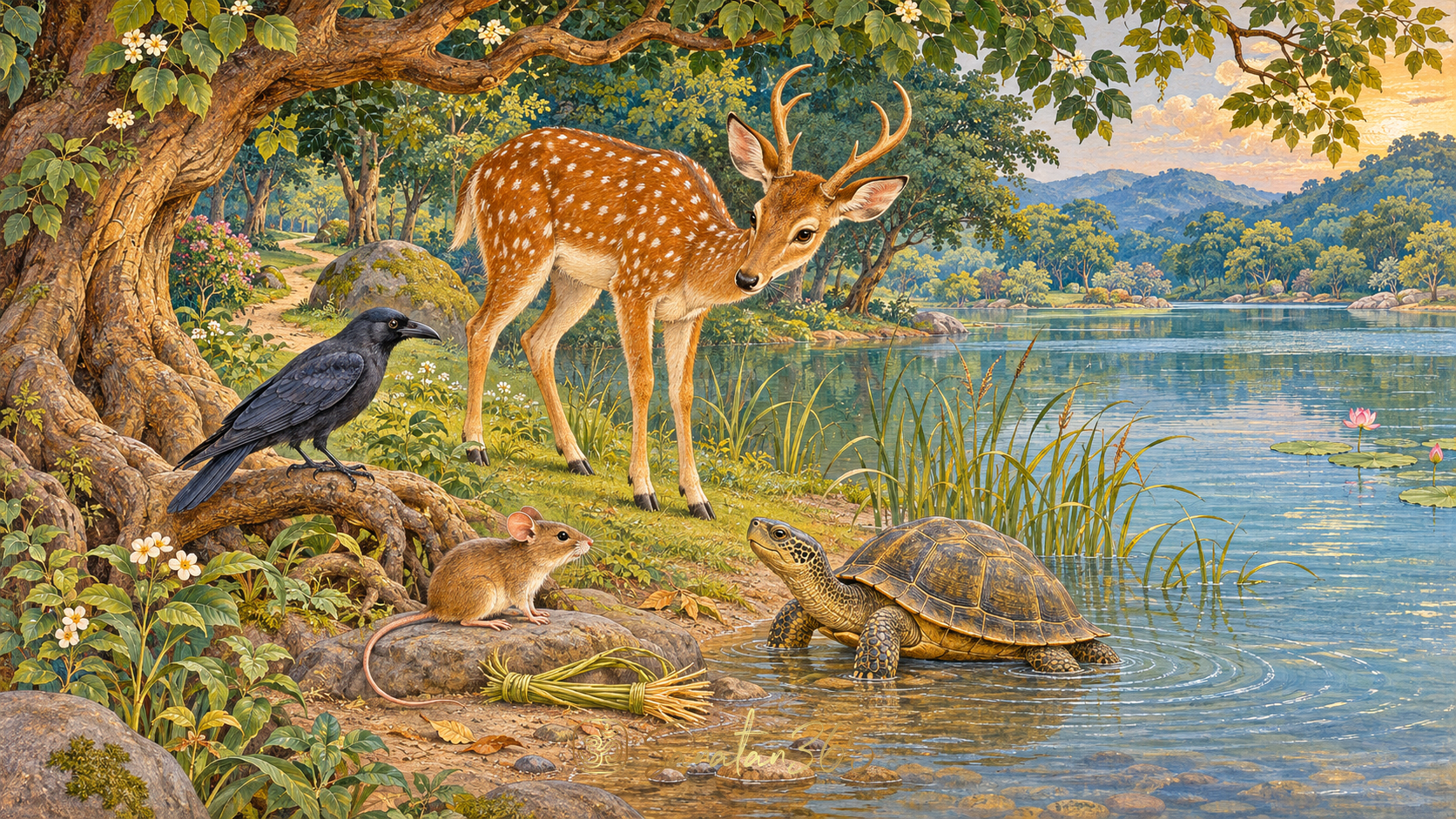
The four friends Panchatantra story follows a deer, crow, mouse and tortoise whose different abilities become useful in a crisis. In this closing episode of the Pañcatantra (पञ्चतन्त्र, Five Treatises), one escape leads to another danger. The friends must change their plan when the tortoise is captured. The second rescue makes their care for one another visible through a sequence of practical decisions.
What is the four friends Panchatantra story?
The episode belongs to Book Two, “The Winning of Friends,” in Arthur W. Ryder’s translation of the Panchatantra. The four animals have become companions by a lake. They meet and enjoy one another’s company. Their friendship has an ordinary rhythm before the plot puts it under pressure.
Ryder gives them English names. The crow is Swift, the mouse is Gold, the tortoise is Slow and the deer is Spot. This article uses the animal names to keep the retelling easy to follow. The selected episode is near the end of the book’s larger frame story, which contains other tales within it.
The 1925 translation of Book Two lets a reader follow the two rescues in their full setting. One day the deer fails to appear at the usual meeting. His absence matters because the others know when to expect him. Concern begins with noticing that something familiar has changed.
The crow can search farther and faster than the mouse or tortoise. He flies out to look and finds the deer caught in a trap near a swamp. The deer is frightened, and the crow returns for the mouse, whose teeth can cut the binding. Each step brings a different ability into use.
A family telling the story aloud can pause here. What has each friend contributed so far? The answer may include noticing an absence, going to look and knowing whom to bring. The small acts prepare the way for the more dramatic moment of escape. Friendship is already active before the binding is cut.
Key takeaway: The tale begins its crisis with a missed meeting. The friends notice, search and bring the help the situation calls for.
How do the crow and mouse help the trapped deer?
The crow brings the mouse to the deer. In Ryder’s account, the friends speak about how a wary creature came to be caught, and the deer tells of an earlier captivity. The mouse then cuts the binding as the hunter arrives. The deer runs, the crow flies away and the mouse finds a small place to hide.
These movements are different because the animals are different. A crow can leave the ground. A mouse can disappear into a narrow opening. A deer can bound into the forest. The story makes those differences part of the action, so the reader can understand how the three escape.
Before the hunter arrives, the tortoise has also come to the scene. Affection for the deer draws him out from his watery shelter. The others worry about his presence because he cannot make the same quick escape. The mouse points out the danger, and the tortoise answers from the strength of his attachment to his friends.
That exchange gives the episode more depth than a simple picture of everyone agreeing. The tortoise wants to be near a friend in distress. The mouse sees a problem in how he has arrived. Both the affection and the practical risk are present in the same scene. A reader can notice them together.
A child may want to decide at once whether the tortoise was right or wrong to come. The story offers a more exact question. What could the friends have arranged so that his care for the deer did not leave him exposed? It is a discussion question drawn from the episode, rather than an extra event added to it.
The earlier article on the Panchatantra pigeons and shared leadership explores another way a group works through danger. Here the focus is on a group whose members have unequal ways of moving. Their escape plan has to take that difference seriously.
Key takeaway: The first rescue suits the deer, crow and mouse. The tortoise’s presence reveals a need that the same escape cannot meet.
Why does the tortoise need a second rescue?
The hunter arrives to find the deer free. He is surprised, then notices the tortoise on the ground. He binds the tortoise’s feet with a rope made from grass, attaches it to the end of his bow and starts home. The danger has moved from one friend to another.
The mouse is distressed when he sees the tortoise being carried away. The deer and crow join him, and the three grieve. Yet the mouse also recognises that there is still an opportunity while their friend remains in sight. He turns from lament to a plan that gives each of them a part.
The deer is to move ahead unseen and lie down near water, pretending to be dead. The crow is to act like a scavenging bird beside him. The sight is meant to draw the hunter’s attention from the tortoise. When the hunter puts the tortoise down and goes toward the deer, the mouse can cut the binding.
The friends carry out the plan. As the hunter approaches, the deer springs up and runs. The crow flies to a tree. The tortoise, freed by the mouse, reaches water, while the mouse slips into cover. The friends later come together unharmed. This time the route to safety has been planned around the tortoise’s need for water.
The second rescue therefore changes what the reader can see in the first. Running and flying were enough for some of the friends, but the group’s work was unfinished while one remained vulnerable. They have to return their attention to the particular creature still in danger. The plan becomes more complete because it has to account for him.
Key takeaway: The second plan gives the tortoise a route into water. The friends adapt their actions to the one whose needs have changed the situation.
What does the friends’ plan teach about helping well?
The mouse’s plan is useful because it is specific. The deer goes ahead, the crow provides the convincing appearance, and the mouse waits for the chance to cut. The water is part of the plan from the beginning. Everyone needs to know what the others are trying to make possible.
This is a close reading of the story’s sequence. It is easy to praise friendship in a general way, but the tale supplies actions that can be described. Searching is one kind of help. Cutting a binding is another. Drawing attention elsewhere is another. The reader can follow how one action creates room for the next.
The deer also changes position within the group. A short time earlier he needed help and could do little to free himself. In the second rescue his speed becomes part of the others’ chance to save the tortoise. Receiving help has not fixed him permanently in the role of the helpless one. He has something to offer when the circumstances change.
The tortoise’s vulnerability likewise does not remove him from the friendship. The ending brings all four together. A reader can stay with that return as well as with the cleverness of the escape. The plan’s success is measured by who is safe at the end, including the friend who could not run or fly.
The deception in this episode serves an escape from capture. A family can discuss that context directly. What are the animals trying to protect? What makes this different from misleading a friend for personal advantage? Keeping the purpose in view allows the story’s difficult details to become part of the conversation.
Key takeaway: Helpful action depends on the actual need, the abilities available and the purpose of the plan. The roles can change from one moment to the next.
How can families discuss the story’s friendship lesson?
Tell the two rescues separately before trying to name a moral. Ask the listener to put the events in order. Who noticed the deer’s absence? Who found him? Who cut the binding? When did the tortoise become the friend who needed help? The sequence gives every answer something in the story to point to.
A second reading can follow one animal at a time. The crow’s flight connects distant places. The mouse works close to the binding. The deer’s movement changes the hunter’s attention. The tortoise’s route ends in water. Each path has a different shape, which makes the story suitable for a simple drawing or a spoken retelling.
Three questions can open a family discussion.
- Which friend needed help first, and who needed it next?
- What could each animal do that the others could not do in the same way?
- What detail made the second escape work for the tortoise?
A child may answer the last question by naming the mouse’s teeth. Another may remember the water. Both are useful observations. The mouse frees the tortoise, and the chosen place lets him reach safety. The conversation can show how several details belong to one successful plan.
An everyday comparison can be small. Suppose a group is making kites. One child can cut paper neatly, another can hold the frame steady, and another notices that a younger child needs the instructions repeated. A helpful plan gives each a task and changes when someone needs something different. This is an example for discussion, not a claim that the story’s danger resembles ordinary play.
The tortoise and geese story about thoughtful speech gives families another tale to compare. Its tortoise faces a different challenge. Keeping the plots distinct helps a child notice how the same kind of animal can belong to very different lessons.
The four friends’ ending offers a final place to pause. Imagine them meeting again by the water, after the urgency has passed. Each has seen a friend in danger and each belongs in the returned circle. The second rescue has made that belonging something they have acted on together.
Key takeaway: Ask about the sequence before supplying a moral. The lesson becomes clearer when a child can explain how the friends changed their help.
FAQ
Who are the four friends in the Panchatantra story?
They are a deer, crow, mouse and tortoise. The episode appears in the frame story of Book Two, “The Winning of Friends.”
Which friend frees the trapped deer?
The mouse cuts the binding after the crow brings him to the deer. The deer then escapes when the hunter arrives.
How is the tortoise saved?
The deer and crow distract the hunter near water. The mouse cuts the tortoise’s binding, allowing him to reach the water.
What is the main friendship lesson?
The friends adapt their help when another member becomes vulnerable. The second rescue shows that their roles and needs can change.
About the author
Sanatan365 Editorial
Bringing Sanatan Dharma to modern seekers through authentic, scripture-grounded content.
Related in Lessons
 Lessons
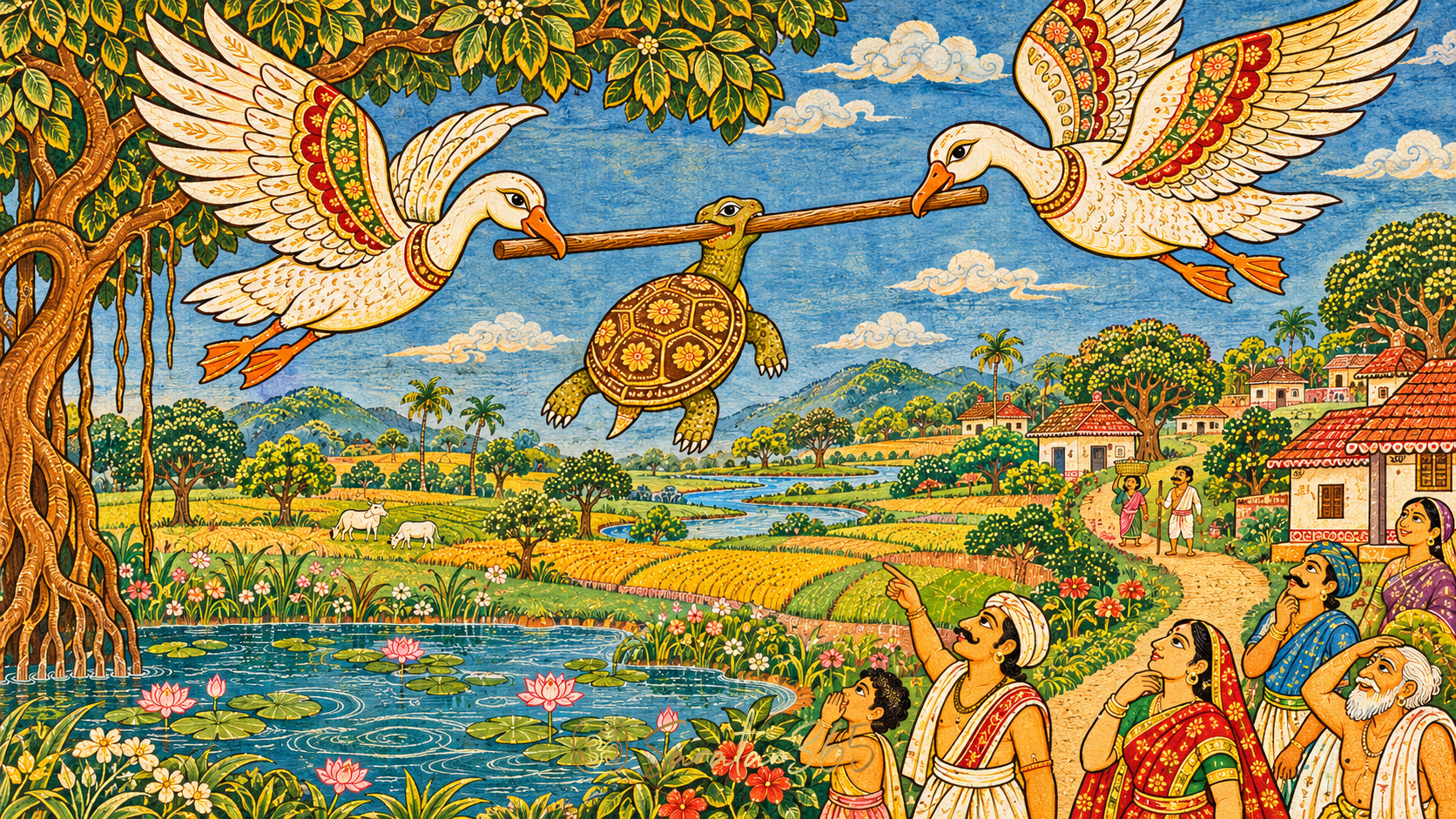
Tortoise and Geese Story: Knowing When to Hold a Reply
A familiar Panchatantra fable asks a precise question: what happens when the wish to answer a crowd becomes stronger than the purpose frien…
 Lessons
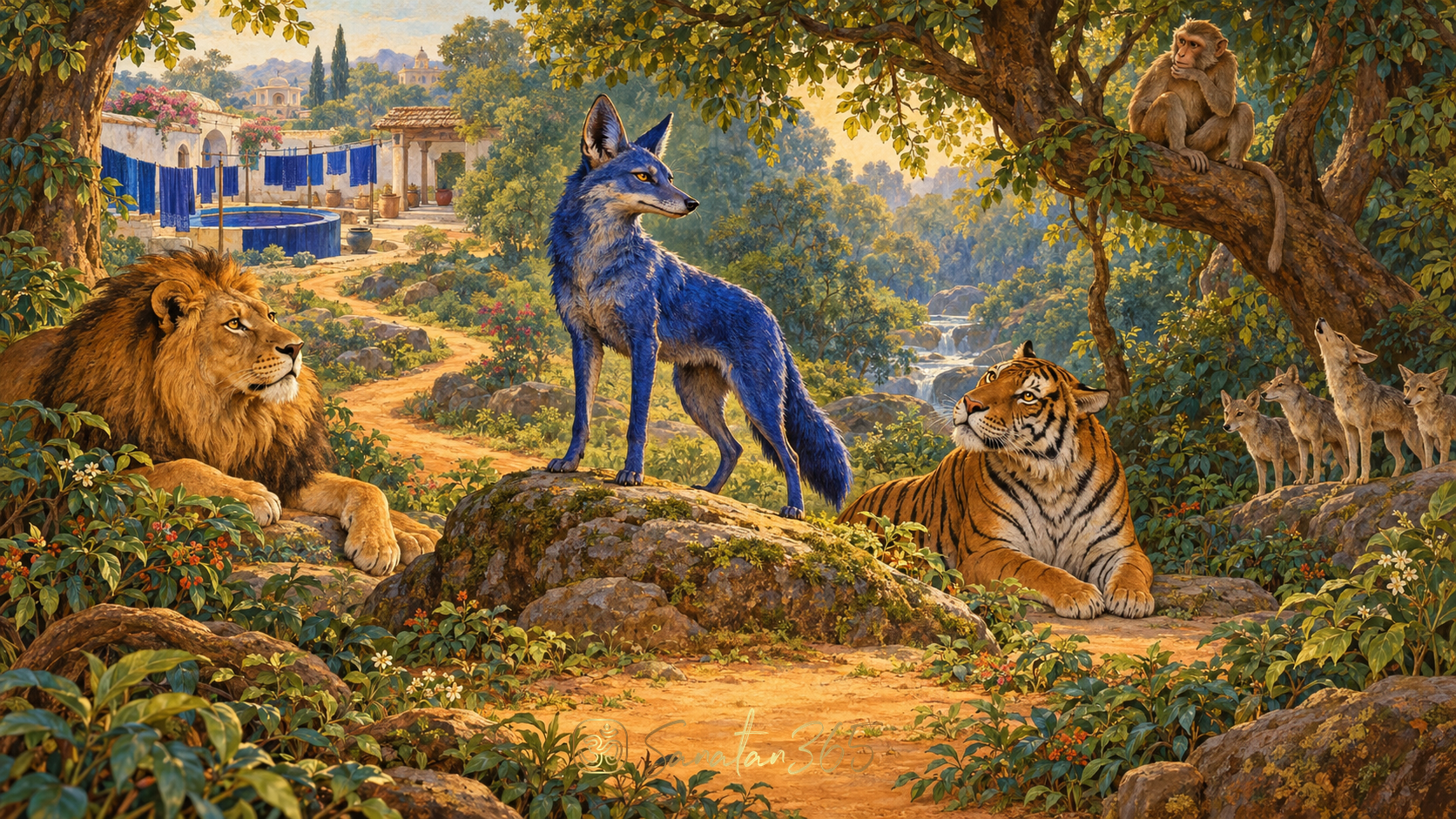
Blue Jackal Panchatantra Story: Appearance and Earned Trust
A hungry jackal acquires an extraordinary coat, then turns an accident into a claim to rule. Read the fable through evidence, accountabilit…
 Lessons
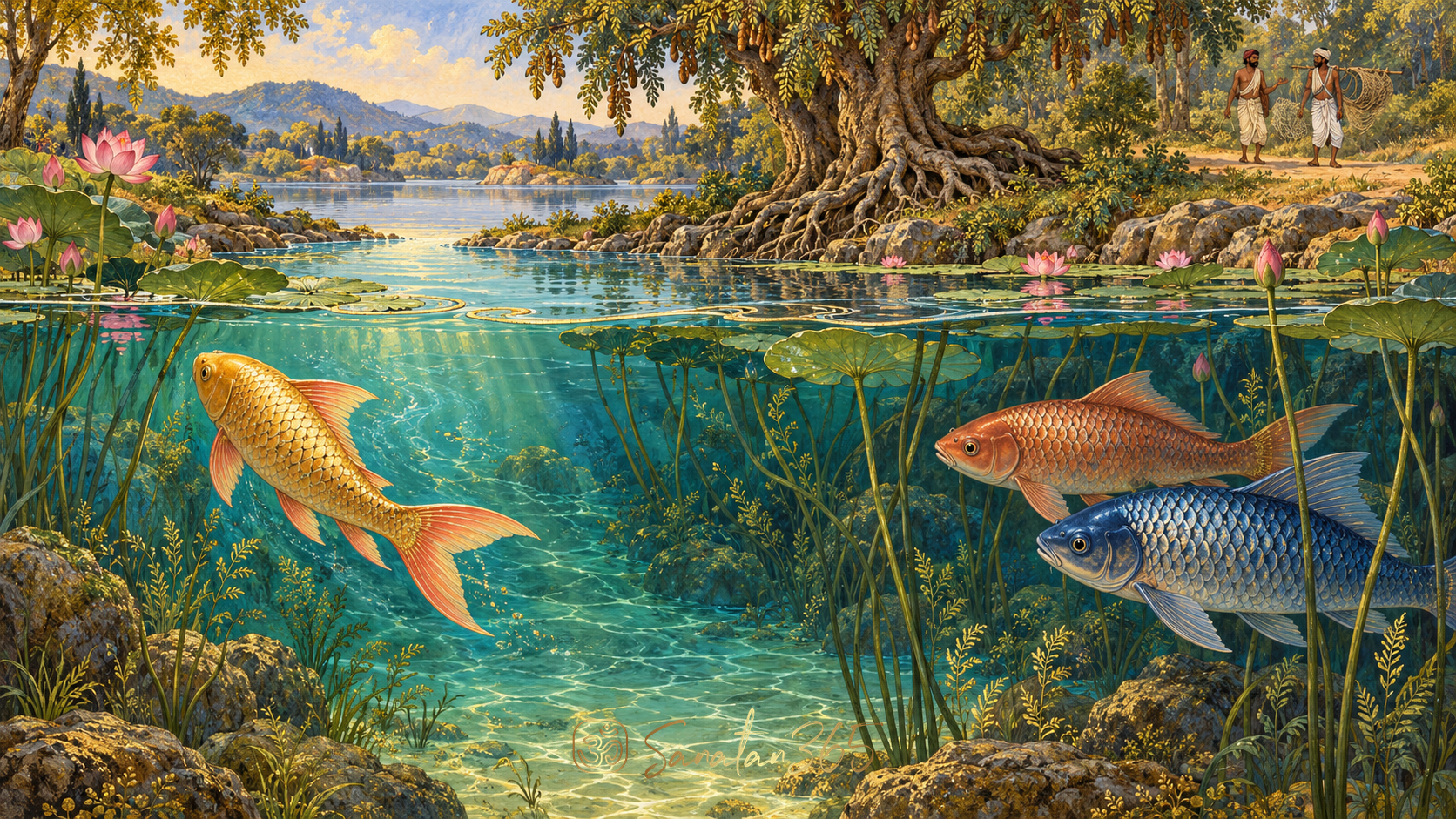
Three Fishes Panchatantra Story: Foresight and Timely Action
Three fish hear the same warning but respond differently. A careful reading of preparation, ready wit, and fatalistic delay in the Panchata…

