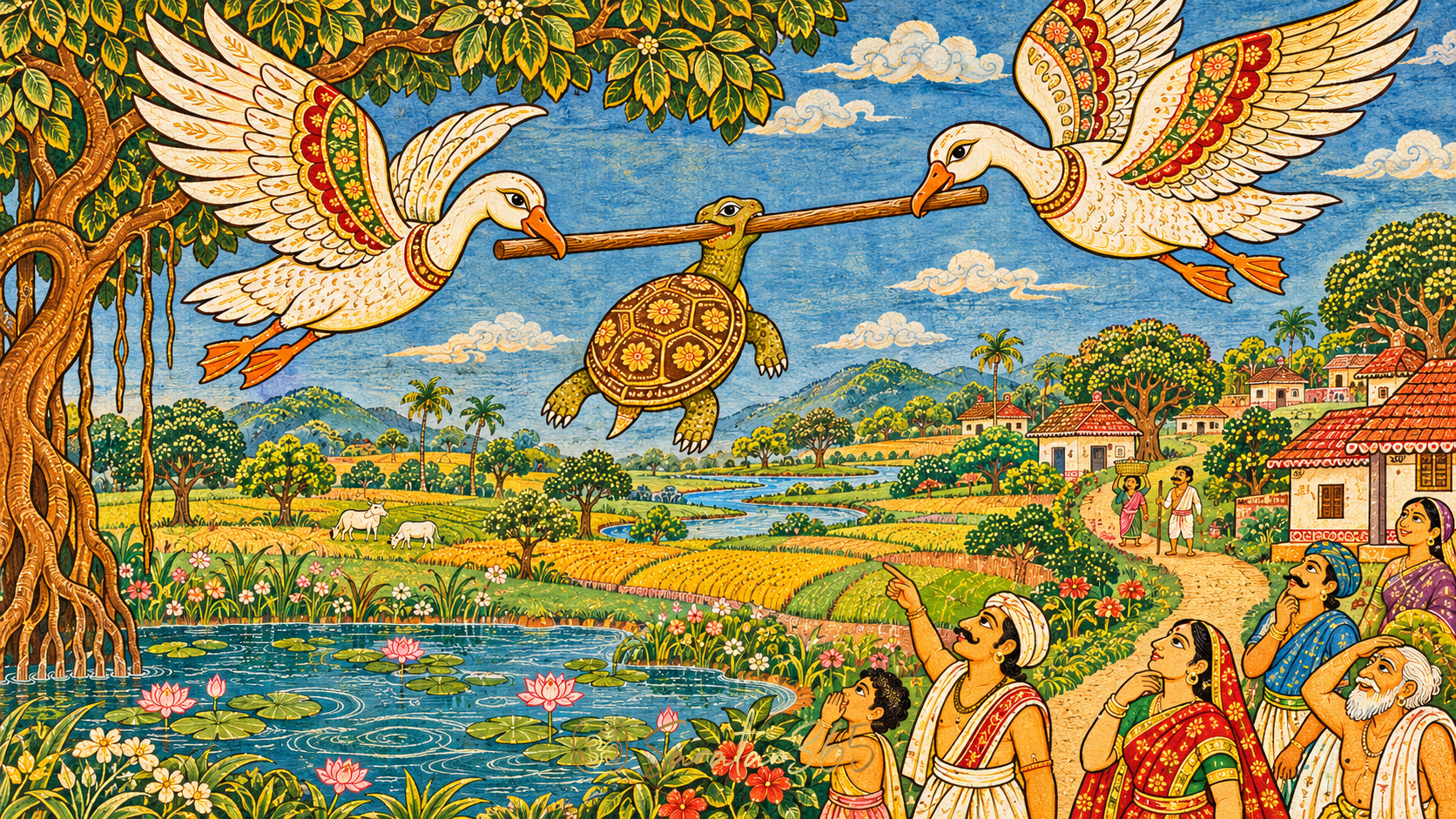
Tortoise and Geese Story: Knowing When to Hold a Reply
A familiar Panchatantra fable asks a precise question: what happens when the wish to answer a crowd becomes stronger than the purpose friends are protecting together?
The tortoise has an answer ready. What he cannot do is give that answer and keep his grip at the same time.
The tortoise and geese story is a fable about listening to sound advice and choosing the right moment to speak. Two birds carry their friend on a stick that he holds with his mouth; when he answers people below, he lets go. Read carefully, the lesson concerns a particular danger: abandoning an important shared purpose for an immediate reply. It does not mean children should never question adults or that silence is always a virtue.
The tale belongs to the Pañcatantra (पञ्चतन्त्र, “five treatises”), a collection of instructive animal stories. Its memorable flying arrangement makes an invisible decision visible. Attention, friendship and a workable plan can all be present, yet one poorly timed response can interrupt them.
What happens in the tortoise and geese story?
In the version printed in NCERT's Ruchira, chapter 2, a tortoise and two friendly waterbirds share a pond. Fishermen announce that they will return to catch its creatures. The tortoise wants to leave and proposes an unusual escape: the birds should hold opposite ends of a stick while he grips its middle with his mouth.
The birds identify the danger. People watching from below will say things; if their friend answers, he will fall. The tortoise insists that he can remain quiet. During the flight, however, the comments of onlookers anger him. He opens his mouth to reply, loses his hold, and falls. The ending is fatal.
This is a brief retelling, rather than a translation of the textbook. Its difficult ending needs no graphic elaboration. What matters for the discussion is the link between a clearly understood condition and the moment it is forgotten.
Why might another telling begin differently?
Readers may remember a drying pond instead of fishermen. That is not necessarily a mistake. In Arthur W. Ryder's English translation, the chapter called “Shell-Neck, Slim, and Grim” begins with drought. The tortoise asks his friends for rescue, proposes the stick, and later responds to the noise of people below. This version is available in the Panchatantra scan hosted by the Indira Gandhi National Centre for the Arts, printed pages 147–149.
Naming the version prevents details from different tellings being silently combined. A family can enjoy its familiar version and still ask which book it comes from. For a broader approach to that conversation, see reading Hindu stories with children.
Key takeaway: Keep the chosen telling clear, and keep the causal lesson more prominent than the harshness of the ending.
Why does a clever plan fail at the moment of reply?
The most interesting feature of the plan is its dependence on cooperation. No single friend can complete it alone. The birds supply flight; the tortoise supplies the grip; all three must keep their roles aligned. The stick connects their efforts, but it cannot decide for them.
This invites a useful reading of the fable. Intelligence is more than producing an ingenious idea. It also includes remembering the conditions under which that idea works. A plan can be clever and still require patient execution. Understanding a warning once is different from holding it in mind when a competing impulse arrives.
The tortoise's mouth has two possible functions at that moment. It can preserve the connection, or it can answer the crowd. Both actions are ordinary in themselves. Their consequences change because of the setting. The problem is not that speech is inherently bad; it is that this particular speech requires giving up something more important.
The crowd does not become the destination
A modern reader can imagine how quickly a passing comment starts to feel like the main event. A person sets out to finish a task, help a friend or learn something, then spends the next hour defending a small remark. The original purpose has not disappeared. Attention has simply been reassigned without a deliberate decision.
That is a contemporary application, not a claim that the ancient storyteller described social media or today's habits. The image of the stick offers a question for such moments: what is being held together right now? The answer might be a conversation, a shared responsibility, or the chance to understand before responding.
Sound advice also becomes easier to recognize when its reason is explicit. The birds' warning is tied to the actual mechanics of the rescue. In family discussion, this is more helpful than treating every instruction as wise merely because someone delivered it firmly. A good explanation allows the listener to see the risk.
The related three fishes fable about foresight examines when to act before danger develops. Here the emphasis is different: how to sustain a sensible decision after action has already begun.
Key takeaway: A wise plan includes the conditions that keep it working when attention is pulled elsewhere.
How can families discuss the ending without fear?
A difficult fable is best approached through conversation, rather than a verdict about the child listening to it. Calling a child “the foolish tortoise” converts an opportunity for reflection into a label. The story is more useful when everyone, including the adult, can recognize moments of impatience without being reduced to them.
Before reading aloud, the adult can check which version is in hand. Some adaptations change the outcome; the NCERT version used here has a fatal ending. For a younger listener, that can be stated in one calm sentence without describing injury. If an adult chooses a gentler adaptation, it should be introduced as an adaptation, rather than presented as the identical text.
The aim is thoughtful engagement, not making the story frightening enough to compel obedience. Children can notice the disappointment of the friends, the brilliance of their cooperation, or the unfairness of a crowd's remarks. These observations deserve room beside the conventional moral.
Questions that make room for judgment
Instead of asking only “What is the moral?”, a family might try:
- What did each friend contribute to the plan?
- Why was the warning connected to this exact situation?
- Could the tortoise have answered after reaching safety?
- Was the crowd's behaviour kind, even though the tortoise's reply was dangerous?
- What could someone do after a mistake in a situation where repair is still possible?
There is no need to force identical answers. One child may focus on friendship, another on the wish to defend oneself. The adult can return to the story's sequence and ask how each interpretation fits it. That makes reading a practice of attention rather than a test of compliance.
An especially helpful follow-up is to invent a separate, clearly labelled alternative scene. Suppose the friends reach the new pond safely: what could the tortoise say then? The exercise does not rewrite the source. It explores the difference between postponing an answer and losing the right to have one.
Adults can also offer an ordinary example of their own: interrupting an explanation, answering too sharply, or responding before checking what was meant. This shows that learning about speech continues throughout life. It is not a fault assigned to the youngest person in the room.
Key takeaway: Discuss the choice and its consequences without using the character as a shaming label for a child.
When is a pause wise, and when is speaking necessary?
The story's warning has a precise boundary. The tortoise must keep his mouth closed because his mouth is holding the stick. Remove that circumstance, and the practical reason changes. Extending the rule into every area of life would miss the care with which the danger is shown.
A useful pause can protect understanding. It can leave time to hear the rest of an explanation, distinguish an insult from a misunderstanding, or choose words that address the actual issue. Such a pause has a purpose and usually an endpoint. It is not a demand that a person abandon questions or accept humiliation.
Speaking is necessary when someone needs help, when a danger must be reported, when consent is absent, or when a boundary needs to be made clear. Children should be encouraged to tell trusted adults about harm and to keep seeking help if an initial response is inadequate. A fable about a dangerous moment in flight must never become a reason to suppress such speech.
Good advice can be examined
The phrase “listen to good advice” contains an important task: judging whether the advice is good. Does it explain the situation? Does it protect the people involved? Can questions be asked? Would the same guidance still make sense if circumstances changed?
For an everyday example, an adult carrying a hot pot may ask a child to step back immediately. The reason can be explained once the pot is safe. In a different setting, “do not tell anyone” might conceal something harmful. Similar words can serve very different purposes; context and care matter.
The fable also leaves room to criticize the onlookers. Their remarks do not become admirable because the tortoise responds unwisely. Recognizing one person's mistake need not excuse another person's unkindness. Family discussion can hold both judgments together.
This is where the tale becomes richer than “talking causes trouble.” Thoughtful speech includes the freedom to speak, the ability to listen, and the judgment to choose a moment. A person's dignity does not depend on answering every provocation immediately.
Key takeaway: A pause should serve care and judgment; it must never be used to prevent questions, boundaries or requests for help.
How can this lesson guide everyday replies?
The following suggestions are present-day reflections inspired by the fable, not instructions quoted from the Panchatantra. They offer a small way to notice the difference between an urgent need and the feeling that an answer must be immediate.
Name the purpose before composing the answer
Before replying to a difficult message, ask what the exchange is meant to accomplish. Is a factual correction needed? Is someone asking for help? Is a practical arrangement being made? Naming that purpose can make an unrelated provocation easier to recognize.
For example, relatives arranging a shared meal may disagree about a minor detail. The useful reply is the one that helps settle the arrangement respectfully. A long defence of every earlier comment may make the practical task harder. The question is not who can produce the final sentence, but what the people need next.
Give a delayed answer a clear place
Postponement works better when it includes a return. “Let me finish reading this, then I will respond” preserves both attention and the other person's place in the conversation. An indefinite silence can feel evasive; a named pause can be considerate.
In a family conversation, someone might write down a question rather than interrupting the explanation. In a group message, a person might reread the original request before sending a correction. These are modest acts, but they preserve a connection between words and purpose.
Practise repair where repair is possible
Real life often offers opportunities that a sharply ended fable does not. An impatient reply can be acknowledged: “That answer was harsher than it needed to be.” A misunderstanding can be corrected without blaming the listener. A question interrupted earlier can be invited again.
The lesson of truthfulness in daily life connects with this willingness to speak accurately about one's own actions. In the present story's terms, learning is not a contest to prove that the stick was never dropped. It is a commitment to understand what happened and act with greater care next time.
Key takeaway: Hold on to the purpose of a conversation, make room for a considered answer, and repair mistakes honestly when possible.
FAQ
What is the moral of the tortoise and geese story?
Its central lesson is to listen to sound advice and choose the right time to speak. The tortoise understands the condition of the rescue but abandons it when he wants to reply. The warning concerns judgment in context, rather than a claim that speaking is generally wrong.
Why do some versions mention a drought and others fishermen?
The story circulates in different tellings. NCERT's Ruchira chapter begins with a threat from fishermen; Ryder's “Shell-Neck, Slim, and Grim” begins with drought. Naming the chosen source keeps those differences clear and avoids presenting a blended version as an exact translation.
Is the story saying that children should always remain silent?
No. The silence has a specific practical purpose during the flight. Children should be able to ask questions, express disagreement respectfully, report danger and seek help. Adults should not turn the fable into a general rule against a child's voice.
How can the tale be shared with a younger child?
Choose a version suitable for the listener, check its ending beforehand, and describe difficult events briefly without graphic details. Discuss the friends' cooperation and the possibility of waiting until safety to answer. If the ending has been changed, call the telling an adaptation.
About the author
Sanatan365 Editorial
Bringing Sanatan Dharma to modern seekers through authentic, scripture-grounded content.
Related in Lessons
 Lessons
Four Friends Panchatantra Story: Why the Second Rescue Matters
The deer is free, but the story is not over. Follow the four friends as the tortoise needs a second rescue, and see how care becomes a coor…
 Lessons
Blue Jackal Panchatantra Story: Appearance and Earned Trust
A hungry jackal acquires an extraordinary coat, then turns an accident into a claim to rule. Read the fable through evidence, accountabilit…
 Lessons
Three Fishes Panchatantra Story: Foresight and Timely Action
Three fish hear the same warning but respond differently. A careful reading of preparation, ready wit, and fatalistic delay in the Panchata…

