Goddess Kali Meaning: Time, Protection, and the Death of Ego
A careful guide to Goddess Kali's meaning in Hindu Dharma, from time and transformation to motherly protection, iconography, and devotional practice.
Kali is frightening only when we mistake transformation for destruction.
The Goddess Kali meaning in Hindu Dharma is the fierce grace of time, protection, and ego-transcendence. Kali, often lovingly called Maa Kali (माँ काली, Mother Kali), is a form of Shakti (शक्ति, divine power) who cuts through illusion, protects devotees, and reminds the seeker that everything false must fall before truth can be seen. Her image can look intense, but its heart is maternal, liberating, and deeply compassionate.
Kali is not a symbol of random violence. She is time that cannot be bribed, truth that cannot be postponed, and motherly power that does not abandon the soul when life becomes difficult.
Why does Goddess Kali meaning begin with time?
The name Kali is closely connected with kala (काल, time), and many traditions understand her as the power before which all forms rise, change, decay, and return. Britannica describes Kali as a Hindu goddess associated with time, doomsday, and death, while also noting later devotional traditions that see her with motherly love (Britannica). This paradox is central to understanding her: the same time that ends one form also makes space for renewal.
In ordinary life, time feels like pressure. It ages the body, changes relationships, alters plans, and exposes what cannot last. In the spiritual life, time can become a teacher. Kali stands at that threshold. She does not flatter the ego with permanence. She shows that the body, possessions, praise, fear, and resentment are all temporary.
That can sound severe, but it is also freeing. If everything limited is passing, the seeker is invited to ask: what is worth holding? What is dharma (धर्म, righteous order and duty)? What is Atman (आत्मन्, the Self) beyond changing circumstances? Kali's fierce presence points the mind toward these questions.
This is why her symbolism is not only about endings. It is about clarity. The end of illusion is the beginning of wisdom.
Key takeaway: Kali teaches that time is not merely loss; rightly understood, it is a sacred force that strips away unreality.
What does Kali's fierce iconography really mean?
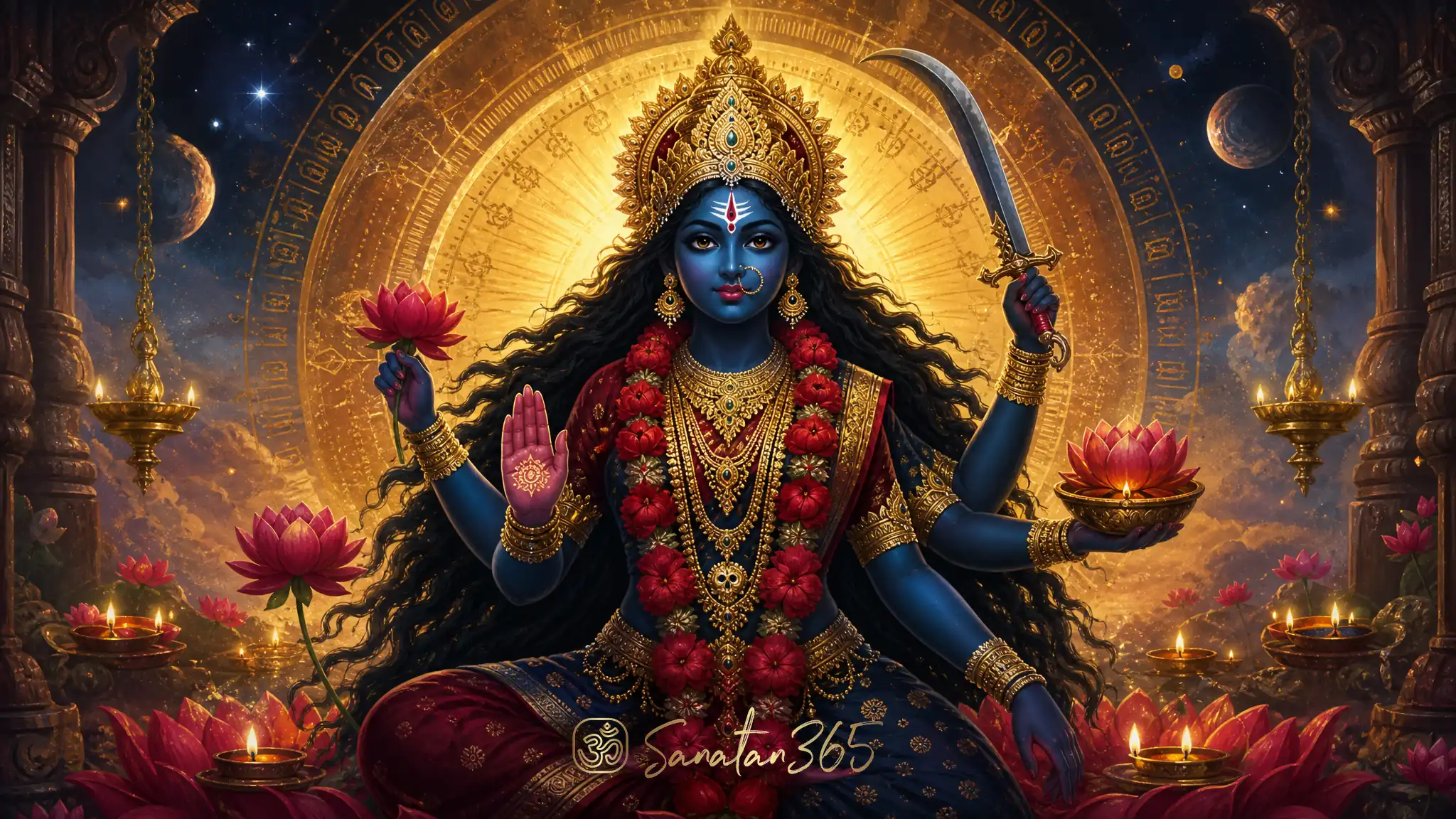
Kali's iconography can include dark or blue-black skin, flowing hair, a protruding tongue, weapons, severed heads, a garland, and a stance connected with Shiva. These details are often misunderstood when viewed outside their devotional and symbolic setting. The Met's essay on seeing Kali clearly notes that wrathful images of the divine in South Asian traditions are meant to protect and nurture, not simply to frighten (The Met).
The dark complexion points to the vast unknown, the unmanifest, and the mystery into which all names and forms dissolve. Darkness here does not mean evil. It can mean the immeasurable, the cosmic night before creation, and the reality beyond easy categories.
The sword is often read as jnana (ज्ञान, liberating knowledge). It cuts ignorance, self-deception, and the false identity that clings to "I" and "mine." The severed head can symbolize the ego, not a command toward harm. Hindu American Foundation's educational overview explains Kali as symbolizing the death of the ego in the movement toward moksha (मोक्ष, liberation) (Hindu American Foundation).
Her garland and dramatic form remind devotees that mortality cannot be hidden forever. The body is sacred, but it is not permanent. Speech is powerful, but it can be purified. Action matters, but action must be freed from arrogance.
Her right hands are often shown in gestures of protection and blessing, including abhaya mudra (अभय मुद्रा, gesture of fearlessness) and varada mudra (वरद मुद्रा, gesture of blessing). This is crucial. Kali's form may confront fear, but her blessing is fearlessness.
Key takeaway: Kali's fierce image is a symbolic language of protection, ego-cutting wisdom, and liberation, not a celebration of cruelty.
Why is Maa Kali also understood as the Divine Mother?
In Bengal and many Shakta communities, Kali is loved as Maa, the Mother. This changes the emotional tone of her worship. A child may fear the intensity of a mother's correction, but the correction comes from care. Kali is fierce because she does not want the child of the Divine to remain trapped in ignorance.
Shakta (शाक्त, goddess-centered) devotion sees the Divine Mother not only as gentle beauty but also as cosmic power. A mother gives birth, nourishes, protects, disciplines, and, when needed, fiercely defends. Kali contains this full range. She is not limited to softness because reality itself is not limited to softness.
The devotional heart of Kali worship often rests in trust. Devotees bring fear, grief, anger, shame, and confusion to her. They do not need to pretend to be polished before approaching the Mother. Kali receives the raw human being and turns that rawness toward purification.
This is one reason Kali devotion can feel especially powerful during periods of crisis. When life has already stripped away surface comforts, a gentle but vague spirituality may not feel honest enough. Kali offers a language for meeting pain directly without losing faith.
Still, reverence matters. Kali is not a fashion symbol or a shock image. She is a living presence in Hindu devotion. To approach her respectfully means understanding her as Maa Kali, not reducing her to anger, rebellion, or visual intensity alone.
Key takeaway: Maa Kali's motherhood is not separate from her fierceness; her fierceness is one expression of protective love.
How does Goddess Kali meaning relate to ego and liberation?
The ego wants continuity on its own terms. It wants to be praised, defended, obeyed, and remembered. Kali disrupts this illusion. Her sword, time-symbolism, and cremation-ground associations all ask the seeker to examine what is truly being protected when the ego says, "I am hurt" or "I am afraid."
In Vedantic and devotional language, the problem is not healthy personality or practical self-respect. The problem is ahamkara (अहंकार, ego-maker), the mistaken identity that treats the limited self as ultimate. Kali does not destroy the dignity of the person. She destroys the false center that keeps the person bound.
This distinction matters. A shallow reading of Kali might imagine that spiritual life requires hating the self. Hindu wisdom does not ask that. It asks for discernment. The limited ego is not the deepest Self. When false identification loosens, compassion can grow. Duty can become cleaner. Prayer can become less transactional.
Kali's confrontation with ego is also moral. If pride, greed, anger, or fear rule the heart, then the person becomes smaller. Kali's symbolism says: do not negotiate endlessly with what degrades the soul. Cut it at the root.
This is why Kali can be both terrifying and consoling. She terrifies whatever is false. She consoles whatever longs for freedom.
Key takeaway: Kali's ego-cutting symbolism is not self-hatred; it is the liberation of the deeper Self from false identity.
How is Kali worship practiced with respect?
Kali worship differs by region, lineage, family custom, and temple tradition. In Bengal, Kali Puja is a major devotional observance. In other places, devotees may honor her through mantra, flowers, lamps, meditation, or visits to temples dedicated to the Divine Mother. The details should be learned from one's family tradition, guru, temple, or trusted acharya when possible.
For a general seeker, respectful Kali devotion can begin simply:
- Light a clean lamp with reverence.
- Offer flowers or water if appropriate to one's tradition.
- Sit quietly and invoke Maa Kali as protective Mother.
- Chant a simple mantra only if received respectfully or commonly used in one's family practice.
- Reflect on one fear, attachment, or harmful habit that needs to be surrendered.
- End with gratitude, not demand.
The inner attitude is more important than display. Kali worship is not about imitating dramatic imagery. It is about honesty before the Divine. A devotee can pray, "Mother, remove what keeps me from truth. Give me courage to live by dharma."
Some Kali practices are tantric and require proper initiation, discipline, and guidance. They should not be copied casually from the internet. Sanatan Dharma has always preserved both public devotional forms and specialized disciplines. Respect means knowing the difference.
Key takeaway: Respectful Kali worship begins with humility, cleanliness, guidance, and sincere surrender, not spectacle.
What can modern seekers learn from Kali without losing reverence?
Modern life often rewards image-management. People are trained to look successful, stay productive, avoid grief, and turn even spirituality into self-improvement. Kali cuts through this performance. She asks whether the life looks good or is actually truthful.
Her teaching can be applied in quiet, practical ways:
- Let time clarify priorities before crisis forces clarity.
- Face fear directly instead of decorating it with excuses.
- Offer anger into disciplined action rather than harm.
- Practice courage without becoming harsh.
- Remember death without becoming hopeless.
- Let devotion include the parts of life that feel messy.
This is not a psychological replacement for medical or professional help. If someone is facing severe distress, grief, trauma, or crisis, they should seek qualified support and trusted loved ones. Spiritual practice can support the heart, but it should not be used to avoid necessary care.
Kali's modern relevance is not that she makes life easy. It is that she makes denial harder. She helps the seeker honor a deeper truth: what is temporary should be loved wisely, not worshipped blindly.
Key takeaway: Kali's wisdom for modern life is courageous honesty: love deeply, act rightly, and do not build identity on what time will take.
FAQ
What is the simplest Goddess Kali meaning?
The simplest Goddess Kali meaning is the Divine Mother's fierce power as time, protection, transformation, and liberation. She cuts ignorance and ego so the devotee can move toward truth.
Is Goddess Kali only a goddess of destruction?
No. Kali is connected with destruction, but in a spiritual sense this often means the destruction of illusion, ego, fear, and adharma (अधर्म, disorder or unrighteousness). Devotional traditions also honor her as a loving and protective Mother.
Why does Kali look frightening?
Kali's fierce form uses symbolic language. Her sword can represent knowledge, her dark form can point to the cosmic mystery, and her fearsome imagery confronts death, time, and ego. The purpose is protection and awakening, not horror.
Is Kali worship common only in Bengal?
Kali worship is especially prominent in Bengal, but she is revered across India and in the global Hindu diaspora. Regional forms, rituals, and devotional moods vary widely.
Can beginners pray to Maa Kali?
Yes, beginners can pray to Maa Kali with humility and respect through simple devotion, such as lighting a lamp, offering flowers, and asking for courage and clarity. Specialized tantric practices should be learned only through proper guidance.
Kali's deepest gift is not fear. It is fearless truth: time will take what is false, but the Divine Mother protects the soul that turns toward freedom.
About the author
Sanatan365 Editorial
Bringing Sanatan Dharma to modern seekers through authentic, scripture-grounded content.
Related in Deities
 Deities
Agni Deva Meaning: Sacred Fire and the Divine Messenger
Meet Agni as the Vedic priest and messenger, read the first Rig Veda hymn, and understand sacred fire without reducing a living deity to a…
 Deities
Brahma Deva Meaning: Four Faces, Creation, and Sacred Knowledge
Understand Brahma, the Hindu creator deity, through his four faces, lotus imagery, sacred knowledge, and a careful distinction from Brahman…
 Deities
Ushas, the Vedic Goddess of Dawn: Light, Renewal, and Time
Ushas, the Vedic goddess of dawn, appears in the Rigveda as radiant light that awakens life, calls beings to activity, and reveals both ren…