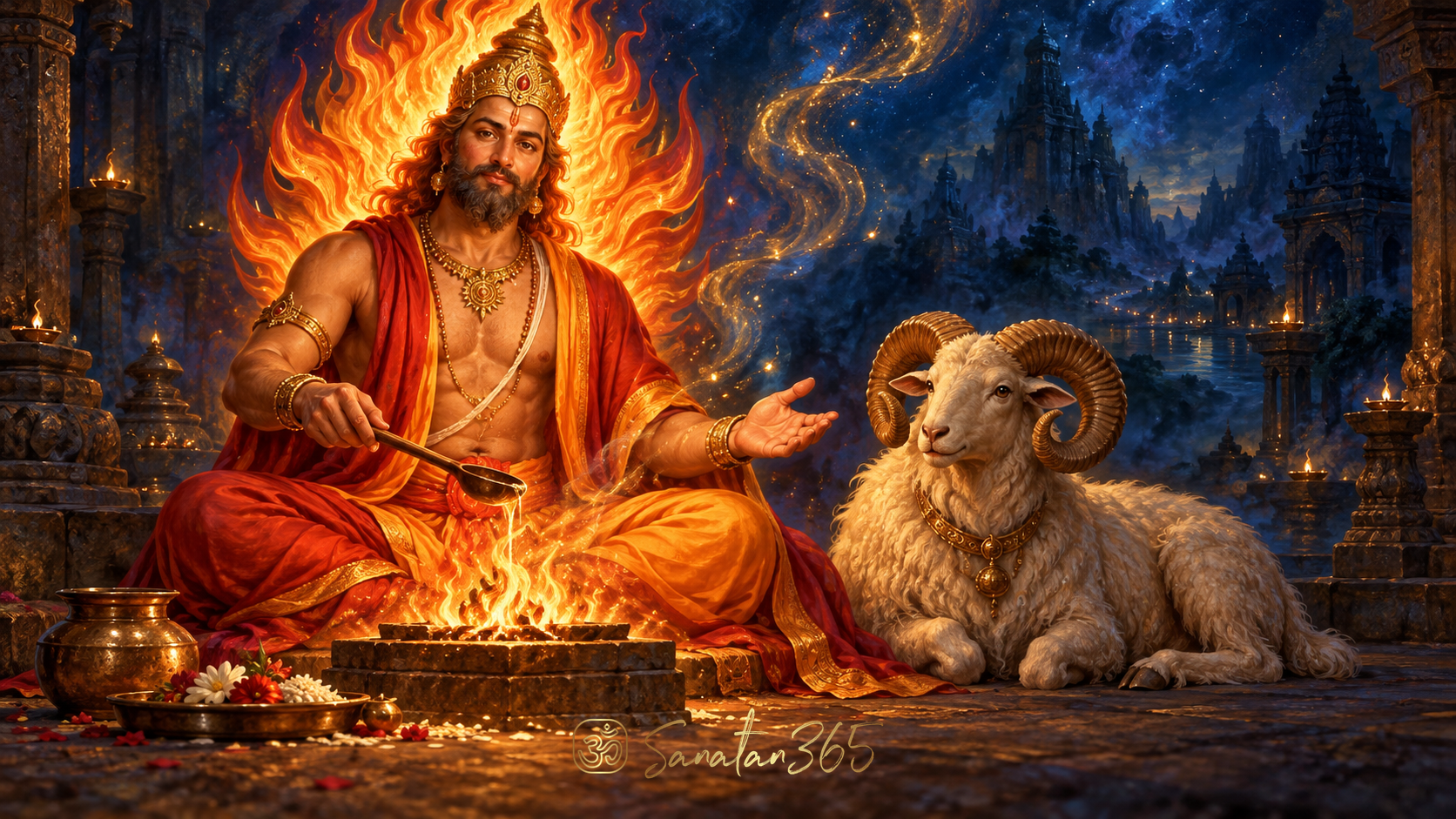
Agni Deva Meaning: Sacred Fire and the Divine Messenger
Meet Agni as the Vedic priest and messenger, read the first Rig Veda hymn, and understand sacred fire without reducing a living deity to a symbol.
The Rig Veda opens not with a distant throne, but with a presence invited to stand at the heart of an offering.
Agni Deva meaning begins with Agni (अग्नि, fire) as the Vedic deity of sacred fire. Deva (देव, deity) names his divine identity. In the opening hymn, Agni is praised as priest, bearer of offerings and a presence through whom the gods are approached. He is not merely a dramatic flame or a metaphor for enthusiasm. His significance lies in the relationship between the visible fire, the disciplined act of offering and the Divine addressed through worship.
That relationship makes Agni a particularly revealing figure for readers learning how Hindu sacred language works. A physical element can be encountered directly, addressed personally and interpreted thoughtfully without any one of those approaches cancelling the others.
Agni Deva meaning: what do the Vedic hymns reveal?
Agni belongs to the devotional world of the Rig Veda, the collection of Vedic hymns whose received arrangement begins with praise of him. The opening is a useful starting point because it tells readers what Agni does, rather than supplying only a list of his attributes.
The first verse calls him purohita (पुरोहित, the priest placed in front), ritvij (ऋत्विज्, the priest who officiates at the appointed time) and hotri (होतृ, the invoking priest). These are distinct ritual descriptions, not three interchangeable words for a flame. Together they present Agni as a divine participant who helps establish and conduct the sacrificial encounter. The Sanskrit and a verse-by-verse grammatical reading are available in this analysis of Rig Veda 1.1.
Here yajna (यज्ञ, sacrificial worship or offering) means an ordered sacred act. In this context, “sacrifice” should not automatically be read as a modern slogan about personal struggle. It describes a ritual world of offerings, invocations, appointed responsibilities and divine recipients. Later ethical reflections can draw from that world, but should first acknowledge its actual setting.
The hymn also praises Agni as a bestower of treasures. Its third verse asks for increasing nourishment, wealth and heroic offspring. These requests belong to the concerns of the hymn's speakers. Respectful reading neither hides their material aspirations nor converts them into a guarantee that lighting a fire will produce money, achievement or a particular family outcome.
A devotional prayer can express hope without becoming a transaction. Agni's presence joins gratitude and aspiration to a form of worship that requires care, not a promise that circumstances will obey the worshipper.
For beginners, three distinctions help:
- Agni as fire: the tangible flame through which a ritual offering is made.
- Agni as deity: the sacred presence praised and addressed in the hymn.
- Agni as a subject of reflection: an invitation to think about offering, attention and responsibility.
The third is a thoughtful application, not a replacement for the first two. Calling Agni “inner motivation” alone would leave much of the Vedic account unexplained.
Key takeaway: Agni is both encountered in sacred fire and addressed as a deity with an active role in worship.
Why does the Rig Veda begin by praising a priest?
The opening words, commonly transliterated agnim ile purohitam, mean “I praise Agni, the priest placed in front.” This is a short explanatory rendering of the first phrase, not a complete translation or a guide to Vedic chanting. The full verse continues with the sacrificial and bestowing roles described above.
Beginning with a priest makes the opening relational. Before a request can reach its recipient, the meeting must be prepared. Someone must invoke, attend and offer. The first hymn places Agni inside that work of connection.
Its nine verses have a clear progression. Rather than extracting one line and treating it as the whole teaching, readers can follow the sequence:
- Verse 1 introduces his ritual roles. Agni is praised as the divine priest and bestower.
- Verse 2 joins earlier and present praise. The hymn remembers former seers while including those who praise now.
- Verses 3–6 turn toward offering and blessing. Prosperity is requested, the sacrifice reaches the gods, and Agni is praised for wisdom and truth.
- Verses 7–9 draw closer. Worshippers approach day by day with reverence, address him as a guardian of sacred order and ask that he be accessible like a father to a son.
This last movement matters. The hymn does not end by making divine fire more remote. It asks for closeness and well-being. Majesty and approachability are held together.
The “day by day” language in verse 7 also changes the scale of attention. A great ceremony may be memorable, but continuity is part of the hymn's own vocabulary. Reverence is not confined to exceptional moments. Returning with attention has value even when nothing spectacular happens.
In verse 8, rita (ऋत, sacred or cosmic order) appears as something Agni guards. The word has a rich Vedic setting and cannot be reduced to punctuality or tidy behaviour. Still, the verse offers a grounded reason to connect worship with truthfulness and order rather than with display alone.
The text is short enough to read slowly twice. On the first reading, notice its descriptions of Agni. On the second, notice the worshippers' actions: praising, approaching, bringing reverence and asking. This method reveals a relationship, not merely a catalogue of powers.
Key takeaway: The opening hymn presents sacred encounter as prepared, truthful and renewed through repeated reverence.
How is Agni both the offering fire and a divine messenger?
The messenger role becomes especially clear when the second and fourth verses are read together. Verse 2 asks Agni to bring the gods here. Verse 4 says that the sacrifice he encompasses reaches the gods. The movement is not only upward from human beings; it also concerns divine presence at the place of worship.
This is why “messenger” is useful but incomplete if it suggests a mechanical courier. Agni is also the priest who participates in the act. He does not simply deliver something after everyone else has finished. His presence belongs to the offering itself.
Fire provides a striking visible setting for this theology. What is offered changes as it enters the flame. Heat, light and movement are immediately perceptible. The hymn speaks to that encounter through divine address; a chemical account of combustion and a devotional account answer different kinds of questions.
Neither account needs to be confused with the other. The ritual meaning does not establish that smoke is harmless or that offerings have scientifically proven cleansing effects. Equally, describing combustion does not tell a worshipper everything about the act's sacred significance.
The traditional language is most intelligible when read on its own terms. A participant brings an offering, the rite establishes its form and purpose, and Agni is invoked within that relationship. Reverence involves the giver as well as the object given.
An everyday reflection can then be made carefully: an offering is not simply whatever is easiest to dispose of. It asks for a change in how something is held. Time, food or effort can be approached with gratitude instead of entitlement. That is an ethical application inspired by the rite, not a claim that everyday acts are formally identical to a Vedic sacrifice.
Readers who want a specific fire-ritual discussion can separately explore Agnihotra and its sunrise–sunset offering. Agni is the deity under discussion here; Agnihotra is a particular ritual tradition. Knowing one word does not make every fire ceremony the same.
Similarly, a flame waved in praise and an offering placed into a ritual fire have distinct forms. Their shared brightness should not erase their different liturgical purposes.
Key takeaway: Agni joins the act of offering with divine approach; the messenger image describes a sacred relationship, not a guaranteed mechanism.
What do the ram and flames tell us about Agni?
A Vedic hymn and a later sculpted image are different kinds of evidence. The hymn supplies words used in praise. Sculpture supplies an artistic interpretation shaped by its place, period and iconographic tradition. They can illuminate each other without being treated as identical records.
A sandstone image from Uttar Pradesh, dated around 1000, offers a concrete example. The Cleveland Museum of Art's Agni sculpture shows flames rising behind the deity. Its catalogue identifies him as the figural form of the sacrificial fire and describes his mount as a goat. The same description associates Agni with the southeast and notes smaller scenes of ritual and teaching around him.
Popular descriptions often call Agni's mount a ram. When looking at a particular artwork, however, the catalogue's own identification should be preserved rather than silently changed. A ram is a male sheep, not simply another name for any goat. The useful point is to observe the actual animal and the tradition of the image, not to force every representation into one caption.
Vahana (वाहन, a deity's vehicle or mount) is the familiar term for such an accompanying animal. Its presence helps identify a deity and contributes to the image's character. In this sculpture, the flames and surrounding ritual activity are equally important clues.
The figure is more than a fire with a face. A human-shaped divine image makes worship's recipient visible through expression, posture and attributes. The flames retain the element's identity, while the surrounding scenes situate that identity among practices of offering and learning.
For a family visiting a museum, three questions make the encounter richer:
- Which visible features connect the figure to fire?
- What activities occur beside or above the central deity?
- Which details come from the artwork, and which have been supplied by its modern caption?
Children can answer the first two by looking before an adult supplies an interpretation. This keeps observation distinct from inherited assumptions. Diaspora families can use the same approach when images from several Indian regions appear together in one collection.
The southeast association belongs to directional iconography. It is not, by itself, an instruction to rearrange a home or a prediction about a person's future. Art identification and household prescriptions are different subjects.
Key takeaway: Read Agni's flames, mount and surrounding scenes together, while respecting the specific artwork rather than imposing one universal appearance.
How can sacred fire deepen attention without becoming spectacle?
The opening hymn offers a way to begin with understanding rather than with an elaborate ceremony. Reading it, learning its key terms and listening respectfully to an established recitation can all deepen knowledge before any practical ritual instruction is attempted.
For formal homa (होम, a ritual offering into fire) or havan (हवन, a commonly used name for a fire-offering rite), an experienced practitioner should explain the relevant tradition, materials, recitation and responsibilities. A general article about Agni is not a substitute for that instruction.
Care is part of reverence. Fire should never be left unattended; local fire rules, a suitable setting and the needs of people nearby matter. Large flames, excessive smoke or a crowded arrangement do not make worship more sincere. Where open flame is unsuitable, studying or offering a spoken prayer is a meaningful way to learn without pretending that it replaces every prescribed ritual.
There is also no need to turn attention into a visual performance. Verse 7's repeated approach and verse 9's request for closeness suggest a quieter measure: was the act understood, attended to and carried out responsibly?
A simple reading practice can follow four steps:
- Read the first hymn in a reliable translation, keeping its nine verses together.
- Choose one role, such as priest or messenger, and identify the verse that supports it.
- Notice one unfamiliar term and learn its contextual meaning.
- Ask what gratitude or responsibility would look like after the reading ends.
The last question is deliberately practical. Gratitude might mean acknowledging who prepared a shared meal. Responsibility might mean keeping a promise or cleaning a space used by others. Such examples are contemporary reflections, not rules quoted from the hymn.
For related context, the meaning of the puja thali explores the preparation of offerings in household worship. Different practices have different forms, but thoughtful preparation helps keep devotion connected to care.
The central lesson is not that everything must become fire. It is that sacred encounter requires a response: attention, offering and the willingness to approach with reverence.
Key takeaway: Understanding Agni begins with careful reading and responsible worship, not with bigger flames or promised results.
FAQ
Who is Agni Deva in Hindu tradition?
Agni is the Vedic deity of fire, praised in the opening Rig Veda hymn as priest, bestower and a presence through whom offerings reach the gods. His divine role is related to sacred fire but is not exhausted by a physical description of combustion.
Why is Agni called a messenger of the gods?
Rig Veda 1.1 asks Agni to bring the gods to the worshippers and says that the sacrifice he encompasses reaches them. “Messenger” expresses this connection, while the hymn also gives him the active role of divine priest.
Does Agni always appear with the same mount and features?
Representations vary. Agni is commonly associated with a ram, but the Cleveland sculpture discussed here is catalogued with a goat. The particular artwork, its flames, surrounding figures and documented provenance should guide identification.
Can a beginner understand Agni without performing a fire ritual?
Yes. Reading the hymn in translation, learning its terminology and observing established practice respectfully are useful beginnings. Performing a formal fire offering requires appropriate instruction and a safe setting; reading alone does not claim to replace that rite.
About the author
Sanatan365 Editorial
Bringing Sanatan Dharma to modern seekers through authentic, scripture-grounded content.
Related in Deities
 Deities
Brahma Deva Meaning: Four Faces, Creation, and Sacred Knowledge
Understand Brahma, the Hindu creator deity, through his four faces, lotus imagery, sacred knowledge, and a careful distinction from Brahman…
 Deities
Ushas, the Vedic Goddess of Dawn: Light, Renewal, and Time
Ushas, the Vedic goddess of dawn, appears in the Rigveda as radiant light that awakens life, calls beings to activity, and reveals both ren…
 Deities
Chitragupta Meaning: Divine Records and Ethical Accountability
Chitragupta is remembered as the divine keeper of karmic records in Yama's court. His symbolism connects writing, memory, justice, and ethi…

