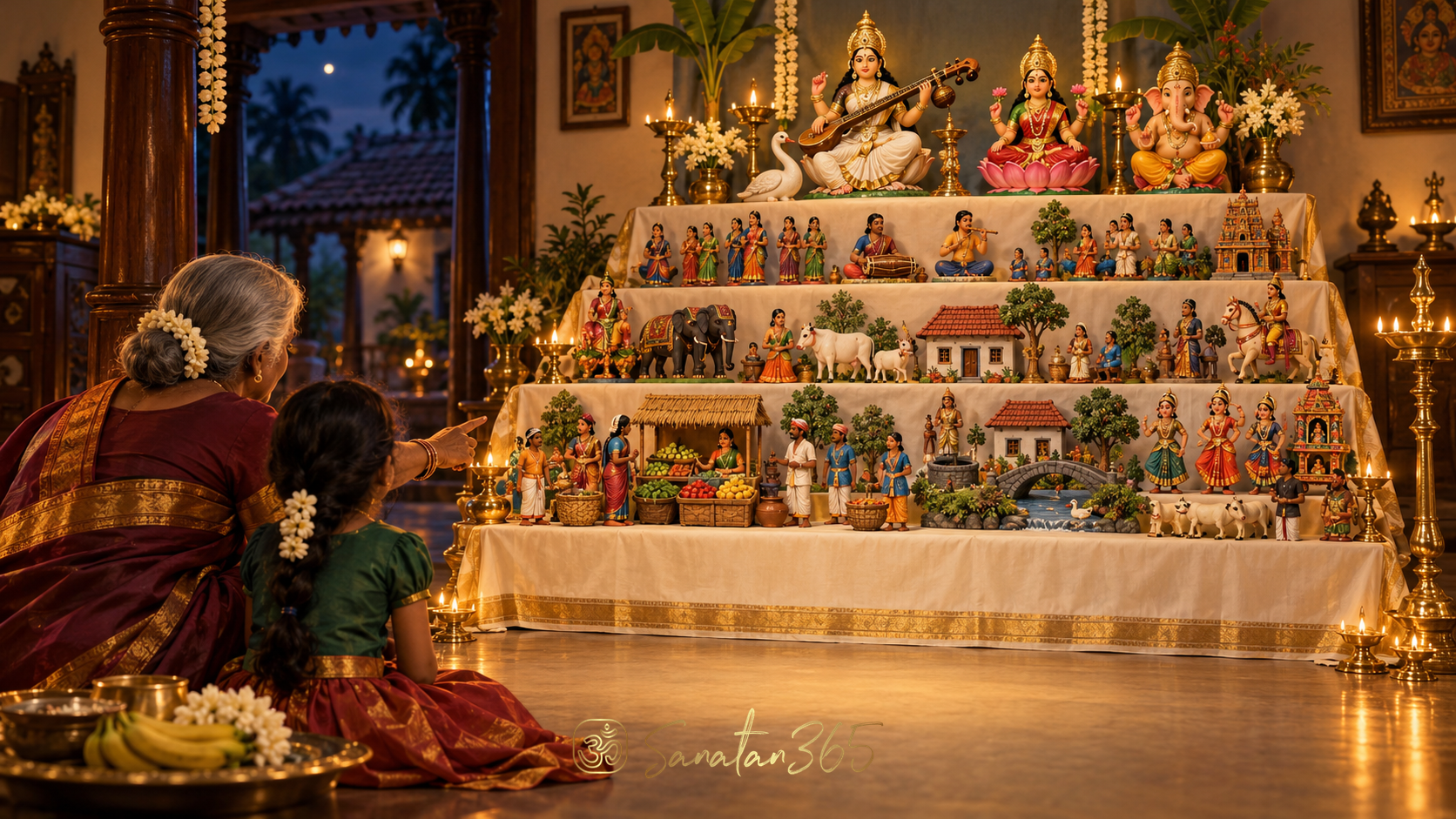
Golu Meaning: Navratri Dolls, Living Stories, and Hospitality
Understand Navratri Golu through its handmade dolls, regional names, family stories and welcoming home visits, with thoughtful preparation for a small display.
A tiny market stall beside a sacred figure can turn a shelf of dolls into a conversation about an entire world.
Golu meaning is best understood through that meeting of devotion and everyday life. Golu, also written Kolu, is the South Indian Navratri tradition of arranging dolls and figurines on stepped displays. Sacred figures, narrative scenes and miniature households become occasions for worship, storytelling and visiting. Navarātri (नवरात्रि) means “nine nights,” the festival honouring the Divine Mother. Golu gives those nights a distinctive household form: a collection is unpacked, familiar stories are retold, and neighbours are welcomed into the room.
The Ministry of Tourism's Incredible India account of Navratri describes South Indian Kolu displays as arrangements of dolls and figurines telling divine stories. Its calendar lists Navratri from 11 to 19 October 2026. Specific opening rites, concluding observances and their timings should follow the household's local calendar and established practice.
This is a guide to understanding the display, not a universal ritual manual. A visitor's curiosity, a maker's patient work and an elder's remembered explanation are all part of what makes Golu worth looking at closely.
What does Golu meaning reveal about Navratri doll displays?
Golu is not simply a collection taken out for decoration. The arrangement creates a setting in which a household can give attention to the sacred and share that attention with others. Pūjā (पूजा), worship through reverent attention and offerings, may accompany the display according to family custom. The dolls also invite a different kind of attention: looking, asking and listening.
The Tamil expression Bommai Golu refers to a doll display; bommai means doll. The steps are often called padi, the Tamil word for steps. Odd-numbered tiers, commonly five, seven or nine, are a familiar convention, but a description of common practice should not become a judgment on every household's space or means.
Zishta's craft-focused account of Golu describes tiered arrangements that bring together deities, narrative figures and everyday scenes. It also records the social practice of visiting displays and exchanging offerings or small gifts. This is useful documentation of a living craft tradition, rather than authority for a rule binding every family.
A household may explain its arrangement as a vision of the divine, human and natural worlds brought into relationship. Another may place particular figures according to inherited custom or the practical needs of its collection. Such explanations are worth hearing from their hosts. There is no need to invent a single ancient text that prescribes every shelf.
The setting matters too. A figure that has spent most of the year wrapped in a box becomes visible again. Someone recognizes it, remembers who bought it, and supplies a story that cannot be read from its painted face. Devotion and family memory meet without being identical: one concerns worship, the other the human history through which that worship has been carried.
Key takeaway: Golu is a devotional display made meaningful by stories, inherited care and the relationships gathered around it.
How can the dolls be read as a living collection of stories?
Begin with one figure rather than trying to identify the entire display at once. What is being represented? Which details help distinguish it? Who in the room knows its story? These questions make looking more thoughtful without turning a visit into an examination.
A deity figure should be understood with respect for its recognizable attributes and the hosts' explanation. A sacred narrative set can invite a retelling from a trusted text or family tradition. A village scene, a musician or a miniature shop can open a conversation about work and ordinary responsibilities. Zishta's account records precisely this coexistence of divine figures, narrative scenes and everyday occupations.
Not every painted object carries a secret code. Some dolls are present because they are beautiful, because a relative gave them, or because children love a particular scene. A useful explanation can distinguish these different kinds of meaning:
- Devotional meaning: whom a sacred figure represents and how the household honours that presence.
- Narrative meaning: which episode a group of figures depicts, with its source identified where possible.
- Craft meaning: how material, painting and small details reveal the maker's work.
- Family meaning: who acquired or inherited the object and what memories belong to it.
For children, the most memorable question may be concrete: why is that person carrying something, or why is this animal beside that figure? Answer only what is known. If an identification is uncertain, say so and look it up together. A plausible guess repeated confidently can become a false family explanation within a few seasons.
The display can also teach patient looking. A small hand-painted face, the shape of a musical instrument, or a repaired corner becomes visible only when someone slows down. Children can draw a favourite scene or ask an elder to describe one doll. These are suggested learning activities, not required observances.
Avoid reducing every sacred story to a slogan about success. The figures belong to traditions with their own theological and literary depth. A short introduction can invite further reading rather than pretend to replace it. For a broader reflection on receiving a guest with dignity, the guide to sacred hospitality and wise boundaries complements the social side of the display.
Key takeaway: Read the dolls through devotion, narrative, craftsmanship and family memory, while keeping known facts separate from guesses.
What changes between Bommai Golu, Bommala Koluvu and Bombe Habba?
The vocabulary changes across South India, and so do particular household customs. Bommai Golu or Kolu is closely associated with Tamil Nadu. Bommala Koluvu is a Telugu name used in Andhra Pradesh and Telangana. Gombe Habba, also rendered Bombe Habba, is a Kannada name for the doll festival in Karnataka. Zishta's regional account describes these related forms without making their local expressions identical.
A shared practice does not mean a visitor should expect the same tiers, opening rites, songs or closing customs everywhere. The household's own explanation is more useful than an online diagram presented as compulsory. A family may have a long-established arrangement that looks quite different from a newly created thematic display.
Regional names also carry language into the celebration. A child who knows the English phrase “doll display” can learn the words an elder uses at home. Recording those words alongside a photograph preserves something that a generic label would miss. Pronunciation can be learned from a speaker of the language rather than inferred from an English spelling alone.
Families away from South India may adapt the scale to a rented flat, a shared room or the dolls they were able to carry abroad. The practical suggestion is to preserve the connection to known household custom while making sensible arrangements for the actual space. Adaptation need not be disguised as an ancient rule, and a small display need not apologize for its size.
Golu should not be treated as a miniature version of every other Navratri celebration. Bengal's Durga Puja, Gujarat's garba gatherings and South Indian doll displays each deserve attention on their own terms. The separate Sharad Navratri date and regional observance guide supplies the wider festival context without replacing the hosts' knowledge of their own display.
Key takeaway: Related regional traditions share the doll-display idea, but language and household practice deserve their own careful recognition.
How can a first Golu display be arranged with care?
A first display benefits from a clear intention: to honour the festival and make a small collection understandable. It need not imitate the largest arrangement seen online. Before buying anything, ask what the household already has, what its established custom requires, and what can be safely maintained throughout the celebration.
The following is a practical preparation sequence, not an instruction for initiating formal rites:
- Learn the household practice. Ask a knowledgeable relative or trusted guide about the family's devotional focus, opening and concluding customs, and local calendar.
- Choose a stable place. Use a firm support, keep access routes clear, and consider children, pets and anyone who needs to move through the room.
- Inspect the collection. Separate fragile pieces, check loose parts, and arrange handling before unpacking everything.
- Create a readable arrangement. Group related figures so their story can be explained without crowding every available surface.
- Plan the welcome. Decide when visitors can come and how preparation, food and cleaning will be shared.
- Leave room for attention. Lighting and decoration should help people see the figures, not overwhelm them.
Sacred figures should be placed reverently according to the household's practice. Where a kalaśa (कलश), a sacred ritual pot, forms part of the observance, learn its use from the person guiding that practice. A photographed arrangement is not enough information to undertake a ritual independently.
The common preference for odd-numbered steps is described in the craft account above. A beginner should not conclude that more tiers automatically mean more devotion. If a formal custom specifies an arrangement, seek guidance about what is appropriate for the available space rather than substituting an internet rule.
Ordinary safety belongs in the preparation. Keep flames away from cloth and fragile displays, never leave lamps unattended, and respect building rules. Avoid unstable stacks or heavy figures placed where they can fall. The purpose is a welcoming room, not a display that everyone is afraid to approach.
Key takeaway: A thoughtful first Golu begins with family guidance, stable supports and a collection that can be cared for well.
What makes visiting and hosting part of the celebration?
A display becomes more than a private arrangement when its stories are shared. Zishta records visiting, conversation, offerings and modest gifts as part of Golu's social life. The important point is the welcome, not the financial value of what changes hands.
Prasāda (प्रसाद) means a blessed offering received after worship. Hosts may share it according to their custom. Menus vary; no particular dish should be presented as a universal requirement. Ask about ingredients and dietary needs without making a guest explain more than they wish.
As a visitor, arrive within the agreed time, ask before handling dolls, and obtain permission before taking photographs. Give the host a chance to explain a favourite figure. A question such as “Which piece has been with your family longest?” can invite a more personal conversation than judging the arrangement's size.
Participation should not become a performance test. A guest who is invited to sing may enjoy doing so, but someone who prefers to listen can also be welcomed warmly. Children should be able to ask respectful questions without being embarrassed for not already knowing the answers.
Hosts can keep the gathering manageable by planning a few visiting windows and sharing the work. One person need not prepare every dish, narrate every story and clean the room afterward. A quiet visit with genuine attention can be more memorable than an evening too crowded for anyone to look closely.
Small gifts, when part of the household custom, can remain modest. The display is not a competition in generosity. Thoughtful hospitality protects both the dignity of guests and the limits of those preparing the celebration.
Key takeaway: Visiting completes the display's social meaning when curiosity, consent and an unpressured welcome remain central.
How can Golu dolls and their stories be preserved after Navratri?
Packing away the figures is also an opportunity to preserve what was learned. Follow the household's established concluding custom and local calendar; a general cultural guide should not prescribe a single closing time for every family.
Before packing, take a photograph of the arrangement and record the names of a few significant pieces. Note who identified them, where an explanation came from, and which details remain uncertain. A short voice recording, made with permission, can preserve an elder's pronunciation and recollection more faithfully than a rushed caption.
Treat care advice as material-specific. A painted clay figure, a wooden doll and a fabric costume may need different handling. Ask the maker or a suitable conservator before attempting repairs on an old or valuable piece. Avoid assuming that washing, strong adhesive or fresh paint will be harmless.
Keep an inventory of damaged parts and storage locations. Protect fragile projections, separate pieces that might rub against one another, and choose dry storage appropriate to their materials. These are ordinary handling suggestions rather than guarantees of conservation.
A collection need not grow every year to remain alive. Revisiting its stories, crediting its makers and welcoming someone who has never seen it before can give familiar figures renewed meaning. The lasting lesson is simple: care for the objects in a way that also preserves the people, languages and stories gathered around them.
Key takeaway: Preserve Golu through careful handling and honest records of its stories, not merely through adding more dolls.
FAQ
What is Golu during Navratri?
Golu is a South Indian tradition of displaying dolls and figurines on stepped arrangements during Navratri. Sacred figures, story scenes and everyday life are brought together for devotion, learning and household visits. Particular practices vary by family and region.
How many steps should a Golu display have?
Odd-numbered tiers, often five, seven or nine, are a familiar convention. They are not a measure of a household's devotion. Follow established family guidance for formal arrangements and choose supports that are stable and suitable for the space.
Are Golu, Bommala Koluvu and Bombe Habba identical?
They are related doll-display traditions known by different regional names. Bommai Golu is associated with Tamil Nadu, Bommala Koluvu with Telugu-speaking households, and Bombe Habba with Karnataka. Shared features do not erase differences in language and household custom.
Can a beginner start with a small collection?
A modest arrangement can support attentive learning and a warm welcome. Ask a knowledgeable guide about the household's observance, use sacred figures respectfully, and avoid treating a decorative photograph as a complete ritual instruction.
When is Navratri in 2026?
Incredible India lists 11–19 October 2026 for the festival. Check a local calendar and household guidance for actual ritual timings and concluding customs. Golu's lasting value is not the size of its display, but the care with which devotion, craftsmanship and stories are shared.
About the author
Sanatan365 Editorial
Bringing Sanatan Dharma to modern seekers through authentic, scripture-grounded content.
Related in Festivals
 Festivals
Sharad Navratri 2026: Dates, Nine Nights, and Devotion at Home
Understand Sharad Navratri 2026, its October dates, the meaning of nine nights, regional traditions, and a thoughtful home observance witho…
 Festivals
Parivartini Ekadashi 2026: Date, Meaning, and Gentle Vrat Guide
Parivartini Ekadashi 2026 falls on September 22. Learn why it is called Parsva or Vamana Ekadashi, how it relates to Chaturmas, and how to…
 Festivals
Hartalika Teej 2026: Date, Meaning, Puja, and Parvati's Resolve
Hartalika Teej 2026 is observed on September 14 in honour of Goddess Parvati and Lord Shiva. Learn the festival's story, vrat meaning, regi…

