Grihastha Ashrama Meaning: Householder Dharma in Hindu Life
Grihastha Ashrama is the Hindu householder stage, where family, work, service, and spiritual practice become one field of dharma.
Grihastha Ashrama meaning is often reduced to "married life," but the older Hindu idea is deeper: the home itself can become a place of dharma, service, discipline, and spiritual growth.
Grihastha Ashrama (गृहस्थ आश्रम, the householder stage) is the second of the four ashramas, or life stages, in Hindu thought. It is the phase where a person supports family, earns ethically, practices hospitality, gives in service, and carries spiritual values into ordinary responsibilities. Rather than treating family life as a distraction from inner life, the grihastha path asks a person to make daily action sacred.
What is Grihastha Ashrama meaning in simple terms?
Grihastha comes from griha (गृह, home) and stha (स्थ, one who stands or abides). A grihastha is therefore "one who stands in the home," not merely as an owner of property, but as a person who accepts the responsibilities of household life. Britannica defines grihastha as the married householder stage within the ashrama system, following the student stage and preceding retirement into deeper contemplation Britannica.
In the classical sequence, the four ashramas are:
- Brahmacharya (ब्रह्मचर्य, student discipline): learning, self-control, and formation.
- Grihastha (गृहस्थ, householder life): family, livelihood, contribution, and ritual responsibility.
- Vanaprastha (वानप्रस्थ, forest-dweller or gradual withdrawal): simplification and mentorship.
- Sannyasa (संन्यास, renunciation): complete dedication to liberation.
This sequence is not always a rigid timetable in modern life. It is better understood as a map of human responsibilities. A student learns. A householder contributes. An elder simplifies. A renunciant lets go. The important point is not age alone, but the dharma appropriate to one's role.
Key takeaway: Grihastha Ashrama is the stage where Hindu spiritual life enters family, livelihood, generosity, and daily duty.
Why is the householder stage considered spiritually important?
The householder stage matters because it supports more than one person's private spiritual progress. A grihastha feeds, protects, educates, gives, hosts, and sustains. In traditional Hindu social imagination, students, elders, guests, mendicants, teachers, and ritual life all depend in some way on householders who create food, wealth, stability, and care.
This is why householder dharma is not treated as second-class spirituality. The Bhagavad Gita teaches that action done without selfish attachment can become a path of inner growth: "perform action, abandoning attachment" is the broad lesson of Gita 3.19 Gita Supersite. The home becomes a training ground for this teaching because family life repeatedly asks for patience, generosity, truthfulness, restraint, and humility.
A person living alone may choose silence for a day. A householder learns patience when a child is crying, an elder needs help, a bill is due, and dinner still has to be prepared. That pressure is not outside spiritual life. It is exactly where dharma becomes real.
Modern seekers sometimes imagine spirituality as escape from responsibilities. Grihastha Ashrama offers a different view: responsibility can become a sacred discipline when guided by dharma. Work becomes cleaner when wealth is earned without exploitation. Family becomes sacred when love is not possession. Ritual becomes alive when the lamp lit at home changes the conduct of the person who lit it.
Key takeaway: Householder life is spiritually important because it turns ordinary responsibility into disciplined, generous, dharmic action.
What are the main duties of householder dharma?
Householder dharma is not one duty. It is a field of duties held together by conscience. Different texts and communities explain it differently, but several themes repeat across Hindu practice.
First is ethical livelihood. Artha (अर्थ, material means) is one of the purusharthas, or goals of life, but it is meant to be held inside dharma. Earning is not rejected. Dishonest earning is rejected. A grihastha is asked to provide without losing integrity.
Second is family care. This includes care for spouse, children, parents, elders, dependents, and sometimes the wider kinship network. Hindu family life is not only emotional companionship. It is a place where duty, affection, sacrifice, and memory are transmitted.
Third is hospitality and dana. Dana (दान, giving) protects the heart from becoming small. A householder's food is not only private consumption. It can become prasad-like when shared with guests, workers, neighbors, animals, and those in need. This connects naturally with the Hindu ideal of seva, selfless service offered without constant demand for recognition.
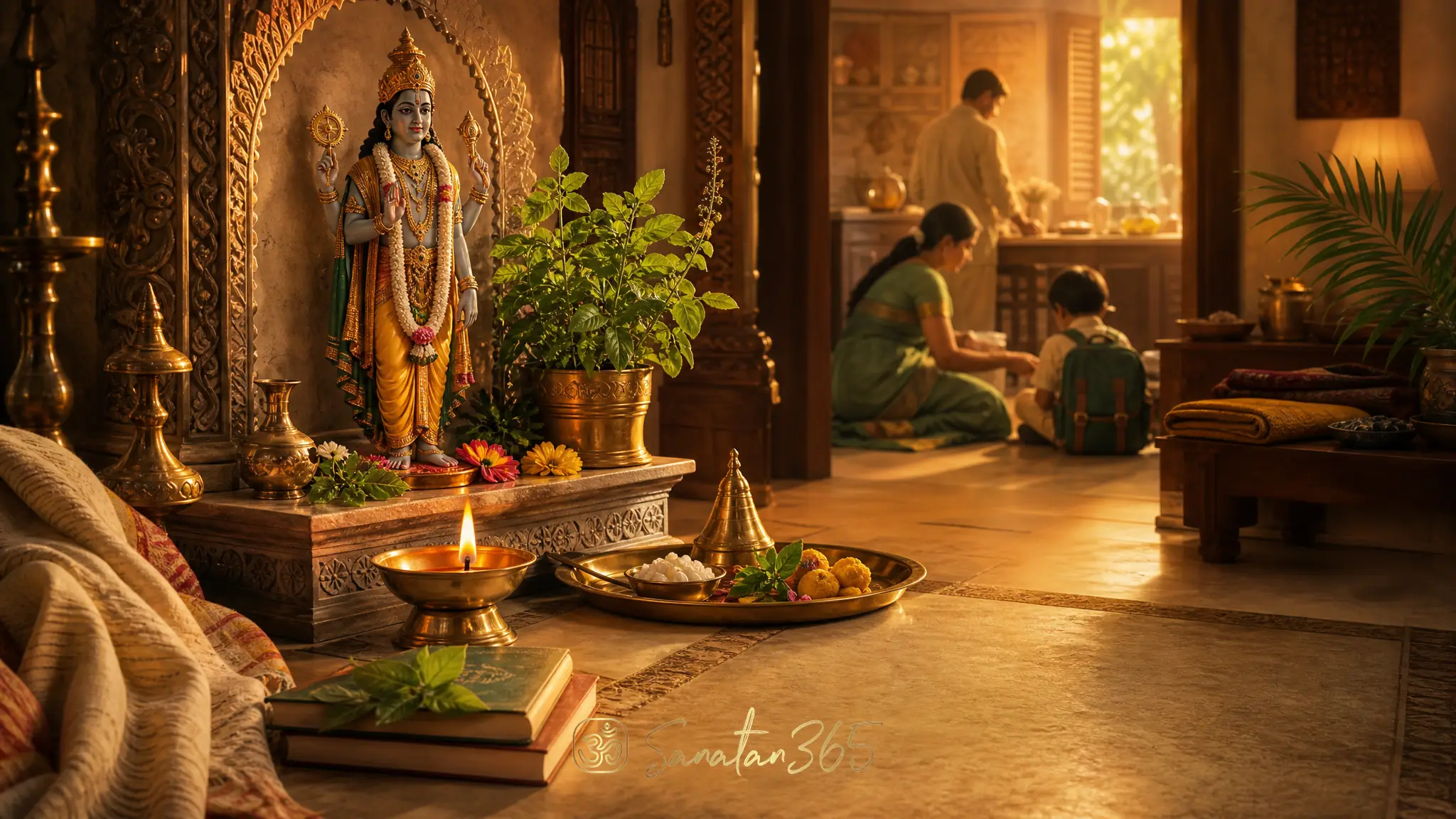
Fourth is ritual continuity. Lighting a diya, remembering ancestors, observing vrata (व्रत, sacred vow or disciplined observance), keeping a small altar, reciting mantras, or teaching children simple stories are ways the home becomes a living carrier of tradition.
Fifth is character formation. The householder path constantly tests satya (सत्य, truthfulness), ahimsa (अहिंसा, non-harm), asteya (अस्तेय, non-stealing), and self-restraint. These are not abstract values. They appear in small choices: how one speaks in anger, how money is handled, how promises are kept, and how power is used inside the family.
Key takeaway: Householder dharma joins livelihood, care, giving, ritual, and character into one daily spiritual discipline.
How does Grihastha Ashrama balance dharma, artha, kama, and moksha?
The householder stage is where the four purusharthas, or aims of life, are most visibly balanced. Dharma is right order and responsibility. Artha is livelihood and resources. Kama (काम, wholesome desire, affection, beauty, and enjoyment) is emotional and relational fulfillment. Moksha (मोक्ष, liberation) is freedom from bondage and ignorance.
In Grihastha Ashrama, artha is not denied. The family needs food, shelter, education, healthcare, and security. Kama is not denied either. Marriage, affection, beauty, music, meals, festivals, friendship, and celebration all have a place. The danger is not that humans have needs and desires. The danger is when artha and kama lose the guidance of dharma.
Dharma gives shape to wealth. It asks: Was this earned honestly? Does it harm others? Does it support something good? Dharma gives shape to desire. It asks: Is this relationship truthful? Does this pleasure deepen gratitude or increase greed? Does this family life make people freer, kinder, and more awake?
Moksha remains present as the final horizon. A householder may not live like a monk, but can still remember impermanence, practice detachment, and serve without ego. The Gita's teaching that a person can worship through their own work, when performed rightly, gives modern householders a powerful frame for daily life Gita Supersite.
This balance is especially relevant today. Many Hindu families live across cities, countries, languages, and work cultures. The old joint-family structure may be absent. The calendar may be crowded. Children may be learning tradition in English. Even then, the householder principle survives: earn cleanly, love responsibly, remember the Divine, serve beyond the self, and do not let success become forgetfulness.
Key takeaway: Grihastha Ashrama does not reject worldly life. It asks worldly life to remain guided by dharma and open toward moksha.
How can modern families practice Grihastha Dharma today?
Modern Grihastha Dharma does not require recreating every detail of an ancient household. It requires sincerity, rhythm, and integrity. A small apartment in Mumbai, Bengaluru, New Jersey, London, or Singapore can become a dharmic home if the people inside it live with steadiness.
Here are practical ways to bring the householder ideal into modern life:
- Keep one daily sacred anchor. Light a diya, chant one mantra, sit for five minutes, or offer gratitude before food. Consistency matters more than performance.
- Make earning ethical. Avoid work habits that depend on deception, exploitation, or careless harm. Let livelihood support dignity, not only ambition.
- Treat family speech as spiritual practice. The home is often where people speak most carelessly. Practicing satya with kindness is a serious discipline.
- Create a giving rhythm. Set aside time, money, food, skill, or attention for others. Dana should become a habit, not an occasional mood.
- Teach through visible practice. Children remember what adults repeat. A weekly story, a festival explanation, a simple pranam, or helping prepare prasad may teach more than lectures.
- Use festivals as family memory. Even when time is limited, explain why a vrata, puja, or festival matters. Meaning protects tradition from becoming mere decoration.
- Practice rest without guilt. A tired householder becomes harsh. Rest, prayer, and dhyana help responsibility stay loving.
The point is not to become perfect. The point is to make the home less forgetful. A dharmic household is not one where no one struggles. It is one where struggle is met with prayer, accountability, and repair.
Key takeaway: Modern Grihastha Dharma is practiced through daily anchors, ethical earning, truthful speech, giving, family teaching, and steady remembrance.
What does Grihastha Ashrama teach about spiritual maturity?
Grihastha Ashrama teaches that maturity is not proven only by withdrawal from the world. It is also proven by how one handles closeness, money, fatigue, desire, disagreement, and care. These are not small tests. They reveal the actual condition of the heart.
A householder cannot hide behind idealism for long. If one speaks beautifully about compassion but is cruel at home, the home exposes the gap. If one praises simplicity but lives in endless comparison, household life exposes that too. This is why Grihastha Ashrama can be such a powerful spiritual mirror.
The householder path also softens pride. Family life teaches that one is needed, but not central to the universe. Work teaches skill and limitation. Parenting teaches love without control. Caring for elders teaches gratitude and mortality. Marriage teaches listening. Financial responsibility teaches discipline. Ritual teaches remembrance. Service teaches humility.
This is a demanding path, but it is not a lesser path. It is the path where dharma must survive traffic, invoices, school schedules, aging bodies, difficult conversations, and private disappointments. When it does survive there, it becomes strong.
Key takeaway: Grihastha Ashrama matures the soul by asking spiritual values to survive real relationships and real responsibilities.
FAQ
What is Grihastha Ashrama meaning?
Grihastha Ashrama meaning is the Hindu householder stage of life. It refers to the phase where a person takes responsibility for family, livelihood, hospitality, ritual continuity, and service while continuing spiritual growth.
Is Grihastha Ashrama only for married people?
Traditionally, grihastha refers to married householder life. In modern application, its deeper principle can also guide anyone responsible for a home, family members, dependents, livelihood, or social contribution.
Why is Grihastha called important in Hindu life?
Grihastha is important because householders sustain family, society, ritual life, giving, education, and care. It is also the stage where dharma is tested in daily action rather than only in thought.
Can a householder pursue moksha?
Yes. Hindu tradition does not limit spiritual growth to renunciants alone. A householder can pursue moksha through ethical action, devotion, self-control, study, meditation, service, and detachment from ego.
How can a modern Hindu practice householder dharma?
A modern Hindu can practice householder dharma by earning ethically, caring for family, keeping a small daily spiritual routine, speaking truthfully, giving regularly, honoring festivals, and remembering the Divine in ordinary work.
Grihastha Ashrama asks a bold question: can the home become a place where duty, affection, livelihood, and spiritual remembrance support each other instead of competing? Its answer is yes. The householder path is not a pause before spirituality begins. It is one of the places where spirituality is most honestly tested.
Key takeaway: The heart of Grihastha Ashrama is not mere domestic life, but the transformation of home, work, love, and responsibility into dharma.
About the author
Sanatan365 Editorial
Bringing Sanatan Dharma to modern seekers through authentic, scripture-grounded content.
Related in Modern Life
 Modern Life
Samatva Meaning: Equanimity Without Indifference
Samatva is the evenness of mind praised in the Bhagavad Gita: acting with full care while loosening attachment to success and failure. It i…
 Modern Life
Shravana, Manana, Nididhyasana: How Vedantic Learning Becomes Lived Wisdom
Shravana, Manana, and Nididhyasana are the Vedantic disciplines of listening, reflection, and deep contemplation. Together they explain how…
 Modern Life
Atithi Devo Bhava Meaning: Sacred Hospitality in Hindu Dharma
Atithi Devo Bhava teaches that an unexpected guest should be received with reverence. Explore its Upanishadic source, ethical limits, regio…

