Guru Brahma Guru Vishnu Mantra Meaning: Honoring the Teacher
A clear guide to the Guru Brahma Guru Vishnu mantra, its meaning, Guru Purnima context, and simple ways to recite it with reverence.
The smallest teacher-prayer in many Hindu homes carries a complete theology of learning.
Guru Brahma Guru Vishnu mantra meaning is simple at the surface: the guru is honored as the force that creates knowledge, preserves wisdom, removes ignorance, and points the seeker toward Para Brahman (परब्रह्म, the Supreme Reality). In the familiar Sanskrit line, guru (गुरु, spiritual teacher or remover of darkness) is not treated as a casual expert, but as the sacred presence through whom right understanding becomes possible.
For many families, this mantra is heard before study, satsang, pravachan, music class, yoga practice, or Guru Purnima. Its power is not in volume or performance. Its power is in remembering that learning is sacred when it makes the mind humbler, clearer, and more truthful.
What Is the Guru Brahma Guru Vishnu Mantra Meaning?
The commonly recited verse is:
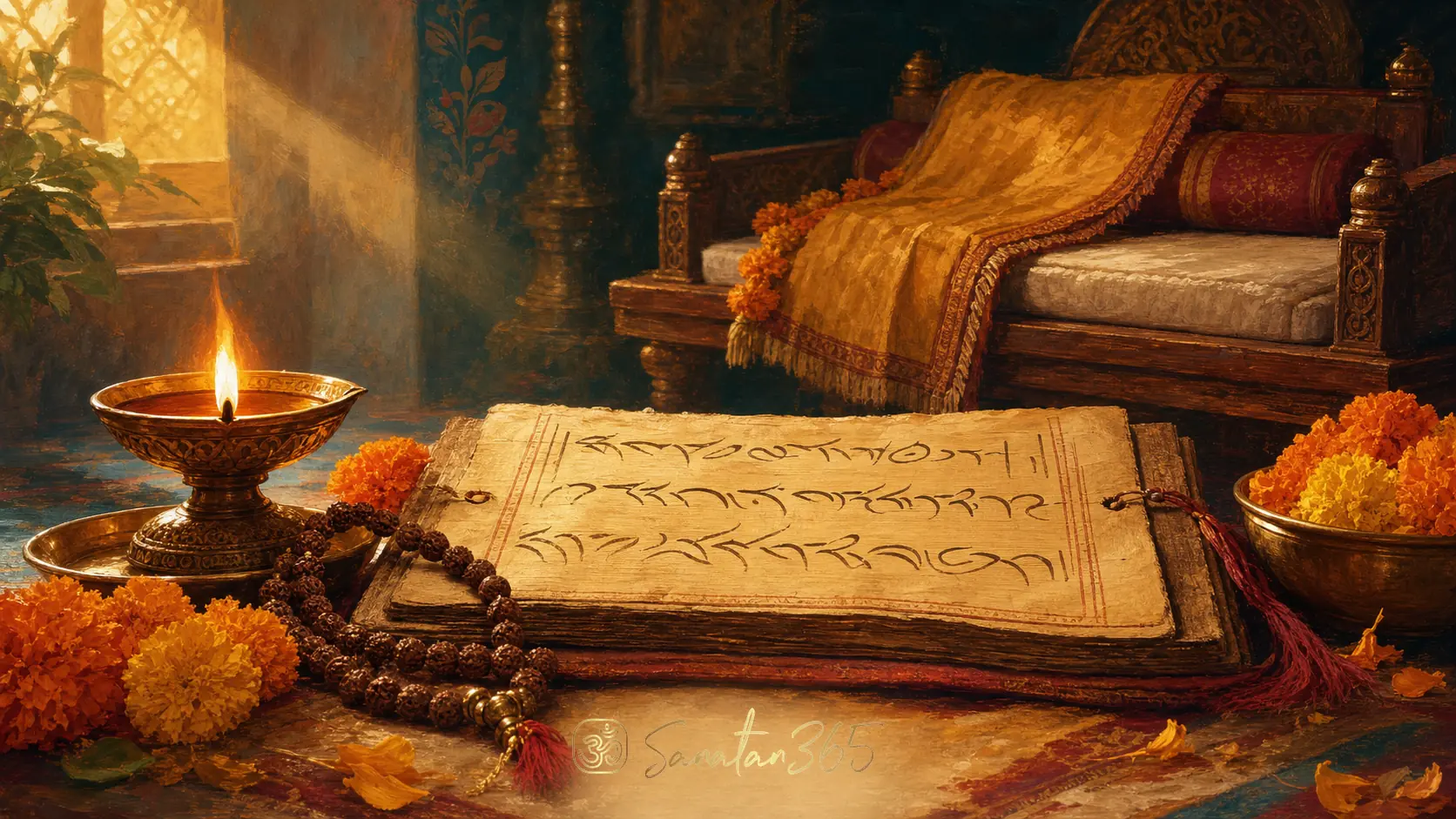
Gurur Brahma Gurur Vishnuh Gurur Devo Maheshvarah Guruh Sakshat Param Brahma Tasmai Shri Gurave Namah
A careful meaning is:
The guru is Brahma, the guru is Vishnu, the guru is Maheshwara. The guru is directly the Supreme Brahman. To that revered guru, I bow.
This is why the Guru Brahma Guru Vishnu mantra meaning should not be reduced to flattery of a human personality. In Hindu thought, Brahma is associated with creation, Vishnu with preservation, and Maheshwara, a name of Shiva, with transformation and dissolution. The mantra sees the true guru as one who creates understanding, preserves dharma in the student, and dissolves ignorance.
The final line, tasmai shri gurave namah (तस्मै श्री गुरवे नमः), means "salutations to that revered guru." It is an offering of humility. The student is not worshipping ego; the student is bowing to the light of knowledge that flows through the teacher.
Key takeaway: The mantra honors the guru as a sacred channel of knowledge, not as a personality cult.
Why Does the Mantra Name Brahma, Vishnu, and Maheshwara?
The Trimurti language gives the mantra its philosophical depth. Brahma creates. Vishnu sustains. Maheshwara transforms. A real teacher performs all three movements inside the student.
First, the guru creates a new way of seeing. A child who learns the alphabet does not merely gain letters; a doorway to language opens. A seeker who learns a mantra does not merely gain sound; a doorway to attention opens. This is the Brahma function.
Second, the guru preserves what is true. Sanatan Dharma is not learned in one burst of inspiration. It is protected through repetition, correction, practice, and remembrance. When a teacher patiently brings the student back to discipline, the Vishnu function is active.
Third, the guru removes what blocks wisdom. Pride, confusion, careless speech, and mechanical practice must be seen clearly. This is not always comfortable. Yet this transforming power is close to Maheshwara: what is false must fall away so that what is real can stand.
This is why the mantra can feel intimate and cosmic at once. It begins with the human teacher in front of us, then opens into the Divine order behind teaching itself.
Key takeaway: Brahma, Vishnu, and Maheshwara describe three movements of true guidance: creation, preservation, and transformation.
How Is Guru Different From Teacher or Expert?
In modern English, "guru" is often used for any skilled person. In the Hindu sense, guru is deeper. A guru is one who removes darkness, especially the darkness of avidya (अविद्या, ignorance or wrong knowing). The point is not information alone. The point is right seeing.
An academic teacher may teach mathematics, grammar, music, or scripture. A parent may teach patience. A grandparent may teach reverence. A spiritual guide may teach mantra, meditation, Vedanta, bhakti, or seva. The guru-principle can shine through many forms when the teaching leads the student toward truth.
The Taittiriya Upanishad gives a famous ethical instruction: "May the mother be to thee a God. May the father be to thee a God. May the Guru be to thee a God. May the guest be to thee a God" in one English rendering of 1.11.2 (gita.pub). The verse places the teacher within a sacred pattern of gratitude and responsibility.
That reverence also has boundaries. Hindu tradition honors discernment. A teacher should guide toward dharma, humility, truthfulness, compassion, and self-mastery. If someone demands blind obedience, encourages harm, or uses spiritual language for ego, wealth, or control, that is not the spirit of this mantra.
Key takeaway: Guru means a remover of darkness, and reverence for the guru must remain joined to dharma and discernment.
When Is This Mantra Recited?
The Guru Brahma Guru Vishnu mantra is often recited in settings where learning is about to begin. Families may chant it before study. Students may offer it before music, dance, Sanskrit, or scripture lessons. Devotees may recite it before satsang, guru puja, or meditation. It is also natural during Guru Purnima, the full-moon observance dedicated to honoring teachers and spiritual lineages.
In 2026, Guru Purnima falls on Wednesday, July 29, with the July Purnima tithi running from the evening of July 28 to the evening of July 29 in commonly published panchang references (Prokerala). Local observance may vary by region, sampradaya (सम्प्रदाय, lineage or tradition), and family panchang, so devotees usually follow their local temple or family calendar.
Some recite the mantra once. Some chant it 3, 11, 21, or 108 times. Number matters less than bhava (भाव, devotional feeling). A distracted 108 repetitions may teach less than one clear, grateful recitation.
A simple home rhythm can be:
- Sit steadily and light a diya if appropriate.
- Remember parents, teachers, acharyas, and sincere guides.
- Recite the mantra slowly, with attention to each word.
- Offer one concrete act of gratitude: study well, serve well, forgive a correction, or practice what was taught.
Readers who use Sanatan365's Daily Mantras can treat this as a daily reminder that mantra is not only sound; it is training in attention, humility, and remembrance.
Key takeaway: The best time to chant the guru mantra is before learning, before practice, or whenever gratitude needs to become action.
What Does the Mantra Teach for Daily Life?
The mantra teaches that learning is sacred only when it changes conduct. To bow to the guru while ignoring the teaching is incomplete. The real offering is to live more truthfully.
For students, the mantra can soften anxiety. It reminds them that learning is not a competition for ego. It is a disciplined movement from not-knowing toward clearer knowing.
For parents, it can restore respect for the many teachers around a child: school teachers, music teachers, language teachers, grandparents, temple elders, and patient mentors. The mantra widens gratitude.
For spiritual seekers, it prevents two extremes. One extreme is arrogance: "I need no guidance." The other is dependency: "The teacher must live my life for me." The middle path is shraddha (श्रद्धा, reverent trust) joined with sincere practice.
This is also why the mantra belongs beside other learning-oriented practices, such as Vishnu Sahasranama Meaning: Why the Thousand Names Steady Devotion, the meaning of Om Namah Shivaya in Shiva devotion, and Daily Mantra Chanting: A Practical Guide to Japa with Sage Narada Muni. Each practice trains the mind differently, but all ask the seeker to become more steady, truthful, and awake.
Key takeaway: The guru mantra turns gratitude into discipline: learn sincerely, practice steadily, and let correction refine the ego.
Why Is the Guru Mantra Especially Relevant Before Guru Purnima 2026?
Guru Purnima arrives in Ashadha, a season that traditionally invites reflection, study, and renewed discipline. By late July, many parts of India are entering the monsoon rhythm. Travel slows, skies deepen, and the mind naturally turns toward inner work. The guru mantra fits this mood because it is not only a festival chant; it is a preparation for receiving instruction.
In many Hindu lineages, Guru Purnima is also called Vyasa Purnima, honoring Veda Vyasa, the great sage associated with the Mahabharata, the Puranic tradition, and the organization of Vedic knowledge. Whether a family emphasizes Vyasa, a living guru, a sampradaya acharya, parents, school teachers, or all sincere guides, the emotional center is the same: gratitude for knowledge received.
For diaspora families, this can be especially meaningful. A child may learn Sanskrit pronunciation in one place, Bharatanatyam or tabla in another, stories from grandparents on video calls, and temple values during weekend satsang. The guru mantra gathers all these streams into one act of reverence. It says that knowledge is not merely consumed. It is received, protected, practiced, and passed forward.
Key takeaway: Before Guru Purnima 2026, this mantra helps families prepare gratitude not as a message, but as a living discipline.
How Should Beginners Recite the Guru Mantra?
Beginners do not need a complicated ritual. The safest starting point is respectful simplicity. Sit cleanly, speak clearly, and understand what is being said.
Here is a beginner-friendly approach:
- Pronunciation: Say Gurur Brahma Gurur Vishnuh with a soft, flowing rhythm. If Sanskrit pronunciation is still developing, chant slowly rather than loudly.
- Meaning: Remember that Brahma, Vishnu, and Maheshwara point to creation, preservation, and transformation of knowledge.
- Intention: Offer the chant to all teachers who have helped remove confusion.
- Practice: After chanting, study or serve for a few minutes. Let the mantra lead into action.
- Humility: Do not use the mantra to declare one teacher superior to all paths. Use it to deepen gratitude.
If chanting with children, explain the meaning in one sentence: "We thank the teacher who helps light up the mind." That is often enough. Over time, more philosophical layers can be added.
For adults, the mantra can become a daily check: Who taught me something today? Did I receive correction gracefully? Did I pass on knowledge with kindness? Did I protect the dignity of the person learning from me?
Key takeaway: Recite slowly, understand the meaning, and follow the chant with one act of learning or gratitude.
FAQ
What is the Guru Brahma Guru Vishnu mantra meaning in one sentence?
It means the true guru is honored as the sacred force that creates knowledge, preserves wisdom, removes ignorance, and reveals the Supreme Reality.
Is the guru mantra only for Guru Purnima?
No. Guru Purnima is a powerful occasion for it, but the mantra can be recited before study, satsang, meditation, music practice, scripture reading, or any sincere learning.
Does the mantra mean every teacher is literally God?
The mantra points to the Divine principle of knowledge shining through the true guru. It should be understood with reverence and discernment, not as blind surrender to any personality.
Can children chant Guru Brahma Guru Vishnu?
Yes. Children can chant it respectfully, especially before study or lessons. A simple meaning is enough at first: we bow to the teacher who removes darkness and gives knowledge.
What is the best count for reciting the guru mantra?
There is no single required count for everyone. One attentive recitation is meaningful; some devotees choose 3, 11, 21, or 108 repetitions according to family or lineage practice.
The Guru Brahma Guru Vishnu mantra is short, but it asks for a lifetime of maturity. It teaches that knowledge is sacred, teachers are to be honored, and real learning should make the student less proud and more awake.
Key takeaway: To bow to the guru is to honor the light of wisdom, then live in a way that proves the lesson was received.
About the author
Sanatan365 Editorial
Bringing Sanatan Dharma to modern seekers through authentic, scripture-grounded content.
Related in Mantras
 Mantras
Medha Suktam Meaning: A Vedic Prayer for Understanding
Explore the meaning of Medha Suktam, its prayer for clear understanding and memory, and ways to approach this Vedic hymn respectfully.
 Mantras
Bhaja Govindam Meaning: Devotion, Wisdom, and the Limits of Learning
Explore the meaning of Bhaja Govindam, its call to Govinda, and its reflection on learning, impermanence, and wise living.
 Mantras
Kanakadhara Stotram Meaning: Lakshmi, Compassion, and Prosperity
Kanakadhara Stotram praises Lakshmi through the image of her compassionate glance. Explore its Sanskrit meaning, traditional story, and res…