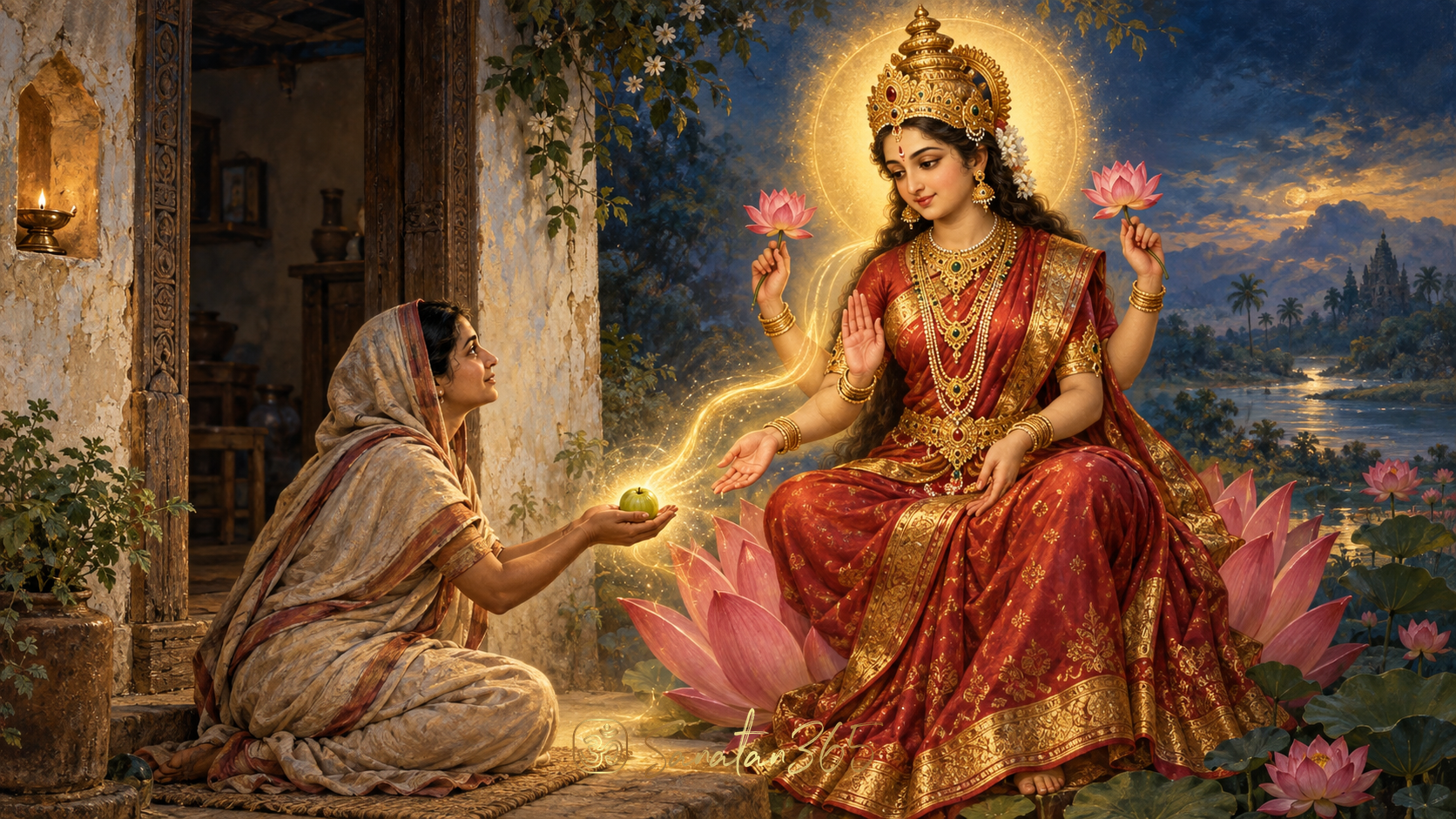
Kanakadhara Stotram Meaning: Lakshmi, Compassion, and Prosperity
Kanakadhara Stotram praises Lakshmi through the image of her compassionate glance. Explore its Sanskrit meaning, traditional story, and respectful recitation without promises of wealth.
A single fruit, given by someone who had almost nothing, stands at the heart of one of the most beloved stories told about a hymn to Lakshmi. The fruit matters less as an object than as a choice: generosity was possible even in scarcity.
Kanakadhara Stotram meaning, in brief: kanaka (कनक) means gold, dhārā (धारा) a stream, and stotram (स्तोत्रम्) a hymn of praise. The Sanskrit hymn addresses Goddess Lakshmi through richly patterned images of her compassionate glance, beauty, and abundance. Tradition associates it with Adi Shankaracharya and a poor woman's gift of an āmalaka (आमलक), or Indian gooseberry. The story can illuminate the hymn's ethical force, but neither story nor verse guarantees money to anyone who recites it. Read the Sanskrit and translation.
What Is Kanakadhara Stotram and What Does Its Name Mean?
A stotra is praise offered in metrical verse. Kanakadhara Stotram is a Sanskrit praise hymn addressed to Lakshmi, widely revered as the goddess of auspiciousness and prosperity. Its title is often translated “stream of gold.” That phrase is vivid, but taking it only as a promise of coins reduces the poem to a bargain it does not need to be. The verses repeatedly turn toward Lakshmi's sight, grace, and the possibility that someone vulnerable may receive care. The Sanskrit text with an English rendering makes the recurring appeal to her glance apparent.
Śrī (श्री), often used as a name for Lakshmi, can carry senses of radiance, beauty, auspiciousness, and flourishing. Prosperity in devotional life therefore need not be narrowed to a bank balance. Food, shelter, trustworthy relationships, honest work, and the ability to give also belong to a meaningful account of well-being. The hymn's language is devotional poetry, not a financial forecast. It can be heard as a prayer that hardship be met with compassion and that abundance be held responsibly.
Traditional recensions differ in verse count and sometimes in wording. Readers should follow a trusted edition or teacher instead of assuming every online text is identical. The hymn is commonly attributed to Adi Shankaracharya in devotional transmission; the details of its origin story belong to tradition, not to independently documented biography. This distinction protects both historical honesty and the devotional value of the account. Compare a full text and translation before memorising a version.
Key takeaway: The “stream of gold” is the title's image; the hymn's living center is an appeal to Lakshmi's gracious attention.
What Does the Hymn Say About Lakshmi’s Compassionate Glance?
Again and again, the poet asks that Lakshmi's kaṭākṣa (कटाक्ष), a sidelong or gracious glance, fall upon a person in need. In Indian devotional poetry, the glance is not a surveillance device or a mechanical power. It is a way to imagine being seen with kindness. The hymn's opening verses place her beside Hari, a name of Vishnu, and describe her eyes through dark-lotus imagery. Later verses speak more plainly of distress and ask for mercy. The movement from ornament to need gives the poem emotional depth. See the verse-by-verse translation.
The eighth verse in one common numbering is especially revealing. Its images include a helpless young bird and the heat of suffering; it asks that Lakshmi's compassionate rain relieve one who is destitute. Translations vary, so it is wiser to understand the cluster of images than to claim that a single English paraphrase captures every nuance. The image places a vulnerable life before a goddess associated with plenty. For a reader, that can turn the attention outward: whose need is visible today, and who is being overlooked?
This is also why the hymn is more than praise of luxury. A generous glance should not end with the reciter. If devotional abundance is received as a gift, it carries a duty to notice hunger, precarity, and loneliness nearby. This is an ethical reading of the poem, not a claim that every verse explicitly teaches modern social policy. The distinction matters. One can read the verses with reverence while acknowledging that a contemporary application is a choice made by the reader.
The imagery of flowers, eyes, rain, and light rewards slow reading. A distinct devotional form, Om Jai Lakshmi Mata Aarti, offers a useful comparison in how praise joins grace with gratitude. Recitation can become merely rapid sound if its images never have time to register. A beginner might pause after one verse, read a reliable translation, and ask which image is being offered to Lakshmi and which need is being expressed. Even without expertise in Sanskrit grammar, that patient attention can make the act of praise more intentional.
Key takeaway: Lakshmi's glance is a poetic expression of grace and recognition, and it invites the reciter to practice recognition too.
How Should the Story of the Amla Fruit Be Understood?
A traditional account says that a young Shankara, seeking alms, came to a household with almost nothing to spare. A woman offered the only āmalaka fruit she had. Moved by the gift, he praised Lakshmi in the hymn; the goddess then showered the home with golden fruit. Versions differ in detail. The account is widely repeated as a devotional origin story, but should not be presented as a verified incident with a securely documented date or location. Its historical status and its moral power are separate questions.
The woman's action is easily lost when the story is retold as a technique for obtaining wealth. She is not a prop in a miracle narrative. She sees a person at her door and shares from scarcity. That is a demanding picture of hospitality. It does not imply that people in poverty owe others their last food, or that hardship can be solved by giving until one is harmed. Compassion includes regard for one's own basic needs. The tale's point is generosity of spirit, not a universal instruction to surrender essentials.
The golden fruit is a narrative image of grace. Devotional stories often use memorable abundance to express that a seemingly small act is not small in moral significance. Treating the image as an investment formula—offer one object, receive a certain sum—changes its meaning. People who pray and remain poor have not failed. Neither their devotion nor Lakshmi's dignity should be measured by the speed of a financial result.
There is a quieter question beneath the spectacle: what can a community do when it sees a person forced to choose between hospitality and hunger? The story can prompt direct, practical generosity: share a meal, pay fairly, help someone find support, or make space for a neighbour's dignity. Such actions do not depend on claiming a supernatural guarantee. They let the compassion that the tale admires become concrete.
Key takeaway: Read the amla-fruit tale as a devotional story about generosity and grace, not as a historically verified wealth formula.
Does Kanakadhara Stotram Promise Material Wealth?
No responsible reader can promise that reciting a hymn will cause money to appear. The text is prayer and praise, not a contract. Many devotees recite Kanakadhara Stotram when facing financial difficulty, and the longing behind that prayer deserves respect. A family worried about rent does not need to be told that material needs are unspiritual. Food and security matter. Yet respect also requires honesty: devotional practice should not replace budgeting, fair work, community help, or qualified financial advice when those are needed.
The distinction between a hope and a guarantee is simple but crucial. A person may hope for Lakshmi's grace while working to change difficult circumstances. They may also experience a change in patience, gratitude, or generosity even if external conditions move slowly. None of these inner possibilities should be sold as certain outcomes. Nor should hardship be blamed on a supposed lack of faith, pronunciation, or ritual purity. Such claims can wound the people most in need of care.
Lakshmi is not merely a symbol of cash. Readers seeking a broader iconographic context can explore Lakshmi’s lotus, owl, and coin symbolism. Across Hindu traditions, her association with auspicious flourishing invites questions about what sustains a household and what makes prosperity worthy of its name. Wealth gained through exploitation is not made ethical by placing a prayer beside it. Conversely, honest effort and modest means are not signs of divine rejection. The hymn's tenderness toward a destitute person is a reason to resist both judgments.
Some online descriptions advertise precise chanting counts and fixed return periods. Those instructions may reflect a particular devotional lineage, but they should be named as lineage-specific practices when they are presented at all. The hymn itself should not be recast as a timed financial product. A seeker may follow a family or teacher's customary rhythm without imposing it on everyone else.
Key takeaway: The hymn can hold a sincere prayer for relief, but it does not guarantee a material result or assign blame for poverty.
How Can a Beginner Recite Kanakadhara Stotram Respectfully?
Begin with a reliable Sanskrit text and an English or regional-language translation. Listen to a careful rendering if pronunciation is unfamiliar. A pāṭha (पाठ) is a recitation; its value lies not only in speed or quantity but also in attention. It is acceptable to read slowly rather than claim a memorised fluency one does not yet have. If a family, temple, or teacher maintains a particular melody or sequence, learn that context with humility.
A simple approach can remain simple:
- Choose a quiet time and a clean, comfortable place. No expensive object is required to read a hymn with sincerity.
- Read the title and the first verse's translation before sounding the Sanskrit. Notice the appeal to Lakshmi's gracious attention.
- Recite only as much as can be followed attentively. One verse understood is better than many rushed without care.
- End with a moment of gratitude and one practical act consistent with the hymn's compassionate spirit.
A lamp, flower, or image may be meaningful in a household practice, but traditions vary and these are not universal prerequisites. If making an offering, avoid waste and respect local custom. A person unable to maintain a long daily practice can still return to the hymn without shame. Devotion is not a contest of resources, accent, or stamina.
A useful reflection after recitation is: “What would it mean to see someone with the compassionate glance I have asked for?” That question can lead to a small and specific act rather than an abstract mood. It may be checking on an elder, sharing food responsibly, paying a worker on time, or asking for help when one is the person in need. The hymn can make room for both receiving and giving.
Key takeaway: Read slowly, use a trustworthy text, honour variation in practice, and let the prayer shape an act of care.
FAQ
What does Kanakadhara Stotram mean in English?
The title is commonly rendered “hymn of the stream of gold”: kanaka means gold, dhārā stream, and stotram hymn of praise. The verses themselves praise Lakshmi and appeal to her compassionate glance; a title translation is not a promise of a cash reward. See the Sanskrit text.
Who composed Kanakadhara Stotram?
Devotional tradition attributes it to Adi Shankaracharya. The celebrated story of a poor woman's amla-fruit gift belongs to that tradition. Its precise historical details should not be asserted as independently verified fact.
Is it necessary to recite the entire hymn every day?
No single schedule is universal. Some families and teachers have customary ways of reciting it. A beginner can start with a verse and its meaning, then grow into a fuller recitation without treating a count as a guaranteed outcome.
Can someone pray for financial relief through this hymn?
Yes. Material hardship is real, and a sincere prayer for relief is understandable. The hymn should not be sold as a guaranteed financial remedy or used instead of practical support and appropriate professional advice.
Is the “golden gooseberry” story a historical fact?
It is best described as a traditional devotional account. Its ethical image of generosity is meaningful even when its precise events cannot be independently established.
Kanakadhara Stotram holds a striking contrast: a gift small enough to fit in a hand and a vision of grace vast enough to be called a stream. Its most durable invitation may be to pray honestly, see need clearly, and let whatever one has become a reason for compassionate action. Key takeaway: Lakshmi's abundance is honoured most responsibly when devotion, truthfulness, and generosity remain together.
About the author
Sanatan365 Editorial
Bringing Sanatan Dharma to modern seekers through authentic, scripture-grounded content.
Related in Mantras
 Mantras
Om Namo Narayanaya Meaning: Surrender, Reverence, and the Eight-Syllable Mantra
Om Namo Narayanaya is the Ashtakshara, or eight-syllable mantra, of the Vaishnava tradition. It expresses reverent surrender to Narayana, t…
 Mantras
Sarve Bhavantu Sukhinah Meaning: A Prayer for Universal Well-Being
Sarve Bhavantu Sukhinah asks that all beings be happy, healthy, secure in what is good, and free from suffering. Explore its line-by-line m…
 Mantras
Ya Devi Sarva Bhuteshu Meaning: Seeing the Divine Mother in All Beings
Ya Devi Sarva Bhuteshu is a repeated salutation from the Devi Mahatmya that honours the Divine Mother as consciousness, wisdom, compassion,…

