The Heron and the Crab Story: When a Rescue Claim Needs Proof
In this Panchatantra tale, a heron promises to carry fish to safety. A crab discovers what the promise concealed by watching where the bird actually flies.
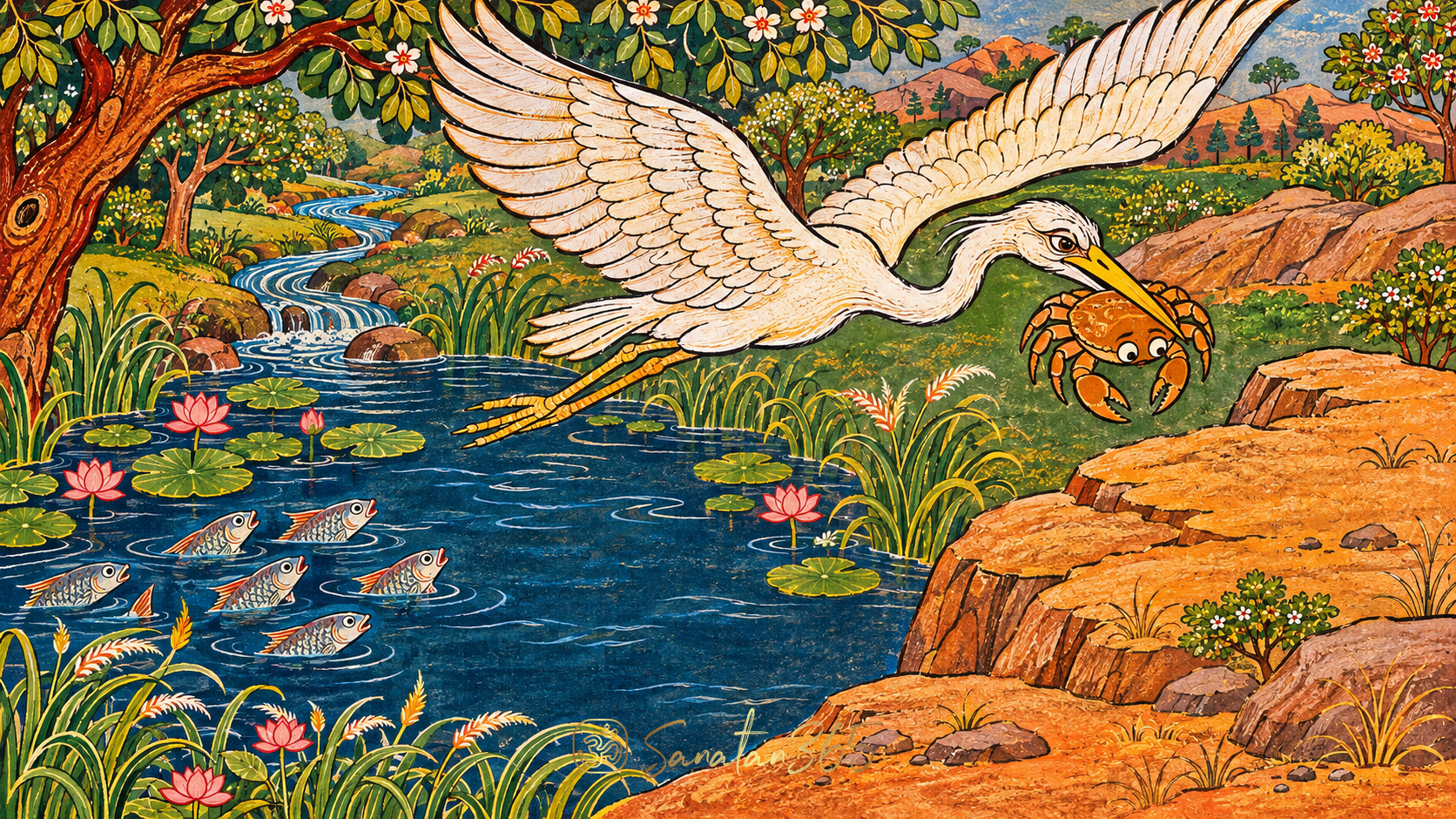
The crab has been promised another pond. Once in the air, he sees the heron fly past water towards a dry rock.
In the heron and the crab story, an old bird frightens the fish with news of approaching fishermen and offers to carry them away. A crab accepts the offer, then notices that the bird is flying somewhere other than the promised refuge. The tale comes from the Pañcatantra (पञ्चतन्त्र, Five Treatises), an Indian collection of stories in which animals often reason and speak. Its lesson begins with a simple comparison between a promise and what actually happens.
What happens in the heron and the crab story?
Arthur W. Ryder's 1925 English translation places the tale in Book I under the title The Heron that Liked Crab-Meat. In that telling, the heron grows old and looks for an easier way to catch fish. He stays beside the pond and deliberately leaves nearby fish alone. The unusual sight draws the crab's attention. The crab approaches and asks why the bird has stopped eating as usual.
The heron says he overheard fishermen planning to cast their net in this pond after visiting a lake near the city. He presents the news as bad for himself as well as for the fish. If the fishermen take the fish, he says, his own source of food will be gone. He explains his apparent sadness as concern about a danger that they share.
The inhabitants ask him to save them. He says he cannot fight the fishermen, but he can carry the inhabitants to another pond. The fish ask to be taken first. Over successive trips he lifts fish in his bill, carries them to a slab of rock and eats them there. Each return gives him another chance to keep the remaining fish confident in him.
The crab eventually asks for a turn. The heron, who is tired of eating only fish, agrees and carries him into the air. The promised destination is a pond. What the crab sees is a flight that avoids bodies of water and approaches a dry rock. When he questions the route, the heron reveals his intention. The crab sees the remains of fish below and realises what has happened.
In Ryder's telling, the crab defends himself, the heron dies and the crab makes his way back to tell the pond's inhabitants what happened. A family retelling can state that outcome simply. The point at which the rescue claim falls apart comes earlier, when the crab compares the destination he was promised with the destination he can see.
Key takeaway: The heron keeps repeating the promise, but the route reveals where his passengers are actually being taken.
Why do the fish believe the heron?
The fish hear the warning from someone who appears to have information they lack. The heron says he heard the fishermen himself. He supplies a time and a detail about their earlier destination. Those details make the report sound concrete. In the tale, however, the fish have only his account of the conversation. The precision of the report is part of how it persuades them.
The bird's behaviour makes the account seem more plausible. A heron that suddenly leaves fish alone can look as though something has disturbed him. The narrator gives the reader a different vantage point. The bird is staging his concern. A child who already knows his plan can notice the gap between the appearance he has made and the reason he gives for it.
There is also a social change in the conversation. The fish address the heron as a relative and friend and ask for help. Those names express their hope that he will act for their benefit. They do not show that he has become trustworthy. The blue jackal story offers a related question about how an appearance comes to stand in for evidence. In the pond, the persuasive appearance is a familiar predator apparently sharing the alarm of his neighbours.
The birds and fish are fable characters, and the narrator has arranged the danger and the offer to come from one voice. That structure gives readers a way to discuss why sensible questions are hardest to ask when everyone feels hurried. The tale makes room for compassion for the fish. Their wish to survive is understandable, and the heron is deliberately exploiting it.
Key takeaway: The heron makes the warning sound specific and his concern look sincere. The fish have yet to see what he does with the trust they give him.
What changes when the crab looks down?
The crab begins in much the same position as the fish. He hears the warning and asks to be carried away. His position changes once he can observe the flight. At first, he notices where the bird is going. A route past water towards rock does not fit the destination the heron described. He asks the heron about the missing pond.
The question matters because it comes before the explanation. The crab has noticed a mismatch even before the bird admits what he is doing. When the heron answers and the crab sees the remains below, there is more evidence than a puzzling detour. The truth of the earlier trips comes into view. A careful reading keeps those stages in order. First there is a reason to ask a question, then there is a reason to change what one believes.
In a picture or retelling, the moment can be conveyed with a change of viewpoint. From the pond, the fish can see the bird leave and return. From above, the crab can see the water it passes and the rock ahead. The new view supplies information the same confident story had hidden. The crab's achievement is to attend to that information when the promise is still fresh in his mind.
The Panchatantra tale of the three fishes also concerns a report of danger at a body of water. That tale examines different responses to a threat. This one asks what happens when the person reporting the danger also controls the proposed escape. Reading the two together lets families ask different questions about urgency, evidence and choice.
Key takeaway: The crab has a reason to ask as soon as the route stops fitting the claim. What he sees next confirms why the question mattered.
What is the moral of the heron and the crab?
A useful moral is that trust can grow through actions that fit a promise. When the actions and the promise diverge, it is reasonable to pause and ask what can be checked. The crab does not discover the heron's plan by becoming suspicious of every animal. He discovers it by noticing something particular about this flight.
The story also helps distinguish an unexplained change from proof of deception. A real guide may take a detour for a sound reason. A question about the destination gives that guide a chance to explain. In this fable, the answer and the rock confirm the deception. In ordinary life, a reader would need to judge the explanation and the evidence available in that case.
Another lesson concerns the structure of the offer. The heron brings the frightening report, proposes the solution and carries each passenger away without a companion. A listener might ask how the pond can learn whether the first arrival reached safety. That question is an invitation to think with the tale. It does not suggest that the fish deserved their fate for having trusted someone.
The Panchatantra story of four friends gives a counterpoint. In that story, the friends' actions can be seen working together during rescue. In the heron tale, each traveller is removed from the others' view. The comparison gives a family two concrete pictures to discuss when considering what help looks like in practice.
Key takeaway: Pay attention to whether a promised action is doing what it was meant to do, especially when urgency makes a second look difficult.
How can families read the tale together?
A parent or teacher can tell the story up to the moment when the heron lifts the crab. Ask listeners what they expect to see at the other end of the trip. Many will say water, another pond or the fish that have already arrived. Invite them to explain which part of the heron's promise led to that expectation. Then describe the flight past water and ask what question they would put to the bird.
For a second reading, draw a pond on one side of a page and a rock shelf on the other. Mark one route that would fit the promise and one route that would prompt a question. A simple map lets younger readers notice the change without needing the grim details of the ending. Older readers can consider which part of the evidence suggested a problem and which part confirmed it.
A conversation can also return to the first scene. The heron did something unusual by refusing easy prey. What did the crab see? What did the heron say it meant? Those answers can be different. Children can practise telling the observation and the explanation apart using the story's own details. That distinction is easier to learn when it is attached to a memorable scene.
The fable can end with the crab returning to share what he learned. That final act matters because the other animals could not see the journey. He brings back information that changes what they understand. The story thus gives attention both to looking carefully and to telling others what was actually seen.
A final reading can compare the crab at the start and at the end. In both scenes he asks a question. His first question invites the heron to explain his behaviour. His later question tests that explanation against a visible route. The difference helps children see that a question can seek a story, or it can ask whether a story fits what they are seeing. Neither requires an accusation. Both can be asked plainly.
Key takeaway: Let the promise set an expectation, then let the route give listeners a reason to ask what is happening.
FAQ
Is this also called the crane and the crab story?
That wording appears in English retellings. Ryder calls the bird a heron in the version followed here, and his title is The Heron that Liked Crab-Meat.
What warning does the heron give in Ryder's version?
He claims to have overheard fishermen planning to cast their net in the pond. The warning and the rescue offer come from the same bird.
How does the crab discover the truth?
He sees the heron avoid bodies of water and approach a dry rock. When he questions the route, the bird reveals his purpose. The crab sees evidence of the earlier trips below.
What is the main lesson for children?
Listen to a promise and notice what happens next. If the action and the promise do not fit, asking a clear question can help reveal what is going on.
About the author
Sanatan365 Editorial
Bringing Sanatan Dharma to modern seekers through authentic, scripture-grounded content.

