Hindu Numerology Meaning: How Sacred Numbers Shape Practice and Reflection
A careful guide to Hindu numerology, sacred number symbolism, and how numbers like 3, 9, and 108 support reflection without becoming fatalistic.
Numbers in Hindu practice are rarely just arithmetic; they often become a way to remember rhythm, restraint, and sacred order.
Hindu numerology meaning refers to the reflective use of numbers, dates, names, and symbolic patterns within Sanatan traditions. It should not be treated as a guarantee of fate. At its best, Hindu numerology helps a seeker notice tendencies, make disciplined choices, and see how numbers like 3, 9, and 108 carry spiritual memory in ritual, mantra, astrology-adjacent practice, and daily reflection.
What is Hindu numerology meaning in simple terms?
Hindu numerology meaning begins with the idea that number can be symbolic, not merely statistical. In many Indian traditions, anka shastra (अंक शास्त्र, the study or discipline of numbers) looks at numbers associated with birth dates, names, and cycles of time. The word anka means number or mark, while shastra means a disciplined body of knowledge.
This does not mean every event is mechanically controlled by a number. Sanatan Dharma has always held a larger vision of life: karma (कर्म, action and its consequences), dharma (धर्म, right order or duty), grace, effort, and self-knowledge all matter. Numerology is one interpretive lens, not the whole sky.
A careful way to understand it is this:
- Numbers can become mirrors for reflection.
- Repeated ritual counts can create discipline.
- Sacred numbers can preserve cultural memory.
- Date and name analysis can invite self-inquiry.
- No number removes personal responsibility.
This distinction is important because popular numerology often becomes sensational. A balanced Hindu view is more sober: numbers may suggest patterns, but they do not replace wisdom, prayer, ethical action, or professional counsel where needed.
Classical Hindu life already uses structured counts everywhere: lunar days in the panchanga (पञ्चाङ्ग, Hindu calendar almanac), mantra repetitions, vrata observances, temple circumambulation, and festival timing. Britannica’s overview of Hindu worship notes how mantra, offering, and ritual action form part of devotional practice, and these practices often use repeated forms and counts in lived tradition (Britannica).
Key takeaway: Hindu numerology is strongest when used as reflective symbolism, not as fatalistic prediction.
Why are sacred numbers important in Hindu practice?
Sacred numbers are important because they help the body remember what the mind may forget. A person can read about devotion once and forget it by evening. But if that person turns a mala bead 108 times each morning, the teaching becomes embodied.
The number does several things at once:
- It gives a practice a clear beginning and end.
- It keeps attention from becoming vague.
- It creates repetition without constant decision-making.
- It connects the seeker to a wider inherited pattern.
- It turns abstract intention into countable discipline.
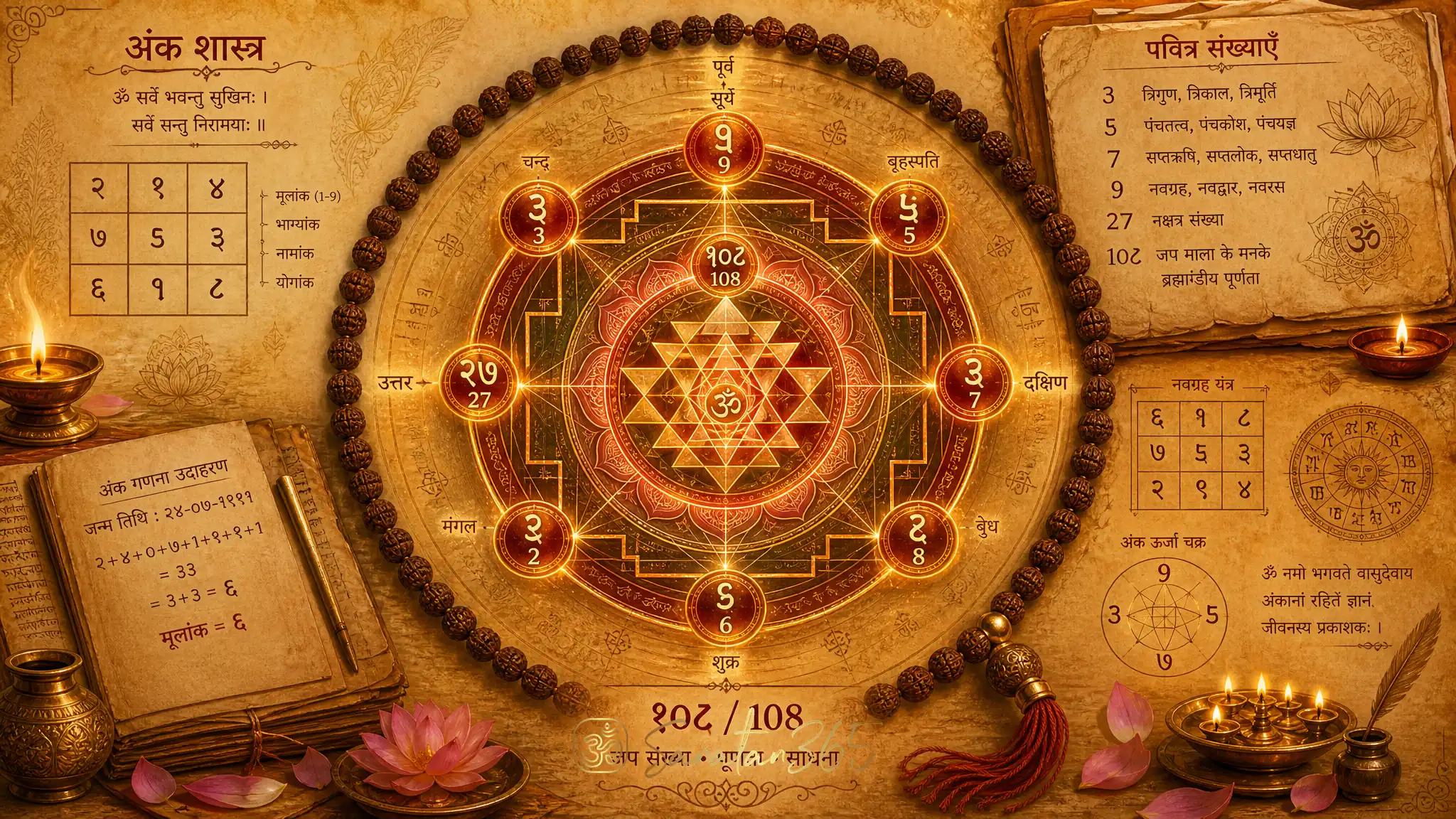
This is why japa (जप, repeated mantra recitation) often uses a mala (माला, prayer garland) of 108 beads. The Hindu American Foundation notes that 108 carries broad sacred significance across Hindu practice and is widely associated with mantra repetition, yoga, and spiritual completeness (HAF).
The number 108 is not the only meaningful number. Hindu practice also gives recurring importance to 3, 5, 7, 9, 11, 12, 27, and 1008 depending on context. For example, three can evoke the trimurti (त्रिमूर्ति, three divine functions of creation, preservation, and dissolution), three gunas, or three daily sandhya periods. Nine appears in Navaratri, nine forms of Devi in many devotional traditions, and the nine planets of navagraha (नवग्रह, nine planetary forces) in Jyotisha-related practice.
This does not mean one should flatten all traditions into one code. The same number can carry different meanings in different regions, sampradayas, temples, families, and ritual contexts. South Indian temple practice, Bengal’s Shakti traditions, North Indian vrata customs, and diaspora household practice may all use numbers with slightly different emphasis.
Key takeaway: Sacred numbers work as memory devices, rhythm-makers, and devotional containers across Hindu life.
How does Hindu numerology differ from astrology and Kundali?
Hindu numerology is related to time and symbolism, but it is not identical to astrology or Kundali. This difference matters.
Jyotisha (ज्योतिष, the traditional Hindu science of light and celestial timing) studies planetary positions, lunar mansions, houses, dashas, and timing. A Kundali or Janam Kundali (जन्म कुण्डली, birth chart) maps the sky at the time and place of birth. Numerology, by contrast, usually works with numbers derived from dates, names, or repeated symbolic counts.
A simple distinction:
- Numerology asks: what reflective pattern appears through number?
- Kundali asks: what celestial pattern appears through birth time and place?
- Panchanga asks: what quality does a date or ritual time carry?
- Mantra practice asks: how can repetition purify attention?
These streams can overlap, especially in popular practice, but they should not be confused. A numerology reading based on a birth date is not the same as a full Kundali analysis. A mantra count of 108 is not the same as a predictive horoscope. A festival tithi is not a personal destiny number.
Sanatan365 reflects this distinction through separate spiritual tools: Numerology Reports by Aryabhata are different from Kundali Reports by Jaimini Rishi and Astrology Reports by Varahamihira. Used responsibly, these report formats can become prompts for self-reflection rather than shortcuts around discernment.
This careful separation also protects the seeker from overclaiming. When numbers are treated as one lens among many, they can be useful. When numbers are treated as absolute commands, they can create anxiety.
Key takeaway: Numerology, astrology, Kundali, panchanga, and mantra counts may touch the same symbolic world, but each has its own method and limits.
Which numbers appear often in Sanatan practice?
Several numbers recur so often that even beginners notice them. Their meanings are not always fixed, but their devotional presence is worth understanding.
3: balance, triads, and complete movement
Three appears in the trimurti, the three gunas of sattva, rajas, and tamas, and the threefold rhythm of thought, word, and action. In daily life, it can remind a seeker to align intention, speech, and behavior.
5: elements and embodied life
Five often evokes the pancha mahabhuta (पञ्च महाभूत, five great elements): earth, water, fire, air, and space. It can also appear in five offerings, five lamps, or fivefold ritual patterns. The number helps connect spirituality to the body and the natural world.
7: layers, rivers, and ascent
Seven appears in many cultural and scriptural patterns: seven steps in marriage ritual in many Hindu weddings, seven sacred rivers in traditional lists, and seven levels or worlds in some cosmological accounts. Its mood is often one of progression.
9: completion before renewal
Nine appears in Navaratri, nine forms of Devi in popular worship, and navagraha practice. Because nine is the last single digit, it often carries a feeling of fullness before a new cycle begins.
27: lunar mansions and time rhythm
Twenty-seven is associated with the nakshatras, the lunar mansions used in Jyotisha and panchanga traditions. This number points less to private personality and more to time as a sacred rhythm.
108: mantra, wholeness, and disciplined repetition
One hundred and eight is one of the most recognized sacred numbers in Hindu practice. It appears in malas, deity names, temple traditions, and mantra discipline. The exact explanations vary, but the lived result is consistent: 108 gives japa a complete devotional arc.
1008: abundance and ceremonial fullness
One thousand and eight often appears in extended lists of divine names or major ritual observances. It suggests ceremonial expansiveness, not casual daily counting.
Key takeaway: Sacred numbers are best read through context: ritual, region, text, family practice, and spiritual purpose.
How can a modern seeker use Hindu numerology responsibly?
A modern seeker can use Hindu numerology responsibly by treating it as a reflective practice, not as a substitute for decision-making.
Here is a grounded approach:
- Begin with observation. Notice numbers connected to your birth date, repeated life patterns, or chosen practice counts without rushing to conclusions.
- Ask ethical questions. Instead of “What will happen to me?” ask “What quality should I strengthen?”
- Keep a practice count. Try 27, 54, or 108 repetitions of a mantra and observe how discipline changes attention.
- Respect lineage and context. If a family or temple uses a number in a particular way, learn its local meaning.
- Avoid fear-based choices. Do not let a number create panic, shame, or superstition.
- Combine reflection with action. If a number suggests discipline, practice discipline. If it suggests compassion, serve someone.
- Do not outsource your conscience. Dharma remains higher than a lucky or unlucky number.
For example, if someone feels drawn to the number 9, a mature reading would not be “everything important must happen on the 9th.” A better reflection might be: completion, devotion, and renewal are themes worth watching. That person could close unfinished tasks, deepen Navaratri practice, or commit to nine days of simple prayer.
Likewise, if 108 feels meaningful, the best response is not to collect trivia about 108. The best response may be to sit down with a mala and practice one full round of japa with humility.
Key takeaway: Responsible numerology turns number-symbolism into self-awareness, discipline, and dharmic action.
What should Hindu numerology never become?
Hindu numerology should never become a tool of fear. It should not be used to shame a person’s name, reject a child, delay necessary medical care, avoid professional advice, or make harsh judgments about marriage, family, work, or spiritual worth.
Sanatan Dharma’s deeper teaching is not that human beings are trapped by digits. The deeper teaching is that life contains pattern, choice, grace, effort, and awakening. Numbers may help us notice rhythm, but they cannot replace compassion.
Avoid these common mistakes:
- Calling a number “bad” in an absolute way.
- Making guaranteed predictions about wealth, marriage, or health.
- Using numerology to pressure someone into a decision.
- Treating name spelling changes as a replacement for effort.
- Mixing random internet claims with sacred tradition.
- Ignoring regional and family context.
A number may become auspicious when it supports remembrance. It becomes harmful when it creates fear or pride.
The Bhagavad Gita repeatedly emphasizes disciplined action and steadiness of mind rather than passive dependence on signs. In 2.48, Krishna teaches equanimity in action: yoga is steadiness amid success and failure (Gita Supersite). That spirit is a healthy corrective to superstition.
Key takeaway: Numerology should support steadiness and responsibility, never anxiety or fatalism.
FAQ
What is Hindu numerology meaning?
Hindu numerology meaning is the reflective study of numbers, names, dates, and sacred counts within Hindu practice. It is best used as a tool for self-inquiry and discipline, not as a guaranteed prediction system.
Is Hindu numerology the same as Vedic astrology?
No. Hindu numerology usually works with symbolic numbers from dates, names, or practice counts. Vedic astrology or Jyotisha studies planetary positions, lunar mansions, and timing. They may overlap in popular practice, but they are different methods.
Why is 108 important in Hindu practice?
The number 108 is widely used in mantra japa, malas, deity-name lists, and devotional practice. Its explanations vary by tradition, but it commonly represents completeness, disciplined repetition, and sacred rhythm.
Are some numbers always lucky or unlucky in Sanatan Dharma?
A careful Hindu approach avoids absolute fear-based labels. Numbers can be auspicious in certain contexts and neutral in others. Context, intention, practice, and dharma matter more than superstition.
How should beginners start with sacred numbers?
Begin simply. Choose a mantra, repeat it 27 or 108 times with attention, and observe the mind. Learn the meaning of numbers in your family or temple tradition before making big claims.
Conclusion
Hindu numerology is most meaningful when it brings a seeker back to attention, rhythm, and dharma. Numbers can illuminate patterns, but they do not imprison the soul. The saner path is to let sacred numbers become reminders: practice steadily, act ethically, and return again and again to the Divine presence behind all forms.
Key takeaway: Hindu numerology meaning is not about surrendering life to numbers; it is about using number-symbolism to remember sacred order and live with clearer intention.
About the author
Sanatan365 Editorial
Bringing Sanatan Dharma to modern seekers through authentic, scripture-grounded content.
Related in Numerology
 Numerology
Number 8 Meaning in Hinduism: Ashta, Balance, and Sacred Order
Explore the meaning of number 8 in Hinduism through ashta symbolism, the eight directions, Ashta Lakshmi, and disciplined balance without r…
 Numerology
Number 4 Meaning in Hinduism: Directions, Foundations, and Sacred Order
In Hindu thought, four often names a complete field: directions, aims of life, stages of life, and the steady work of building a balanced f…
 Numerology
Number 5 Meaning in Hinduism: Pancha, the Senses, and Sacred Balance
The number 5 in Hinduism gathers a recurring pattern: five elements, five senses, five offerings, and disciplines that connect the human be…