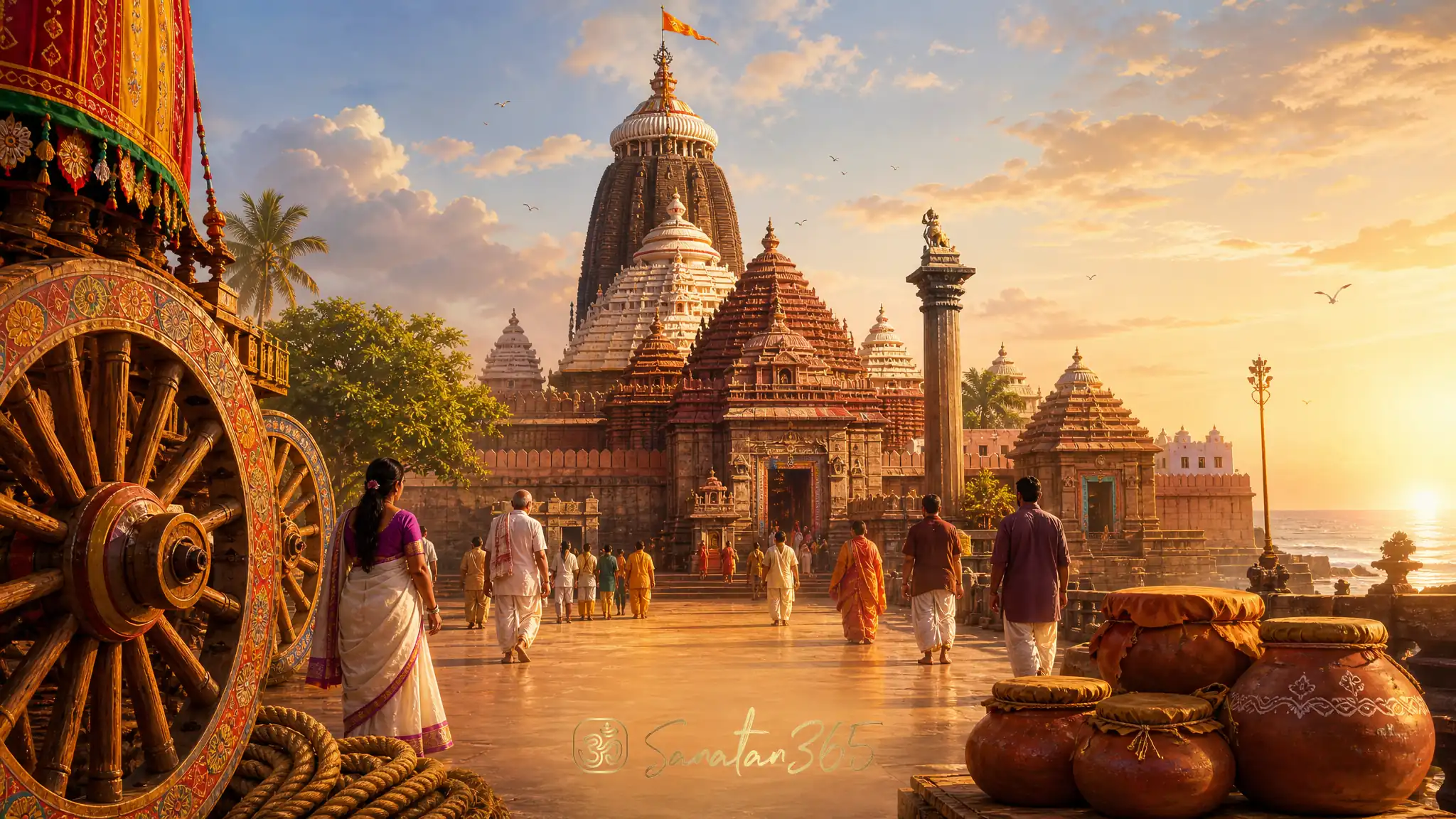
Jagannath Temple Puri Meaning: Darshan, Mahaprasad, and Rath Yatra
A careful guide to Jagannath Temple Puri meaning, explaining Lord Jagannath, darshan, Mahaprasad, Rath Yatra, and the spiritual culture of Odisha.
At Puri, the Divine is not hidden from the road; once a year, the Lord comes out to meet the world.
Jagannath Temple Puri meaning begins with Lord Jagannath, a form of Krishna and Vishnu worshipped at Puri in Odisha with Balabhadra and Subhadra. The temple is a sacred center of darshan (दर्शन, seeing and being seen by the Divine), Mahaprasad (महाप्रसाद, sanctified food offered to the Lord), and Rath Yatra, the great chariot festival. For devotees, Puri is not only a historic temple city. It is a living place where food, movement, music, service, and waiting become devotion.
The temple's outer form is majestic, but its deeper teaching is intimate: the Lord of the universe also receives the pilgrim through food, sight, and shared community.
Key takeaway: Jagannath Temple Puri is meaningful because it turns devotion into a full culture of darshan, sacred food, festival movement, humility, and shared grace.
What Is Jagannath Temple Puri Meaning?
Jagannath Temple Puri meaning rests on the name Jagannath: jagat (जगत्, world) and natha (नाथ, lord), often understood as "Lord of the World." Britannica describes Jagannatha as the form under which Krishna is worshipped at Puri, Odisha, and notes that the 12th-century temple rises above the town with wooden images of Jagannatha, Balabhadra, and Subhadra in the sanctuary Britannica. This triad gives Puri a devotional personality unlike any other major temple.
The form of Jagannath is striking. The large circular eyes, wooden body, and presence with Balabhadra and Subhadra do not fit a narrow idea of classical temple image-making. The form feels both royal and childlike, grand and approachable. Devotees often experience this as the beauty of Jagannath bhava (भाव, devotional mood): the Lord is cosmic, yet emotionally near.
Puri is also one of the great sacred centers of eastern India. The temple belongs to Odisha's living spiritual culture, where Jagannath devotion shapes music, food, painting, festivals, language, memory, and everyday identity. To understand Puri only as a monument would be too small. It is a temple, a pilgrimage center, a kitchen, a festival city, and a spiritual homeland for millions.
The temple's meaning also includes inclusiveness at the level of experience. Devotees approach Jagannath as Krishna, Vishnu, Purushottama, the Lord of Puri, and the compassionate presence who receives people through darshan and prasad. Different lineages may explain the theology differently, but the central devotional feeling is shared: Jagannath is the Lord who draws people close.
Key takeaway: Jagannath Temple Puri is not only a famous shrine; it is a living devotional universe centered on Lord Jagannath, Balabhadra, Subhadra, darshan, prasad, and Odisha's sacred culture.
Why Is Darshan at Jagannath Temple Puri So Powerful?
Darshan at Jagannath Temple Puri is powerful because the devotee does not merely look at an image. The devotee enters a charged relationship of seeing and being seen. In Hindu temple practice, darshan means that the Divine presence receives the worshipper's gaze and returns grace through presence.
At Puri, this experience is shaped by the distinctive wooden murtis (मूर्ति, consecrated sacred forms) of Jagannath, Balabhadra, and Subhadra. Their form is not quiet realism. It is symbolic, intense, and unforgettable. The eyes seem to hold the whole room. Many devotees describe Jagannath's gaze as vast enough for the world and personal enough for one person's prayer.
The temple environment deepens this. Pilgrims arrive from Odisha, Bengal, Andhra Pradesh, North India, South India, and the global diaspora. Some come after years of longing. Some come with family vows. Some come before or after major life transitions. Some come simply because the name Jagannath has lived in their home since childhood.
Darshan is brief for most pilgrims. That brevity is part of the discipline. The devotee cannot control the timing, crowd, temple flow, or emotional intensity. The practice is to arrive with humility, offer the prayer, receive what is given, and carry it back into conduct.
A wise pilgrim prepares through small acts:
- Learn the names of Jagannath, Balabhadra, and Subhadra before entering.
- Respect temple rules on entry, dress, offerings, photography, and queue discipline.
- Hold one clear prayer rather than many restless demands.
- Receive Mahaprasad with gratitude if available.
- Let the darshan change speech and behavior after leaving.
The final point matters most. Darshan should not end at the temple door. If seeing Jagannath makes a person more patient, generous, truthful, or steady, the visit has continued inwardly.
Key takeaway: Darshan at Puri is powerful because Jagannath's sacred presence asks the pilgrim to receive grace quickly, humbly, and then live more consciously afterward.
What Does Mahaprasad Teach at Jagannath Temple Puri?
Mahaprasad at Jagannath Temple Puri teaches that food can become theology. Prasad (प्रसाद, grace-filled offering) is food offered to the Divine and received back as blessing. Mahaprasad means "great prasad," and at Puri it holds extraordinary importance in temple culture.
Food is not a side detail here. It is part of how Jagannath receives the world. The temple kitchen, offerings, distribution, and shared eating culture reveal a devotional truth: grace is not only heard in philosophy or seen in darshan. It is also tasted.
The spiritual meaning is simple but deep. Ordinary food nourishes the body. Prasad nourishes memory. When a devotee receives food that has first been offered to Jagannath, the meal becomes an act of humility: "This is not mine first. It has passed through the Divine."
Mahaprasad also softens pride. Eating prasad is not about status display. It reminds pilgrims that everyone depends on nourishment. The scholar, laborer, traveler, elder, child, local devotee, and faraway visitor all receive through the same basic human need: food. In that sense, Mahaprasad becomes a lesson in equality before grace.
There is also a household lesson. Many Hindu families preserve the habit of offering food before eating, even in simple form. A plate placed before the home altar, a short mantra, or a moment of gratitude can transform the meal's mood. The food may be ordinary rice, dal, fruit, or sweets, but the attitude changes the home.
Puri's Mahaprasad culture reminds families that devotion is not limited to rare pilgrimages. The kitchen, dining floor, and lunchbox can also become places of remembrance when food is treated with gratitude, restraint, and sharing.
Key takeaway: Mahaprasad at Puri teaches that food becomes sacred when it is offered, received humbly, shared respectfully, and remembered as grace.
How Does Rath Yatra Reveal Lord Jagannath's Devotion?
Rath Yatra reveals Lord Jagannath's devotion through movement. Instead of devotees only entering the temple, Jagannath comes out in a public chariot festival. Britannica notes that Rathayatra for Jagannatha takes place annually in Puri during Ashadha, which falls around June or July in the Gregorian calendar Britannica. The festival is among the most recognizable Hindu celebrations in the world.
The visual language is unforgettable: large wooden chariots, immense ropes, devotional songs, crowds of pilgrims, and the sacred movement of Jagannath, Balabhadra, and Subhadra. The English word "juggernaut" is historically linked to the massive chariots of Puri, though the devotional meaning is far more tender than the later English usage Britannica.
Spiritually, Rath Yatra teaches that the Divine is not locked away from the public. Jagannath's movement outward is a sign of accessibility. The Lord who sits in the sanctum also travels through the street. The deity who receives worship also allows the wider public to participate in darshan.
This has deep emotional power for devotees. Not everyone can enter every sacred space. Not everyone can stand near the sanctum. Not everyone has perfect ritual knowledge. But the chariot road expands the circle of seeing. The festival makes the city itself part of the temple experience.
Rath Yatra also teaches collective effort. Pulling the chariot is not a private meditation. It is shared devotion. Many hands hold the rope. Many voices chant. Many bodies stand under heat, rain, or crowd pressure. Devotion becomes public, embodied, and communal.
For diaspora Hindus, Rath Yatra celebrations in cities outside India often carry this same emotional message. The chariot may be smaller, the street may be foreign, and the crowd may be mixed, but the core symbol remains: Jagannath meets people where they are.
Key takeaway: Rath Yatra reveals a Lord who moves toward devotees, making public space, shared effort, and festival joy part of spiritual practice.
How Should Pilgrims Approach Puri With Respect?
Pilgrims should approach Puri with respect by remembering that Jagannath Temple is a living place of worship, not a sightseeing backdrop. Reverence begins before arrival.
First, learn local customs. Temple entry rules, dress expectations, offering procedures, festival crowd patterns, and photography restrictions should be checked from current local guidance. A sacred place should not have to absorb a visitor's carelessness. Respect includes preparation.
Second, prepare the body and mind. Puri can be crowded, humid, intense, and emotionally overwhelming during major seasons. Families traveling with elders or children should plan rest, water, medicines, and realistic timing. Spiritual seriousness does not require ignoring health.
Third, avoid entitlement. Pilgrimage often includes waiting. Queues, crowd movement, security rules, changing temple timings, and limited access can become tests of humility. A pilgrim who remains kind under pressure has already received one teaching.
Fourth, honor Odisha's culture. Jagannath devotion is inseparable from Odia language, song, food, art, ritual vocabulary, and local memory. Visitors should not flatten this living culture into generic temple tourism. Listening is part of pilgrimage.
Fifth, carry the experience home responsibly. A pilgrim can bring back Mahaprasad, stories, photos from permitted areas, and family memories. But the deeper return is a changed habit: offering food before eating, keeping a weekly temple rhythm, chanting a name of the Divine, or serving others quietly.
For those who cannot travel, learning about Puri, watching temple-related educational content, reading about Rath Yatra, and practicing daily darshan at home can prepare the heart. Sanatan365 includes Daily Live Temple Darshan from Home with Jagannath Temple Puri among its live-streaming temple options, alongside other sacred sites. Used humbly, such tools can support remembrance, but they should deepen reverence for the living temple rather than replace it.
Key takeaway: Respectful pilgrimage to Puri requires preparation, humility, cultural listening, health awareness, and a sincere effort to bring devotion back into daily life.
What Can Families Learn From Jagannath Temple Puri?
Families can learn from Jagannath Temple Puri that devotion is not one activity. It is a complete culture. Children may first remember the colors, chariot wheels, food, bells, temple height, or stories of Jagannath's big eyes. Over time, those memories can become spiritual roots.
Parents and elders can teach Puri through simple themes:
- Jagannath means the Lord belongs to the whole world.
- Darshan means the Divine sees us too.
- Mahaprasad teaches gratitude before eating.
- Rath Yatra teaches that the Lord comes out to bless people.
- Pilgrimage teaches patience, respect, and humility.
These lessons are easy for children to understand because they are concrete. A child may not grasp theological nuance, but a child can understand offering food before eating. A child can understand waiting patiently for darshan. A child can understand that pulling together is different from pushing ahead alone. A child can understand that sacred places deserve quiet speech and clean behavior.
The temple also teaches adults. The shared food questions pride. The crowd tests patience. The chariot questions passivity. The darshan asks for surrender. The regional culture asks visitors to listen before judging. The whole ecosystem of Puri pushes the devotee beyond private spirituality into community, humility, and service.
This is why Puri remains powerful across generations. It is not preserved only by architecture. It is preserved by repeated acts: cooking, offering, singing, pulling, walking, waiting, remembering, and returning.
Key takeaway: Jagannath Temple Puri gives families concrete spiritual lessons that can become home practices: gratitude, patience, shared devotion, and reverence.
FAQ
What is Jagannath Temple Puri meaning?
Jagannath Temple Puri meaning refers to the spiritual significance of Lord Jagannath's temple in Puri, Odisha. It centers on darshan of Jagannath, Balabhadra, and Subhadra, Mahaprasad, Rath Yatra, pilgrimage discipline, and the living devotional culture of Odisha.
Who is Lord Jagannath?
Lord Jagannath is worshipped as a form of Krishna and Vishnu at Puri. The name Jagannath is commonly understood as "Lord of the World." At the Puri temple, Jagannath is worshipped with Balabhadra and Subhadra in distinctive wooden sacred forms.
Why is Mahaprasad important at Jagannath Temple?
Mahaprasad is important because it is food offered to Lord Jagannath and received back as grace. At Puri, Mahaprasad is central to temple culture and teaches gratitude, humility, sharing, and the sacredness of food.
What is Rath Yatra in Puri?
Rath Yatra in Puri is the annual chariot festival of Lord Jagannath, Balabhadra, and Subhadra. The deities are brought out in great chariots, allowing public darshan and making the city itself part of the devotional celebration.
How should first-time pilgrims prepare for Jagannath Temple Puri?
First-time pilgrims should learn current temple rules, dress respectfully, plan for crowds and weather, prepare elders and children realistically, approach darshan with humility, and receive prasad with gratitude. They should also respect Odisha's local devotional culture.
Conclusion
Jagannath Temple Puri gathers many forms of devotion into one sacred culture: darshan, food, festival, pilgrimage, music, family memory, and public grace. Its meaning is not limited to history or architecture. It is found in the way Lord Jagannath receives devotees through sight, Mahaprasad, and movement.
Key takeaway: Jagannath Temple Puri teaches that the Lord of the World can be approached through humble seeing, grateful eating, shared celebration, and a life that returns home more devoted than before.
About the author
Sanatan365 Editorial
Bringing Sanatan Dharma to modern seekers through authentic, scripture-grounded content.
Related in Temples
 Temples
Kailasanathar Temple Kanchipuram: Learning to Read Shiva in Stone
Read Kanchipuram’s Pallava Shiva temple through its sandstone, sanctum tower, sculpted shrines and the care that sacred heritage asks of vi…
 Temples
Vittala Temple Hampi: Reading the Stone Chariot and Sacred Courtyard
Understand Hampi’s Vittala Temple through its Garuda stone chariot, pillared halls, Vishnu devotion, and careful heritage visiting.
 Temples
Kirtimukha Meaning: The Face of Glory Above the Temple Door
The fierce face above a temple doorway is not a warning to turn away. Learn to recognize Kirtimukha, read its sacred story, and notice how…

