Kailasanathar Temple Kanchipuram: Learning to Read Shiva in Stone
Read Kanchipuram’s Pallava Shiva temple through its sandstone, sanctum tower, sculpted shrines and the care that sacred heritage asks of visitors.
A temple can ask for attention before it asks for explanation. At Kailasanathar, the stone itself offers the first lesson: look closely, but do not mistake closeness for permission to touch.
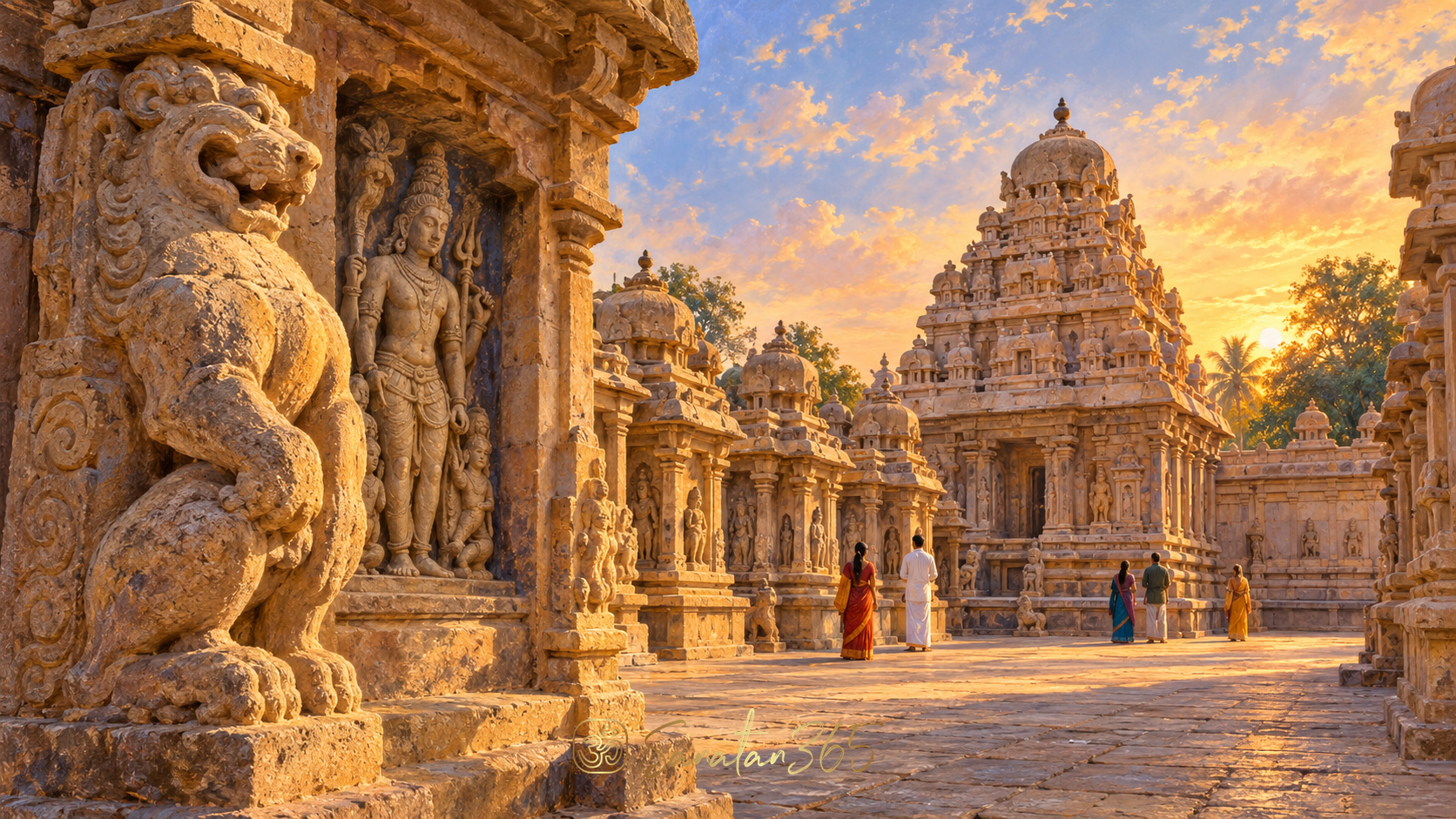
Kailasanathar Temple Kanchipuram is a Pallava-period Shiva temple in Tamil Nadu, distinguished by its sandstone superstructure, sculpted subsidiary shrines and tower above the main sanctum. Its importance lies not only in age or architectural achievement. The relationship between a concentrated sacred centre and an abundance of sculpted forms makes it a rewarding place to learn how to see a temple without reducing it to a collection of photographs.
The Kancheepuram district’s official account associates the temple with the Pallava ruler Rajasimha, also known as Narasimhavarman II, and describes a granite foundation beneath sandstone construction. This article follows those established features while distinguishing documented history, devotional meaning and suggestions for attentive visiting. It does not prescribe a ritual route or guarantee access to any particular interior.
Why does Kailasanathar Temple Kanchipuram reward a slower look?
The first useful change is to stop treating scale as the only measure of significance. A visitor familiar with the enormous entrance towers of later South Indian temple complexes may arrive expecting the most imposing gateway to explain everything. Kailasanathar invites a different question: how do the parts of a relatively concentrated sanctuary speak to one another?
Begin with three relationships rather than a checklist of masterpieces:
- The main shrine and the smaller shrines around it.
- The broad architectural shape and the carved figures within that shape.
- The enduring sacred purpose and the vulnerable material that carries it.
These relationships give a beginner something to notice without requiring instant mastery of iconography. The eye can move from an overall silhouette to a particular carving, then return to the whole. Each movement corrects the other. A close photograph may preserve an ornament but lose the setting that gives it meaning; a distant view may preserve the building while making its figures disappear.
The name Kailasanatha refers to Shiva as Lord of Kailasa, his sacred mountain abode. Here, however, a visitor is encountering a Tamil temple in Kanchipuram, not a literal mountain recreated at full scale. The name provides devotional orientation; the architecture provides a particular human expression of that reverence.
Historical dating also benefits from patience. The district page places construction in the seventh century, while a Frontline conservation report drawing on Archaeological Survey of India specialists associates Rajasimha with an early-eighth-century reign. The cautious description is a temple of Rajasimha’s Pallava period, around the turn of the eighth century. An exact foundation year is unnecessary to understand what makes the building distinctive.
This restraint does not diminish its antiquity. It prevents a convenient date from sounding more certain than the sources consulted allow. Sacred heritage deserves the same care in language that it receives in stone.
Key takeaway: Start with relationships, not records: Kailasanathar becomes clearer when the small shrine, the larger tower and the material surface are seen together.
How does the sanctum tower organize the sacred space?
Two architectural words help prevent a common confusion. A vimāna (विमान, the tower or superstructure above a shrine’s sanctum) marks the sacred centre. A gopura (गोपुर, a monumental entrance gateway) marks an approach or boundary. They are not interchangeable simply because both can rise above surrounding buildings.
The district’s description celebrates Kailasanathar’s tower over the sanctum. For the visitor, that distinction is more useful than memorizing an isolated technical label. Look at where the tower stands in relation to the shrine below. Its architectural emphasis belongs to the place of worship, not merely to the point of entry.
The garbhagṛha (गर्भगृह, the innermost sanctum) contains the temple’s sacred centre. Shiva is worshipped through the liṅga (लिङ्ग, a sacred emblem of Shiva). Knowing these terms does not give a visitor access rights or turn an interior into an exhibit. It helps explain why a building’s visual and devotional priorities may differ from a tourist’s preferred viewpoint.
A useful exercise is to observe from an ordinary permitted position. Notice the tower’s tiered outline, then follow the building downward toward its base. Ask how the smaller architectural forms repeat or vary the larger one. This is an invitation to observation, not a claim that every tier has one simple meaning that can be decoded from a distance.
The same care applies when comparing temples. Readers familiar with the Shore Temple at Mahabalipuram will encounter another major Pallava context. The connection makes comparison worthwhile, but it does not make the two sites interchangeable. Their settings and architectural arrangements must be noticed on their own terms.
There is also a practical courtesy in following the building’s priorities. Someone standing in front of an active worship space should not obstruct another person’s prayer merely to complete a photograph. The sacred centre remains a centre for those who worship, even when an observer is concentrating on art history.
Key takeaway: The tower helps locate the temple’s centre of gravity; understanding it means looking toward the sanctum rather than assuming the entrance is the whole story.
What can the sculpted shrines teach a careful observer?
Kailasanathar’s subsidiary shrines make repeated looking especially rewarding. The 2003 conservation report describes 58 devakulikās (देवकुलिका, small subsidiary shrines) around the main temple. It records sculptures and surviving painting traditions associated with Shiva and his divine family, alongside a rich range of sacred imagery.
The number is a documented architectural detail, not an instruction to count every accessible niche. A visitor may learn more from attending carefully to a few forms than from turning a sacred enclosure into a scavenger hunt.
Consider three different kinds of looking:
- Look for placement. Is a figure inside a niche, on a flank, or associated with the framing architecture?
- Look for relationships. Does the composition present a seated pair, a family grouping, an attendant or a dynamic form?
- Look for limits. Is enough of the carving visible to identify it responsibly, or is the honest description simply “a partially preserved figure”?
The conservation account discusses the Somāskanda (सोमास्कन्द, Shiva with Uma or Parvati and their son Skanda) panel associated with the sanctum. This family image gives a different emphasis from an isolated emblem or a vigorous dancing form. It allows the sacred to be understood through relationship as well as through stillness and power.
That interpretation should not become a claim that every carved family group carries exactly the same lesson for every devotee. Iconographic identification names what a composition represents. Personal reflection considers what it might invite someone to contemplate. The two can enrich each other without becoming identical.
The same report records lion sculptures revealed during conservation. A lion is therefore not merely an atmospheric decoration in an illustrated account of this temple; it belongs to its documented sculptural vocabulary. Yet a single motif cannot explain the entire monument. Attention grows when details are related to their setting, rather than promoted into universal keys.
Readers interested in another way architecture frames attention may compare the Mukteshvara Temple’s gateway and shrine. Such comparisons are most useful when they sharpen differences. Kailasanathar’s enclosed rhythms and sandstone surfaces should not be flattened into a generic idea of an “ancient Indian temple.”
For families visiting together, one gentle question is enough: what changes when the same sacred subject appears in a different posture or setting? There is no need to quiz a child on deity names or invent an explanation for an unfamiliar image. Shared curiosity is a sounder beginning than confident guessing.
Key takeaway: The sculpted shrines reward careful comparison, but naming a figure responsibly includes knowing when not to guess.
Why does sandstone change the way visitors should behave?
Material is not a secondary detail at Kailasanathar. It shapes both the beauty of the monument and the responsibilities of those who approach it. The official district description distinguishes the granite foundation from the sandstone superstructure. The conservation report describes the fragile nature of sandstone and the specialized work required to protect architectural members and sculpted surfaces.
That history changes the meaning of an ordinary gesture. Leaning against a carved wall for a portrait, rubbing a surface to make a detail clearer, or placing a bag on a fragile feature treats the monument as a prop. A visitor does not need to be a conservator to recognize that restraint is part of respect.
Simple habits are enough:
- Observe barriers and follow instructions from site staff.
- Do not climb, rub, scratch or lean on sculpted surfaces.
- Do not apply substances, make offerings on carvings or light anything outside authorized worship arrangements.
- Keep food, packaging and personal equipment away from vulnerable stone.
- Ask before photographing worshippers, and follow the current rules for interiors and equipment.
These are visitor-care recommendations, not a substitute for the site’s present regulations. A rule displayed locally takes precedence over a suggested itinerary found online.
Conservation also complicates the idea of an untouched past. The Frontline report describes substantial work on the main tower, subsidiary shrines and other parts of the complex. It discusses architectural stones being repositioned, foundations strengthened and later supports assessed by specialists. What a visitor sees is therefore also the result of continuing decisions about protection and presentation.
This is not a reason to distrust the temple’s authenticity. It is a reason to recognize stewardship. An inherited place survives through skilled work, resources and judgments that are often less visible than a royal name. Admiring the original sculptor while ignoring the conservator leaves the story incomplete.
Nor should a historical restoration report be read as a current access bulletin. A passage described as repaired in 2003 may not be open today. Present conditions must be checked locally; a past conservation success is not an invitation to enter an enclosed space.
Key takeaway: At a sandstone temple, reverence includes leaving fragile surfaces undisturbed and accepting conservation limits without treating them as obstacles to an experience.
How can a visit leave room for worship and uncertainty?
A rewarding visit does not require pretending to know everything. It requires enough preparation to notice, enough humility to ask, and enough consideration to share the space well.
The district page publishes morning and evening opening periods, but those listings should be treated as planning references rather than permanent promises. Check current timings, worship arrangements, photography rules and any access restrictions before travelling. Heat, crowds, conservation work and individual mobility needs can also change what is comfortable or possible on a particular day.
A short personal sequence can keep the visit grounded:
- Pause at the permitted approach and notice the temple’s overall arrangement.
- Follow the ordinary visitor route without attempting restricted passages.
- Choose one sculptural detail and one architectural relationship to observe carefully.
- Allow time for prayer if desired, without blocking others.
- Leave with one reliable observation and one question worth researching later.
This sequence is an editorial suggestion, not a prescribed religious observance. Devotees should follow the guidance of those responsible for worship. Visitors interested primarily in history can behave respectfully without imitating practices they do not understand.
Kanchipuram also contains distinct sacred traditions within one city. The earth-element associations of Ekambareswarar Temple belong to that temple’s particular devotional identity. They should not automatically be transferred to Kailasanathar because both are dedicated to Shiva. Shared devotion does not erase the individuality of a place.
The deepest practical lesson is modest: looking well does not mean possessing the object of attention. A photograph, a description and a remembered moment each preserve something different. None replaces the responsibility to leave the place intact for worshippers and visitors who come later.
Key takeaway: Kailasanathar is best approached with attentive eyes, accurate words and considerate actions; understanding grows without requiring unrestricted access or complete certainty.
FAQ
Where is Kailasanathar Temple Kanchipuram?
It is in Kanchipuram, Tamil Nadu. The official district tourism page lists it among the city’s places of interest. Confirm the exact destination when planning transport because other temples use similar names.
Who built Kailasanathar Temple?
The temple is associated with the Pallava ruler Rajasimha, also called Narasimhavarman II. A cautious historical description places it around the turn of the eighth century rather than insisting on one exact construction year.
What makes its architecture distinctive?
Its sandstone superstructure, tower above the sanctum and richly sculpted subsidiary shrines are defining features. Their relationship matters as much as any individual carving: the sacred centre and the surrounding images form a connected architectural experience.
Is every passage or shrine open to visitors?
Access should never be assumed. Follow current instructions from temple and conservation staff. A description of a passage in an older publication does not establish that it is accessible, appropriate or safe to enter today.
Can visitors touch the sculptures?
Avoid touching, leaning on or rubbing carved surfaces. Respect barriers and local instructions. The temple’s sandstone and its conservation history make careful, non-contact observation an especially meaningful form of respect.
About the author
Sanatan365 Editorial
Bringing Sanatan Dharma to modern seekers through authentic, scripture-grounded content.
Related in Temples
 Temples
Vittala Temple Hampi: Reading the Stone Chariot and Sacred Courtyard
Understand Hampi’s Vittala Temple through its Garuda stone chariot, pillared halls, Vishnu devotion, and careful heritage visiting.
 Temples
Kirtimukha Meaning: The Face of Glory Above the Temple Door
The fierce face above a temple doorway is not a warning to turn away. Learn to recognize Kirtimukha, read its sacred story, and notice how…
 Temples
Somanathapura Keshava Temple: Three Shrines and the Art of Looking
Read the star-shaped plan, three Vishnu shrines and carved narratives of Somanathapura, with a respectful guide to a protected Hoysala monu…

