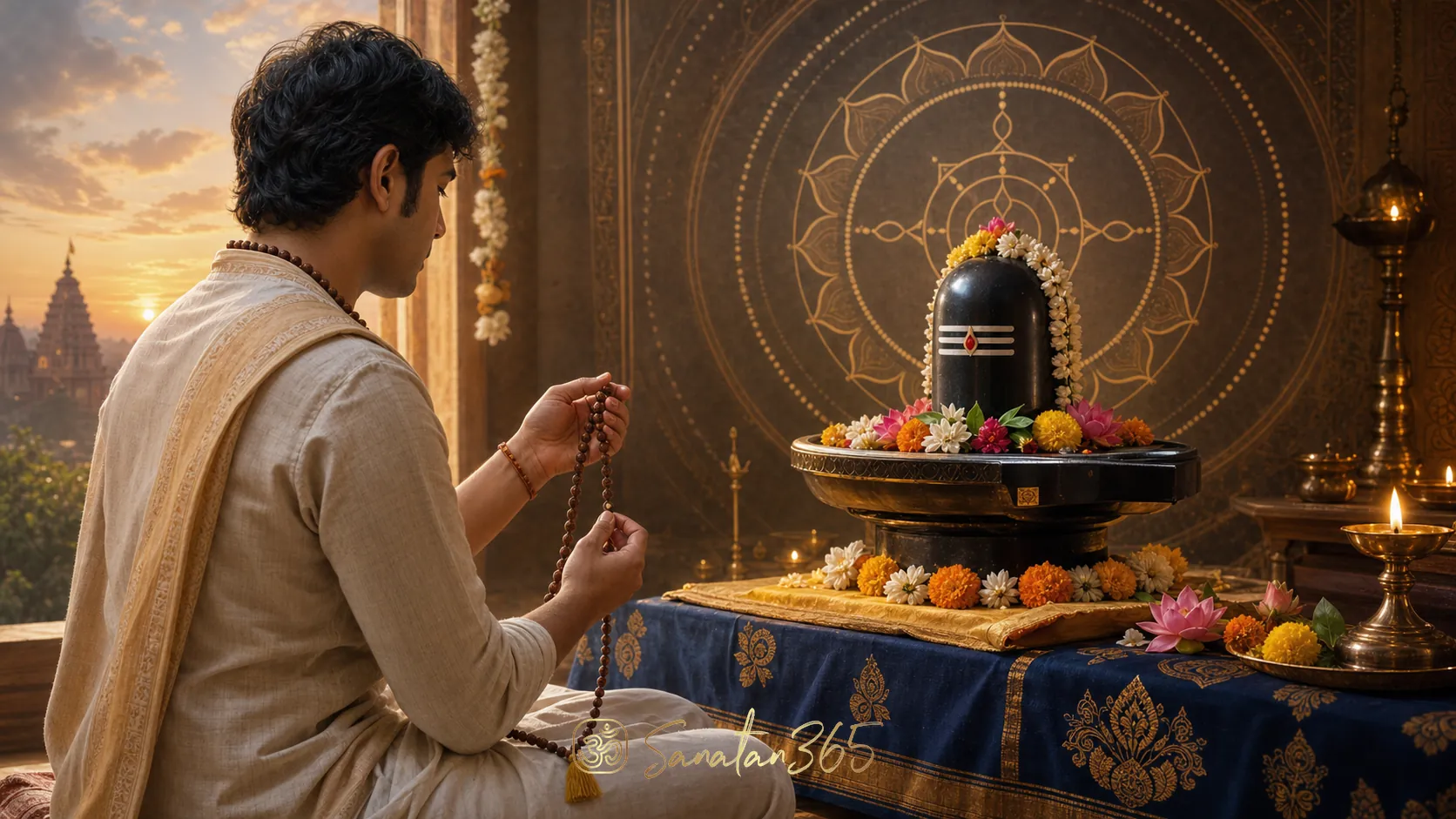
Japa Meditation Meaning: Mantra Repetition as Daily Practice
Japa meditation is the Hindu practice of repeating a sacred mantra or divine name with attention, devotion, and steadiness. This guide explains its meaning, methods, mala use, and daily rhythm.
The quietest practices often ask for the most courage: one sound, one bead, one return of attention.
Japa meditation meaning begins with japa (जप, repeated recitation or murmuring): the steady repetition of a mantra, divine name, or sacred phrase with attention and reverence. In Hindu practice, japa may be spoken aloud, whispered softly, repeated mentally, or counted on a japa mala (prayer beads). Its purpose is not mechanical counting. It trains the mind to return, again and again, to sacred remembrance.
For many Hindu families and seekers, japa is the bridge between formal worship and daily life. A person may practice before a home altar, after lighting a diya, while seated quietly in the morning, or inwardly during travel. The form can be simple, but the discipline is deep.
What does Japa meditation meaning reveal about mantra repetition?
Japa meditation meaning is best understood as disciplined remembrance through sound. A mantra is not treated as ordinary language. It carries sacred association, rhythm, memory, and intention. The repetition gives the wandering mind one thread to hold, while the heart gradually turns toward bhakti (भक्ति, devotion), shanti (शान्ति, peace), or inner steadiness.
The Sanskrit root often connected with japa means to mutter, whisper, or repeat inwardly. Traditional practice therefore includes both sound and silence. A beginner may chant audibly to stay attentive. A more settled practitioner may use upamshu japa (उपांशु जप, soft whispering) or manasika japa (मानसिक जप, mental repetition). These are not rigid ranks for showing superiority. They are ways of matching the practice to one's focus, environment, and readiness.
The Bhagavad Gita gives japa a striking dignity. In 10.25, Krishna says that among sacrifices, he is japa-yajna, the sacrifice of repeated sacred recitation. The verse matters because it places an inward, accessible practice beside grand ritual forms. A person does not need wealth, public display, or complex arrangement to begin. Attention becomes the offering. Readers who want a related mantra example can also study Om Namah Shivaya Meaning: Shiva's Five-Syllable Mantra of Surrender.
The Yoga Sutras also honor repeated sacred focus. Patanjali teaches repetition and contemplation of pranava, Om, as a doorway to inner clarity in Yoga Sutras 1.27-1.28. This is not merely sound production. The sound is joined with bhavana (भावना, contemplative feeling or intentional reflection), so repetition becomes a path of meaning.
Key takeaway: Japa is sacred repetition that turns attention into offering, not a race to finish a number.
Why is japa used in Hindu meditation?
The mind is rarely still by command. It moves toward memory, planning, irritation, fear, and desire. Japa gives the mind a dharmic rhythm. Each repetition says: return here. Return to the name. Return to the breath. Return to the presence behind the sound.
This is why japa appears across household worship, temple life, yoga practice, and devotional traditions. Hindu American Foundation's guide to visiting a Hindu temple describes mantra meditation as a common practice in Hindu temples, often counted on natural beads as devotees chant a chosen divine name. Its traditional puja guidance also notes that a simple daily practice may include lighting a lamp, offering shloka or mantra, and chanting one of God's names with a japa mala, commonly made with 108 beads.
Japa also protects practice from the extremes of mood. On a joyful day, the mantra becomes gratitude. On a difficult day, it becomes support. On an ordinary day, it becomes continuity. This is why many teachers advise choosing a steady time and place. The power of japa often comes less from intensity and more from faithful repetition over months and years.
There is also a subtle humility in japa. A practitioner does not need to produce a dramatic spiritual experience. The task is to sit, hold the mantra respectfully, and notice when the mind has wandered. The return is the practice. A hundred returns can be more honest than one imagined state of perfect concentration.
Key takeaway: Japa steadies the mind because it gives attention a sacred rhythm that can continue through ordinary life.
How does a japa mala support practice?
A japa mala (जप माला, garland for counting mantra repetitions) helps the body participate in meditation. The fingers move bead by bead while the mind repeats the mantra. This gentle physical rhythm reduces the need to count mentally, which allows attention to rest more fully in the sound and meaning.
Many malas have 108 beads plus a larger meru or guru bead. The practitioner usually begins near the guru bead, moves one bead per mantra, and stops when the cycle returns to that bead. Traditional etiquette often avoids crossing the guru bead; the mala is turned around for another round. The exact handling may differ by sampradaya (सम्प्रदाय, spiritual lineage or tradition), family custom, or teacher instruction.
The mala should not become the center of the practice. It is a support, not a display object. A simple tulsi, rudraksha, sandalwood, crystal, or plain counting mala can be meaningful when used with reverence. The real question is not whether the beads look impressive. It is whether they help the practitioner return to the mantra with steadiness.
For home practice, a beginner can keep the method simple:
- Sit comfortably with the spine naturally upright.
- Hold the mala respectfully in one hand.
- Choose a mantra received from family tradition, guru guidance, or a widely honored devotional source.
- Repeat the mantra once per bead.
- When distracted, return without irritation.
- Close with gratitude rather than abruptness.
Some practitioners prefer not to use a mala at first. That is also acceptable. A fixed time, such as five or ten minutes, can work well. The mala is most helpful when it deepens attention rather than creating anxiety about completion.
Key takeaway: A japa mala gives the hands a sacred rhythm so the mind can stay with the mantra.
What are the main types of japa?
Traditional explanations often describe several ways of practicing japa. The terms may vary, but the basic forms are widely recognized.
Vaikhari japa (वैखरी जप, audible repetition) is chanting clearly enough to hear the sound. It is useful for beginners because the voice, ear, breath, and mind work together. It can also carry devotional emotion, especially in family or temple settings.
Upamshu japa is soft repetition, usually whispered or murmured so quietly that others are not disturbed. It can feel more inward than audible chanting while still giving the practitioner the support of subtle sound.
Manasika japa is mental repetition. The lips and tongue are still, and the mantra is held inside the mind. This can be powerful, but it also requires honesty. If the mind keeps drifting, audible or whispered japa may be better for that season of practice.
Likhita japa (लिखित जप, written repetition) means writing the mantra repeatedly with attention. It is especially helpful for people whose minds settle through hand movement and visual focus. The writing should be reverent, neat, and not treated as casual scribbling.
Ajapa japa (अजपा जप, effortless or unceasing inner repetition) is often described as a mature state in which the mantra seems to continue within awareness. It should not be imitated or claimed quickly. In daily practice, it is enough to repeat sincerely and let deeper states arrive, or not arrive, by grace.
These forms are not competing brands of meditation. They are tools. A person may use audible japa during a morning puja, mental japa before sleep, and soft japa during travel. The practice should remain respectful, steady, and suited to the situation.
Key takeaway: Different forms of japa help different temperaments, but all depend on attention and reverence.
How can beginners practice japa meditation daily?
A beginner's japa practice should be modest enough to keep and meaningful enough to respect. Starting with five minutes daily is better than attempting a long routine for three days and abandoning it. A small, truthful sankalpa (संकल्प, sacred intention) builds trust with oneself.
Choose a clean and quiet place if possible. A home altar, a small lamp, an image or murti, or a simple sacred symbol can help create focus. If no formal altar is available, sit in a consistent place and begin with a moment of inward respect. The sacredness of japa does not depend on decoration, but environment does shape attention.
Choose the mantra carefully. Many Hindus use a mantra connected to their ishta devata (इष्ट देवता, chosen or beloved form of the Divine), family tradition, or guru lineage. Common examples include Om Namah Shivaya, Om Namo Narayanaya, Sri Ram Jai Ram Jai Jai Ram, the Gayatri Mantra where traditionally appropriate, or a simple divine name. The deeper meaning of the Gayatri Mantra is explored separately in Gayatri Mantra Meaning: A Vedic Prayer for Clear Intelligence. If a mantra belongs to a specific initiation tradition, honor that boundary and seek proper guidance.
Then set a clear container:
- Begin with one deep breath and a quiet bow of the mind.
- Repeat the mantra with attention to sound and meaning.
- If using a mala, move one bead per repetition.
- Do not scold the mind for wandering.
- End by offering the fruit of practice for clarity, humility, and the welfare of all.
The first aim is not mystical experience. The first aim is steadiness. Over time, the mantra may begin to shape speech, mood, and choices. A person who repeats a name of compassion may become more watchful about harsh words. A person who repeats a Shiva mantra may become more aware of stillness before reaction. This is where japa leaves the meditation seat and enters conduct.
Key takeaway: Daily japa works best when the promise is simple, steady, and connected to real life.
What mistakes should practitioners avoid?
The most common mistake is treating japa as a number game. Counting can support discipline, but the count is not the deity. Finishing 108 repetitions with impatience is not deeper than five minutes of sincere attention. Quantity becomes valuable when joined with quality.
A second mistake is choosing too many mantras at once. Variety can be beautiful in bhajan, kirtan, study, and festival practice. Daily japa usually benefits from one stable mantra for a meaningful period. The mind needs a groove. Constant switching can keep practice at the surface.
A third mistake is forcing the voice or breath. Japa should not strain the throat, tighten the body, or create breathlessness. Let the sound be natural. If the mantra is long, slow down. If the body is tired, sit gently. Discipline in Hindu practice does not mean violence toward oneself.
A fourth mistake is using japa to escape responsibility. Sacred repetition should make a person more truthful, patient, and dharmic, not less available to family, work, or service. The Gita's larger teaching never separates inner practice from right action. Japa should soften ego, not decorate it.
Finally, avoid comparing experiences. Some people feel warmth, tears, concentration, or peace. Others feel restlessness for weeks. Both can be part of honest practice. The fruit of japa is often seen quietly: a slightly calmer response, a cleaner intention, a steadier morning, a more careful word.
Key takeaway: The best japa is not loud, long, or impressive. It is sincere, steady, and transformative in conduct.
Conclusion: one mantra, one return
Japa meditation is a humble practice with vast depth. It asks the practitioner to bring sound, body, breath, and intention into one line. In a world of scattered attention, japa offers a sacred way to return without drama.
The daily question is simple: can one repetition be done with presence? If yes, the path has already begun.
Key takeaway: Japa meditation turns repetition into remembrance, and remembrance into a daily discipline of the heart.
FAQ
What is the simple meaning of japa meditation?
Japa meditation is the repeated recitation of a mantra, divine name, or sacred phrase with attention and reverence. It may be spoken aloud, whispered, repeated mentally, or counted on a mala.
Is japa the same as mantra meditation?
Japa is a major form of mantra meditation, especially in Hindu practice. Mantra meditation can include many methods, while japa specifically emphasizes repeated recitation or remembrance.
Do I need a japa mala to practice?
No. A japa mala is helpful for counting and focus, but it is not mandatory. Beginners may practice for a fixed time, such as five or ten minutes, and add a mala later if it supports attention.
Which mantra should beginners use for japa?
Many beginners use a widely honored divine name or mantra from family tradition, temple practice, or teacher guidance. If a mantra belongs to a specific initiation lineage, it should be received through the proper tradition.
Can japa be practiced silently?
Yes. Silent mental repetition is called manasika japa. Beginners may find audible or whispered japa easier at first, then move toward silence as concentration becomes steadier.
About the author
Sanatan365 Editorial
Bringing Sanatan Dharma to modern seekers through authentic, scripture-grounded content.
Related in Meditation
 Meditation
Chidakasha Dharana Meaning: Awareness of the Inner Space
Understand the space experienced with closed eyes, how observation differs from visualization, and a gentle introduction to this yogic conc…
 Meditation
Antar Mouna Meaning: Inner Silence Without Fighting Thought
Understand inner silence in Satyananda Yoga, its sensory and thought-awareness stages, and a responsible beginning that does not demand a b…
 Meditation
Ajapa Japa Meaning: The Mantra Remembered with Every Breath
Ajapa japa means remembrance that continues without deliberate repetition. Yogic traditions connect it with the natural rhythm of breath an…