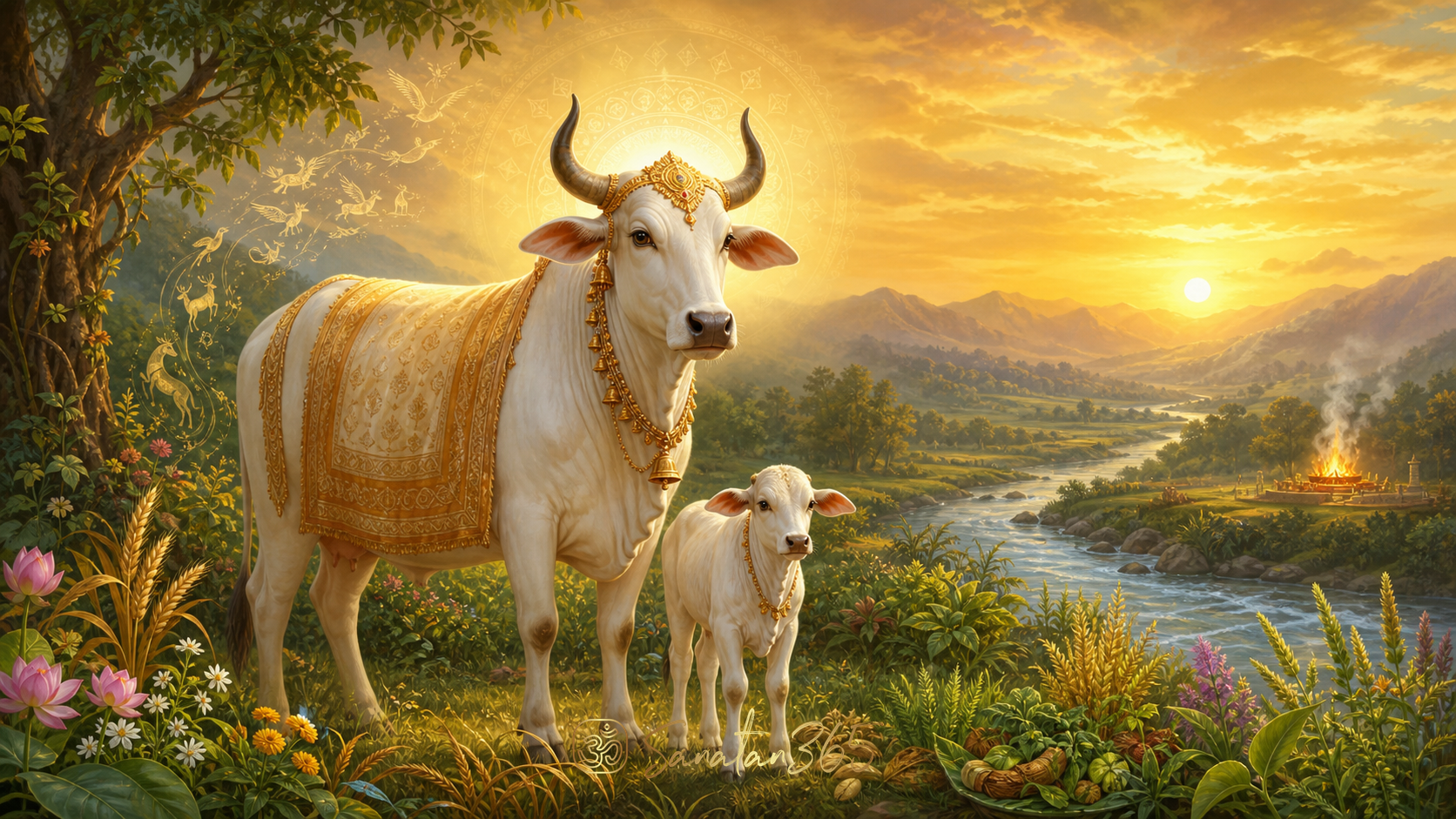
Kamadhenu Meaning: The Divine Cow of Abundance and Sacred Giving
Kamadhenu is the divine cow of Hindu tradition, embodying nourishment, abundance, generosity, and the duty to protect life. Her stories turn wish-fulfilment into a deeper teaching about reciprocal care.
A being who can grant every desire might seem to represent unlimited consumption. Kamadhenu teaches almost the opposite.
The Kamadhenu meaning in Hindu tradition is the divine source of nourishment whose abundance exists to sustain life, sacred duty, and generous exchange. Known also as Surabhi, she is revered as the mother of cows and the archetypal “cow of plenty.” Her stories connect milk, ghee, agriculture, hospitality, and yajna (यज्ञ, yajña, sacred offering) with a moral insight: prosperity becomes sacred when it circulates through care.
This is why Kamadhenu is more than a miraculous animal from a distant story. She gives visual form to a civilizational memory in which dependence is acknowledged, nourishment is honoured, and receiving creates responsibility.
What Is the Kamadhenu Meaning in Hinduism?
The name Kāmadhenu (कामधेनु) is commonly understood through kāma (काम, desire or rightful wish) and dhenu (धेनु, a milk-giving cow). It therefore evokes “the cow from whom what is desired may be drawn” or the divine cow of plenty. The idea is not simply that a person asks and instantly receives. Kamadhenu represents the conditions that allow life to flourish: food, fertility, continuity, ritual offering, patient labour, and maternal care.
She is also called Surabhi (सुरभि, fragrant, pleasing, or auspicious), a name used across several scriptural traditions for a celestial cow or mother of cattle. The names Kamadhenu and Surabhi sometimes refer to one divine figure and sometimes to closely related manifestations. Nandini (नन्दिनी, she who brings joy), the extraordinary cow associated with Sage Vasistha, is likewise described in different tellings as Kamadhenu, Surabhi, or Surabhi’s daughter.
These variations are not necessarily contradictions. Hindu sacred literature often preserves several regional and textual lineages rather than forcing every symbol into one fixed biography. The shared centre remains clear: a divine bovine presence gives nourishment, supports dharma (धर्म, sustaining order and right conduct), and cannot be reduced to property.
The Encyclopaedia Britannica account of Samudra Manthana lists Kamadhenu or Surabhi among the treasures revealed during the churning of the cosmic ocean. She is entrusted to the sages so that milk products, including ghee, can support sacred offerings. Other Puranic accounts place Surabhi’s emergence, parentage, or dwelling differently. Together, they present theological meaning rather than a single modern-style chronology.
Key takeaway: Kamadhenu signifies abundance held in trust, not wealth detached from duty.
Why Is Kamadhenu Called the Wish-Fulfilling Cow?
The phrase “wish-fulfilling cow” can sound like a promise of magical acquisition. In the stories, however, Kamadhenu’s power reveals the character of the person who approaches her.
The best-known narrative concerns Sage Vasistha and a royal visitor, often identified as King Vishvamitra before he became a great rishi (ऋषि, seer). Vasistha’s hermitage is able to offer astonishing hospitality through Nandini’s abundance. The king sees the cow’s capacity and wants to possess her. Vasistha refuses because Nandini belongs within a sacred relationship and sustains the hermitage’s obligations. When royal force is used, ordinary measures of power are overturned.
The story works at several levels:
- Hospitality is a sacred use of abundance. The hermitage’s wealth is expressed by feeding a guest, not displaying luxury.
- Living sources of nourishment are not inert assets. Nandini has agency and a relationship with the sage.
- Political force has limits. A king cannot rightfully seize everything merely because he has soldiers.
- Spiritual power is linked to restraint. Vasistha does not turn abundance into greed.
- Desire can become a teacher. Vishvamitra’s confrontation with a different kind of power becomes part of his long transformation toward rishihood.
The wish-fulfilling quality therefore carries an ethical test. What is the wish for? Who benefits? What relationships make fulfilment possible? What duty follows?
Kamadhenu does not sanctify endless wanting. She reveals whether desire has matured into kāma guided by dharma. Hindu thought does not automatically reject desire; it places desire among the puruṣārthas (पुरुषार्थ, aims of human life), where it must remain in conversation with ethical order, material responsibility, and liberation.
Key takeaway: Kamadhenu fulfils more than wishes; her stories examine whether a wish serves life or merely possession.
Where Does Surabhi Appear in Hindu Sacred Stories?
There is no single universally dominant origin story for Surabhi. That plurality is part of her depth.
The churning of the ocean
In accounts of Samudra Manthana (समुद्रमन्थन, churning of the ocean), devas and asuras churn the ocean of milk and many powerful treasures emerge. Kamadhenu or Surabhi appears among these gifts. Her milk supports curd and ghee used in yajna, linking cosmic abundance to ritual reciprocity. The world yields nourishment, and human beings return an offering rather than treating the world as mute supply.
This narrative places her alongside other forms of value whose use requires discernment. The ocean produces medicine, beauty, power, danger, and immortality-seeking. Abundance alone does not settle the moral question; the manner of receiving matters.
Vasistha’s Nandini
The Vasistha narrative brings the cosmic symbol into the social world of a hermitage. Nandini supports students, guests, worship, and community. Her gift is relational. She is not valuable only because she produces commodities; she enables a whole ecology of learning and hospitality.
Surabhi as mother
Several Puranic traditions honour Surabhi as Gomata (गोमाता, cow as mother) or the progenitor of cattle. Maternal language here points to sustained giving: milk, dung used traditionally as fuel or purified surface material, support for agrarian households, and the continuity of herds. The symbolism grew within societies that directly understood how human survival relied on animals, soil, water, and seasonal care.
This maternal image should not be flattened into sentimentality. A mother is honoured not merely for what can be extracted from her, but because care calls forth gratitude, protection, and restraint.
Readers may also encounter many artistic forms of Kamadhenu: a white cow with a woman’s head, wings, peacock-like features, a calf, or a body containing multiple deities. Iconography varies by period and region. The central visual claim is that the sacred order is gathered within the life-giving cow. The image says: what appears ordinary may hold an entire network of divine dependence.
Key takeaway: Surabhi’s varied stories consistently join nourishment with worship, hospitality, and protection.
What Does Kamadhenu Symbolism Teach?
Kamadhenu symbolism becomes clearest when its elements are read together rather than as isolated promises of luck.
Abundance is a relationship
Milk does not appear without a living animal, food, water, time, and care. Grain does not appear without soil, seed, rain, labour, and restraint. Kamadhenu personifies this interdependence. She makes prosperity visible as a web of relationships.
This challenges the illusion of the self-made individual. Every meal carries contributions from lives and systems that the eater did not create. Gratitude is therefore not decorative spirituality; it is accurate perception.
Nourishment must circulate
In sacred stories, Kamadhenu’s plenty supports guests, students, sages, ritual, and community. Hoarded abundance fails its purpose. This does not mean careless giving or the absence of boundaries. It means that wealth reaches fulfilment when it supports worthy life.
The Bhagavad Gita describes a cycle in which beings, food, rain, and yajna participate in mutual sustenance (Bhagavad Gita 3.14–16). The passage is not specifically a biography of Kamadhenu, but it illuminates her symbolism: life continues through reciprocal offering, not isolated consumption.
Gentleness can contain power
Kamadhenu’s bovine form represents patience and nurture, yet stories of Nandini show immense protective force. Gentleness is not helplessness. The sacred source of food and hospitality can resist exploitation.
This balance matters. Reverence without protection becomes empty language; power without nurture becomes domination. Kamadhenu holds both.
The sacred can inhabit daily materials
Milk, curd, and ghee belong to kitchens as well as ritual spaces. Cow dung historically served agrarian and household functions. Kamadhenu’s symbolism does not separate spirituality from material life. It asks a family to encounter food, fuel, land, and animal care with reverence.
This does not require every seeker to reproduce one historical economy. Diets, livelihoods, and local conditions differ. The enduring principle is to reduce cruelty, avoid waste, honour sources, and make consumption accountable.
Key takeaway: Kamadhenu turns abundance from a possession into a practice of grateful, protective, and generous living.
How Is Kamadhenu Honoured in Home and Temple Traditions?
Kamadhenu is not usually approached through one mandatory pan-Hindu ritual. Practices vary among regions, temples, farms, households, and sampradāyas (सम्प्रदाय, spiritual lineages). Some devotees honour an image of Kamadhenu with her calf. Others express the same reverence through go-seva (गोसेवा, service and care for cows), feeding animals responsibly, supporting ethical shelters, or offering gratitude before meals.
Common devotional expressions may include:
- keeping a respectful Kamadhenu image in a clean puja space;
- offering flowers, water, a lamp, or a simple prayer according to family tradition;
- remembering the Divine as the source behind food and livelihood;
- supporting genuine animal welfare rather than performative symbolism;
- avoiding food waste and sharing meals through anna-dāna (अन्नदान, the giving of food);
- teaching children that reverence includes gentle behaviour toward animals;
- verifying that a goshala (गोशाला, cow shelter) provides real veterinary care, food, space, and transparent stewardship before donating.
No object should be sold or treated as a guaranteed mechanism for wealth. A Kamadhenu murti (मूर्ति, sacred image or embodied form) can support remembrance and devotion, but it does not replace ethical work, financial judgment, or responsibility.
For diaspora families with no access to traditional cattle-care settings, the principle remains available. A household can practise gratitude for food, choose more humane sources where possible, donate to credible animal welfare, support farmers using responsible methods, and reduce waste. Sacred geography can travel through conduct.
The same care applies when encountering regional customs. Some communities emphasize Govatsa Dwadashi, Gopashtami, Krishna traditions, or local temple observances. These should be learned from the community itself without claiming that one pattern is universal.
Key takeaway: The most faithful honour to Kamadhenu joins prayer with tangible care for animals, food, and those who provide nourishment.
How Can Kamadhenu’s Teaching Shape Modern Life?
Kamadhenu offers a strong framework for decisions far beyond ritual.
Ask what sustains the source
Before seeking more output from a person, animal, team, field, or system, ask what keeps that source healthy. Extraction eventually destroys the abundance it pursues. Sustainable care is not opposed to prosperity; it protects prosperity’s roots.
Measure wealth by nourishment
A prosperous home is not only one with more possessions. It is one where people are fed, elders are respected, children are taught, guests are welcomed with wise boundaries, and resources are used without humiliation or waste.
Convert gratitude into protection
Saying “thank you” matters, but Kamadhenu’s symbolism presses further. If a source is sacred, it should not be neglected after its most productive years. This principle can shape animal care, elder care, environmental stewardship, and workplace ethics.
Let desire pass through dharma
When a desire arises, three questions can refine it:
- Does fulfilment harm or exploit another being?
- Will this benefit remain private, or can some part circulate?
- What responsibility comes with receiving it?
These questions do not abolish ambition. They give ambition a sacred container.
Practise one small act of reciprocal abundance
A weekly Kamadhenu-inspired practice may be simple: share food, support a verified shelter, thank someone whose labour is usually invisible, compost suitable waste, or choose one purchase with greater attention to welfare. Consistency matters more than spectacle.
Key takeaway: Modern abundance becomes sacred when its sources are sustained and its benefits are shared.
Kamadhenu as a Vision of Enough
Kamadhenu is often introduced as the cow who can provide everything desired. Her deeper gift is teaching what “everything” means.
It is not an endless pile of objects. It is a living world in which nourishment continues: soil remains fertile, animals receive care, guests can be fed, learning can flourish, sacred offerings can be made, and power accepts limits. Such abundance is not passive. It depends on gratitude expressed as duty.
To contemplate Kamadhenu is to remember that receiving and giving are one movement. Milk flows because life has been sustained. A lamp burns because many materials and hands have converged. A meal arrives because earth, rain, seed, animal, farmer, carrier, cook, and family participate.
Kamadhenu’s divine body gathers that network into one unforgettable form. She asks the seeker to see dependence without shame, plenty without greed, and protection without domination.
Key takeaway: True plenty is the capacity to nourish life without exhausting the source of nourishment.
FAQ
What is the simple meaning of Kamadhenu?
Kamadhenu means the divine cow of plenty in Hindu tradition. She represents nourishment, abundance, generosity, maternal care, and prosperity guided by dharma.
Are Kamadhenu and Surabhi the same?
Many texts and traditions use Kamadhenu and Surabhi for the same divine cow or closely related manifestations. Other accounts distinguish Surabhi as the mother and Nandini as her daughter. The shared symbolism is more consistent than a single biography.
Why is Kamadhenu shown with many deities?
Some later artworks depict deities or sacred worlds within Kamadhenu’s body. The image expresses the belief that the life-giving cow gathers a wide sacred order within her. Artistic details vary by region and period.
Does worshipping Kamadhenu guarantee wealth?
No devotional practice guarantees material wealth. Kamadhenu worship is better understood as cultivating gratitude, generosity, responsible prosperity, and reverence for the sources of nourishment.
How can someone honour Kamadhenu today?
A person can pray according to family tradition, practise go-seva, support a transparent animal shelter, avoid wasting food, share meals, choose humane sources where possible, and treat animals gently. Ethical care gives devotional symbolism practical form.
Kamadhenu’s enduring message is simple: abundance is sacred when it protects, nourishes, and keeps giving. The single key takeaway is that every gift received creates a duty to sustain its source and share its goodness.
About the author
Sanatan365 Editorial
Bringing Sanatan Dharma to modern seekers through authentic, scripture-grounded content.
Related in Deities
 Deities
Agni Deva Meaning: Sacred Fire and the Divine Messenger
Meet Agni as the Vedic priest and messenger, read the first Rig Veda hymn, and understand sacred fire without reducing a living deity to a…
 Deities
Brahma Deva Meaning: Four Faces, Creation, and Sacred Knowledge
Understand Brahma, the Hindu creator deity, through his four faces, lotus imagery, sacred knowledge, and a careful distinction from Brahman…
 Deities
Ushas, the Vedic Goddess of Dawn: Light, Renewal, and Time
Ushas, the Vedic goddess of dawn, appears in the Rigveda as radiant light that awakens life, calls beings to activity, and reveals both ren…

