King Rantideva Story: Compassion When There Is Almost Nothing Left
The King Rantideva story in the Bhagavata Purana shows generosity tested by hunger and thirst. Its lasting lesson is that compassion becomes clearest when giving is costly, conscious, and rooted in seeing dignity in every being.
He had gone forty-eight days with almost nothing, yet the final test was not whether King Rantideva could endure hunger. It was whether another person's hunger would still matter to him.
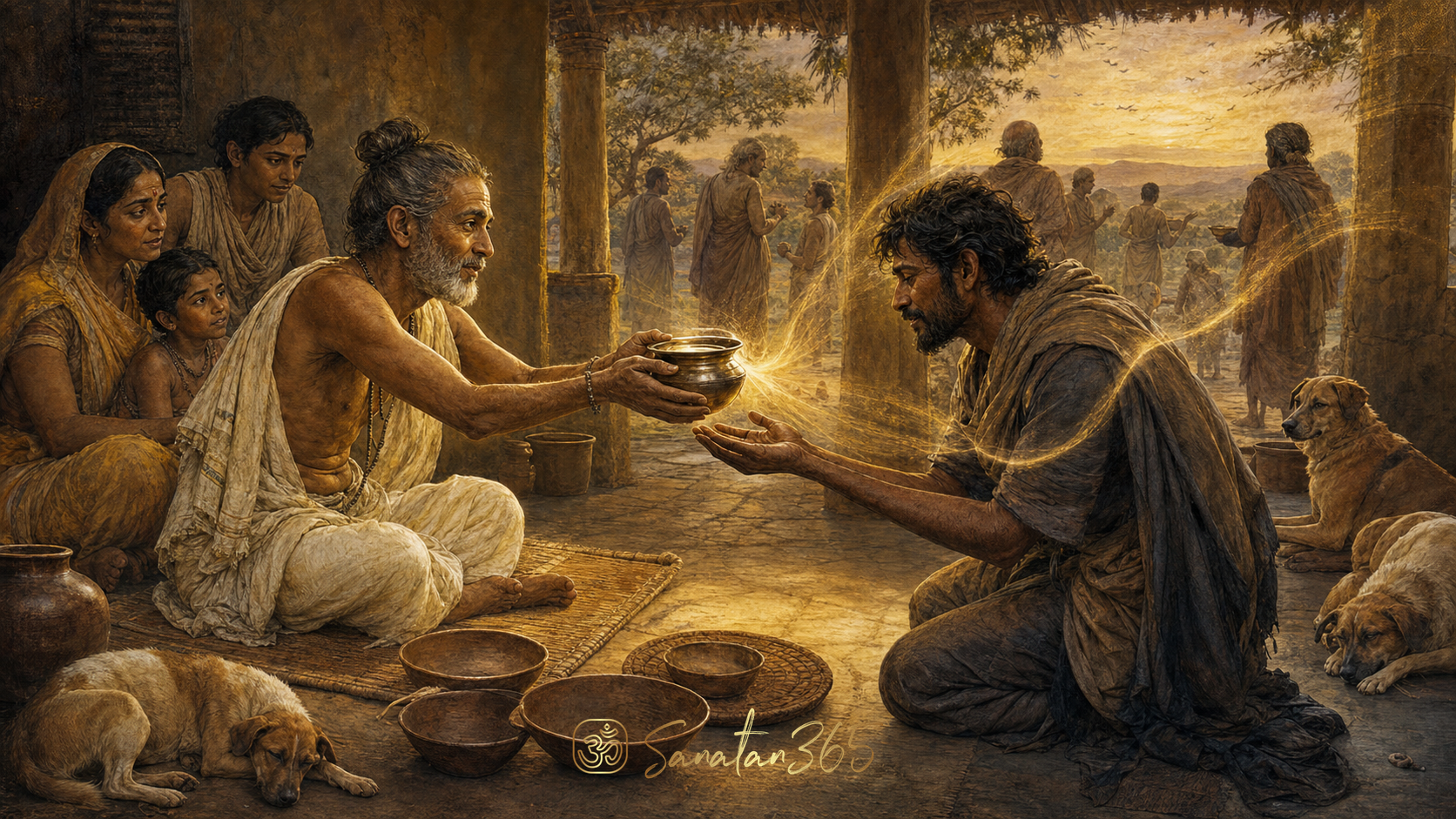
The King Rantideva story in the Srimad Bhagavata Purana tells of a ruler who receives food and water after a long fast, only to share each portion with guests who arrive in need. When only a little water remains, he gives that away too. The story presents compassion not as a comfortable feeling but as the disciplined recognition of another being's dignity, even under severe scarcity. It also asks a necessary modern question: how can selfless service remain wise rather than becoming harmful self-neglect?
What Is the King Rantideva Story?
The account appears in Book 9, Chapter 21 of the Srimad Bhagavata Purana. Rantideva belongs to the lineage of Bharata and is remembered less for conquest than for generosity. The text says that he did not struggle to accumulate wealth for personal pleasure. He accepted what arrived through providence and shared it with others.
Then scarcity became extreme. Rantideva and his household went without food and water for forty-eight days. At last, they received a modest meal prepared with ghee and milk, along with water. They were weak, thirsty, and ready to eat.
Before they could finish, a sequence of guests arrived.
- A brahmana guest came first, and Rantideva respectfully gave him a portion.
- Another hungry traveler arrived, and the king shared again.
- A man accompanied by dogs came seeking food, and Rantideva gave away what solid food remained.
- Finally, a thirsty person appeared when the household had only one small portion of water left.
The Sanskrit principle of atithi-seva (अतिथि-सेवा, service to an unexpected guest) gives the scene its cultural depth. Atithi literally points to one who arrives without a fixed date. Hospitality is therefore not merely social polish. It becomes a practice of alertness: a household recognizes need when it appears at the threshold.
Rantideva offers the last water. In the chapter's culminating prayer, he does not ask for extraordinary spiritual powers or even personal liberation. He wishes to remain among living beings and bear their suffering so that they may be relieved. The visitors then reveal that the encounter was a test. The king's attention, however, had never been fixed on reward. His mind remained directed toward the Divine present within all beings.
Readers can consult the chapter in Srimad Bhagavatam 9.21 and compare the ethical vision with the Bhagavad Gita's description of the yogi who sees the happiness and distress of others as comparable to one's own (Bhagavad Gita 6.32).
Key takeaway: The plot is simple, but each arriving guest narrows Rantideva's margin of comfort until compassion must stand without abundance, recognition, or certainty of reward.
Why Does Rantideva Keep Sharing Food and Water?
Rantideva does not give because resources are endless. He gives because his sense of relationship has expanded beyond the boundary of “mine.” That distinction matters. Plenty can make generosity easy; scarcity reveals what a person believes another life is worth.
The story joins three important ideas:
- Dāna (दान, generous giving): the voluntary offering of resources without humiliating the receiver.
- Sevā (सेवा, selfless service): action offered for another's welfare without making the ego the center.
- Darśana (दर्शन, sacred seeing): here, the capacity to perceive divine presence and dignity in living beings.
These ideas keep the episode from becoming a tale about dramatic deprivation alone. Rantideva's real discipline is perception. The guests are not interruptions to his spiritual life; his response to them is his spiritual life.
This is also why the order of the visitors is so effective. Every act of giving changes the cost of the next act. The first portion can be shared while some food remains. The next share reduces security. Giving food to the man and his dogs leaves only water. Offering the final drink places Rantideva's own body at the edge of endurance.
Yet the narrative does not describe contempt for the body. Rantideva feels hunger, thirst, trembling, and exhaustion. Compassion is meaningful precisely because those needs are real. He does not pretend pain is absent. He refuses to let pain erase his awareness of someone else's suffering.
There is a useful connection here with the meaning of dakshina, where sacred giving is understood as gratitude and responsible reciprocity rather than a transaction. Rantideva's gift is not a purchase of merit. It is a response to presence.
Key takeaway: Rantideva keeps sharing because he sees the receiver as a bearer of dignity, not as a problem competing with his own needs.
What Does Rantideva See in Every Guest?
The deepest turn in the King Rantideva story is not the disappearance of food. It is the disappearance of social distance.
The guests arrive with different identities, needs, and forms of social standing. The final visitor would have been treated as socially marginal in many historical settings. The narrative places him at the moral center of the test. Rantideva does not ask whether the thirsty person has earned the water. He sees suffering and responds.
This reflects a vision expressed in the Bhagavad Gita: the disciplined seeker sees the Self in all beings and all beings in the Self (6.29). The claim is not that differences vanish. People retain distinct histories, responsibilities, and circumstances. Sacred seeing means those differences do not cancel the underlying worth of a life.
The story therefore challenges several common distortions of charity:
- Giving is not permission to display the receiver's vulnerability.
- Service is not a stage for proving the giver's moral superiority.
- Hospitality is not reserved only for those who resemble the host.
- Compassion does not wait for perfect certainty about a person's social value.
Rantideva's prayer goes further than pity. Pity can preserve distance: one person stands above while another remains below. Karuṇā (करुणा, compassion) moves closer. It recognizes suffering and seeks its relief without reducing the sufferer to that pain.
For a modern reader, this makes dignity part of the gift. Food given with contempt does not carry the same ethical meaning as food offered respectfully. Aid that exposes a person's identity for applause can reproduce harm. Quiet assistance, informed consent, and fair treatment often embody Rantideva's insight more faithfully than a dramatic public gesture.
Key takeaway: Rantideva sees each guest as more than a social label; he sees a living being whose pain deserves a truthful response.
Does Compassion Require Reckless Self-Neglect?
This question must be asked directly. A sacred story of extreme giving should not be turned into a command for vulnerable people to tolerate abuse, ignore illness, or surrender every boundary.
Rantideva's action belongs to a Puranic narrative of an exceptional, voluntary spiritual test. It is not a universal instruction to imitate the physical extremity of a forty-eight-day fast or to give away necessities when doing so would endanger dependents. The moral center is compassionate recognition, not compulsory suffering.
Several distinctions help keep the lesson responsible:
Voluntary offering is not coerced sacrifice
Rantideva chooses his response. A person pressured by family, institution, or authority to surrender safety is not in the same ethical position. Dharma does not become an excuse for exploitation.
Service includes responsibility to dependents
A householder may have duties toward children, elders, colleagues, or community. Giving that creates foreseeable harm for those entrusted to one's care requires discernment. Viveka (विवेक, discriminating wisdom) asks what action genuinely reduces suffering rather than merely appearing noble.
Boundaries can protect compassion
Burnout often makes service brittle. Rest, nourishment, and sustainable limits can preserve the capacity to help over time. The discipline of mitahara, or measured eating offers a related reminder: spiritual practice respects balance and attention rather than glorifying bodily damage.
Emergency care is not a spiritual failure
Someone facing starvation, dehydration, illness, violence, or severe distress should seek qualified help. The story should never replace medical care, safeguarding, or practical support. Compassion includes allowing oneself to receive assistance.
Rantideva's example can therefore be honored at the level of principle: do not let fear of scarcity make the heart indifferent. That principle can coexist with budgets, boundaries, shared responsibility, and professional care.
Key takeaway: The story praises freely chosen compassion under pressure; it does not sanctify coercion, abuse, or preventable self-harm.
How Can Rantideva's Example Guide Generosity Today?
Most readers will not face Rantideva's exact test, but daily life offers smaller thresholds where scarcity shapes conduct. Time feels limited. Attention is fragmented. Money is allocated tightly. Emotional energy is finite. The question remains: can another person's need still be seen clearly?
Rantideva's example can become practical through five disciplines.
1. Share before waste occurs
Households, restaurants, temples, and workplaces can plan responsible food sharing before usable food is discarded. Local food-safety rules and reliable community partners should guide the process.
2. Give without demanding a performance of gratitude
A receiver does not owe a public story, photograph, testimonial, or display of submission. Protecting privacy can be part of dāna.
3. Include beings who are easy to overlook
The narrative explicitly includes a man with dogs. Compassion is not limited to socially approved recipients. Feeding animals responsibly, supporting shelters, and offering water in safe ways can express a wider field of care.
4. Build a sustainable practice
A small recurring contribution of food, skill, time, or money may help more than one unsustainable burst. Families can choose a monthly service practice, verify the recipient organization, and review whether the support is genuinely useful.
5. Receive as respectfully as one gives
Rantideva himself first receives food. Human life includes both giving and receiving. Accepting help without shame can allow generosity to circulate rather than harden into a one-sided identity.
A simple weekly reflection can make the story concrete:
- What resource did the household receive this week?
- Where is there genuine need nearby?
- What can be shared safely and respectfully?
- Does the action preserve the receiver's dignity?
- Can the practice continue without neglecting essential duties?
The result need not be dramatic. A meal served without condescension, water offered during heat, patient attention to an isolated elder, or skill freely shared can carry the same orientation: another person's life is not invisible.
Key takeaway: Rantideva's compassion becomes modern when generosity is dignified, practical, inclusive, and sustainable.
Conclusion: Compassion Is Clearest When It Costs Something
King Rantideva is remembered because scarcity did not shrink his field of concern. Hunger and thirst were real, yet they did not make another person's suffering unreal. His final offering reveals a form of devotion in which sacred seeing, generous action, and human dignity become inseparable.
The story does not ask everyone to reproduce an extreme ordeal. It asks something quieter and more demanding: when comfort narrows, will compassion disappear first? A wise response joins an open heart with discernment, protects the vulnerable from coercion, and turns available resources into respectful service.
Key takeaway: The King Rantideva story teaches that genuine generosity is not measured only by how much is given, but by how clearly the giver sees and honors the life before them.
FAQ
Who was King Rantideva?
King Rantideva was a ruler in the lineage of Bharata whose story appears in Book 9, Chapter 21 of the Srimad Bhagavata Purana. He is remembered for generosity, devotion, and compassion toward guests during severe scarcity.
How long did Rantideva fast?
The Bhagavata Purana account says that Rantideva and his household went without food and water for forty-eight days before receiving a small meal and water. This is a Puranic narrative detail, not a fasting practice for readers to imitate.
Why did Rantideva give away his last water?
He saw the thirsty visitor's suffering and responded with compassion. His prayer shows that he valued the relief of living beings above personal power or reward, while perceiving the Divine within all.
What is the main lesson of the Rantideva story?
Its central lesson is that compassion and dignity should not depend on abundance or social status. The story also encourages generosity without ego, while modern application requires healthy boundaries and responsible care.
Does the story teach people to neglect their own health?
No. Rantideva's exceptional voluntary act should not be used to justify coercion, abuse, dangerous fasting, or avoidance of medical help. Its responsible lesson is to resist indifference and serve others with both compassion and discernment.
About the author
Sanatan365 Editorial
Bringing Sanatan Dharma to modern seekers through authentic, scripture-grounded content.