Lord Murugan Meaning: The Vel, Courage, and Clear Wisdom
A careful guide to Lord Murugan meaning, the symbolism of the vel, and how Murugan devotion teaches courage, clarity, humility, and disciplined action.
A spear can wound, but in Murugan devotion the vel points toward healing through clarity.
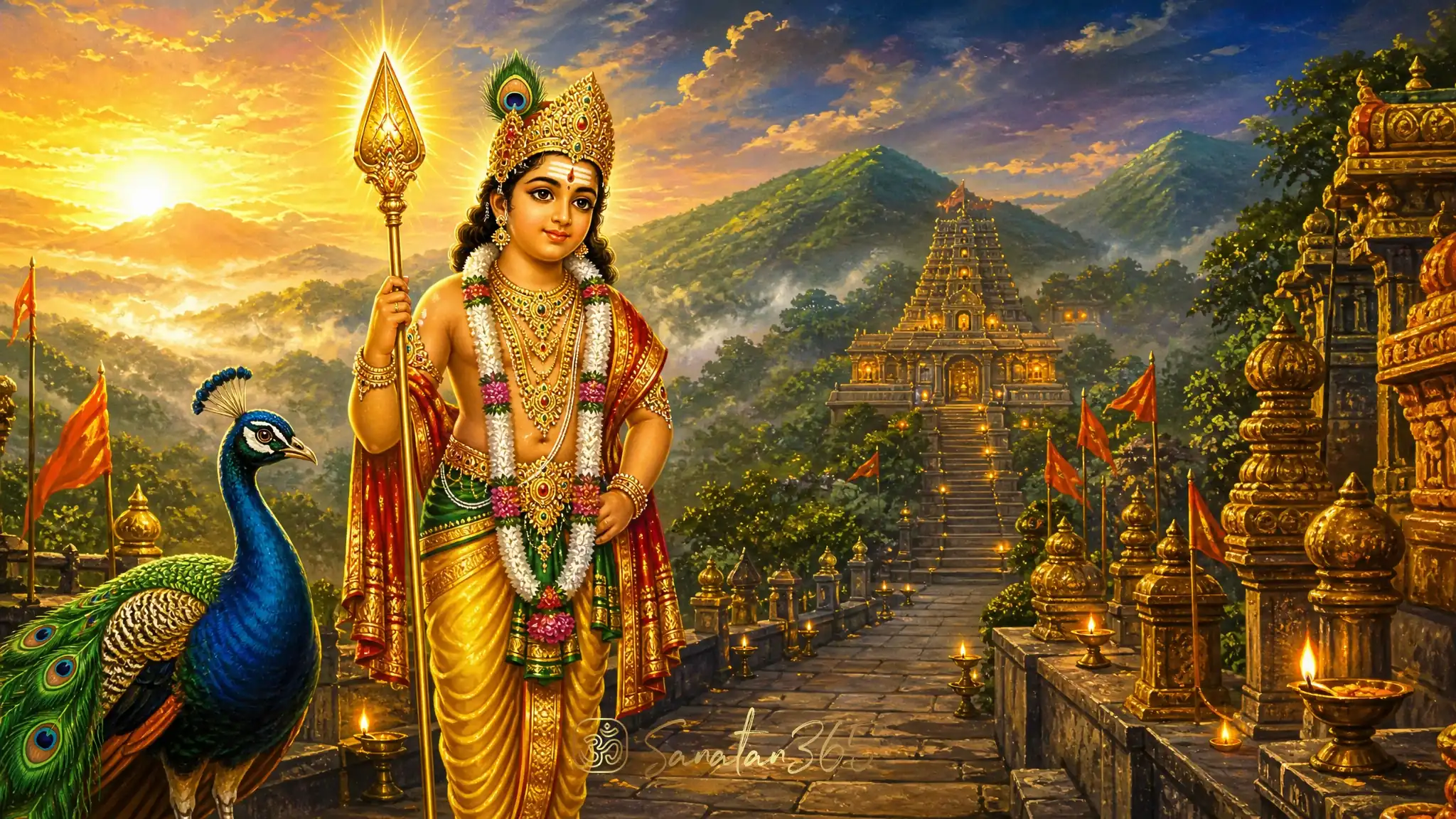
Lord Murugan meaning begins with the image of divine youth carrying fearless wisdom. Murugan, also known as Kartikeya, Skanda, Subrahmanya, Shanmukha, and Kumara, is revered as a radiant son of Shiva and Parvati, a commander of divine forces, and a beloved deity of Tamil spiritual life. His vel (வேல், sacred spear) represents sharp discernment, courage, and the power to cut through confusion without hatred.
What does Lord Murugan meaning reveal about courage?
Lord Murugan meaning is not limited to warfare. In devotional understanding, Murugan represents the courage to face disorder inside and outside oneself. He is often described as youthful, beautiful, disciplined, and victorious, but his victory is not a crude celebration of aggression. It is the triumph of jnana (ज्ञान, wisdom) over avidya (अविद्या, ignorance).
Britannica identifies Murugan as a major deity of the ancient Tamils of South India and notes his later connection with the wider pan-Indian figure Kartikeya or Skanda (Britannica). That layered identity matters. Murugan is deeply Tamil, yet not only Tamil. He is local and universal at once: a hill deity, a warrior child, a teacher of wisdom, and a protector of devotees across South India, Sri Lanka, Malaysia, Singapore, and the global diaspora.
A seeker can read Murugan’s courage in three careful ways:
- Moral courage: choosing dharma when convenience pulls elsewhere.
- Inner courage: naming one’s fear, pride, anger, or confusion honestly.
- Devotional courage: trusting grace while still doing disciplined work.
This is why Murugan worship often feels energetic rather than passive. The devotee is not asked to deny difficulty. The devotee is invited to stand upright before it.
Murugan’s many names also deepen the meaning. Skanda is often associated with movement and attack in a sacred-warrior sense. Kartikeya links him with the Krittikas in classical tradition. Subrahmanya is used widely in Sanskritic worship. Shanmukha (षण्मुख, six-faced one) points to his sixfold perception. Kumara (कुमार, youth or prince) remembers divine freshness. Each name opens a slightly different doorway.
Key takeaway: Murugan’s courage is not anger with a divine label; it is disciplined clarity in service of dharma.
Why is the vel central to Lord Murugan meaning?
The vel is central because it turns Murugan’s power into a symbol of precision. A sword may suggest broad combat; a spear suggests focus. In Murugan devotion, the vel is not only a weapon. It is a spiritual instrument that pierces falsehood, protects the sincere, and reminds the mind to become one-pointed.
Tamil tradition often remembers the vel as a gift of the Divine Mother. In many retellings, Parvati gives Murugan the vel before his battle with Surapadman. The theological meaning is tender and powerful: Murugan’s courage is not separate from the Mother’s grace. The spear is sharp, but its source is compassion.
The vel can be contemplated through five meanings:
- Discernment: the ability to tell truth from appearance.
- Protection: the strength that shelters devotees and sacred order.
- Concentration: the one-pointed mind needed for practice.
- Purification: the cutting away of harmful tendencies.
- Grace in action: power guided by compassion, not ego.
This is especially important for modern readers. Many people think courage means reacting quickly. Murugan’s vel suggests something better: see clearly first, then act. The point of the vel is not emotional explosion. It is exactness.
Classical and regional sources place Murugan in stories of divine battle, especially against Surapadman. But a devotional reading should avoid reducing the story to outer conflict alone. Surapadman can also be read as the inflated force of ego, confusion, and misdirected power. When Murugan’s vel strikes, the deeper teaching is that ignorance cannot survive steady wisdom.
The peacock beside Murugan strengthens this interpretation. In many images, the peacock is vibrant, proud, and beautiful. Devotion does not destroy beauty; it disciplines pride. The peacock becomes Murugan’s vehicle, suggesting that restless display can be transformed into service.
Key takeaway: The vel is sacred focus: courage sharpened by wisdom and softened by compassion.
How do the six faces and six abodes shape Murugan devotion?
Murugan’s six faces are among his most beloved forms. As Shanmukha, the six-faced Lord, he sees in every direction. This does not mean mere physical sight. It suggests complete awareness, the ability to perceive the many layers of a situation before acting.
A practical way to meditate on the six faces is to see them as six strengths:
- Wisdom to understand what is true.
- Courage to do what is right.
- Compassion to protect without cruelty.
- Discipline to stay steady in practice.
- Humility to receive guidance.
- Joy to keep devotion alive.
Tamil Murugan worship is also anchored in the Arupadai Veedu (ஆறுபடை வீடு, six sacred abodes). These six temples in Tamil Nadu are traditionally associated with key moments in Murugan’s sacred presence and devotional memory. They are commonly listed as Tirupparankundram, Tiruchendur, Palani, Swamimalai, Thiruthani, and Pazhamudircholai. Devotees approach them not as tourist stops alone, but as stations of surrender, gratitude, and renewal.
The six-abode tradition also shows how regional devotion becomes embodied. Murugan is worshiped in hills, seashores, forests, and temple towns. The landscape itself becomes a teacher. A hill climb can become an act of tapas (तपस्, disciplined spiritual effort). A temple queue can become patience. A simple offering can become the heart’s training.
For diaspora families, these symbols often carry memory across distance. A child in Singapore, Toronto, London, or Sydney may not climb Palani hill every year, but the story of Murugan’s vel and peacock can still teach courage, restraint, and devotion at home.
Key takeaway: Murugan’s six faces and six abodes teach complete awareness: devotion that sees widely, acts wisely, and remembers its roots.
What can modern seekers learn from Murugan without becoming aggressive?
Modern seekers can learn from Murugan by separating courage from aggression. Aggression wants to dominate. Courage wants to serve truth. Aggression is restless. Courage is steady. Aggression often hides fear. Courage can admit fear and still choose dharma.
This distinction matters in homes, workplaces, classrooms, and inner life. Murugan’s symbolism can guide a person who needs strength but does not want harshness.
A Murugan-inspired practice may look like this:
- Name the confusion. What exactly is unclear, tempting, or frightening?
- Choose one dharmic action. Do not attempt to solve everything at once.
- Use the vel as a mental image. Let attention become precise.
- Offer the result. Act sincerely without becoming arrogant about control.
- Return to humility. Victory without humility becomes another form of bondage.
This is a careful devotional way to understand “victory.” Murugan does not teach the seeker to crush other people. He teaches the seeker to overcome inner disorder so that action becomes cleaner.
Parents can also use Murugan stories with children in a gentle way. Instead of emphasizing monsters and battles alone, the lesson can be framed as: “When we are confused or afraid, we ask for wisdom, stand with courage, and do the right thing.” This keeps the story spiritually meaningful without making it fear-based.
Murugan’s youthfulness is also significant. Divine wisdom is not always pictured as old age. Sometimes wisdom appears as fresh energy, quick intelligence, and fearless innocence. The child-warrior form says that purity itself can be powerful.
Key takeaway: Murugan devotion turns strength away from domination and toward clear, humble, dharmic action.
How is Lord Murugan meaning connected to Tamil bhakti?
Lord Murugan meaning is inseparable from Tamil bhakti (भक्ति, loving devotion). Murugan is one of the great devotional centers of Tamil culture, praised in poetry, temple song, pilgrimage, family worship, and festival practice. The ancient Tamil text Tirumurukarruppatai is especially important in Murugan devotion, while later works such as the Kanda Puranam shaped many beloved narrative forms.
Tamil bhakti often brings Murugan close to the devotee. He is not only distant majesty. He is child, warrior, teacher, brother, beloved Lord, and protector. This closeness is one reason Murugan devotion has traveled so strongly through Tamil communities in Sri Lanka, Malaysia, Singapore, Mauritius, South Africa, Europe, North America, and beyond.
The festival of Thaipusam is one public expression of this devotion, especially in Tamil communities. Its practices can be intense, and they should be described with respect, not spectacle. For many devotees, vow, discipline, kavadi-bearing, and temple worship express gratitude and surrender. The outer form may vary by region, but the inner grammar is familiar: the devotee offers burden, receives strength, and remembers grace.
Murugan bhakti also carries music. Names such as “Muruga,” “Kanda,” “Saravana,” and “Subrahmanya” are sung with intimacy. Repetition softens the heart. The deity who holds the spear also receives the devotee’s tenderness.
This balance is one of Murugan devotion’s great gifts: power and sweetness together. The vel is sharp; the heart is soft. The peacock is splendid; the devotee bows. The Lord is victorious; the practice is humble.
Key takeaway: Tamil Murugan bhakti preserves a rare balance of courage, beauty, discipline, and intimate love.
How can someone begin a simple Murugan practice at home?
A simple Murugan practice at home does not require complexity. It should begin with reverence, cleanliness, and sincerity. The aim is not to imitate every temple tradition, but to create a steady devotional rhythm.
A beginner-friendly practice can include:
- Light a lamp safely before a clean image or symbol of Murugan.
- Offer a flower, fruit, or simple water with respect.
- Chant “Om Saravanabhavaya Namah” slowly 11 or 27 times.
- Sit quietly for one minute and visualize the vel as clear wisdom.
- Ask for courage to do one dharmic action that day.
- Close with gratitude.
The mantra Om Saravanabhavaya Namah may be understood as a reverent salutation to Murugan, remembered through the sacred name Saravana. If a family follows a specific lineage or temple tradition, that inherited practice should be honored.
Seekers should also be careful with vows. A vrata (व्रत, sacred observance or vow) should not become ego performance or self-harm. If a practice involves fasting, physical austerity, or intense discipline, it should be approached through family tradition, temple guidance, and common sense. Devotion should deepen steadiness, not create recklessness.
The simplest Murugan prayer may be: “May my courage become clean.” That one sentence holds much of the teaching. It asks for strength, but not pride. It asks for action, but not anger. It asks for clarity, but not coldness.
Key takeaway: Begin Murugan practice with simple reverence, steady repetition, and one honest act of courage.
Conclusion
Lord Murugan meaning is the union of youth and wisdom, power and tenderness, victory and humility. The vel teaches that spiritual courage is not noisy aggression. It is the clear point of awareness that cuts confusion and protects dharma. For modern seekers, Murugan’s presence offers a practical prayer: may strength become compassionate, may beauty become disciplined, and may action become wise.
Key takeaway: Murugan’s vel is a reminder to meet life with clear wisdom, brave devotion, and a heart free from cruelty.
FAQ
What is Lord Murugan meaning in simple words?
Lord Murugan meaning refers to divine courage, youthful wisdom, protection, and clear action. He is worshiped as Murugan, Kartikeya, Skanda, Subrahmanya, Shanmukha, and Kumara across different Hindu traditions.
What does Murugan’s vel symbolize?
Murugan’s vel symbolizes sharp wisdom, protection, concentration, and the power to cut through ignorance. In devotional understanding, it is courage guided by the Divine Mother’s grace.
Why is the peacock associated with Lord Murugan?
The peacock is Murugan’s vehicle in many traditional images. It can be read as transformed pride and vibrant beauty placed in service of dharma.
What are the six abodes of Murugan?
The Arupadai Veedu, or six sacred abodes of Murugan, are traditionally remembered as Tirupparankundram, Tiruchendur, Palani, Swamimalai, Thiruthani, and Pazhamudircholai in Tamil Nadu.
How can beginners worship Lord Murugan at home?
Beginners can light a lamp safely, offer a simple flower or fruit, chant “Om Saravanabhavaya Namah,” sit quietly, and ask for courage to perform one dharmic action with humility.
About the author
Sanatan365 Editorial
Bringing Sanatan Dharma to modern seekers through authentic, scripture-grounded content.
Related in Deities
 Deities
Agni Deva Meaning: Sacred Fire and the Divine Messenger
Meet Agni as the Vedic priest and messenger, read the first Rig Veda hymn, and understand sacred fire without reducing a living deity to a…
 Deities
Brahma Deva Meaning: Four Faces, Creation, and Sacred Knowledge
Understand Brahma, the Hindu creator deity, through his four faces, lotus imagery, sacred knowledge, and a careful distinction from Brahman…
 Deities
Ushas, the Vedic Goddess of Dawn: Light, Renewal, and Time
Ushas, the Vedic goddess of dawn, appears in the Rigveda as radiant light that awakens life, calls beings to activity, and reveals both ren…

