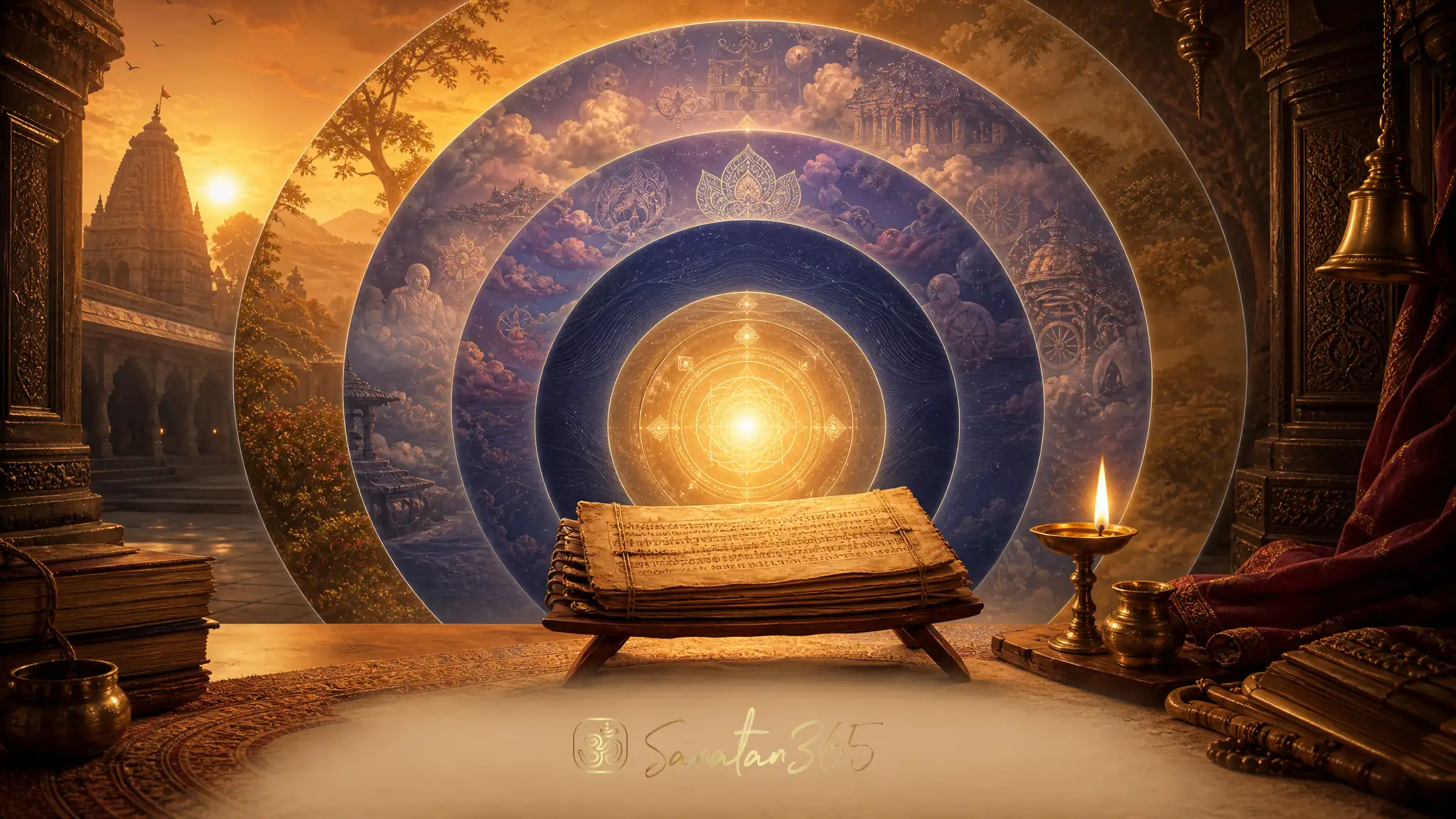
Mandukya Upanishad Meaning: Om, Turiya, and the Four States of Consciousness
Mandukya Upanishad meaning explained through Om, waking, dreaming, deep sleep, turiya, and a practical Vedantic way to reflect on awareness.
The shortest Upanishad can feel like one of the largest mirrors.
Mandukya Upanishad meaning begins with Om (ॐ, the sacred syllable often written Aum) and a simple observation: every person passes through waking, dreaming, and deep sleep, yet something remains continuous enough to say, "I was awake, I dreamed, I slept." The Mandukya Upanishad uses that everyday cycle to point toward atman (आत्मन्, the Self) and brahman (ब्रह्मन्, ultimate reality), teaching that the silence beyond the sound of Om is as important as the sound itself.
This is why the text matters for modern readers. It does not begin with a remote heaven or a complicated ritual. It begins with the fact that awareness is already present in ordinary experience.
Key takeaway: The Mandukya Upanishad uses Om and the daily cycle of consciousness to guide the seeker from changing experience toward the changeless Self.
What Is Mandukya Upanishad Meaning in Vedanta?
Mandukya Upanishad meaning is the teaching that Om, the Self, and reality are not separate topics. The text is traditionally counted among the principal Upanishads, the sacred Vedantic texts that explore ultimate reality, the Self, knowledge, and liberation. Britannica notes that the Upanishads are the concluding portions of the Vedas and foundational for Vedanta, the Hindu philosophical tradition that interprets them Britannica.
The Mandukya is famous because it is brief. In only twelve mantras, it maps all experience onto Om. That compactness can be misleading. A short text is not always a simple text. The Mandukya asks the reader to look carefully at the structure of experience: the outward-facing waking state, the inward-moving dream state, the quiet potential of deep sleep, and turiya (तुरीय, "the fourth"), which is not merely another mental state but the underlying reality through which the other three are known.
The text begins with a sweeping claim: Om is connected with all that was, is, and will be. In Vedantic reading, this does not mean Om is a magic sound detached from understanding. It means Om becomes a contemplative doorway. The seeker chants, listens, and reflects until sound becomes a pointer to awareness itself.
This also protects the teaching from becoming abstract. Waking, dreaming, and sleeping are not rare mystical categories. Every reader knows them directly. The Mandukya says: begin there. Notice that waking feels solid while it lasts. Dream also feels real while it lasts. Deep sleep lacks ordinary objects, yet afterward one says, "I slept well." What knows these changes?
Key takeaway: Mandukya Upanishad meaning is not only about defining Om; it is about using Om to inquire into the Self that witnesses all experience.
Why Does the Mandukya Upanishad Connect Om With Consciousness?
The Mandukya Upanishad connects Om with consciousness because Om contains sound, transition, closure, and silence. These four dimensions become a teaching model for the fourfold analysis of experience.
The syllable Aum is often understood through three audible elements: A, U, and M. The Mandukya pairs these with waking, dreaming, and deep sleep. Then it points to the silence after the sound as turiya. This silence is not empty in the sense of nothingness. It is a sign of that which cannot be reduced to a sound, object, image, mood, or thought.
This is why Om practice in the Mandukya tradition is both devotional and philosophical. The sound can steady the breath and heart, but the reflection must go deeper than calmness. The seeker asks: who is aware of the chant beginning? Who is aware of the vibration continuing? Who is aware when the sound fades? Who is present in the silence?
The Internet Encyclopedia of Philosophy describes the Upanishads as ancient Sanskrit texts that became deeply influential for Indian philosophical ideas and later schools, including Vedanta IEP. The Mandukya is a vivid example of that influence because it turns a sacred sound into a rigorous inquiry.
Still, the inquiry should remain humble. Om is not a slogan, decoration, or quick spiritual shortcut. In Sanatan Dharma, sacred sound is handled with respect. A person may chant Om slowly before meditation, listen to its resonance, and allow the mind to become less scattered. But the Mandukya invites a further step: let the sound show the difference between passing states and the awareness in which they arise.
Key takeaway: Om becomes a complete teaching because its sound and silence mirror the movement from experience to the witnessing Self.
What Are the Four States of Consciousness?
The four states of consciousness in the Mandukya Upanishad are waking, dreaming, deep sleep, and turiya. The Sanskrit terms are jagrat (जाग्रत्, waking), svapna (स्वप्न, dreaming), sushupti (सुषुप्ति, deep sleep), and turiya (तुरीय, the fourth).
Waking is the outward-facing state. Here the mind engages objects, duties, bodies, family, work, temple visits, food, conversation, and action. It is the state in which dharma is most visibly practiced. A person speaks truth, serves others, studies, earns honestly, and performs daily duties in waking life.
Dreaming is the inward-facing state. The senses rest, but the mind creates a subtle world from memory, desire, fear, impression, and imagination. Dream teaches that the mind can make a world feel convincing without external objects. This does not mean waking life is worthless. It means human certainty should become more humble.
Deep sleep is the state in which ordinary mental activity withdraws. There is no dream narrative, no clear subject-object division, and no active planning. Yet on waking, a person often remembers rest: "I slept and knew nothing." The Mandukya uses this to ask a careful question. If there was no ordinary object, how is the absence later reported?
Turiya is called "the fourth" only because language needs a way to point beyond the first three. It is not a fourth object placed beside waking, dream, and sleep. In Vedantic interpretation, it is the underlying reality of awareness, beyond grasping and description, through which all three changing states are known. Britannica's entry on Advaita notes Gaudapada's Mandukya-karika as a major early work connected with non-dual Vedanta Britannica.
For a beginner, this should not become a claim of personal attainment. It is better to treat the four states as a map for reflection:
- What changes when I wake?
- What changes when I dream?
- What remains ungrasped in deep sleep?
- What is the witness of all three?
Key takeaway: The four states are a contemplative map, not a spiritual status chart.
How Should a Beginner Understand Turiya Meaning?
Turiya meaning is best approached as "the fourth" that is not merely another experience. The word can confuse beginners because it sounds like a hidden state that must be hunted. The Mandukya's teaching is subtler. Turiya is not a mood, trance, vision, or dreamlike blankness. It is the reality because of which waking, dreaming, and deep sleep can be known at all.
A simple example may help. A screen can show a sunrise, a storm, a family scene, or darkness. The images change, but the screen is not burned by the fire, wet by the rain, or destroyed by the darkness. This example is imperfect, but useful. Waking, dream, and deep sleep are like changing appearances. Turiya points to the reality that is not exhausted by any one appearance.
The danger is to make turiya into ego language: "I have reached the fourth state." That is the opposite of the Upanishadic spirit. The teaching should produce humility, clarity, and steadier conduct, not spiritual vanity. If a person becomes harsher after reading non-duality, the reading has not matured.
Turiya reflection can also correct fear. A person often identifies completely with waking roles: job, status, praise, anxiety, family tension, success, failure. The Mandukya does not deny these duties. It asks the seeker not to mistake them for the whole Self. When roles are seen as roles, a person can perform them with more steadiness and less panic.
This is where Vedanta becomes practical. The teaching does not ask the householder to abandon responsibility. It asks the householder to remember that awareness is deeper than every changing condition. From that remembrance, speech can become calmer, decisions less reactive, and devotion less dependent on external mood.
Key takeaway: Turiya is not an achievement to boast about; it is a pointer to the underlying Self that makes all experience knowable.
How Can Om Meditation Use This Teaching Safely?
Om meditation can use the Mandukya teaching safely when it is gentle, reverent, and not mixed with exaggerated claims. A beginner does not need to force mystical experiences. The practice can begin with simple attention.
Sit comfortably, keep the spine steady, and chant Om slowly for a few rounds. Let A open in the body, U roll through the middle, M close softly at the lips, and then do not rush the silence. Listen. The silence after the sound is not a performance. It is a chance to notice awareness without immediately filling it with the next thought.
A practical sequence may be:
- Chant Om three, nine, or eleven times.
- Notice the beginning, middle, ending, and silence.
- Reflect on waking, dream, deep sleep, and turiya without strain.
- End with gratitude, not analysis alone.
- Carry one calmer action into the day.
This approach keeps the practice grounded. No one should use Om meditation as a replacement for medical care, mental health support, sleep treatment, or wise human counsel. Sanatan Dharma contains spiritual practice, but dharma also includes responsibility toward the body, family, and society.
Families can introduce this teaching carefully. Children may learn Om as a sacred sound for calm attention, not as a heavy philosophical burden. Adults can learn the deeper map slowly through study with qualified teachers, commentaries, satsang, and daily reflection.
For further reading on related practices, readers can pair this article with isha-upanishad-meaning-wholeness-action, kena-upanishad-meaning-mind-brahman, and dhyana-meaning-hindu-meditation-practice.
Key takeaway: Om meditation becomes safer and deeper when sound, silence, study, humility, and daily conduct stay together.
Why Does This Upanishad Matter for Modern Life?
The Mandukya Upanishad matters for modern life because many people live as if the waking mind is the whole of reality. Notifications, arguments, ambition, fear, and comparison can make the surface of consciousness feel absolute. The Mandukya gently breaks that spell.
Every night, waking certainty dissolves. Dream builds another world. Deep sleep removes both. Morning returns a familiar identity, but the cycle has already shown that experience is more fluid than ego admits. This can make a person less rigid. If the mind can create and release worlds daily, perhaps today's anger does not need to become tomorrow's identity.
For diaspora Hindus, the text also offers a portable form of depth. A person may be far from a traditional gurukula, temple town, or Sanskrit teacher, yet the basic material for reflection is present: Om, awareness, sleep, dream, duty, and silence. This does not replace lineage or learning. It keeps the door open until deeper study becomes possible.
The Mandukya also helps devotional life. Non-dual reflection need not weaken bhakti (भक्ति, devotion). It can make devotion more spacious. The one who chants, the sound that is chanted, and the silence into which it fades can all become part of worship. A lamp before the altar and inquiry into awareness are not enemies. Both can purify attention.
The final test is conduct. If the Mandukya is understood only as a clever idea, it remains incomplete. If it makes a person less reactive, more truthful, more patient in family life, and more capable of quiet prayer, the teaching has begun to enter life.
Key takeaway: The Mandukya Upanishad gives modern seekers a compact but profound way to remember that awareness is deeper than the mind's changing weather.
FAQ
What is Mandukya Upanishad meaning?
Mandukya Upanishad meaning is the teaching that Om, the Self, and ultimate reality are connected. The text uses waking, dreaming, deep sleep, and turiya to guide the seeker from changing experience toward the changeless Self.
What are the four states in the Mandukya Upanishad?
The four states are jagrat, or waking; svapna, or dreaming; sushupti, or deep sleep; and turiya, the fourth. Turiya is not simply another mental state, but a pointer to the underlying reality through which the other three are known.
What does Om mean in the Mandukya Upanishad?
Om represents the whole range of experience. A, U, and M are associated with waking, dreaming, and deep sleep, while the silence after Om points toward turiya, the reality beyond verbal description.
Is turiya the same as deep sleep?
No. Deep sleep is one of the three changing states analyzed by the text. Turiya is described as the underlying reality or witnessing Self, not merely the blankness or restfulness of sleep.
How can beginners study the Mandukya Upanishad?
Beginners can start by chanting Om reverently, learning the four-state map, reading a reliable translation with commentary, and reflecting on daily waking, dream, and sleep experience. Study is best kept humble and supported by qualified teachers when possible.
Mandukya Upanishad meaning finally returns to a quiet question: what is present through every changing state? The answer is not meant to inflate the ego. It is meant to soften it. Om begins as sound, matures into silence, and points the seeker toward the Self that cannot be reduced to either.
Key takeaway: The Mandukya Upanishad teaches that the sacred syllable Om is a doorway from changing experience into the deeper reality of awareness.
About the author
Sanatan365 Editorial
Bringing Sanatan Dharma to modern seekers through authentic, scripture-grounded content.
Related in Scriptures
 Scriptures
Amritabindu Upanishad Meaning: The Mind, Bondage, and Freedom
A close reading of the Amritabindu Upanishad on attachment, the one Self, and the difference between collecting teachings and understanding…
 Scriptures
Tattva Bodha Meaning: Four Qualifications for Clear Self-Inquiry
A beginner-friendly reading of Tattva Bodha, its four qualifications, six inner disciplines, and careful distinction between preparation an…
 Scriptures
Nirvana Shatakam Meaning: Six Verses of Self-Inquiry
Read the six verses of Nirvana Shatakam as careful Advaita self-inquiry, understand Shivoham, and distinguish contemplative freedom from ne…

