Mangala Aarti Meaning: Morning Worship, Light, and Auspicious Devotion
Mangala Aarti is the auspicious morning offering of light in Hindu worship. Learn its meaning, symbolism, home practice, and why the first flame of the day matters.
A small flame before sunrise can change the emotional temperature of an entire home.
Mangala Aarti meaning is the auspicious offering of light at the beginning of worship, usually in the early morning. Mangala (मङ्गल, auspicious or blessed) points to a sacred beginning, while aarti (आरती, offering of light) is the waving of a lamp before the Divine as part of puja (पूजा, reverent worship). In temples, Mangala Aarti may mark the first public darshan of the day. At home, it can become a simple, disciplined way to begin the morning with gratitude, clarity, and devotion.
The practice is not only about lighting a lamp. It is about placing attention where the day should begin: before the murti, picture, Shiva linga, sacred symbol, or inner presence of the Divine. In Hindu worship, light is both an offering and a reminder. It illumines the form before the devotee, and it asks the devotee to let inner dullness, distraction, and ego soften before the sacred.
What is Mangala Aarti meaning in Hindu worship?
Mangala Aarti is the morning form of the Hindu aarti ritual: a lamp is lit, offered in a reverent circular motion, and accompanied by prayer, mantra, or devotional song. The word mangala carries the sense of auspiciousness, welfare, and blessing. The word aarti is commonly understood as the ritual offering of flame, often with a lamp of ghee, oil, or camphor.
In the wider structure of Hindu worship, aarti usually appears as part of puja. The Hindu American Foundation describes puja as ritual worship that may include offerings, mantras, and reverence to the Divine in a chosen form HAF. BAPS explains arti as a ceremony of light in which a lamp is waved before the sacred image so devotees may behold darshan with devotion BAPS Shri Swaminarayan Mandir, London.
Mangala Aarti gives that offering a special morning emphasis. The day has not yet become crowded with duties. The mind has not fully entered work, messages, errands, and noise. The first action becomes a statement: the Divine is not an afterthought; the day begins in remembrance.
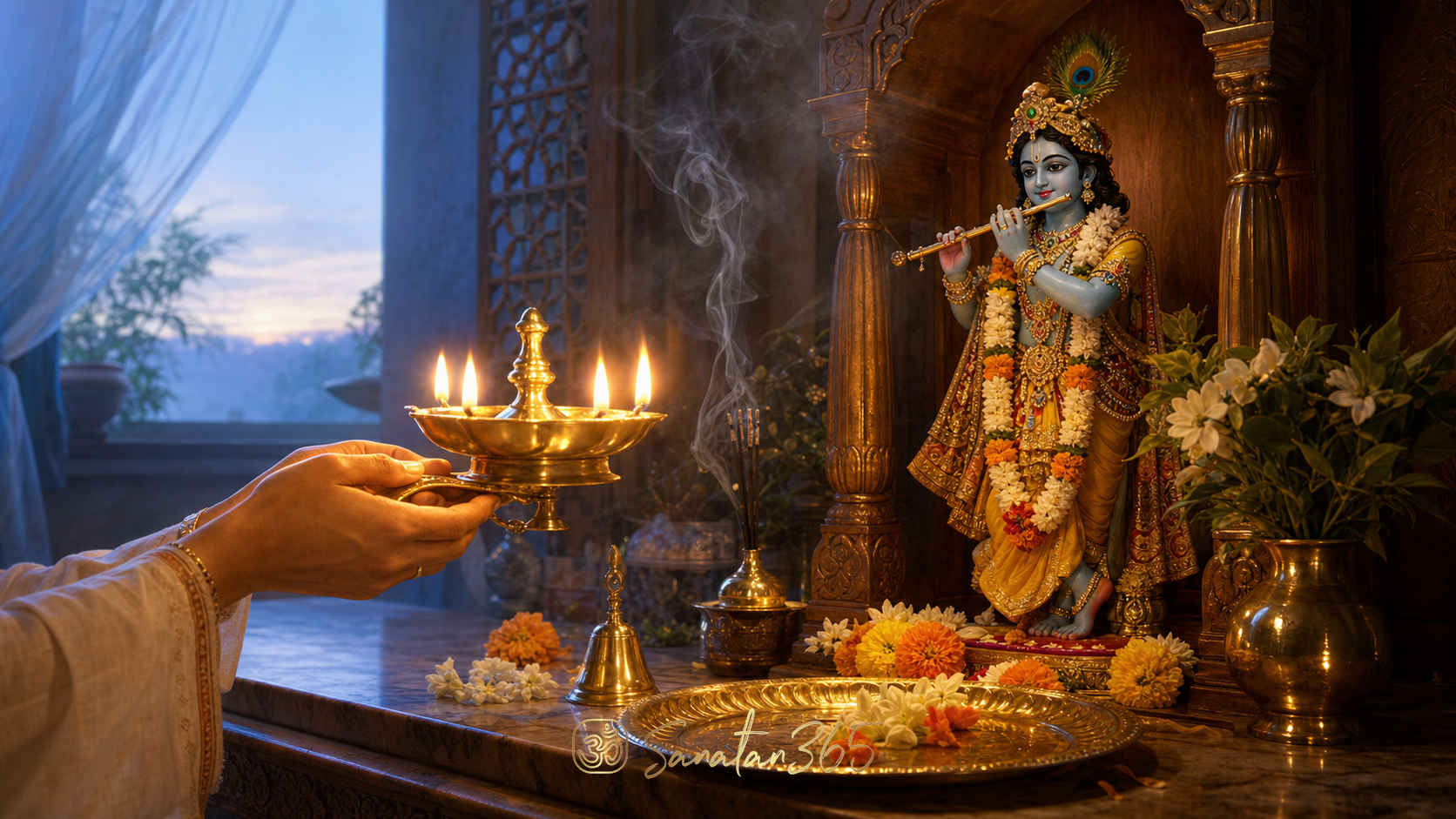
In temples, Mangala Aarti often belongs to the rhythm of waking, bathing, dressing, offering, and serving the deity. In many home shrines, it is simpler: clean the space, light the lamp, offer flowers or water if available, chant a short prayer, and receive the warmth of the flame with folded palms.
Key takeaway: Mangala Aarti is the auspicious morning offering of light that begins the day by placing devotion before activity.
Why is morning aarti considered auspicious?
Morning aarti is considered auspicious because it joins three powerful ideas: sacred time, fresh attention, and the symbolism of light. Dawn is a natural threshold. Night is ending, the senses are waking, and the mind is often less burdened than it will be later in the day. Hindu practice has long treated such thresholds as spiritually useful.
The Bhagavad Gita offers a beautiful image of divine light. Krishna says, "I, dwelling in their hearts, destroy the darkness born of ignorance with the shining lamp of knowledge" Bhagavad Gita 10.11, Gita Supersite. Mangala Aarti does not claim that a physical lamp automatically solves the mind's confusion. Rather, the lamp becomes a visible teaching: knowledge, devotion, and grace are invited before the day's choices begin.
The morning also has practical value. A short ritual gives the household a steady beginning. Children see reverence before hurry. Adults pause before checking the world outside. Elders often feel continuity with family and temple traditions. Diaspora families may find that a five-minute aarti keeps language, song, and sacred memory alive even far from ancestral towns or villages.
In North Indian Vaishnava homes, Mangala Aarti may be linked with Krishna or Rama devotion. In Shaiva homes, the lamp may be offered before a Shiva linga or image of Shiva. In Shakta homes, it may be offered before Durga, Lakshmi, Kali, or another form of Devi. In South Indian homes, the morning lamp may stand within a broader rhythm of kolam, bath, shrine cleaning, and food offering. The forms vary; the principle is shared.
Key takeaway: Morning aarti is auspicious because it uses the first clear moments of the day to invite light, order, and remembrance.
How does the Hindu aarti ritual use light as a symbol?
The Hindu aarti ritual uses light as both an offering to the Divine and a teaching for the devotee. A lamp is not offered because the Divine lacks light. It is offered because the devotee is learning how to see.
In a temple sanctum, flame reveals the murti's face, ornaments, eyes, hands, and posture. This matters because darshan (दर्शन, sacred seeing) is central to Hindu worship. The devotee does not simply look at an object. The devotee receives a moment of being seen by the Divine, and the flame makes that encounter vivid. BAPS notes that the lamp historically helped devotees see the sacred image, while also becoming an act of reverence and devotion BAPS.
Light also carries inner meaning. Fire transforms what it touches. A camphor flame burns cleanly and disappears; many teachers interpret this as a reminder of ego offered into devotion. A ghee lamp burns steadily; it can suggest discipline, nourishment, and continuity. A cotton wick slowly gives itself to light; it becomes a quiet image of service.
The circular motion of aarti also teaches. The lamp moves around the Divine, not the other way around. The devotee learns that daily activity should revolve around dharma, gratitude, and sacred presence. This does not require withdrawal from ordinary life. It asks ordinary life to remember its center.
After the lamp is offered, devotees often pass their hands over the flame and touch the warmth to their eyes or head. The gesture says: may this light be received, may the mind be illumined, may speech and action become cleaner. It is a small act, but repeated daily it can shape the body's memory of reverence.
Key takeaway: Aarti light reveals the Divine form outwardly and reminds the devotee to seek clarity inwardly.
How can a family perform Mangala Aarti at home?
Mangala Aarti at home does not need to imitate a large temple ceremony. It should be clean, reverent, safe, and sustainable. A family can begin with a five-to-ten-minute version and deepen it over time.
A simple home practice may look like this:
- Clean the shrine area and place the murti, picture, Shiva linga, or sacred symbol respectfully.
- Wash hands and settle the breath for a few moments.
- Light a diya (दीया, oil or ghee lamp) or a safe camphor flame.
- Offer the flame in small clockwise circles before the Divine form.
- Chant a short mantra, sing a known aarti, or sit in silent prayer.
- Offer flowers, water, or a simple mental prayer if physical offerings are not available.
- Receive the warmth of the flame with the hands and bow.
- Close with one clear intention for the day, such as truthful speech, patience, or service.
For safety, the lamp should be placed on a stable plate, away from curtains, paper, and loose clothing. Children can participate by ringing a small bell, offering flowers, or singing, but an adult should handle the flame. In apartments or dorm rooms where open flames are not allowed, a devotee may use a battery lamp with sincerity, then perform a full flame offering when possible in an appropriate setting.
Which deity should be worshipped? The family may follow its tradition. Some offer Mangala Aarti to Krishna, Shiva, Durga, Lakshmi, Ganesha, Rama, Hanuman, or a family deity. Others offer to a Shiva linga, the sacred syllable Om, or a formless altar. Sanatan Dharma allows devotion through many forms while honoring the same eternal truth.
The most important rule is not complexity. It is regularity with respect. A short daily aarti performed with attention is better than an elaborate ritual done with irritation or pride.
Key takeaway: Home Mangala Aarti should be simple, safe, sincere, and steady enough to become a real daily practice.
What should be sung or chanted during morning aarti?
What is sung during morning aarti depends on family tradition, region, language, and deity. Many homes sing a familiar aarti in Hindi, Sanskrit, Marathi, Gujarati, Tamil, Telugu, Kannada, Bengali, or another family language. Others chant a short mantra and sit quietly.
For Krishna worship, some families sing a Krishna aarti or chant the names of Krishna. For Shiva worship, they may chant "Om Namah Shivaya" or sing a Shiva aarti. For Devi worship, they may offer the flame with a Durga, Lakshmi, or Kali prayer. For Ganesha, many begin with a Ganesha mantra because he is traditionally invoked at beginnings.
The principle is that sound and light support each other. The flame gathers the eyes; the mantra gathers the speech; the meaning gathers the mind. If the family does not know a full song, one clear mantra repeated with attention is enough. A beginner may use:
- "Om Namah Shivaya" for Shiva devotion.
- "Om Namo Bhagavate Vasudevaya" for Vishnu or Krishna devotion.
- "Om Shri Durgayai Namah" for Durga devotion.
- "Om Gam Ganapataye Namah" for Ganesha devotion.
- The Gayatri Mantra where family tradition permits and teaches proper reverence.
Pronunciation should be treated respectfully, but beginners should not become afraid of worship. The learning itself can be devotional. Families may gradually learn one verse, then one full aarti, then its meaning. Children especially benefit when adults explain simple terms: jyoti (ज्योति, light), bhakti (भक्ति, devotion), prasad (प्रसाद, blessed offering), and shanti (शान्ति, peace).
Key takeaway: The best morning aarti chant is one that is traditional, understood with care, and repeated with humility.
What does Mangala Aarti teach beyond ritual?
Mangala Aarti teaches that the day should not begin by surrendering attention to chaos. It begins by choosing a center.
This is why the practice remains meaningful for modern families. It does not ask a software engineer, student, parent, shopkeeper, or retired elder to abandon daily duties. It asks each person to bring a clearer inner posture into those duties. The flame says: act, but do not forget light. Work, but do not forget humility. Speak, but do not forget truth. Earn, but do not forget dharma.
The ritual also disciplines the senses. The eyes rest on the flame and the deity. The ears receive mantra or bell. The hands fold, offer, and receive. The nose may sense incense or flowers. The body bows. Rather than treating spirituality as an abstract idea, Mangala Aarti trains devotion through the whole person.
For families, the practice can become a daily inheritance. A child may not understand every philosophical layer, but the child remembers the lamp, the bell, the song, the parent standing still for a moment. These impressions become part of cultural and spiritual memory.
For solitary practitioners, Mangala Aarti can be equally powerful. Even one person before a small shrine participates in a much larger rhythm of temple bells, home lamps, riverbank prayers, and dawn offerings across India and the diaspora.
Key takeaway: Mangala Aarti turns the first act of the morning into a training in attention, humility, and sacred memory.
FAQ
What is Mangala Aarti meaning in simple words?
Mangala Aarti meaning is the auspicious morning offering of light to the Divine. A lamp is waved before a deity, murti, Shiva linga, sacred symbol, or altar while the devotee prays, sings, or chants with reverence.
Is Mangala Aarti only done in temples?
No. Many temples perform a formal morning aarti, but families can also perform a simple Mangala Aarti at home. The home version may be shorter, but it should still be clean, safe, and respectful.
What time should morning aarti be performed?
Morning aarti is usually performed after waking, bathing or washing, and preparing the shrine. Some temple traditions perform it before sunrise; home practice can adapt to the family's schedule while preserving the spirit of beginning the day with devotion.
Can beginners perform aarti at home?
Yes. Beginners can light a safe lamp, offer it respectfully, chant a short mantra, and bow. It is wise to learn from family elders, a trusted temple, or a qualified teacher when adding more formal steps.
Which deity is best for Mangala Aarti?
There is no single compulsory deity for every family. Devotees may offer Mangala Aarti to Krishna, Shiva, Durga, Lakshmi, Ganesha, Rama, Hanuman, Vishnu, a family deity, a Shiva linga, or another sacred focus according to their tradition.
Mangala Aarti is a small morning act with a large inner message: begin with light before the world asks for attention. The lamp may burn for only a few minutes, but its teaching can follow the devotee through the entire day.
About the author
Sanatan365 Editorial
Bringing Sanatan Dharma to modern seekers through authentic, scripture-grounded content.
Related in Aarti
 Aarti
AartiOm Jai Lakshmi Mata Aarti Meaning: Grace, Prosperity, and Gratitude
Om Jai Lakshmi Mata praises Goddess Lakshmi as the source of auspicious abundance, ethical prosperity, nourishment, virtue, and household w…
 Aarti
AartiAarti Kije Hanuman Lala Ki Meaning: Hanuman’s Strength in Rama’s Service
Understand Aarti Kije Hanuman Lala Ki through its refrain, Ramayana memories, devotional themes, textual variants, and a simple home practi…
 Aarti
AartiOm Jai Shiv Omkara Aarti Meaning: Shiva, Omkara, and Sacred Unity
Om Jai Shiv Omkara is a beloved Shiva aarti whose images of Brahma, Vishnu, and Sadashiva invite devotees to see creation, preservation, an…