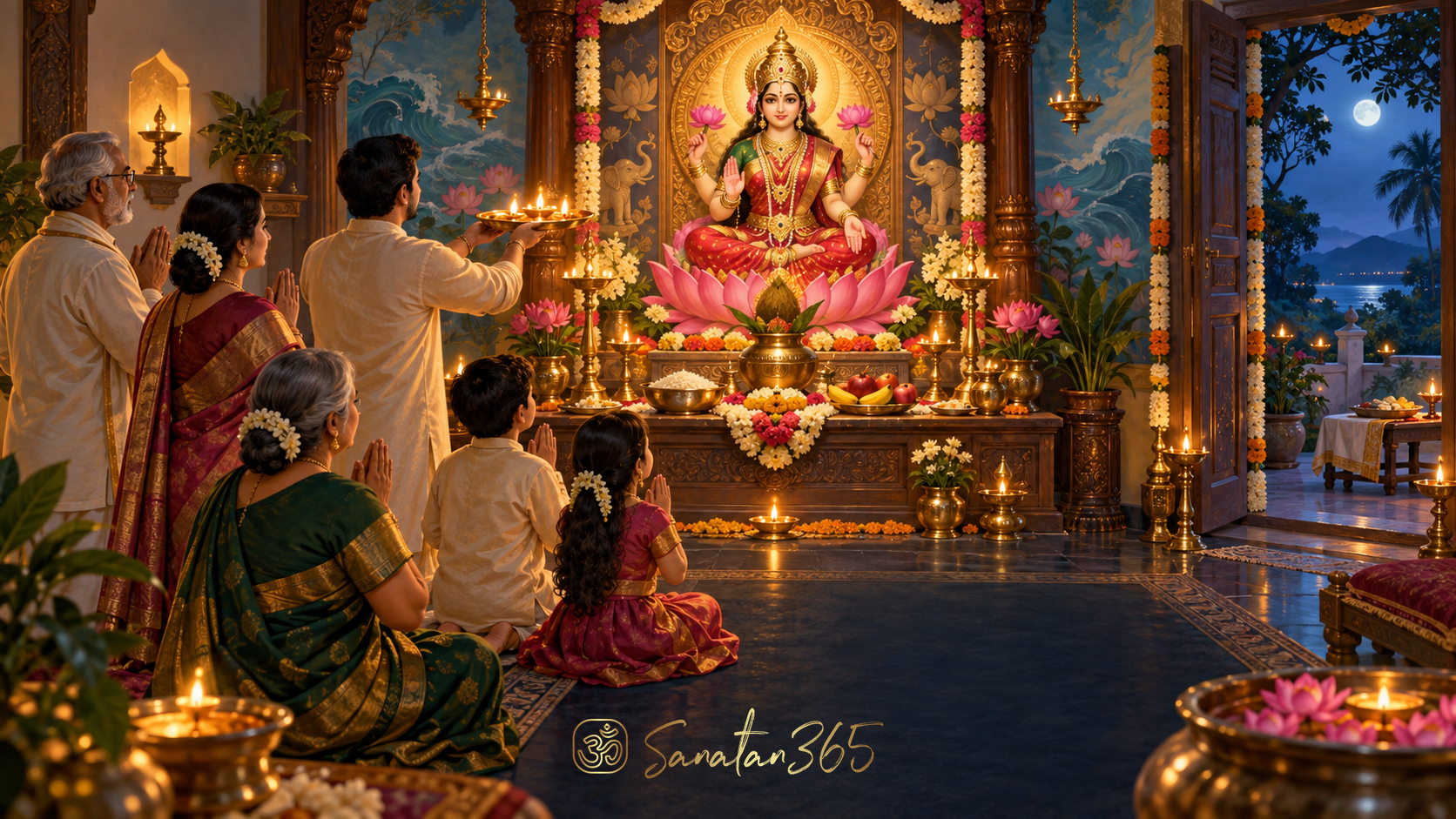
Om Jai Lakshmi Mata Aarti Meaning: Grace, Prosperity, and Gratitude
Om Jai Lakshmi Mata praises Goddess Lakshmi as the source of auspicious abundance, ethical prosperity, nourishment, virtue, and household well-being.
A song about prosperity can easily be mistaken for a request to possess more. Om Jai Lakshmi Mata offers a more demanding vision: prosperity becomes sacred when it is joined with virtue, nourishment, steadiness, gratitude, and sharing.
The Om Jai Lakshmi Mata meaning is a devotional praise of Goddess Lakshmi as the Divine Mother whose grace supports well-being in its fullest sense. The aarti (आरती, ārati, a devotional offering of light) honours her not merely as a giver of money, but as the presence of auspiciousness, good character, food, clothing, courage, and harmony within a household. Its verses invite devotees to receive abundance responsibly and remember its sacred source.
What Is the Om Jai Lakshmi Mata Meaning?
The refrain means, simply, “Om, victory and praise to Mother Lakshmi.” Jaya (जय, victory or praise), commonly sung as jai, is an acclamation of reverence; mātā (माता, mother) names the intimate relationship. Repeated after each verse, it returns every description of prosperity to devotion. The singer addresses a compassionate Divine Mother, not an impersonal force of luck.
Aarti is upasana (उपासना, upāsanā, devoted attendance or worship). The devotee draws near through attention, song, flame, and remembrance. The light offered before the murti (मूर्ति, mūrti, a sacred embodied form) also turns inward as a question: can the household use what it receives with clarity and care?
Published versions of the traditional Om Jai Lakshmi Mata lyrics show the familiar refrain and verse sequence; household renditions may vary slightly in spelling or repetition. The central movement remains praise of Lakshmi’s forms, grace, nourishment, shelter, and joy.
The song belongs within the wider practice explained in the meaning of aarti. The lamp does not purchase grace. It makes gratitude visible.
Key takeaway: The refrain transforms desire for prosperity into attentive, grateful worship of Lakshmi as Mother.
Who Is Goddess Lakshmi in This Aarti?
Lakshmi is honoured as the goddess of shri (श्री, śrī, splendour, auspiciousness, dignity, and flourishing). She is commonly shown upon a lotus, a flower rising clean above muddy water. The image suggests beauty and order that do not depend on perfect external conditions. Her association with Vishnu places prosperity within preservation, responsibility, and the sustaining of life.
The Encyclopaedia Britannica overview of Lakshmi notes her association with wealth, good fortune, beauty, and abundance, and her place beside Vishnu. The Sri Sukta, a Vedic hymn in praise of Shri-Lakshmi, asks for radiance, fertility, nourishment, and worthy abundance while rejecting hunger and destructive lack. Flourishing includes the conditions by which life is supported.
The aarti addresses Lakshmi through multiple honoured forms and names. References to Uma, Rama, Brahmani, and other Divine forms should be received as devotional poetry, not forced into one rigid theological chart. Household traditions often express divine unity through overlapping names. Different sampradayas (सम्प्रदाय, sampradāya, teaching traditions) may explain them differently, and those differences deserve respect.
One verse remembers Lakshmi as kṣīrodadhi-jātā (क्षीरोदधिजाता, born from the ocean of milk). This points to the samudra manthana (समुद्र मन्थन, samudra manthana, churning of the ocean) narrative in the Vishnu Purana, Book I, Chapter IX, where Shri emerges during the cosmic churning and chooses Vishnu. The story connects abundance with cosmic order: precious things appear amid collective effort, danger, patience, discernment, and grace, not greed alone.
Lakshmi therefore cannot be reduced to cash. Food that nourishes, clothing that protects, skills used well, relationships held with integrity, and resources placed in responsible hands can all participate in shri. Money obtained through harm does not become sacred merely because it is plentiful.
Key takeaway: Lakshmi represents flourishing held within preservation, dignity, nourishment, and responsibility.
What Do the Main Verses of Om Jai Lakshmi Mata Teach?
The aarti’s compact verses form a devotional map. Their language is simple enough for congregational singing, yet each theme opens into reflection.
Lakshmi is honoured in many forms
The opening praises the Mother whom Vishnu serves and remembers her through several divine names. Sacred abundance includes wisdom, courage, care, beauty, order, and sustaining power. This does not make every goddess interchangeable in every scripture. It expresses devotional wholeness while allowing each form its sacred character.
Grace reaches beyond human control
Another verse describes Lakshmi as able to alter destiny and make the impossible possible. Devotional poetry uses expansive language to express trust that no circumstance is completely closed to grace. It is not a guaranteed promise that singing will produce a job, money, recovery, or another specific outcome.
Healthy devotion holds effort and surrender together. A family may pray while budgeting carefully, working honestly, seeking qualified help, or asking trusted people for support. Faith supports responsible action; it does not replace it.
A prosperous home receives virtues
A revealing line says that where Lakshmi resides, sadguna (सद्गुण, sadguṇa, good qualities) enter. Prosperity is measured not only by possessions but by honesty, hospitality, restraint, cleanliness, patience, generosity, and mutual respect.
This protects Lakshmi worship from becoming transactional. If prayer for abundance leaves conduct unchanged, the deeper invitation has been missed. To welcome Lakshmi is to make the home more worthy of what it receives.
Food and clothing are abundance
The song names food, drink, and clothing. These necessities ground devotion in embodied life. Prosperity begins with nourishment, shelter, and daily dignity. A meal carries labour, soil, water, sunlight, transport, and skill.
When food is offered to the Divine, it may be received as prasad, sacred food shared through grace. This movement from possession to offering captures the aarti’s ethic: what enters the home should circulate with gratitude.
Joy completes the offering
The concluding verse describes the heart filling with ananda (आनन्द, ānanda, deep spiritual joy). That joy does not mean every difficulty has vanished. Attention moves from anxiety about having enough toward gratitude, relationship, and trust.
Claims about sins falling away express purification and renewed direction. They should encourage humility and ethical correction, not the belief that song mechanically cancels consequences.
Key takeaway: The verses move from praise to trust, virtue, grateful care for necessities, and devotional joy.
Why Does the Aarti Connect Prosperity with Virtue and Nourishment?
Modern speech often narrows prosperity to purchasing power. Hindu thought offers a wider frame. Artha (अर्थ, artha, material means and purposeful prosperity) is one of the four purusharthas (पुरुषार्थ, puruṣārtha, aims of human life), but it is pursued under dharma (धर्म, dharma, sustaining ethical order). Wealth is legitimate and necessary; the question is how it is earned, held, and used.
The aarti’s mention of virtues, food, clothing, and household steadiness fits this relationship. Resources sustain education, caregiving, hospitality, worship, art, and service. They become destructive when joined with exploitation, vanity, fear, or compulsive accumulation.
Lakshmi worship can therefore prompt practical questions:
- Was income earned without deception or needless harm?
- Are essential needs met before display and excess?
- Is someone’s invisible labour being taken for granted?
- Can a portion be shared through dana (दान, dāna, generous giving)?
- Does the household care for food, objects, time, and relationships?
These questions are not a purity test for people facing poverty. Financial hardship does not prove spiritual failure. Circumstances are complex, and suffering calls for compassion and material support, not judgment. Lakshmi’s abundance should enlarge generosity.
Cleanliness and order are associated with welcoming Lakshmi, but these ideas must not shame families, domestic workers, women, disabled people, or anyone with limited resources. The spiritual principle is care, not social display.
Key takeaway: Prosperity becomes auspicious when material means serve dharma, dignity, generosity, and care.
How Can Om Jai Lakshmi Mata Be Sung Respectfully at Home?
The aarti is commonly sung during Lakshmi pūjā (पूजा, worship), Diwali, Friday worship, and regular household prayer, as the cited traditional-lyrics account also notes. Customs vary. A simple practice is enough; elaborate materials are not required.
- Prepare a clean, calm place. Arrange a respectful image or murti of Goddess Lakshmi.
- Place the lamp safely. Use a stable dīpa (दीप, sacred lamp), often called a diya, away from loose cloth, children, pets, and drafts. An electric lamp is reasonable when flame is unsafe.
- Offer what is available. Water, flowers, fruit, or simple food may be offered. The value lies in bhava (भाव, bhāva, devotional feeling), not expense.
- Sing attentively. Follow a trusted Devanagari or transliterated text. Family variations need not be treated as errors.
- Offer the light. Follow family or temple custom while keeping the movement safe.
- Pause in gratitude. Name one form of abundance already present and one responsible use for it.
- Share the offering. Distribute prasad and avoid wasting food.
Pronunciation improves over time. Sincere learners need not wait for perfection. Listening carefully, following the text, and understanding the meaning matter more than rushing through familiar sounds.
Families can ask children: “What did we receive this week, and whom can we help?” Diaspora households may combine Hindi singing with an English explanation. Translation supports reverence when it supports understanding.
The practice should never be sold as a guarantee of wealth. Financial decisions should not be based on devotional promises. Prayer can support steadiness and values, while qualified professionals remain the right source for financial, medical, or legal advice.
Key takeaway: Respectful singing combines a sacred focus, safe light, understood words, simple offerings, gratitude, and responsible sharing.
Conclusion
Om Jai Lakshmi Mata is memorable because its melody carries an entire household theology. Lakshmi’s grace appears in wealth, food, clothing, virtue, courage, harmony, and grateful worship. The song asks devotees to see abundance clearly and make it auspicious through dharma.
The deepest offering may begin after the lamp is lowered: earning honestly, wasting less, honouring care work, feeding someone, sharing resources, and keeping gratitude alive during uncertainty.
Key takeaway: To praise Lakshmi is to welcome abundance reverently and place it in service of a generous, well-ordered life.
FAQ
What is the simple meaning of Om Jai Lakshmi Mata?
It means “Om, praise and victory to Mother Lakshmi.” The aarti honours Goddess Lakshmi as the source of auspiciousness, nourishment, virtue, well-being, and responsible prosperity.
When is Om Jai Lakshmi Mata usually sung?
It is widely sung during Lakshmi Puja and Diwali, on Fridays in many households, and during regular Lakshmi worship. Customs and timings vary by family, temple, and region.
Does singing Lakshmi aarti guarantee money or success?
No. Aarti is devotional worship, not a financial guarantee. It can cultivate gratitude and ethical reflection, while practical decisions still require responsible action and suitable professional advice.
Can the aarti be sung without elaborate puja materials?
Yes. A clean space, a respectful image or murti, a safely placed lamp, and sincere attention are sufficient. Flowers, fruit, or food may be offered according to means and custom.
Why does the aarti mention food, clothing, and good qualities?
Those lines broaden prosperity beyond money. They present well-being as nourishment, dignity, virtue, household harmony, and the capacity to care for and share with others.
About the author
Sanatan365 Editorial
Bringing Sanatan Dharma to modern seekers through authentic, scripture-grounded content.
Related in Aarti
 Aarti
Durge Durghat Bhari Aarti Meaning: A Marathi Prayer for Refuge
Read the Marathi Durga aarti through its appeal for compassion, the limits of description, and its closing image of devotion at the Mother’…
 Aarti
Aarti Kunj Bihari Ki Meaning: Seeing Krishna Through Song
Read the names and poetic images of Aarti Kunj Bihari Ki, from Krishna's flute and forest grove to Radha, Ganga and attentive devotional si…
 Aarti
Jai Ganesh Deva Aarti Meaning: Reading the Song With Reverence
Understand the familiar Hindi Ganesh aarti through its refrain, sacred imagery, offerings and language of refuge, without turning devotiona…

